
 Worksheets
Intro to Biology Exam
Total questions: 80
Worksheet time: 43mins
Flammable material like alcohol should never be dispensed or used near _____.
an open sink
an open flame
another student
a wet surface
What is an example of Homeostasis
Getting a fever
Staying the same body temp
Eating an apple
Sitting in the sun
This is all the chemical reactions that are keeping you alive.
Development
Stimulus
Metabolism
Homeostasis
What property of water is when water sticks to water?
Adhesion
Cohesion
High Specific Heat
Less Dense as a Solid
What property of water is when water sticks to plant material?
Adhesion
Cohesion
High Specific Heat
Less Dense as a Solid
What type of molecule is water?
Ionic
Polar
Covalent
Enzyme

What is this lab safety symbol?
electrical safety
heat safety
poison safety
sharp objects safety
The part of the microscope which moves the stage up and down, and is primarily used for the low power object lens is called the _____. The part of the microscope that is used for focusing on all objective lens is called the _____.
course adjustment knob; fine adjustment knob
fine adjustment knob; course adjustment knob
revolving nose piece; stage clips
stage clips; revolving nose piece
What does CER stand for?
Create, Evaluate, Results
Claim, Evidence, Reasoning
Current, Experiment, Reasoning
Can't, Even, Remember
Oil does not dissolve when placed in water, and things that do not dissolve in water are said to be _____.
hydrophillic
hydrophobic
polar
catalysts
Living things have cells, and this characteristic of life is _____.
response to stimuli
adaptation
organization
reproduction
Biology is the study of living things. What term described any living thing?
evolution
genetic material
homeostasis
organism
A cow eats grass all day. The cows digestive system breaks down the grass and extracts the nutrients from it. Then those nutrients are used to build essential molecules in the cow's body. What characteristic of life best explains this?
All living things are made of cells.
All living things need and use energy.
All living things reproduce.
All living things react and respond to stimuli.
Water is partially negative and partially positive. Molecules with partial charges are called what?
nonpolar
hydrophobic
polar
magnets
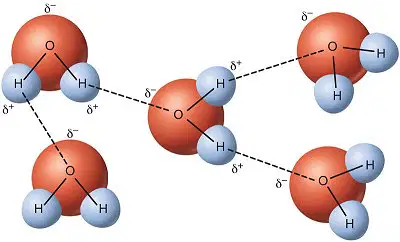
What is being represented with the black dotted lines?
oxygen
hydrogen
hydrogen bond
covalent bond
Capillary action is a property of water. What is an example of capillary action?
Water being pulled up from a plants roots to its leaves.
an insect sitting on top of the water's surface.
Salt dissolving in a glass of water.
A drop of rain water on a leaf.
Hydrogen bonds in water molecules are accomplished through the attraction of the partial charges. What is the charge of hydrogen in a water molecule?
positive
negative
neutral
full
Certain insects have the ability to stand on top of ponds an lakes. Which property of water allows this to occur?
adhesion
evaporation cooling
universal solvent
surface tension
This macromolecule is known for providing quick energy, and can also be a structural component in plant cell walls.
lipids
nucleic acids
proteins
carbohydrates
Amylase speeds up the reaction in which starch is broken down into glucose. What kind of molecule is amylase?
lipid
enzyme
steroid
nucleic acid
What kind of macromolecule has these characteristics?
1. large molecule
2. cell membranes
3. nonpolar covalent bond
lipid
protein
carbohydrate
nucleic acid
Which statement best describes the composition and function of proteins in an organism?
Long chains of hydrocarbon used for digestion and respiration.
Sugar and starches that provide energy for metabolic processes.
Fats and oils that are well suited for long term energy storage.
Long chains of amino acids used for building, repairing, and maintenance.
The cell membrane is an essential part of the cell. Which of these macromolecules makes up the cell membrane?
phospholipids
DNA
starch
keratin
Which macromolecule functions in storing and transmitting the instructions to make proteins?
nucleic acids
lipids
carbohydrates
enzymes
Animals such as bears, store most of their excess energy reserves as ____. This is because ____.
glucose; that macromolecule is easy to break down.
fat; that macromolecule stores twice as much energy as carbohydrates per gram.
protein; that macromolecule is a compact source of energy in bodies.
nucleic acids; that macromolecule stores twice as much energy per gram.
What macromolecule is considered the most diverse because it has many purposes within the cells.
lipids
proteins
carbohydrates
nucleic acids
Monosaccharides are the monomer for what macromolecule?
carbohydrates
lipids
proteins
nucleic acids

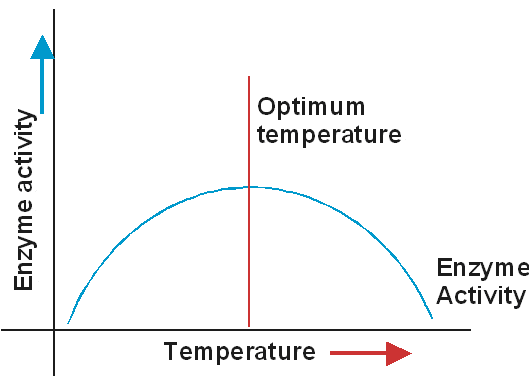
What temperature does this enzyme have the highest activity?
10 degrees C
30 degrees C
52 degrees C
38 degrees C

What do you think happens to the enzyme at a temperature of 60 degrees C?
The enzyme is at its optimal temperature.
The enzyme is denatured.
The enzyme is being made.
The enzyme becomes a coenzyme.
Kayla has breakfast, it was toast with cinnamon and sugar. Which macromolecule did she consume the most of?
carbohydrates
lipids
proteins
nucleic acids
A researcher discovers a molecule in muscle tissue that is rich in nitrogen, soluble in water, and lacks phosphorus. The molecule also contains carbon, hydrogen and oxygen in uneven ratios. The molecule must be a ____.
protein
fatty acids
nucleic acids
monosaccharide
A starch made of several strands of the monosaccharide glucose, what term would be best to describe the structure of the starch?
phospholipid
polysaccharide
protein
disaccharide
____ are lipids that store energy and are typically composed of multiple building blocks containing 3 fatty acids attached to a glycerol molecule.
fats
polysaccharides
proteins
nucleotides
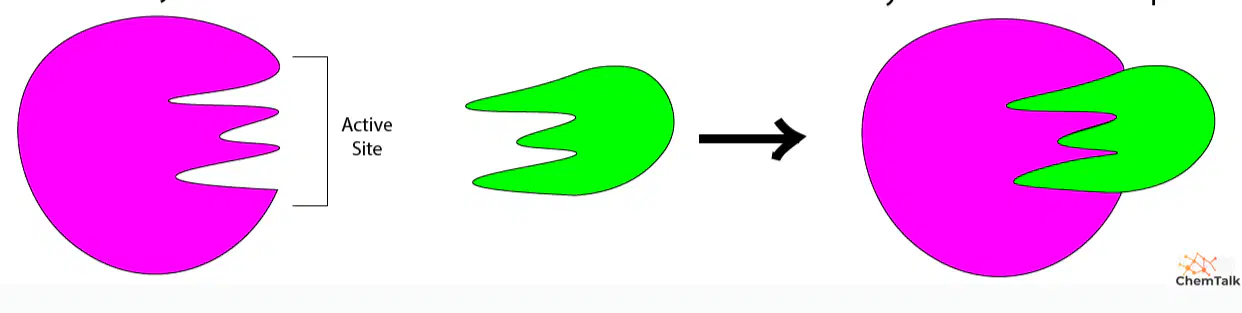
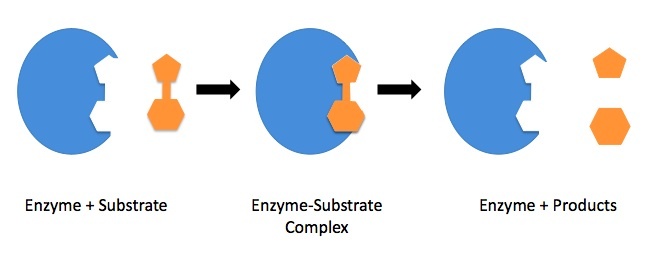
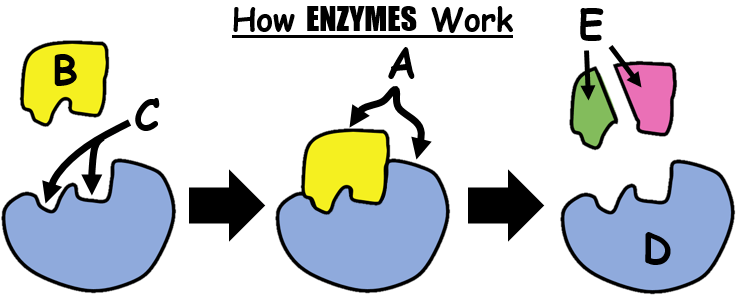
What is the green part represent in the image?
enzyme
product
active site
substrate
Which of the following correctly identifies the elements found in nucleic acids?
C, H, O, M, P
C, H, O
C, H, O, N, P
C, H, O, S,
Which of the following is not a part of a nucleotide?
sugar
nitrogen base
phosphate
glycerol
In the enzymatic reaction, the ____ is on the left of the arrow while the products are to the right of the arrow.
hydrogen peroxide ----> water + oxygen
enzyme
filtrate
pre product
reactant
Molecules that speed up chemical reactions without being consumed by the reaction are ____.
reactants
catalysts
products
chemical specialist
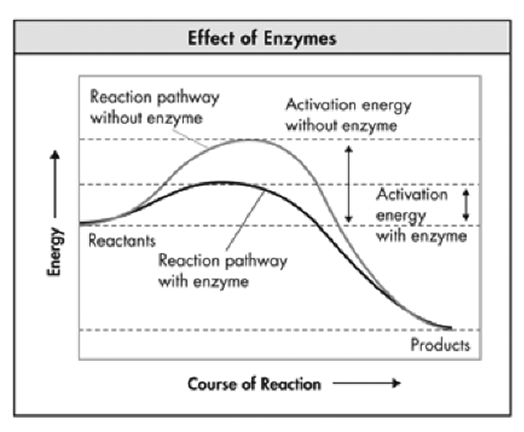
How do enzymes speed up chemical reactions? Enzymes ____.
lower the activation energy of chemical reactions.
raise the temperature of the cell, speeding chemical reactions.
store ATP, allowing more energy to be used in chemical reactions.
act as miniature transfer trucks, gathering material for chemical reactions, and placing them together.
Proteins differ in the number and type of ____ in the polypeptide chains.
fatty acids
amino acids
nucleic acids
monosaccharides
Enzymes: ____.
are composed of long chains of fatty acids.
can be destroyed by variations in temperature and pH.
are used up in the processes of performing chemical reactions.
raise the amount of energy required for chemical reactions.

Which polymer is represented in the image?
cellulose
polypeptide
DNA
triglyceride

Which characteristic is shown in the image?
Organisms grow and develop
Organisms react to stimuli
Organisms can adapt
Organisms use and obtain energy
Organisms are made up of cells

Which characteristic is shown in the image?
Organisms reproduce
Organisms react to stimuli
Organisms can adapt
Organisms use and obtain energy
Organisms are made up of cells

Which characteristic is shown in the image?
Organisms reproduce
Organisms react to stimuli
Organisms can adapt
Organisms use and obtain energy
Organisms are made up of cells

Which characteristic is shown in the image?
Organisms reproduce
Organisms react to stimuli
Organisms can adapt
Organisms use and obtain energy
Organisms are made up of cells

In the image shown, what is the response?
the plant bending towards the light
the light source
In the image shown, what is the stimulus?
the plant bending towards the light
the light source
Which is NOT an example of adaptation?
camels have humps that store water for the dry days
night animals have special eyes to see in the dark
fishes developed gills to breath underwater
an elephant gives birth to one offspring
Choose the statement(s) TRUE for ALL organisms
have cells
can move
grow or develop
use sunlight to make food
have features that help them adapt

Water has a high specific heat

-A water molecule is composed of 2 H atoms and 1 O atom. What is the chemical equation for water?
HO
H2O
H3O
H2O2

Which part of the microscope moves the stage up quickly?
coarse adjustment knob
fine adjustment knob
diaphragm
rotating nose piece
what part of the microscope changes the objective lens?
coarse adjustment knob
fine adjustment knob
diaphragm
rotating nose piece
what is the total magnification if the ocular lens is 10x and the objective lens is 4x?
40x
400x
4x
4000x
what part of the microscope hold the slide on the stage?
objective lenses
stage clips
rotating nose piece
fine adjustment

What is number 1?
arm
base
light source
stage

What is number 2?
fine adjustment knob
coarse adjustment knob
light source
base

What is number 3?
fine adjustment knob
coarse adjustment knob
stage
diaphragm

What is number 4?
stage
light source
stage clips
rotating nose piece

What is number 5?
base
stage
light source
arm

What is number 6?
diaphragm
light source
stage
stage clips

what is number 7?
diaphragm
light source
stage
arm

What is number 8?
stage
stage clips
base
nose piece

What is number 9?
rotating nose piece
objective lens
ocular lens
adjustment knob

What is number 10?
objective lenses
ocular lens
rotating nose piece
stage

What is number 11?
body tube
ocular lens
nose piece
arm
In order to increase the rate of reaction using an enzyme a scientist could.... (Choose all that apply)
Increase the amount of substrate
Decrease the temperature
Increase the temperartue
Introduce a competitive inhibitor

