
Font size
 Worksheets
1.4-1.7 APES Review
Total questions: 51
Worksheet time: 36mins
Humans burn fossil fuels and wood, releasing carbon dioxide into the atmosphere. This carbon dioxide is then absorbed by trees for photosynthesis. These processes are contributory to which chemical cycle?
The carbon cycle
The water cycle
The nitrogen cycle
The phosphorous cycle
How does the human body return carbon to the atmosphere in the carbon cycle?
Waste products
Photosynthesis
Cellular respiration
Formation of glucose
In the carbon cycle, animals can release carbon back into the cycle through __________ or through __________.
burning . . . photosynthesis
fixation . . . decomposition
decomposition . . . photosynthesis
respiration . . . decomposition
respiration . . . photosynthesis
Which of the following is an example of human impact on the carbon cycle?
The increased production of methane gases from cattle farms
The burning of fossil fuels
The cutting down of trees for lumber
Driving automobiles
All of the above
If a forest fire occurs, what will happen to the carbon in the forest?
It will go into the soil
It will go into the atmosphere
It will runoff into nearby streams and rivers
It will be destroyed
By what method is the majority of carbon moved from the lithosphere (upper part of Earth's crust) to the atmosphere?
Weathering
Deposition
The burning of fossil fuels
Respiration
What kind of organism takes out the most carbon from the atmosphere?
Plants
Bacteria
Animals
Humans
Which compound does NOT contain carbon atoms?
carbon dioxide
ammonium
calcium carbonate
methane

Which is a true statement?
Humans depend on oxygen, plants depend on carbon dioxide
Plants produce carbon dioxide
Humans depend on carbon dioxide, plants depend on oxygen
Humans don't depend on plants for the air they need
Which of the following creates a calcium carbonate structure?
plants
cows
corals
decomposers
The process in which nitrogen circulates and is recycled is called
The nitrogen cycle
The carbon cycle
The water cycle
The phosphorus cycle
Gas that makes up 78% of our atmosphere.
Oxygen
Nitrogen
Hydrogen
Carbon Dioxide
What is the process of combining nitrogen gas with other elements to make nitrogen into usable compounds?
nitrogen composition
nitrogen fixation
ammonia
denitrification
What is the formula for atmospheric nitrogen?
N
N2
NH3
NO3
What process occurs when dead plant and animal matter decomposes and nitrogen is released back into the atmosphere?
Assimilation
Fixation
Ammonification
Denitrification
Plants and animals cannot use nitrogen directly from the air.
True
False
Bacteria fix nitrogen from the atmosphere into a form plants can use.
True
False
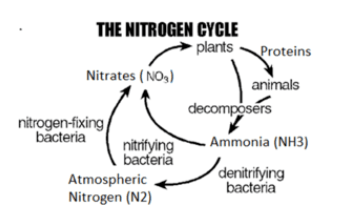
According to this diagram, plants absorb
nitrates
nitrogen fixing bacteria
animals
decomposers
This is NOT a part of the phosphorus cycle.
Phosphate is incorporated into sedimentary rocks
Phosphate bound to soil
Atmospheric phosphate
Phosphate is absorbed from the soil by plants
_____ brings phosphorous into our waterways. .
Precipitation
Runoff
Transpiration
Condensation
This is released by the weathering of rocks.
Carbonate
Phosphate
Phosphorus
Nitrogen
Too much phosphorus in waterways (rivers, lakes) can lead to___________.
eutrophication
nothing
decreased pH levels
diseases
How does eutrophication cause the death of aquatic organisms
the build up of carbon dioxide in the water
the lack of nitrogen in the water
the lack of carbon dioxide in the water
the lack of oxygen in the water
The two critical nutrients in eutrophication are... (select two)
nitrates
phosphates
carbon dioxide
dissolved oxygen
In eutrophication, dissolved oxygen levels decrease because
bacteria use it as they decompose organic material
algae uses it during photosynthesis
it reacts with hydrogen to form H2O (water)
fish use it up as they consume algae
What effect does the sun have on surface water?
It causes it to boil
It causes it to rain
It causes it to sink
It causes it to evaporate
When water vapor is cooled and forms droplets of liquid water
Condensation
Evaporation
Transpiration
Runoff

What is precipitation?
Sweat from our bodies on hot days
Warm rain but not cold snow or sleet
Gas that we use in furnaces or ovens
Any form of water that falls from the sky
The process when plants release water vapor from their leaves is called _____________.
precipitation
evaporation
transpiration
condensation
____________________ is the process by which water on the ground surface enters the soil. ________________ rate in soil science is a measure of the rate at which soil is able to absorb rainfall or irrigation.
Infiltration
Percolation
Deposition
Condensation
The process of water movement through a plant and its evaporation from aerial parts, such as leaves, stems and flowers.
water cycle
evaporation
evapotranspiration
precipitation

