wayground logo

Free Printable Worksheets

NEW

Font size

S
M
L
XL
Worksheets

Review Quiz Topic 2 Savvas

Total questions: 55

Worksheet time: 55mins

Name
Class
Date
1.

Band of high-speed winds about 10-kilometers above Earth's surface.

a)

Jet Stream

b)

Barometer

c)

Global Ocean Conveyor

d)

Mountain Breeze

2.
Which pie chart correctly shows the percentages of elements in the air?
a)
a
b)
b
c)
c
d)
d
3.
Where you will find the ozone layer.
a)
stratosphere
b)
thermosphere
c)
exosphere
d)
mesosphere
4.
Where weather occurs.
a)
stratosphere
b)
thermosphere
c)
troposphere
d)
mesosphere
5.

The jet stream travels in which direction?

a)

north to south

b)

west to east

c)

south to north

d)

east to west

6.
What two gases are found throughout all layers of the atmosphere?
a)
Nitrogen and carbon dioxide
b)
Nitrogen and oxygen
c)
Oxygen and carbon dioxide
d)
Trace gases and water vapor
7.
What does the earth's atmosphere do?
a)
help to regulate the temperature on Earth
b)
Help UV rays to reach the Earth's surface
c)
Creates meteors in the sky
d)
Keep ocean waters cold
8.
What is the function of the ozone layer?
a)
to allow UV rays to get to Earth
b)
to block UV rays from getting to Earth
c)
To keep oxygen in
d)
to allow meteors to get to Earth
9.
This is the layer where most commercial jet airliners fly.
a)
Troposphere
b)
Stratosphere
c)
Mesosphere
d)
Thermosphere
10.
The higher you go, the air becomes _____ _____.
a)
More dense
b)
Less dense 
11.
This is the layer where meteors, or shooting stars, burn up.
a)
Troposphere
b)
Stratosphere
c)
Mesosphere
d)
Thermosphere
12.
What happens to the density (thickness)/air pressure of the air as you increase in altitude?
a)
density increases
b)
density decreases
c)
density stays the same
d)
density disappears
13.

Ginny enjoys mountain climbing. Today, she is climbing Mt. Sheridan, which is the tallest mountain she’s ever climbed. When Ginny makes it to the top of the mountain, she notices that it is more difficult to catch her breath. At higher elevations, why is it harder for Ginny to breathe?

a)

At higher altitudes, the air is very cold.

b)

At higher altitudes, the air pressure is lower.

c)

At higher altitudes, the air contains more nitrogen.

d)

At higher altitudes, the air contains more carbon dioxide.

14.

This gas makes up a majority of our atmosphere.

a)

Nitrogen

b)

Oxygen

c)

Argon

d)

Hydrogen

15.

As altitude goes up, air pressure goes_________.

a)

Stays the same

b)

Goes up

c)

Goes Down

d)

Gets hotter

16.

Our atmosphere does each of the following except.

a)

Help regulate rain fall

b)

Provides safety from the sun’s harmful rays

c)

Destroys a lot of space debris

d)

Helps maintain the right temperature for life.

17.

As altitude increases, what happens to the pressure of the air?

a)

The air pressure increases.

b)

The air pressure decreases.

c)

The air pressure stays the same.

d)

The air pressure becomes warmer.

18.

The more gas molecules the _____ the temperature.

a)

lower

b)

cooler

c)

hotter

d)

higher

19.

The layer of the atmosphere closes to the ground.

a)

Stratosphere

b)

Mesosphere

c)

Troposphere

d)

Thermosphere

20.
What percentage of the earth's atmosphere is oxygen?
a)
78%
b)
28%
c)
71%
d)
21%
21.
What percentage of the earth's atmosphere is nitrogen?
a)
78%
b)
28%
c)
71%
d)
21%
22.
What causes winds to occur?
a)
Unequal distance
b)
Unequal humidity
c)
unequal heating
d)
unequal mass
23.
Energy in the form of electromagnetic waves is
a)
Conduction 
b)
Convection
c)
Radiation
d)
Density
24.
Energy transferred by circulation of a liquid or gas is
a)
Conduction 
b)
Convection
c)
Radiation
d)
Density
25.
Energy transferred by direct contact in the form of heat is
a)
Conduction 
b)
Convection
c)
Radiation
d)
Density
26.

In which layer of the atmosphere do most satellites orbit Earth?

a)

stratosphere

b)

mesosphere

c)

exosphere

d)

troposphere

27.

When you climb a high mountain, you lose your breath more easily because

a)

the air pressure is greater

b)

the air is denser

c)

amount of oxygen decreases

d)

amount of oxygen increases

28.

In which layer of the atmosphere is the majority of water vapor (weather) found?

a)

thermosphere

b)

troposphere

c)

stratosphere

d)

exosphere

29.

The mixture of gases and particles that surrounds a planet, held by gravity is called what?

a)

greenhouse effect

b)

hydrosphere

c)

atmosphere

30.

At which location would air pressure be the greatest?

a)

mountain top

b)

flying in an airplane

c)

sea level (on the ground)

31.

Which layer of the atmosphere contains the least number of gas molecules (least dense)?

a)

stratosphere

b)

mesosphere

c)

exosphere

32.

This gas is found in the stratosphere where it helps protect us from UV radiation.

a)

ozone

b)

oxygen

c)

nitrogen

d)

carbon dioxide

33.

Clouds form during the process of...

a)

evaporation

b)

condensation

c)

precipitation

d)

runoff

34.

Which term best describes water vapor?

a)

Solid

b)

Liquid

c)

Gas

35.
How do we characterize an air mass that forms over the ocean?
a)
Dry
b)
Wet
c)
Cold
d)
Warm
36.
How do we characterize an air mass that forms over land?
a)
Dry
b)
Wet
c)
Cold
d)
Warm
37.
How do we characterize an air mass that forms near the poles?
a)
Dry
b)
Wet
c)
Warm
d)
Cold
38.
What types of air masses form over oceans?
a)
Maritime
b)
Continental
c)
Polar
d)
Tropical
39.
What's the humidity and temperature of a continental tropical air mass?
a)
Wet and cold
b)
Dry and warm
c)
Wet and warm
d)
Dry and cold
40.
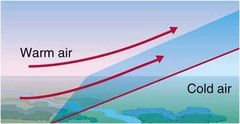
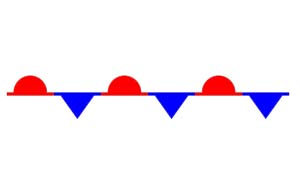
Which type of front is displayed?
a)
Cold
b)
Warm
c)
Stationary
d)
Occluded
41.
Which type of front is displayed?
a)
Cold
b)
Warm
c)
Stationary
d)
Occluded
42.
Which type of front is displayed?
a)
Cold
b)
Warm
c)
Stationary
d)
Occluded
43.
When two different air masses collide...
a)
A front forms
b)
They casually become one
c)
A new planet evolves
d)
Dinosaurs become extinct
44.
When a cold front is approaching, what happens?
a)
warm air is pushing under cold air causing humid weather and lower temperatures
b)
warm air is pushing under cold air causing humid weather and higher temperatures
c)
warm air rises, cools, and causes rain and thunderstorms
d)
cold air is pushed over warm air causing rain and thunderstorms
45.
What type of storm front is this?
a)
warm front
b)
cold front
c)
stationary front
d)
occluded front
46.
What type of weather would you expect to see after a cold front has passed through an area?
a)
cool and clear skies
b)
warm and humid
c)
thunderstorms
d)
foggy
47.
What type of weather would you expect to see after a warm front has passed through an area?
a)
cool and clear skies
b)
warm and humid
c)
thunderstorms
d)
foggy
48.
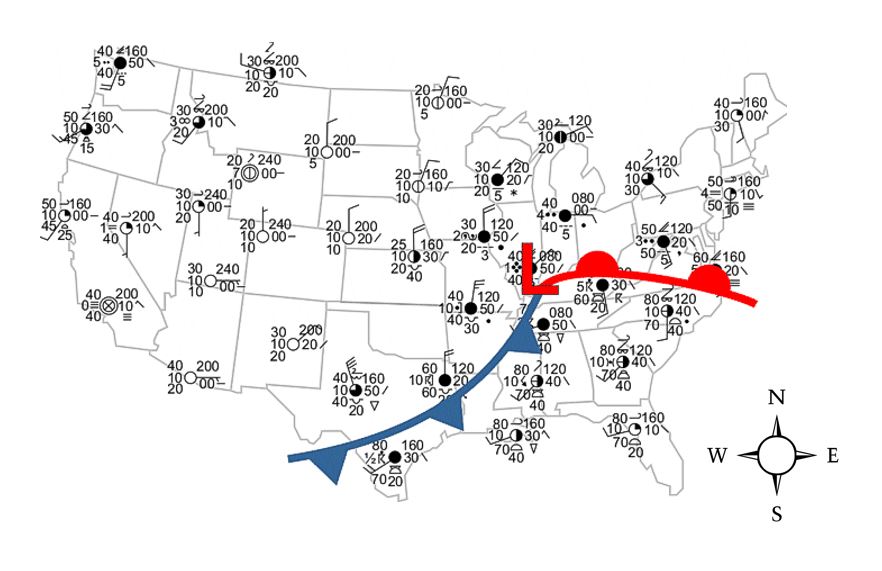
What direction is the warm front moving on the map? 
a)
North
b)
South
c)
East
d)
West
49.
What direction is the cold front moving on the map? 
a)
Southwest
b)
Northwest
c)
Southeast
d)
Northeast
50.

Which is the correct symbol for an occluded front?

a)
b)
c)
d)
51.

Which is the correct symbol for a stationary front?

a)
b)
c)
d)
52.

What type of front occurs when a warm air mass and a cold air mass do not have enough energy to move the other one out of the way?

a)

Warm front

b)

Cold front

c)

Stationary front

d)

Occluded front

53.
What's the humidity and temperature of a continental tropical air mass?
a)
Wet and cold
b)
Dry and warm
c)
Wet and warm
d)
Dry and cold
54.
What does a barometer measure? 
a)
measures high and low pressure in the air
b)
measures humidity in the air
c)
measures speed of the wind 
d)
measures the amount of rain that has fallen
55.

Which type of storm always forms over and pulls energy from a large body of warm water?

a)

tornado

b)

thunderstorm

c)

hurricane

d)

winter storm