wayground logo

Free Printable Worksheets

Font size

S
M
L
XL
Worksheets

Revision series - 1

Total questions: 180

Worksheet time: 3hrs 0mins

Name
Class
Date
1.

Which of the following is composite number

a)

2

b)

9

c)

5

d)

11

2.

Which of the following are coprimes

a)

4,6

b)

8,9

c)

5,10

d)

10,12

3.

H.C.F. of any two prime numbers is (a)  

4.

L.C.M of 17,23 is________

a)

391

b)

231

c)

651

d)

567

5.

Last digit of 6 power n is‐----

a)

6

b)

0

c)

5

d)

7

6.

When divisor is 4 then possible remainders are-------'

a)

3,4,5

b)

1,2,3

c)

0,1,2,3

d)

Greater than 5

7.

as per euclid division lemma when divisor is 3 then possible integers are____

a)

3q,3q+1,3q+2

b)

3q+1,3q+2,3q+3

c)

3,4,5,6

d)

None

8.

When divisor is 3, square of any integer should be of the form of _______,____

(a)  

9.

LCM of 19 and 23 is

a)

437

b)

247

c)

3258

d)

None

10.

what is H.C.F. of 29 and 31

a)

5

b)

1

c)

23

d)

29

11.

Which of the following is non-terminating decimal

a)

1/2

b)

12/5

c)

17/14

d)

9/10

12.

For some integer m , every even integer is of the form

a)

m

b)

2m+1

c)

2m

d)

m+1

13.

The product of a non-zero rational and an irrational numbers is

a)

Always irrational

b)

Always rational

c)

Rational r irrational

d)

1

14.

If the HCF of 60 and 110 is expressible in the form 60m-110, then the value of m is

a)

4

b)

2

c)

1

d)

3

15.

A rational numbers can't be expressed as

a)

Terminating decimal

b)

Non-terminating repeating decimal

c)

Non terminating non repeating decimal

d)

Recurring decimal

16.

π is

a)

terminating decimal

b)

rational number

c)

irrational number

d)

recurring decimal

17.

Which of the following is not a terminating decimal

a)

23/32

b)

41/75

c)

41/50

d)

23/2³5²

18.

p/q form of the decimal 0.875 is

a)

7/8

b)

25/31

c)

7/12

d)

6/7

19.

HCF of 144 and 420 is 12 then their LCM is

a)

6040

b)

4200

c)

1440

d)

5040

20.

The unit digit in 6¹²⁵ is

a)

1

b)

5

c)

6

d)

0

21.

1. degree of the polynomial P(x) = x4 + 3x25x  + 8x^4\ +\ 3x^2-5x\ \ +\ 8  

a)

4

b)

3

c)

2

d)

1

22.

2. If p(x) = ax + b, then zero of p(x)    is ________

a)

a/c

b)

-b,/a

c)

a

d)

b

23.

3. Graph of a quadratic polynomial is a_______

a)

(a)   straight line     


b)

(b)   circle     

c)

(c)   parabola     

d)

(d)   ellipse

24.

4.The degree of a linear polynomial is:______

a)

2

b)

3

c)

4

d)

1

25.

5, Find the zeroes of the polynomial P ( x ) = x2 − 3

a)

±3\pm\sqrt[]{3}  

b)

4\sqrt[]{4}  

c)

3

d)

±3\pm3  

26.

6. In the given graph, the number of zeros of the polynomial y = p(x) is:______

a)

3

b)

4

c)

2

d)

1

27.

7. If P(x) = 2x 3 + 3x2 – 11x + 6 , then find the value of P ( 1 )._____

a)

1

b)

2

c)

3

d)

0

28.

8. Degree of the constant polynomial is _________________

a)

0

b)

1

c)

2

d)

3

29.

9.if two zeroes are  3 & 2  then write the  quadratic polynomial is ______________

a)

x2+2x 3x^2+2x\ -3  

b)

x25x +6x^2-5x\ +6

c)

x2+5x +3x^2+5x\ +3

d)

x2+2x 6x^2+2x\ -6

30.

10. If  product of the zeroes is one in quadratic polynomials  then which of the following is correct ------------           

a)

a=c

b)

 a  = b   

c)

 c= b   

d)

a

31.

which of the following expressions are polynomial

a)

4x²+5x-2

b)

y²-8

c)

5

d)

all above

32.

The variable in the polynomial p(x)=3xyz

a)

x

b)

y

c)

z

d)

x,y,z

33.

Number of terms in a polynomial p(x)=x³-4x+2 is

a)

1

b)

4

c)

2

d)

3

34.

The degree of the polynomial p(x)= x⁶-3x⁷+8x+5

a)

6

b)

7

c)

5

d)

8

35.

The constant term of the polynomial p(x)= x⁶-3x⁷+8x⁵+4x-5 is

a)

1

b)

-3

c)

8

d)

-5

36.

The co-efficient of x³ in the polynomial p(x)= 2-x³+x²

a)

2

b)

-1

c)

1

d)

3

37.

x²+x+4 is a

a)

Quadratic polynomial

b)

cubic polinomial

c)

linear polinomial

d)

simple polynomial

38.

2x+1 is

a)

linear polynomial

b)

quadratic polynomial

c)

cubic polynomial

d)

none of these

39.

x-x³ is a

a)

linear polynomial

b)

binomial

c)

cubic polynomial

d)

quadratic polynomial

40.

If p(x)= 2x+1 then p(0)=

a)

2

b)

1

c)

3

d)

0

41.
The pair of linear equations 3x + 5y = 3 ; 6x + ky = 8 do not have any solutions if : 
a)
k = 5
b)
k = 10
c)
k ≠ 10
d)
k ≠ 5
42.
The pair of linear equations:
 kx + 4y = 5 ; 3x + 2y = 5
 is consistent only when:
a)
k ≠ 6
b)
k = 6
c)
k ≠ 3
d)
x = 3
43.
The pair of lines 'x = a' and 'y = b' graphically represent lines which are 
a)
parallel
b)
intersecting at (a , b)
c)
coincident
d)
intersecting at (b , a)
44.
The pair of equations 'y = 0' and 'y = -7' has ____
a)
one solution 
b)
two solutions 
c)
infinitely many solutions 
d)
no solutions
45.
Say 'TRUE' or 'FALSE':
The line represented by x = 7 is parallel to x - axis 
a)
TRUE
b)
FALSE
46.
Say 'TRUE' or 'FALSE'
The line represented by y = 0 is parallel to y - axis.
a)
TRUE
b)
FALSE
47.
a)
Consistent and unique solution
b)
Inconsistent : No solution 
48.
If a pair of linear equations is consistent, then the corresponding lines will be ____
a)
parallel
b)
always coincident
c)
always intersecting in a unique point 
d)
intersecting or coincident
49.
a)
Consistent : Unique solution
b)
Consistent: Many Solutions 
c)
Inconsistent: No solution 
d)
None of the above 
50.
The solution for the lines represented by x = 0 and y = 0 is ____
a)
(0, 0)
b)
No Solution exist
c)
Infinitely many solutions
d)
All the points the axes are solutions 
51.
Graphically, the pair of equations 6x – 3y + 10 = 0 , 2x – y + 9 = 0 represents two lines which are
a)
intersecting at exactly one point
b)
intersecting at exactly two points.
c)
coincident. 
d)
 parallel.
52.
The pair of equations x + 2y + 5 = 0 and –3x – 6y + 1 = 0 have  
a)
 a unique solution
b)
exactly two solutions
c)
infinitely many solutions
d)
No solution
53.
The value of c for which the pair of equations cx – y = 2 and 6x – 2y = 3 will have infinitely many solutions is 
a)
b)
– 3 
c)
–12 
d)
no value
54.
If the lines given by 3x + 2ky = 2 and 2x + 5y + 1 = 0 are parallel, then the value of k is 
a)
–5/4
b)
2/ 5 
c)
15/4
d)
3/2
55.
The pair of equations x = a and y = b graphically represents lines which are  
a)
parallel 
b)
 intersecting at (b, a)
c)
 coincident
d)
 intersecting at (a, b)
56.
For which value(s) of k will the pair of equations kx + 3y = k – 3 12x + ky = k have no solution?
a)
6
b)
−6
c)
± 6
d)
4
57.
The graph of the line x = 6 is a line___
a)
parallel to x -axis at a distance of 6 untis from origin
b)
parallel to y-axis at a distance of 6 units from the origin
c)
making an intercept 6 on the x-axis
d)
making an intercept 6 on both the axis
58.
If we multiply or divide both sides of a linear equation with a non-zero number, then the solution of the linear equation____
a)
Changes
b)
Remains the same 
c)
Changes in case of multiplication only
d)
Changes in case of division only
59.
How many linear equations in x and y can be satisfied by x = 1 and y = 2
a)
Only one
b)
Two
c)
Infinitely many
d)
Three
60.

There are 50 donkeys and chickens on a farm. There are a total of 174 legs. Which system below can be used to figure out how many of each animal the farm has?

a)

d + c = 174

4d + 2c = 50

b)

d + c = 50

4d + 2c = 174

c)

d + c = 50

2d + 4c = 174

d)

d + c = 174

2d + 4c = 50

61.
Say 'TRUE' or 'FALSE'
Every Quadratic equation has exactly one root
a)
TRUE
b)
FALSE
62.
Say 'TRUE' or 'FALSE'
A quadratic equation ax2 + bx + c = 0 has equal roots, then b2 - 4ac = 0 
a)
TRUE
b)
FALSE
63.
a)
a)
b)
b)
c)
c)
d)
d)
64.
The Equation (x2 + 1)2 - x2 = 0 has ___
a)
four real roots
b)
two real roots
c)
no real roots
d)
one real root
65.
The positive real root of the equation : 64x2 - 1 = 0 is ______
a)
8
b)
c)
1⁄16
d)
1⁄4
66.
Roots of the quadratic equation of the type ax2  + bx = 0 is _____
a)
x = 0 
b)
ax + b = 0 
c)
x = 0 and ax + b = 0
d)
Not possible to find
67.
Can 0 be a root of a quadratic equation?
a)
Yes. Possible
b)
No. Not posssible
68.
Can both the roots of quadratic equation be zero?
a)
Yes. Possible
b)
NO. Not possible
69.
Is (x +1)2 = x2 + 2x + 1 is a quadratic equation?
a)
YES
b)
NO
70.
The non-zero root of the equation 3x - 5x2 = 0 is_____
a)
3⁄5
b)
5⁄3
c)
-3⁄5
d)
-5⁄3
71.

Solve the following quadratic equation...


x2 + 9x + 20 = 0

a)

x = -2

x = -10

b)

x = -5

x = -4

c)

x = -1

x = -20

d)

x = 4

x = 5

72.
What is another word for zeros?
a)
y-intercepts
b)
roots
c)
vertex
d)
axis of symmetry
73.
Fill the blank space to complete the perfect square trinomial
x2-18x+____=(x- ____)2
a)
9 and 3 respectively
b)
81 and 9 respectively
c)
-9 and -3 respectively
d)
-81 and -9 respectively
74.
Solve using the quadratic formula.
2x2 - 9x - 35 = 0
a)
x = 7/2, x = -6
b)
x = -5/2, x =5
c)
x = -3/7, x =6
d)
x = -5/2, x = 7
75.

If  12\frac{1}{2}  is a root of the equation   x2 + kx  54x^2\ +\ kx\ -\ \frac{5}{4}  then the value of k is

a)

2

b)

-2

c)

3

d)

-3

76.

A natural number, when increased by 12, equals 160 times its reciprocal. Find the number.

a)

3

b)

8

c)

4

d)

7

77.

The positive root of  3x2 + 6 = 9\sqrt{3x^2\ +\ 6}\ =\ 9  is  

a)

3

b)

5

c)

4

d)

7

78.

In a class test, the sum of Shefali’s marks in Mathematics and English is 30. Had she got 2 marks more in Mathematics and 3 marks less in English, the product of their marks would have been 210. Find her marks in the two subjects.

a)

12,18

b)

13,17

c)

Both 12,18 and 13, 17

d)

None of these

79.

A motorboat whose speed in still water is 18 km/hr, takes 1 hour more to go 24km upstream than to return downstream to the same spot. Find the speed of the stream.

a)

6 km/hr

b)

8 km/hr

c)

10 km/hr

d)

12 km/hr

80.

The sum of the square of two consecutive natural number is 421 . find the numbers

a)

14 and 5

b)

14 and 15

c)

10 and 5

d)

none of these

81.

1) Find the missing term 1 , 5, 9,---, 17, 21

a)

11

b)

12

c)

13

d)

14

82.

Find the missing term

12 , 22 , 32 , 42 , ---

a)

43

b)

22

c)

62

d)

52

83.

12 , 10 ,8 , 6 , ---

a)

2

b)

4

c)

0

d)

3

84.

5 , 5 , 5 , ---

a)

1

b)

2

c)

3

d)

5

85.

Write the sixth term of the AP

2 , 12 , 22 , 32 ,

a)

42

b)

62

c)

52

d)

72

86.

100, 90 , 80 , ---In the AP each term is reduced by

a)

10

b)

20

c)

30

d)

40

87.

3, 3 ,3 ,3 ,3 .. In this AP common difference is

a)

1

b)

2

c)

0

d)

4

88.

Find the fifth term of the AP

3, 7 , 11 ,

a)

14

b)

15

c)

19

d)

12

89.

Find the missing term

50, 45 , 40 , 35 , ---

a)

35

b)

30

c)

40

d)

2

90.

Find the next term 1 , 10 , 100 , 1000 ,

a)

1000

b)

10000

c)

10

d)

1

91.
Choose the correct answer from the given four options:
In an AP, if d = –4, n = 7, an = 4, then a is
a)
6
b)
7
c)
20
d)
28
92.
Choose the correct answer from the given four options:
The 10th term of the AP: 5, 8, 11, 14, ... is
a)
32
b)
35
c)
38
d)
25
93.
Choose the correct answer from the given four options:
The 21st term of the AP whose first two terms are –3 and 4 is
a)
17
b)
137
c)
-137
d)
127
94.
If the common difference of an AP is 5, then what is a18 – a13 ?
a)
5
b)
15
c)
25
d)
10
95.
A list of numbers -10, -6, -2, 2 is _________
a)
an A.P with d = -16
b)
an A.P with d = 4
c)
an A.P with d = -4
d)
Not an A.P
96.

The next term of an AP  7\sqrt{7}  , 28\sqrt{28}  , 63\sqrt{63}  ,......is 

a)

70\sqrt{70}  

b)

84\sqrt{84}  

c)

98\sqrt{98}  

d)

112\sqrt{112}  

97.

What is the formula for the nthn^{th}  term of the AP  23, 1, 43, ...\frac{2}{3},\ 1,\ \frac{4}{3},\ ...  

a)

Tn=13(n1)T_n=\frac{1}{3}\left(n-1\right)  

b)

Tn=13(n+1)T_n=\frac{1}{3}\left(n+1\right)  

c)

Tn=23(n+1)T_n=\frac{2}{3}\left(n+1\right)  

d)

Tn=23(n1)T_n=\frac{2}{3}\left(n-1\right)  

98.
The next two terms of the sequence
4, 7, 10, 13 are ....
a)
16 and 19
b)
15 and 19
c)
16 and 18
d)
15 and 18
99.
Which of the following is not an Arithmetic Progression?
a)
1, 4, 7, 10, .....
b)
-5, -2, 1, 4, .....
c)
3, 7, 12, 16, ......
d)
11, 14, 17, 20, .....
100.
Find the 10th term.
a)
16
b)
12
c)
21
d)
30
101.

All circles are

a)

similar

b)

congruent

c)

both similar and congruent

d)

none of these

102.

All _____ triangles are similar

a)

scalene

b)

isosceles

c)

equilateral

d)

right angled

103.

If a line divides any two sides of a triangle in the same ratio then the line is_____ to the third side

a)

equal

b)

parallel

c)

intersecting

d)

coinciding

104.

in the fig, if DE ll BC then find the value of AD

a)

16

b)

8

c)

4

d)

32

105.

In the fig, DE ll BC. find the value of EC

a)

4

b)

18

c)

12

d)

16

106.

The mathematician who proposed basic proportionality theorem

a)

Pythagoras

b)

thales

c)

euclid

d)

Aryabhatta

107.

If ΔABC and ΔDEF\Delta ABC\ and\ \Delta DEF  are similar triangle such that  A=450A=45^0  and  F=560F=56^0  , then C is equal to

a)

45045^0  

b)

56056^0  

c)

1010101^0  

d)

79079^0  

108.

Two poles of height 9 m and 15 m stand vertically upright on a plain ground, if the distance between their tops is 10 m then the distance between their foot is

a)

9 m

b)

7 m

c)

8 m

d)

6 m

109.

A vertically stick 20 m long casts a shadow 10 m long on the ground, At the same time a tower casts a shadow 50 m long on the ground, The height of the tower is

a)

100 m

b)

120 m

c)

25 m

d)

200 m

110.

ΔABC   ΔDEF,\Delta ABC\ \sim\ \ \Delta DEF,  AB=4 cm BC=3.5 cm CA=2.5 cm and DF=7.5 cm, then perimeter of  ΔDEF\Delta DEF  is

a)

10 cm

b)

14 cm 

c)

25 cm

d)

30 cm

111.
What is the "reason" for step 5 of the proof?
a)
Angle Bisector Theorem
b)
Reflexive property
c)
CPCTC Theorem
d)
Proof
112.
What does CPCTC stand for?
a)
Corresponding Parts of Congruent Triangles are Congruent
b)
Congruent Parts of Congruent Triangles are Corresponding
c)
Colorful Pieces of Corresponding Triangles are Congruent
d)
Congruent Pieces of Congruent Triangles are Congruent
113.
What is the missing piece of information required to prove these triangles congruent?
a)
QY ≅ QY
b)
NY ≅ PY
c)
∠N ≅ ∠P
d)
QY is the perpendicular bisector
114.
What are the 2 missing pieces of information?
a)
Transitive Property, SAS(Side-Angle-Side)
b)
Reflexive Property, SAS(Side-Angle-Side)
c)
Transitive Property, SSS(Side-Side-Side)
d)
Reflexive Property, SSS(Side-Side-Side)
115.
What is the "statement" for step 2 of the proof?
a)
AD=AD
b)
AD=DA
c)
HD=DN
d)
HA = AN
116.
What is the "statement" for step 3 of the proof?
a)
HT=TA
b)
HA=AH
c)
MA=AM
d)
MA=MH
117.
What is the "statement" for step 3 of the proof?
a)
HA=HA
b)
HA=AH
c)
MA=AM
d)
MA=MA
118.
What is always the 1st statement in reason column of a proof?
a)
Prove
b)
Given
c)
Reason
d)
Statement
119.
What is the "statement" for step 3 of the proof? 
a)
∡EDA≅∡DCB
b)
∡AED≅∡BEC
c)
DE=CE
d)
∡AED≅∡CED
120.
Determine if the triangles are congruent, if "yes" state the theorem.
a)
yes, SAS
b)
not congruent
c)
yes, ASA
d)
yes, AAS
121.
Fill in the blanks:
Point (0 , -7) lies______
a)
on the x-axis
b)
in the second quadrant
c)
on the y-axis
d)
in the fourth quadrant
122.

x-coordinate of a point is also known as _____

a)

Ordinate

b)

Origin

c)

Abscissa

d)

Ordered pair

123.
The point at which the two coordinate axes meet is called ______
a)
abscissa
b)
ordinate
c)
origin
d)
quadrant
124.
The point whose ordinate is 4 and which lies on y-axis is _____
a)
(4 , 0)
b)
(0 , 4)
c)
(1 , 4)
d)
(2, 4)
125.
Say 'TRUE' or 'FALSE'
Point (1 , -1) and (-1 , 1) lies in the same quadrant
a)
TRUE
b)
FALSE
126.

What is the mirror image of (3 , 9) considering x-axis as mirror?

a)

(3 , -9)

b)

(9 , 3)

c)

(-9 , -3)

d)

(-3 , -9)

127.
Name the quadrant in which the point (-5 , -4) lie
a)
I QUDRANT
b)
II QUADRANT
c)
III QUADRANT
d)
IV QUADRANT
128.
The sign of x-coordinate of a point lying in the IV quadrant is 
a)
+
b)
-
c)
±
d)
None of the above
129.
The figure obtained by plotting the points (2 ,3), (-2, 3), (-2, -3) and (2, -3) is _________
a)
Trapezium
b)
Rectangle
c)
Square
d)
Rhombus
130.

What shape is form when we join point (0,7) , ( 0,0) , (8,0)?

a)

Rectangle

b)

Triangle

c)

Square

d)

Parallelogram

131.
What is the distance of the point (-3, -4) from x axis 
a)
3
b)
4
c)
7
d)
12
132.
Say 'TRUE' or 'FALSE'
The points (-3 , 0), (0 , 0) and (0 , 2) are collinear
a)
TRUE
b)
FALSE
133.
What is the distance of the point (3, 4) from the origin?
a)
5
b)
4
c)
6
d)
7
134.
The distance between the points A(0 ,6) and B(0 , -2) is _____
a)
6
b)
4
c)
8
d)
16
135.
Mid point of line segment joining points (-2 ,4) and (6, 10) is _____
a)
(2, 5)
b)
(2 , 7)
c)
(3 , 7)
d)
(3, 8)
136.
Name the quadrant in which the point (-2 , 3) lies 
a)
I QUADRANT
b)
II QUADRANT
c)
III QUADRANT
d)
IV QUADRANT
137.
a)
(3, 0)
b)
(0, 3)
c)
(0 , -3)
d)
(-3, 0)
138.
If three points are collinear, then the area of the triangle formed by these points will be ____
a)
Equal to zero
b)
Non zero 
139.
a)
14
b)
15
c)
16
d)
7
140.
a)
5
b)
4
c)
3
d)
6
141.

(sin30° + cos30°) – (sin 60° + cos60°)

a)

-1

b)

0

c)

1

d)

2

142.

Value of tan30°/cot60° is:

a)

1/√2

b)

1/√3

c)

√3

d)

1

143.

sec2θ – 1 = ?

a)

tan2θ

b)

tan2θ + 1

c)

cot2θ – 1

d)

cos2θ

144.

If cos A = 4/5, then tan A = ?

a)

3/5

b)

3/4

c)

4/3

d)

4/5

145.

If sin A + sin2 A = 1, then cos2 A + cos4 A = ?

a)

1

b)

0

c)

2

d)

4

146.

If sin A = 1/2 and cos B = 1/2, then A + B = ?

a)

0°0\degree

b)

30°30\degree

c)

60°60\degree

d)

90°90\degree

147.

In a right triangle ABC, the right angle is at B. Which of the following is true about the other two angles A and C?

a)

There is no restriction on the measure of the angles

b)

Both the angles should be obtuse

c)

Both the angles should be acute

d)

One of the angles is acute and the other is obtuse

148.

Given that sin θ =  ab\frac{a}{b}  

 then cos θ is equal to

a)

bb2a2\frac{b}{\sqrt{b^2-a^2}}  

b)

ba\frac{b}{a}  

c)

b2a2b\frac{\sqrt{b^2-a^2}}{b}  

d)

ab2a2\frac{a}{\sqrt{b^2-a^2}}  

149.

The value of sin² 30° – cos² 30° is

a)

12\frac{-1}{2}

b)

32\frac{\sqrt{3}}{2}

c)

32\frac{3}{2}

d)

23\frac{-2}{3}

150.

The maximum value of  1cosecθ\frac{1}{\operatorname{cosec}\theta}  is

a)

0

b)

1

c)

32\frac{\sqrt{3}}{2}  

d)

12\frac{-1}{2}  

151.
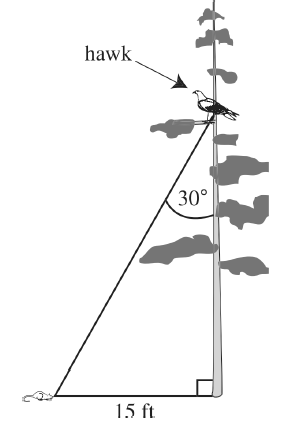
A hawk sitting on a tree branch spots a mouse on the ground 15 feet from the base of the tree.  The hawk swoops down toward the mouse at an angle of 30 degrees. What is the distance from the tree branch to the mouse? 
a)
7.5 ft 
b)
15 ft 
c)
26 ft 
d)
30 ft 
152.
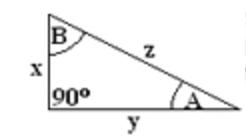
What is tan(A)
a)
X / Y
b)
Y / X
c)
Z / Y
d)
X/ Z
153.
What is the correct equation to solve for x?
a)
tan (45) = x/13
b)
cos (45) = x/13
c)
sin (45) = 13/x
d)
sin (45) = x/13
154.
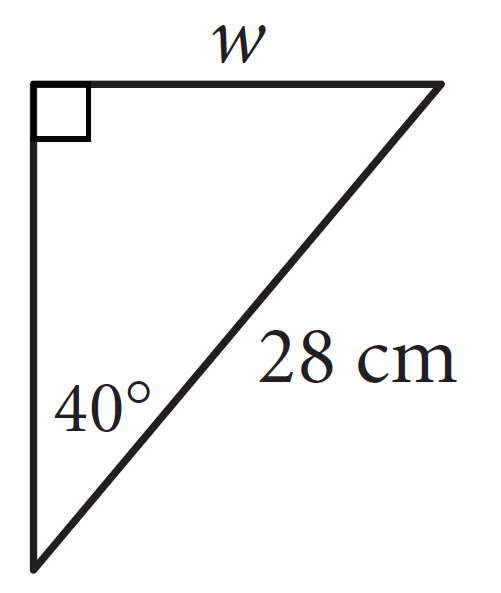
What is the correct equation?
a)
sin 40 = w/28
b)
cos 40 = w/28
c)
tan 40 = w/28
d)
sin 40 = 28/w
155.
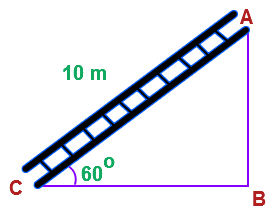
 Find side AB?
a)
20 m
b)
5 m
c)
11.54 m
d)
8.66 m
156.
In a right triangle, one side other than the hypotenuse is 8 cm and an acute angle is 45°. What is the length of the hypotenuse?
a)
4 cm
b)
8 cm
c)
8√2 cm
d)
None of the above
157.
Say 'TRUE' or 'FALSE'
If the length of the shadow of tower is increasing, then the angle of elevation of the sun is also increasing
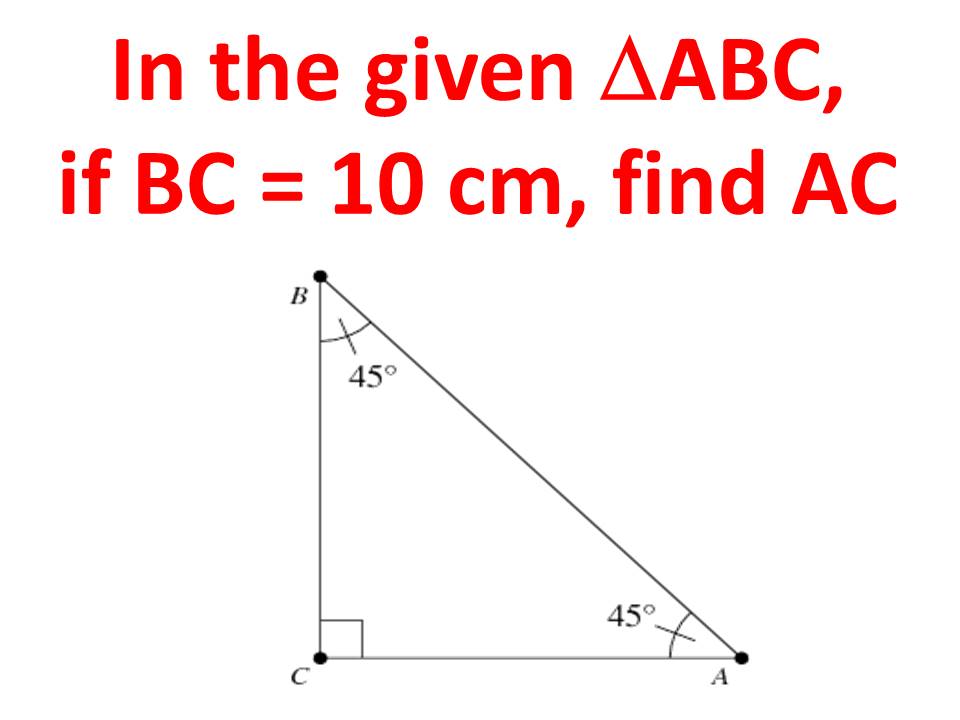
a)
TRUE
b)
FALSE
158.
The ratio of the length of the pole and its shadow is 1 : √3.  The angle of elevation of the sun is ____
a)
30°
b)
60°
c)
45°
d)
90°
159.
a)
10 cm
b)
10√3 cm
c)
5 cm
d)
20 cm
160.

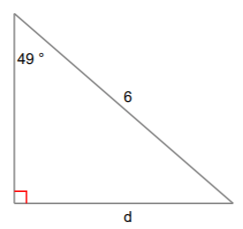
Which trigonometric ratio should you use?

a)

Tangent Ratio

b)

Sine Ratio

c)

Cosine Ratio

d)

Any ratio

161.
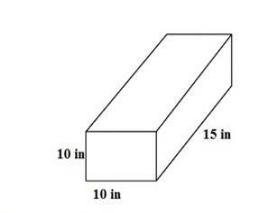
What is the surface area of this figure?
a)
200 cm 2
b)
800 cm 2
c)
400 cm 2
d)
100 cm 2
162.
Find the surface area of this figure.
a)
148 cm²
b)
120 cm²
163.

What is the surface area of this prism?

a)

160 cm2

b)

80 cm2

c)

100 cm2

d)

150 cm2

164.
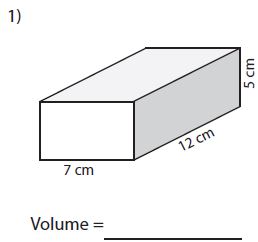
a)
410 cm3
b)
420 cm3
c)
402 cm3
d)
401 cm3
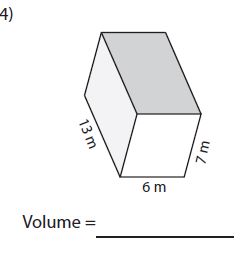
165.
a)
546 m3
b)
456 m3
c)
654 m3
d)
54 m3
166.
What is the volume of this prism?
a)
16 cubic cm
b)
36 cubic cm
c)
144 cubic cm
167.

What is the height and base of the triangle?

a)

8 and 12

b)

3 and 11

c)

12 and 3

d)

8 and 3

168.
Find the volume.
a)
147
b)
588
c)
84
d)
294
169.
Find the volume of the figure. Round to the nearest whole number.
a)
317 units³
b)
635 units³
c)
1,904 units³
d)
890 units³
170.
Find the volume.
a)
240
b)
1440
c)
144
d)
480
171.

The radii of two cylinders are in the ratio 3: 5 and their heights are in the ratio 2 : 3. Find the ratio of their CSA.

a)

3 : 5

b)

2 : 5

c)

2: 3

d)

3: 4

172.

The ratio of the heights of two cones is 1: 3 and their radii are in the ratio 3: 1. The ratio of their volumes is

a)

1 : 3

b)

2 : 1

c)

3 : 1

d)

4: 1

173.

A solid right circular cone of height 84 cm and radius of base 21 cm is melted and recast into a solid sphere. What is the diameter of the sphere?

a)

21 cm

b)

32 cm

c)

42 cm

d)

48 cm

174.

A solid metallic sphere of diameter 8 cm is melted and drawn into a cylindrical wire of uniform width. If the length of the wire is 12 m, find its width.

a)

2/15 am

b)

4/15 cm

c)

8/15 cm

d)

4/30 cm

175.

A rectangular piece of paper 100 cm X 44 cm is rolled along its length to form a cylinder. The volume of the cylinder so formed is

a)

15400 cu. cm

b)

7700 cu. cm

c)

30800 cu. cm

d)

15600 cu. cm

176.

The height of a cone is 8 cm and the area of its base is 156 sq. cm. What is its volume?

a)

312 cubic cm

b)

334 cubic cm

c)

416 cubic cm

d)

468 cubic cm

177.

12 solid spheres of the same size are made by melting a solid metallic cylinder of base diameter 2 cm and height 16 cm. The diameter of each sphere now is

a)

2 cm

b)

3 cm

c)

4 cm

d)

6 cm

178.

The volumes of two spheres are in the ratio 64 : 27. Then the ratio of their surface areas is

a)

3 : 4

b)

4 : 3

c)

9 : 16

d)

16 : 9

179.

The volume of the largest right circular cone that can be carved out from a cube of edge 4.2 cm is

a)

9.7 cu. cm

b)

77.6 cu. cm

c)

58.2 cu. cm

d)

19.4 cu. cm

180.

A metallic spherical shell of internal and external diameters 4 cm and 8 cm, respectively is melted and recast into a cone of base diameter 8 cm. The height of the cone is

a)

12 cm

b)

14 cm

c)

15 cm

d)

18 cm