
 Worksheets
WH Chapter 3 LT Quiz
Total questions: 75
Worksheet time: 52mins
Who gained land on the Black Sea to establish a warm water port for his/her country?
Catherine the Great
Louis XIV
Peter the Great
Ivan the Terrible
Which economic theory would have been employed by the absolute monarchs of Europe?
Mercantilism
Capitalism
Socialism
Fascism

Louis XIV built ____________________as a symbol of his power and wealth
Arc De Triumph
Palace of Versailles
Eiffel Tower
El Escorial

In becoming an absolute ruler, Peter the Great had to control the power of the _______ Church.
Roman Catholic
Protestant
Greek Reformed
Eastern Orthodox
This statement would most likely have been make by a person who believed in:

Who was Peter the Great?
This man promoted Westernization campaigns to make his country more European
This man demonstrated absolutism by building the city Versailles as a way of distracting the French nobility
This man didn't believe that the average person was intelligent enough to participate in government, which led him to believe that enlightened monarchy was best
This man thought that humans were naturally greedy and chaotic and would need a large government to control them
Who was Louis XIV?
This man promoted Westernization campaigns to make his country more European
This man demonstrated absolutism by building Versailles as a way of distracting the French nobility
This man believed that humans were naturally good and would not need a large government to rule over them.
This man did not believe that the average person was intelligent enough to participate in government, which led him to believe that an enlightened monarchy was best.
The English Bill of Rights
created a constitutional monarchy.
resolved all of England's seventeenth-century religious questions.
reaffirmed the divine-right theory of kingship while limiting the king's power.
confirmed the king's right to raise standing armies without parliamentary consent.
During the reign of Charles I of England,
the English Civil War occurred.
Oliver Cromwell emerged as the new military leader.
Parliament was dissolved.
All of the above


Which of these events most directly led to the signing of the English Bill of Rights?
English Civil War
Glorious Revolution
Thirty Years War
Defeat of Spanish Armada
The English Bill of Rights ended the __________________________ in England.
Constitutional Monarchy.
Absolute Monarchy.
Totalitarian State.
westernized Russia.
Which of the following was NOT a factor that helped lead to the rise of Absolute monarchs?
Stimulation of trade from the crusades
Strengthening of the power of the Catholic Church
Weakened power of feudal lords
Protestant Reformation weakening the power of the church


He was a polish mathematician and astronomer who was first to determine that the sun was the center of the solar system.
Galilieo
Humes
Copernicus
Descartes

A German mathematician who was known for his laws of planetary motion in elliptical orbits around the sun.
Leviticus
Kepler
Columbus
Newton

Who was the Italian physicist and astronomer who proved that objects of different weights, if dropped from the same height, fell at the same rate of speec. He was also responsible discovering the law of the pendulum.
Galileo
Vesalius
Hooke
Boyle

Who was the English scientist who discovered the laws of gravitation?
Galileo
Newton
Kepler
Copernicus

Who proposed a system of EXPERIMENTATION to find new truths through this type of scientific method.
Newton
Bacon
Descartes
Frisius
How did scientists begin challenging authority during the Scientific Revolution?
By careful observation of nature and willingness to question old beliefs
By reading classic literature
By collecting samples of plant life
By forming new government ideas

The document that was signed that protected Huguenots in France
Peace of Augsburg
Edict of Worms
Edict of Nantes
Act of Supremacy
The French monarch who declared "I am the State"
Charles V
Henry IV
Louis XIV
Marie Theresa

What city was built in a swamp connected to the Baltic Sea, that became the "New" Capital of Russia in 1703-1917. Also know as "The City built on Bones."
Moscow
Amsterdam
London
St. Petersburg

Which of the following is the best definition of Westernization?
A transition of dress and customs to that of American Cowboys
Expanding a countries borders
Converting to the customs and practices of Western European civilization.
Focusing a countries attention more toward farming and cattle herding

Who is this "Great" Tsar in Russian History?
St. Peter
Peter I
Ivan IV (Ivan the Terrible)
Henry VIII

What is Divine Right?
a set of rules used by the greeks
the God given right to rule
Hitler's reason to exterminate Jewish people
Machiavelli's theory on power

Phillip II of Spain believed it was his duty to defend this branch of Christianity.
Calvinism
Catholicism
Protestantism
Baptism
What is absolutism?
The idea that there is more than one religion
The idea that one group of people
is superior to another group of people
The idea that power is limited to a monarch by a parliament
The idea that all and unlimited power is used by a king or queen
Why was the Palace of Versailles built?
To flaunt the wealth and power of France
To house all of France's money
To downsize the capital
To protect the French border

Louis the XIV ruled what country?
England
Russia
Spain
France
What impact did the Enlightenment have on Absolute Monarchs?
It caused an increase in them in various nations throughout Europe
It caused people to question them and favor more Democratic governments
It caused the acceptance of Divine Right as a legitimate political theory
All of the above
What political purpose did the splendid Palace of Versailles serve?
To aid the artists of the time by displaying their works for others to see
To show the power of Louis XIV and arouse envy of the other monarchs
To reflect the religious faith of Louis XIV and give the appearance of strength and virtue
To reflect Louis XIV’s ideas of westernization and his desire to modernize his country
Which of the following provided England with the beginnings of a constitutional
monarchy?
The English Civil War
The English Bill of Rights
The Long Parliament
The Petition of Right
Which quotation would most likely have been made by an absolute monarch?
"It is the parliament that must make the laws."
"The government must be based on a sound constitution."
"The rights and prohibitions of the nation are joined with my body and reside in my hands alone. Public order in its entirety comes from me."
“People in a state of nature are solitary, poor, nasty, brutish and short."
Absolute monarchs, Philip II of Spain, Louis XIV of France, and Peter the Great of
Russia were all considered absolute rulers because they –
broke from the Roman Catholic Church
helped feudal lords build secure castles
Instituted programs that gave more power to their parliaments.
made government decisions without the consent of their people
Fill in the blank.
All monarchies have one leader, but in an absolute monarchy, that leader has _______ of the power. They are not controlled by anyone else
all
some
none
a little bit
The English Bill of Rights was created to …
limit the power of English monarchs
establish laws protecting the rights of Protestants
organize England’s colonial empire
abolish the role of Parliament
The English Bill of Rights (1689) inspired the…
American Bill of Rights
Rise of Monarchies in Europe
Second Dark Ages
First instance of world peace
Notable Events During The Reign of William & Mary
King and Queen of England after the Glorious Revolution
Signed the English Bill of Rights in 1689
Recognized the supremacy of the English Parliament.
William & Mary are an example of a…
Limited Monarchy
Absolute Monarchy
Enlightened Monarchy
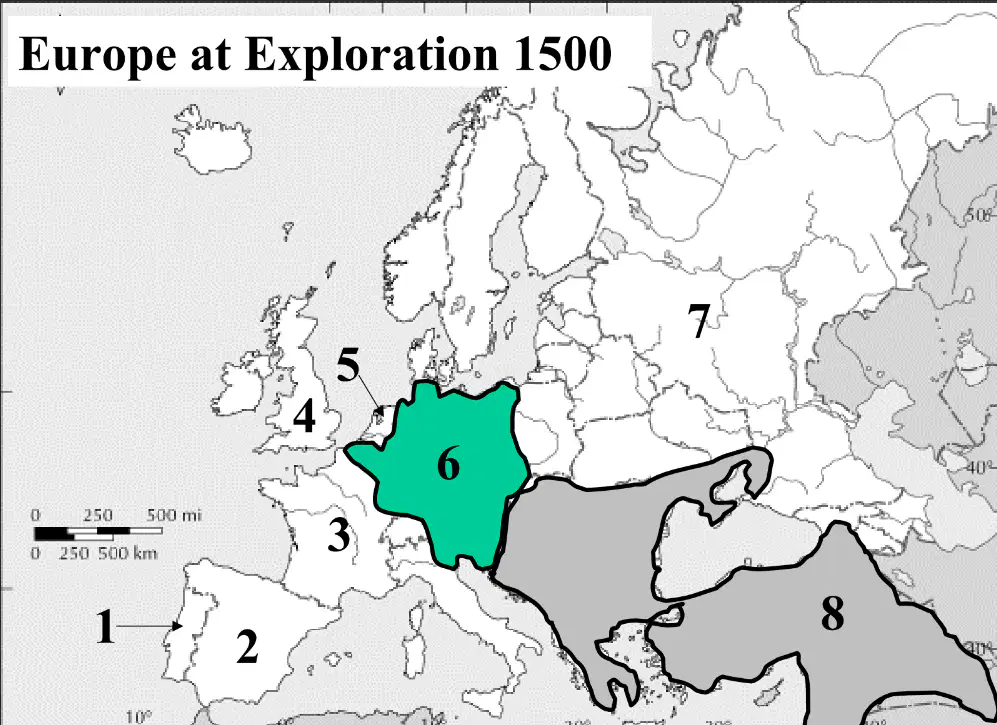
Match the number with the correct country
2
Spain
3
France
4
England
6
Hapsburg (Holy Roman) Empire
7
Russia
Which ruler failed to unite European lands specifically the Hapsburg Empire, under Catholicisim?
Charles V
Peter the Great
Louis XIV
Henry VIII
Which factor of the Hapsburg Empire often resulted in conflict?
located in modern day Germany
very diverse with many ethnic and cultural groups
impact of Northern European trade
lack of Chinese influence

