wayground logo

Free Printable Worksheets

Font size

S
M
L
XL
Worksheets

Intro to Chemistry

Total questions: 42

Worksheet time: 37mins

Name
Class
Date
1.

Which sub-atomic particle is responsible for reactions between most atoms?

a)

Proton

b)

Neutron

c)

Electron

d)

None of these

2.

a charged atom

a)

neutral

b)

isotope

c)

ion

d)

nucleus

3.

What does an elements ATOMIC NUMBER represent?

a)

number of atoms in its nucleus

b)

number of protons in its nucleus

4.

What is the atomic symbol for Carbon?

a)

Ca

b)

C

c)

Cb

d)

Cn

5.

An atom's nucleus contains what particles?

a)

protons and positrons

b)

protons and neutrinos

c)

quarks and quasars

d)

protons and neutrons

6.

This element has an atomic weight of......

a)

54

b)

25

7.

neutrons

a)

no charge, shells

b)

positive charge, nucleus

c)

no charge, nucleus

d)

negative charge, shells

8.

Subatomic particles with a negative charge

a)

Electrons

b)

Neutrons

c)

Protons

d)

Quarks

9.
Subatomic particles with a positive charge
a)
neutrons
b)
atomic mass
c)
protons
d)
isotopes
10.
What two elements make up water?
a)
Helium and oxygen
b)
Hydrogen and oxygen
c)
helium and carbon
d)
oxygen and carbon
11.
Attractions between the negative Oxygen atom of one water molecule and the positive Hydrogen atom of another water molecule are called
a)
Covalent bonds
b)
Ionic bonds
c)
Polar bonds
d)
Hydrogen bonds
12.
the central region of an atom where its neutrons and protons are is its 
a)
nucleus 
b)
electron cloud
c)
core 
d)
center 
13.
an atom with atomic number 6 would have how many protons 
a)
6
b)
12
c)
3
d)
cannot be determined 
14.
How many protons does this atom have?
a)
2.5
b)
6
c)
5
d)
10.811
15.
What part of the atom is the arrow pointing to?
a)
nucleus
b)
proton
c)
electron shell
d)
electron
16.
If the number of protons equal the number of _____, the atom will have no charge
a)
protons
b)
neutrons
c)
electrons
d)
nucleus
17.
What subatomic particle(s) would be found orbiting the nucleus?
a)
Neutrons only
b)
Electrons only
c)
Protons and Neutrons
d)
Protons and Electrons
18.
What are the 3 subatomic particles that make-up the atom?
a)
protons, neutrons, and isotopes
b)
neutrons, isotopes, and electrons
c)
positives, negatives, and electrons
d)
protons, neutrons, and electrons
19.

Which subatomic particle is responsible for causing most chemical reactions?

a)

protons

b)

neutrons

c)

electrons

d)

none of the above

20.

If an atom loses an electron, it will then have a ______ charge.

a)

positive

b)

negative

c)

no change

21.

If an atom gains an electron, it will then have a ______ charge.

a)

positive

b)

negative

c)

no change

22.

Covalent Bonds share electrons

a)

True

b)

False

23.

In a polar molecule, the electrons are

a)

in the nucleus

b)

shared equally

c)

not shared equally

d)

positively charged

24.

Non-polar covalent bonds share electrons equally.

a)

True

b)

False

25.

What type of bond involves the sharing of electrons between atoms?

a)

covalent bond

b)

ionic bond

c)

metallic bond

d)

transfer bond

26.
In a(an) POLAR bond, one atom pulls on the shared electrons more than the other atom. 
a)
True
b)
False
27.
In covalent bonds, electrons are ___________.
a)
transferred
b)
gained
c)
lost
d)
shared
28.

Valence electrons are located _____________ the nucleus of an atom

a)

close to

b)

farthest from

c)

randomly around

29.
a)
2
b)
8
c)
3
d)
13
30.
a)
12
b)
7
c)
8
d)
14
31.
Valence electrons are the...
a)
Innermost electrons
b)
Middle electrons
c)
Outermost electrons
d)
Any electrons
32.
What determines the reactivity of an element?
a)
Size of its nucleus
b)
Number of total electrons
c)
Number of valence electrons
d)
Number of shells
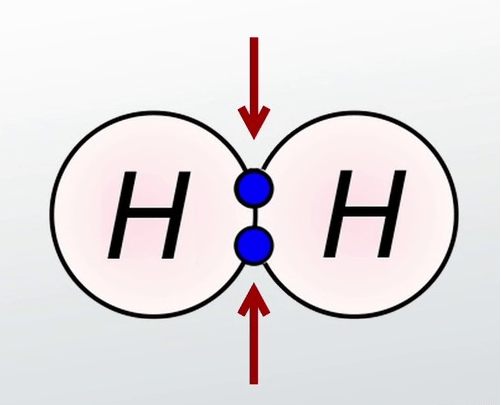
33.
What type of bond is shown in this image?
a)
Ionic
b)
Polar Covalent
c)
Nonpolar Covalent
d)
Van der Waals Force
34.

Electrons will be shared equally in a(n)

a)

Ionic bond

b)

Nonpolar covalent bond

c)

Polar covalent bond

35.

Electrons will be transferred in a(n)

a)

Ionic bond

b)

Nonpolar covalent bond

c)

Polar covalent bond

36.

An atom that has gained or lost an electron is called a(n) _____.

a)

ion

b)

particle

c)

atom

37.

When an ionic bond is formed, electrons are _____.

a)

gained

b)

lost

c)

shared

d)

gained or lost

38.
A cation is a ____ ion.
a)
negative
b)
positive
c)
neutral
d)
ficticious
39.
A anion will be a ____ ion.
a)
negative
b)
positive
c)
neutral
d)
ficticious
40.

How are ionic bonds formed?

a)

transfer of electrons

b)

sharing of electrons

41.

Electrons are involved in chemical reactions, not protons or neutrons.

a)

true

b)

false

42.

Salt is an example of what?

a)

ionic compound

b)

covalent compound