
 Worksheets
Homework UNIT 1 AP Micro
Total questions: 60
Worksheet time: 2hrs 30mins

Based on the table above, what is the opportunity cost to Picnicland of increasing the production of hotdogs from 450 to 900?
150 burgers
225 burgers
300 burgers
450 burgers
The production possibilities curve (PPC) is a graph that shows the various combinations of output that an economy
should produce
demands
can produce
Production Possibilities Curves (PPCs) are usually bowed outward. This is because...
the more resources a society uses to produce one good, the fewer resources it has available to produce another good.
the opportunity cost of producing a good decreases as more and more of that good is produced
of the effects of technological change
resources are specialized; that is, some are better at producing particular goods rather than other goods. (Apples & Carrots example)

What is the opportunity cost to Footville of increasing production of shoes from 400 to 600?
400 socks
300 socks
200 socks
100 socks

Which of the following points on the PPC above represents a combination of Steel & Wheat that this economy could NOT produce?
A
G
D
F
Humphery Flobart is trying to decide whether to take a job as the manager at the local Wendy's (making $25,000/year) OR attend college. He cannot do both. For Humphery, the opportunity cost of attending college includes...
The money he will spend on food whether or not he attends college.
The money he will spend on dates with his girlfriend, whether or not he attends college.
The $25,000 Humphery could make managing the local Wendy's next year if he didn't go to college.
The cost that Humphery's college, Boptown University, just paid to construct a new International Studies building.
Timmy the Eskimo currently makes $20,000/year working as an igloo salesman. He's considering taking a new job as a polar bear preservation guard, where he would be $25,000/year. He can only work one of the two jobs. Which of the following is an opportunity cost of taking the Polar Bear Guard job?
The self-esteem boost Timmy will get when the Polar Bears compliment him on his attentiveness to their security
The excitement of working as a Polar Bear Guard
The $20,000/year he could be making as an igloo salesman
The money Timmy pays for his new coffee maker
Suppose that you prefer reading a book you already own to watching TV and that you prefer watching TV to listening to music. If these are your only 3 choices, what is the opportunity cost of reading?
Watching TV AND Listening to Music
Watching TV
Listening to Music
The Price of the book
Tom has currently studied for AP Microeconomics for 4 hours and AP U.S. History for 4 hours. He's a hard worker. He has 1 more hour available for studying... how should he decide how to spend that hour?
He should compare the total benefit of 5 hours of studying for AP Microeconomics to the total benefit of 5 hours of studying for AP US History.
He should compare the marginal benefit of 1 more hour studying for AP Microeconomics to the marginal benefit of 1 more hour of studying for AP US History.
He should compare the total benefit of 9 hours of studying for AP Microeconomics to the total benefit of 9 hours of studying for AP US History.
Which of the following is the best definition of the word "marginal?"
Additional
Abstract
Econometric
Complicated
Deirdre has one free hour to practice the piano for
an upcoming school concert or work at the library for $7 per hour or babysit her neighbor’s 12-year-
old son for $10 per hour. She chooses to practice
the piano. What is the opportunity cost of
practicing the piano?
The opportunity cost would be $17 because she
chose not to participate in these activities.
Without knowing the marginal value of practicing
the piano, there is no way of knowing the true
opportunity cost.
The opportunity cost would be $20 because it is
necessary to calculate one additional hour of
babysitting to make it profitable.
The opportunity cost would be $10 because it
would be the most profitable alternative.
The opportunity cost would be $3 because it is the
monetary difference between two alternative
choices.
Both Richard and Michele can mow the lawn and
walk their dog on Sunday morning. For every half
hour of walking the dog, Richard can mow twice the
amount of lawn Michele can. According to this
information:
Michele walks the dog because she
has absolute advantage in mowing the lawn
Richard walks the dog because he has comparative
advantage in mowing the lawn
Richard mows the lawn because he has comparative advantage in mowing the lawn
Michele mows the lawn because she has comparative advantage in mowing the lawn
Michele walks the dog because she has
comparative advantage in walking the dog
Which of the following will cause an outward shift of the production possibilities curve?
A grant for educational training for employees
A decrease in a nation’s birthrate, thus decreasing the labor force
A natural disaster creating extreme limitations of a vital natural
resource
A shortage of skilled workers
An increase of unskilled workers
A point lying directly on the production possibilities curve is
efficient
unattainable, yet efficient
attainable and efficient
unattainable
inefficient
Scarcity is best defined as
material resources are unlimited
an idea used by industrializing nations to satisfy
unlimited wants and desires with limited natural
resources
limited vital material resources compared with limited wants and needs
all points lying outside the production possibilities
curve
the idea that a society’s wants and needs are unlimited, and material resources are limited
The law of increasing costs is best defined as
when the price of a good rises, the quantity does not
fall
as more of a product is produced, the greater its opportunity cost
as one obtains more of a good, the marginal utility (the value from one more unit) will decrease
as the economy grows, government spending will increase as well
all costs are opportunity costs
A country is said to have a comparative advantage
over another country when
it can produce a good at a lower opportunity cost than another country
it can produce a good using fewer resources per unit
of output than another country
there is a higher degree of specialization and division of labor
compared to another country
when comparing each country’s production possibilities frontiers, one country is operating at maximum efficiency and
output
one country’s production possibilities frontier is shifted farther to the right compared to another country’s production possibilities frontier
Suppose both Spain and Germany produce soccer
balls and golf balls. Spain can produce soccer balls at
a lower opportunity cost than Germany. Germany can
produce golf balls at a lower opportunity cost than
Spain. According to the law of comparative
advantage:
Germany should stop producing soccer balls; Spain should stop producing golf balls; Spain and Germany should establish a trade for the product they stopped producing
Germany should stop producing golf balls; Spain should stop
producing soccer balls
Germany should increase production of golf balls and decrease the production of soccer balls
Spain should increase the production of soccer balls and decrease the production of golf balls
none of the above
As a result of the scarcity of resources:
every society must commit to central planning
the government must decide how best to use those resources
there is the unavoidable reality of poverty
every society must choose how best to use those
resources
every society must include elements of a market economy and government planning
An economic system is characterized as emphasizing private property and competition, and prices inform buyers and sellers how to allocate their resources. This economic system would be known as a
mixed system
market system
socialist system
command system
barter system
Opportunity Cost is:
The additional benefit of buying an additional unit of a product.
That which we forgo, or give up, while making a choice or a decision.
The cost incurred in the past before we make a decision about what to do in future
A cost that is borne in terms of discomfort and pain while supplying factors of production.
The opportunity cost of watching a movie will be equal to:
The time lost while watching the show.
The pleasure enjoyed by watching the show
The amount paid to buy the tickets.
The pleasure that could have been enjoyed watching TV instead.
Economics is
The study of stocks and bond market.
The study of Management decisions.
The problem of choice under scarcity.
Mainly the study of business firms.
Government-provided healthcare increases public expenditures.
Normative Economic Statement
Positive Economic Statement
Working citizens should not pay for hospital care.
Normative Economic Statement
Positive Economic Statement
Economies where the economic activities are firmly controlled by government.
Centrally Planned Economy
Market Economy
Mixed economy
Economies where the economic activities are controlled by the market forces.
Socialist Economy
Mixed economy
Capitalist Economy
In a market economy, most choices about production and consumption are made by which of the following?
politicians
many individuals and firms
the government
managers
economists
The fundamental problem with command economies is a lack of
central authority
workers
incentives
land
opportunity cost
Suppose that in a day Nigel can make three placemats or one gallon of maple syrup, and Pauline can make two placemats or two gallons of maple syrup. Which of the following terms of trade would be mutually beneficial for Nigel and Pauline?
Nigel trades one placemat for 1/2 gallon of maple syrup from Pauline
Pauline trades one placemat for 1/2 gallon of maple syrup from Nigel
Nigel trades one placemat for two gallons of maple syrup from Pauline
Pauline trades one placemat for two gallons of maple syrup from Nigel
Nigel trades one placemat for 1/4 gallon of maple syrup from Pauline
Assume an economy is using all its available resources efficiently to produce only two goods, X and Y. As more of good X is produced, what happens to the production of good Y?
The production of good Y also increases.
More resources will need to be devoted to producing good Y.
Less of good Y is produced as resources move from producing good Y to producing good X.
The economy can only produce more of good X if there is more labor available.
There will be no loss of good Y produced.
Susan and John both sew t-shirts in a small factory. Using the same resources, John can sew twelve t-shirts and Susan can sew nine t-shirts in one day. Which of the following can be concluded from the given information?
John has a higher opportunity cost of sewing t-shirts than Susan does.
A. Susan has an absolute advantage in sewing t-shirts.
Susan has a comparative advantage in sewing t-shirts.
John has a comparative advantage in sewing t-shirts.
John has an absolute advantage in sewing t-shirts.
Using the same amount of time and resources, Jack can assemble either 10 bikes or 5 computers, whereas Sam can assemble either 5 bikes or 5 computers. Based on the data, which of the following statements is correct?
Sam has an absolute advantage in assembling bikes.
Sam has an absolute advantage in assembling computers.
Sam has a comparative advantage in assembling bikes.
Jack has a comparative advantage in assembling bikes.
Jack has a comparative advantage in assembling both bikes and computers.
Country "A" can produce 12 cars or 8 computers. Country "B" can produce 15 cars or 5 computers. Which country has the absolute advantage in terms of cars?
Country "A"
Country "B"
Neither
Both
Country "A" can produce 12 cars or 8 computers. Country "B" can produce 15 cars or 5 computers. Which country has the absolute advantage in terms of computers?
Country "A"
Country "B"
Neither
Both
Country "C" can produce shirt in 30 minutes or 1 chair in 60 minutes. Country "D" can produce a shirt in 45 minutes or 1 chair in 45 minutes. Which country has the absolute advantage in terms of shirts?
Country "C"
Country "D"
Neither
Both
Country "G" can produce 20 hamburgers or 80 hot dogs. Country "H" can produce 14 hamburgers or 28 hot dogs. What is the opportunity cost for Country "H" to produce 1 hot dog?
12 hamburgers
2 hamburgers
1/2 hamburger
3 hamburgers
Andy can produce a pillow in 15 minutes or a blanket in 20 minutes, and Barbara can produce a pillow in 20 minutes or a blanket in 30 minutes.
Who has the absolute advantage in making blankets?
Andy
Barbara
Neither
Both
The opportunity cost for Timmy to produce one desk is 4.5 chairs. The opportunity cost for Lauren to produce one desk is 6 chairs. Knowing this, who should specialize in producing desks?
Lauren, because she has the higher opportunity cost
Timmy, because he has the lower opportunity cost
There is not enough information to know.
Which model puts the "other product over?"
output model
input model
Which of the following situations would a person use the input model for configuring comparative advantage?
Bob can make 10 cakes in one hour.
Bob can make 10 cakes and 20 brownies in one hour.
It takes Bob 45 minutes to make 1 cake, and 20 minutes to make 3 cupcakes.
Bob can bake 20 cupcakes and 2 strudels in one hour.
Comparative advantages show:
outcomes without trading
who can make more items
competition within countries
who should produce what item at the lowest cost
What type of advantage shows who can make the most item?
absolute advantage
comparative advantage

The PPC shows how many airplanes and pizzas Country A and Country B can produce with a certain number of workers. Which Country should produce Pizzas?
Country A
Country B
Both Country A and Country B
Neither Country A nor Country B
We cannot determine this

If the two countries were to specialize and trade with one another, which country would import airplanes?
Country A
Country B
Neither
Both
We cannot determine this
Amanda can either build 6 models or prepare 4 experiments, and Pam can either build 9 models or prepare 6 experiments. Amanda and Pan have identical time and resources available.
Who has a comparative advantage in building models and who has a comparative advantage in preparing experiments?
Both have a comparative advantage in both goods
Pam has a comparative advantage in both building models and preparing experiments
Neither has a comparative advantage in producing either good
Amanda has a comparative advantage in building models and Pam has a comparative advantage in preparing experiments
Pam has a comparative advantage in building models; both have a comparative advantage in preparing experiments

Martha and Dave like to make identical tacos and cakes. The time it makes Martha and Dave to make tacos and cakes is given in the table provided. Which person has an absolute advantage in the production of tacos, and which person has an absolute advantage in the production of cakes?
Martha has an absolute advantage in tacos; Dave has an absolute advantage in cakes
Neither Dave nor Martha has an absolute advantage at producing either good
Dave has an absolute advantage in producing both goods
Both Martha and Dave have an absolute advantage in producing both goods
Martha has an absolute advantage in producing both goods

Country A and Country B are potential trading partners that can produce boats and umbrellas, as illustrated in the PPCs. Which of the following exchange prices for boats would result in gains from trade for these two countries?
1/4 umbrella per boat
1/3 umbrella per boat
3/5 umbrella per boat
One umbrella per boat
2.5 umbrella per boat

Eric and Melanie like to build apps and coach soccer. The time it takes Eric and Melanie to build apps and plan soccer drills for their team is given in the table. Which person has a comparative advantage in the production of apps, and which person has a comparative advantage in the production of soccer drills?
Both people have a comparative advantage in producing both goods
Eric has a comparative advantage in building apps; nobody has a comparative advantage in planning soccer drills
Neither person has a comparative advantage at producing either goods
Melanie has a comparative advantage in creating soccer drills; Eric has a comparative advantage in building apps
Melanie has a comparative advantage in building apps; Eric has a comparative advantage in creating soccer drills
Using the same amount of time and resources, Kim can write 10 articles or complete 5 worksheets and Leah can either write 3 articles or complete 9 worksheets. If Kim and Leah specialize and trade, who should specialize in each good?
There is no opportunity for gains from trade because neither person has a comparative advantage in producing either good
Kim should specialize in writing articles, Leah should specialize in worksheets
There is no opportunity for gains from trade because both people have identical opportunity costs
There is no opportunity for specialization because they both have an absolute advantage in producing one good
Kim should specialize in worksheets, Leah should specialize in writing articles
Which of the following statements is true about specialization and trade?
A country should specialize in and export the good for which it has absolute advantage
A country should specialize in and import the good for which it has comparative advantage
A country should specialize in and import the good for which it has absolute advantage
A country should specialize in and export the good for which it has comparative advantage
A country should specialize in and export a good for which it has both comparative and absolute advantage
A ban on trade with a particular country.
Subsidy
Embargo
Tariff
Quota

What does point B represent?
Production at greater than the country's minimum potential
Production is less than the country's minimum potential
Productive inefficiency
Productive efficiency
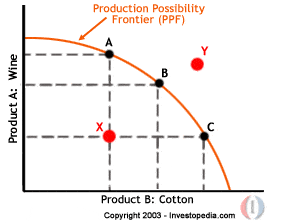
What does point Y represent on the PPC?
Efficiency
Unattainable / impossible
Inefficency
Nothing

The opportunity cost of increasing production from 4 to 7 boats is
1 boat
2 boats
2 trucks
3 trucks
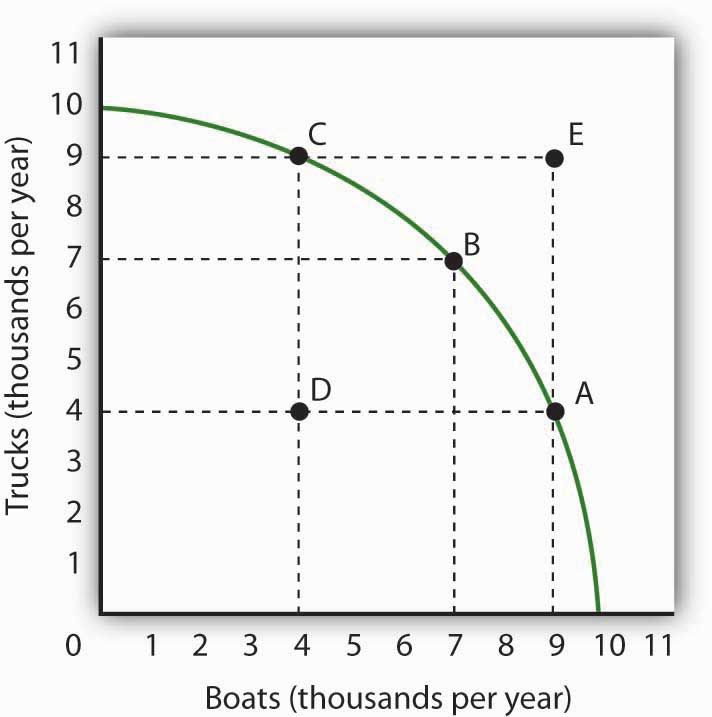
The opportunity cost of increasing production from 7 to 9 trucks is
Scarcity
2 boats
2 trucks
3 boats


