

wayground logo

Free Printable Worksheets

Font size

S
M
L
XL
Worksheets

A Level Proteins and Amino Acids

Total questions: 21

Worksheet time: 11mins
Name
Class
Date
1.
What are the building blocks of proteins?
a)
amino acid
b)
fatty acid
c)
nucleotide
d)
lipid
2.
The level of protein structure that results from hydrogen bonding causing the protein to fold into α-helix and β-pleated sheets is known as
a)
primary structure
b)
secondary structure
c)
tertiary structure
d)
quaternary structure
3.
The name of the initial chain of monomers in a protein is called.....
a)
polypeptide
b)
polysaccharide
c)
polyester
d)
polynucleotide
4.
The tertiary structure folding in proteins is primary due to the interactions of....
a)
the 'R' groups
b)
the 'P' groups
c)
the 'A' groups
d)
the 'S'
5.
Which is not a use or function of protein?
a)
forms enzymes and hormones
b)
forms transport channel in cell membrane
c)
forms structural proteins in the body
d)
quick energy
6.
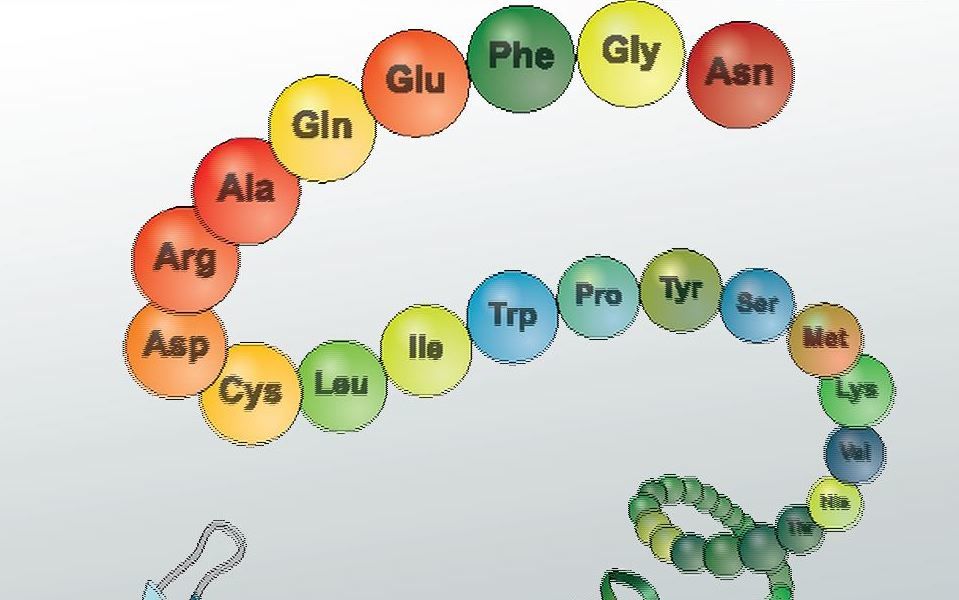
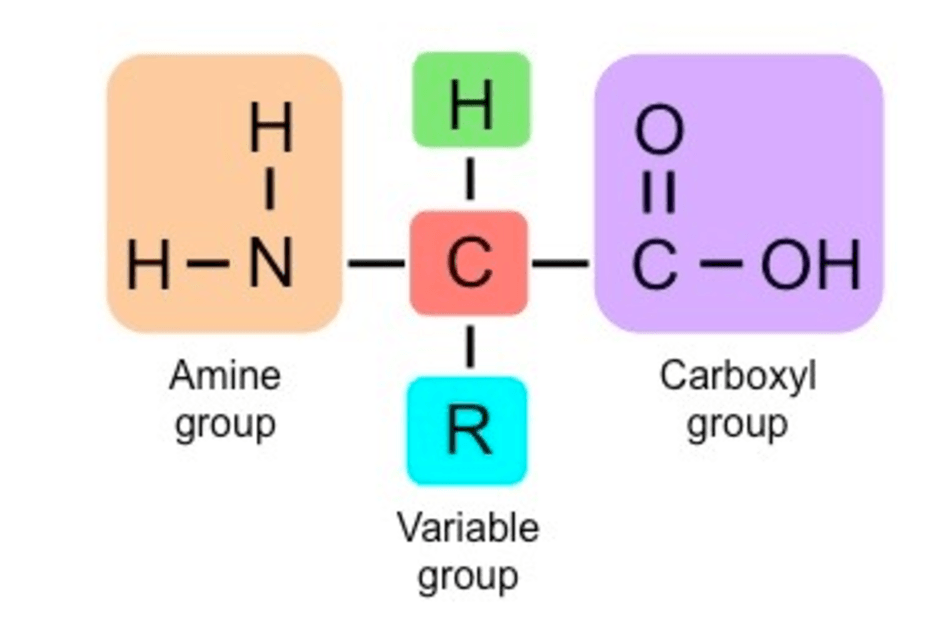
Which structure changes in the 20 different amino acids?
a)
#1
b)
#2
c)
#3
d)
#4
7.
The primary sequence of a protein refers to the:
a)
Order of amino acids
b)
α-Helix or β-Pleated Sheet
c)
Interaction of subunits
d)
Hydrogen Bonding
8.
When a protein unfolds, it is
a)
Denatured
b)
Building
c)
Adding amino acids
d)
Making food
9.
What is a peptide bond?
a)
Bond that holds two amino acids together.
b)
A bond that holds hydrogen and oxygen molecules together.
c)
A bond that holds the phosphate group of one nucleotide and a sugar of a neighboring nucleotide.
d)
A bond that is formed by the sharing of electrons.
10.

The entire polypeptide forms a three-dimensional structure

a)

Primary

b)

Secondary

c)

Tertiary

d)

Quaternary

11.
The element _______is found in all of the organic compounds.
a)
Iron
b)
Nitrogen
c)
Carbon
d)
Oxygen
12.
The bond that joins amino acids are called:
a)
Peptide Bonds
b)
Ester Bonds
c)
Glycosidic Linkages
d)
Phosphodiester Bonds
13.

If a methyl group (-CH3), which does not like water, were at the 'R', the amino acid would likely be:

a)

Hydrophobic

b)

Hydrophilic

c)

Ionic

d)

Acidic

14.
The diagram shows a bond forming between two amino acids. What is the name of this reaction?
a)

Condensation

b)
Hydrolysis
c)
Pepysis
d)
Oxidation
15.

Which of the following bond(s) do(es) NOT exist in a secondary structure? (SELECT TWO ANSWERS)

a)

Peptide bond

b)

Hydrogen bond

c)

Disulphide bond

d)

Ionic bond

16.

The polypeptide in the diagram consists of;

a)

3 amino acids and 3 peptide bonds

b)

3 amino acids and 2 peptide bonds

c)

4 amino acids and 2 phosphodiester bonds
d)

3 amino acids and 2 phosphodiester bonds

17.
What is the monomer of a protein?
a)
amino acid
b)
monosaccharide
c)
fatty acid
d)
nucleic acid
18.

The part of the amino acid in the red circle is

a)

the amino group

b)

the carboxyl group

c)

the R group

d)

the peptide bond

19.
The bond that joins amino acids are called:
a)
Peptide Bonds
b)
Ester Bonds
c)
Glycosidic Linkages
d)
Phosphodiester Bonds
20.

Each amino acid is different from the other due to...

a)

The amino group

b)

Alpha carbon

c)

The R group

d)

The carboxyl group

21.

Beta sheet like arrangements are held together by which bonds?

a)

Ionic

b)

Metalic

c)

Hydrogen

d)

Van der waals
