
NEW
Font size
 Worksheets
Properties of Matter Study Guide
Total questions: 35
Worksheet time: 18mins
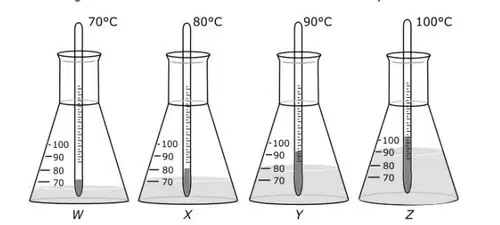
Which flask shows the least rapid particle speed?
Flask W
Flask X
Flask Y
Flask Z
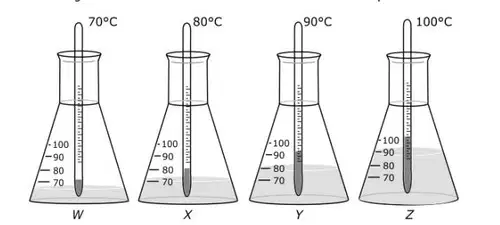
Which flask shows the most rapid particle speed?
Flask W
Flask X
Flask Y
Flask Z
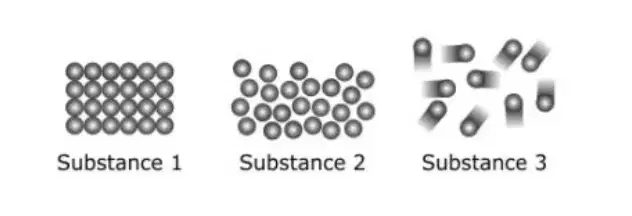
What state of matter is substance 3?
Solid
Liquid
Gas
Plasma
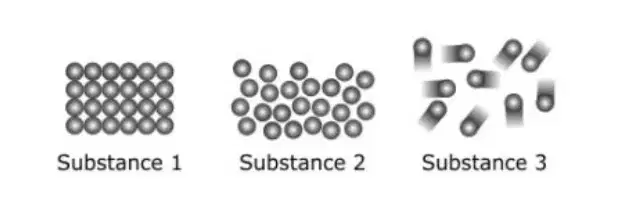
What state of matter is substance 2?
Solid
Liquid
Gas
Plasma
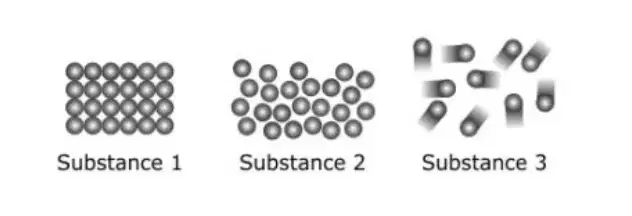
What state of matter is substance 1?
Solid
Liquid
Gas
Plasma
Are all atoms larger than a water molecule?
Yes. All atoms are bigger than a water molecule.
No. Water is made up of three atoms so all atoms can't possibly be bigger than a water molecule.
Depends on the atom
Depends on the molecule
Is the mass the same for a 50 mL sample of liquid water and a 100 mL sample of liquid water?
Yes. The 100mL sample would have more water molecules and therefore, the same mass.
No. The 100mL sample would have more water molecules and therefore, more mass.
Depends on the temperature
Depends on the pressure
Is the boiling point the same for a 50 mL sample of liquid water and a 100 mL sample of liquid water?
Yes. Boiling point does not depend on the sample size.
No. Smaller samples will boil faster.
Depends on the temperature
Depends on the pressure
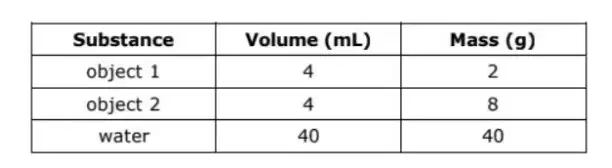
What will happen to the objects in this table when tossed into water?
(Use the formula D=m/v to help you.)
Both objects will float
Both objects will sink
Object 1 will float and Object 2 will sink
Object 1 will sink and Object 2 will float
Are melting and boiling point determined by the size of the sample of matter?
Yes. Boiling point is not an identifying property of matter. The boiling point of a type of matter will be different depending on how big the sample is.
No. Boiling point is an identifying property of matter. The boiling point of a type of matter will be the same regardless of the sample size.
Depends on the substance
Depends on the pressure
Joe saws a wooden board into two pieces. Which statement is true regarding the properties of the resulting pieces?
The density of each piece is the same as the density of the original board.
The mass of each piece is the same as the mass of the original board.
The size of each piece is the same as the size of the original board.
The volume of each piece is the same as the volume of the original board.
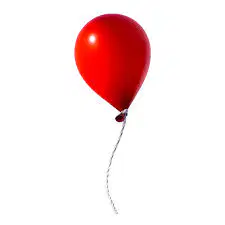
If the temperature of this balloon suddenly increased, how would the balloon change?
the volume of the balloon would decrease
the volume of the balloon would increase
the mass of the balloon would increase
the mass of the balloon would descrease

Which layer has the greatest density?
oil
water
dish soap
syrup
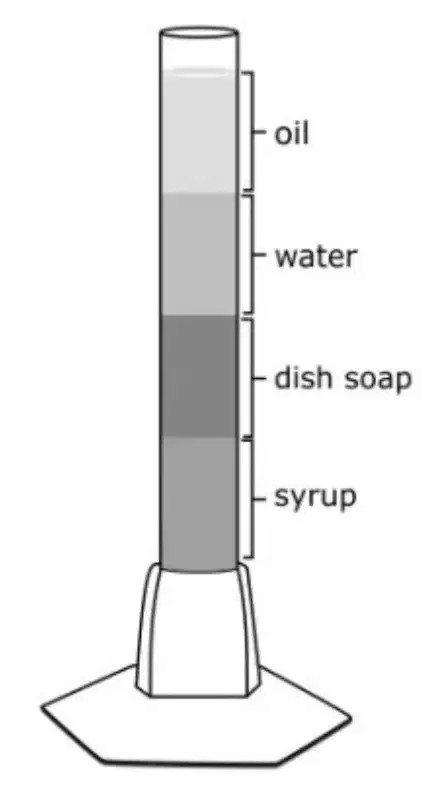
Which layer has the least density?
oil
water
dish soap
syrup
Iron can exist as a solid or a liquid.
Do solid iron and liquid iron have the same type of atoms?
Yes, solid and liquid iron are the same substance, so the atoms would be the same.
No, solid and liquid iron are the same substance, so the atoms would be the same.
Yes, solid and liquid iron have the same volume, so the atoms are the same.
No, solid and liquid iron have different volume, so the atoms are different.
Copper can exist as a solid or a liquid. Is solid copper an element, and is liquid copper a compound?
No. Copper is an element whether it's liquid or solid.
No. Liquid copper is a element and solid copper is a compount.
No. It's impossible to determine.
Yes. Solid copper an element, and is liquid copper a compound.
Do the atoms in an element have different sizes and shapes?
No. The atoms in an element are all the same atoms.
Yes. When a new substance is forms, it is called a chemical change.
No. Mixtures are not a new substance. The substances in the mixture can often be easily identified and separated.
Yes. If all the atoms are the same, then all the properties will be the same.
Can the atoms of an element be seen with a magnifying glass?
No, the atoms of an element cannot be seen with a magnifying glass.
No. If their mass and volume are different, they can't be seen.
Yes, some atoms can be seen without a magnifying glass.
Yes. If all the atoms are the same, then all the properties will be the same.
Do the atoms of an element have mass and volume?
No, the atoms in an element are various shapes and siz
Yes. All atoms have mass and volume.
No. There's no way to tell what an atom looks like because they are too small for even the most powerful microscopes.
Yes. This is because atoms with a certain volume always have the same mass.
When two elements combine to form a new substance what is this called?
physical change
mechanical change
energy change
chemical change
A student is using two samples of gold (Au) in a lab investigation. What is likely to be the same?
volume
mass
density
weight
Which is these is true of all atoms?
The all have the same volume and mass.
They all contain equal amounts of electrons.
They all have mass and take up space.
They all have the same size and shape.
What is the same about 5-gram emerald and a 20-gram piece of iron?
They have the same mass and volume.
They have all the same properties.
They are both liquid at room temperature.
They are both made of atoms.
A student is using two samples of copper (Cu) in a lab investigation. Which of the following is likely to be the same?
weigh
solubility
mass
volume
Which statement describes the atoms of an element?
They can be seen with a magnifying glass.
They have different sizes and shapes.
They have mass and volume.
They are weightless.
Which statement would best explain a property of all elements?
All elements exist in the solid phase.
All elements are pure substances.
All elements have six electrons.
All elements are metal.
A student is using two samples of silver (Ag) in a lab investigation. Which property is most likely the same with the two samples of silver?
density
mass
shape
temperature
Tammy has a blue cup and a green cup. Each cup contains an equal amount of water.
The temperature of the water in the blue cup is 10°C.
The temperature of the water in the green cup is 30°C.
Tammy places the blue cup next to the green cup so that the cups touch each other.
How will heat flow between the cups?
Heat will flow from the blue cup to the green cup, and the particles in the blue cup will slow down.
Heat will flow from the blue cup to the green cup, and the particles in the blue cup will speed up.
Heat will flow from the green cup to the blue cup, and the particles in the blue cup will slow down.
Heat will flow from the green cup to the blue cup, and the particles in the blue cup will speed up.
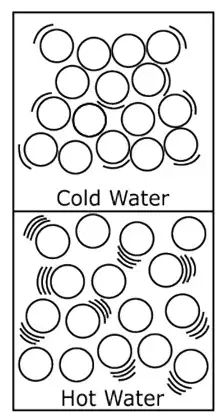
The diagram compares the movement of water particles when the water is cold compared to when it is hot. Which is true?
The particles in the cold water move more quickly.
The particles in the cold water move more freely.
The particles in the cold water do not move at all.
The particles in the cold water move more slowly.
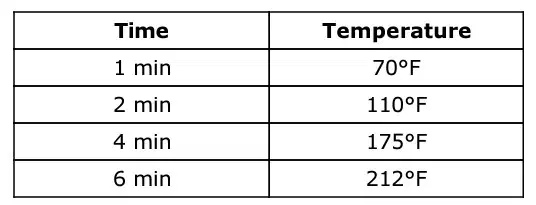
The table shows the times and temperatures for a solid substance being heated on a stove. If the substance melts at 200°F, at which time did the particles in the substance move the slowest?
1 min
2 min
4 min
6 min
When molecules are beginning to move faster what is happening?
Heat is being added, and a gas is turning into a liquid.
Heat is being added, and a solid is turning into a liquid.
Heat is being removed, and a gas is turning into a solid.
Heat is being removed, and a liquid is turning into a solid.
When water evaporates, how do the molecules look?
They move closer together.
They move farther apart.
Their mass decreases.
Their mass increases.
Does the sample size affect the melting point of a substance?
Yes, smaller amounts melt at lower temperatures.
Yes, larger sample sizes require greater temperatures to melt.
No, sample size does not impact the melting point. Melting point is an identifying property.
No, the sample size means lower melting points.
Which propterty is the same for a 150 mL sample of liquid water and a 200 mL sample of liquid water?
mass
weight
volume
boiling point
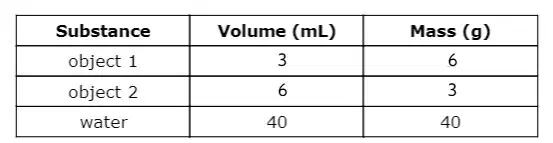
Which of the following is true based on the data?
Use the formula D=m/v to solve.
Both objects will sink.
Both objects will float.
Object 1 will sink, but object 2 will float.
Object 1 will float, but object 2 will sink.

