
 Worksheets
Unit 2: The American Revolution
Total questions: 60
Worksheet time: 30mins
Taxed all printed materials (newspapers, legal documents, licenses, pamphlets, etc.); each purchased printed material must have a tax stamp affixed to the document as proof of tax payment.
Sugar Act
Quartering Act
Stamp Act
Townshend Acts
Taxed the top five most popular British imported goods including paint, tea, paper, lead, and glass.
Sugar Act
Stamp Act
Quartering Act
Townshend Acts
Forced colonists to house, feed, and supply British "Redcoat" soldiers at their own expense under penalty of law and arrest.
Sugar Act
Stamp Act
Quartering Act
Townshend Acts
Taxed molasses, sugar, and various imported British manufactured goods.
Sugar Act
Stamp Act
Quartering Act
Townshend Acts
Series of five separate laws intended to punish the colonists of Boston, Massachusetts for their participation in the Boston Tea Party. Laws included closing Boston Harbor and banning / suspending the Massachusetts legislature and courts.
Boston Massacre
Tea Act
Boston Tea Party
Intolerable Acts
Forced colonists to buy tea only from the British East India Trading Company which was heavily taxed.
Boston Massacre
Tea Act
Boston Tea Party
Intolerable Acts
Event in which British "Redcoat" soldiers shot and killed 5 protesting Boston colonists; including Crispus Attucks - a freed slave who was the first to die.
Boston Massacre
Tea Act
Boston Tea Party
Intolerable Acts
Event in which the Sons of Liberty, led by Samuel Adams, snuck aboard three British merchant ships and destroyed cases of tea from the British East India Company by dumping it into the Boston Harbor as a response to the passage of the Tea Act.
Boston Massacre
Tea Act
Boston Tea Party
Intolerable Acts
Colonial delegates met in Philadelphia to discuss how to manage the war effort against Great Britain. They resolved to appoint George Washington as Commander-in-Chief of the Continental Army and signed the Declaration of Independence on July 4, 1776.
1st Continental Congress
2nd Continental Congress
Battles of Lexington & Concord
Winter at Valley Forge
Battle of Saratoga
Campsite location of the Continental Army; soldiers experienced tough training and various hardships including lack of food / supplies and spread of diseases.
Battles of Lexington & Concord
Battle of Saratoga
1st Continental Congress
Winter at Valley Forge
Battle of Yorktown
Colonial delegates met in Philadelphia to discuss how to maintain peace with England. They resolved to boycott British goods, petition King George III to repeal all taxes, and train local colonial militias in preparation for war.
1st Continental Congress
2nd Continental Congress
Winter at Valley Forge
Battle of Saratoga
Battle of Yorktown
Last major battle of the American Revolution (American victory) forced the British to surrender and sign the Treaty of Paris 1783 to end the American Revolution allowing the United States of America to officially become its own independent nation.
Battles of Lexington & Concord
Battle of Saratoga
Battle of Trenton
Battle of Yorktown
Battle of Bunker Hill
Considered the "Turning Point" battle of the American Revolution (American victory). France signs the Treaty of Alliance to join the war effort on the side of the Continental Army. France provides weapons, money, and supplies to the Continental Army
Battles of Lexington & Concord
Battle of Saratoga
Battle of Yorktown
Battle of Trenton
Battle of Cowpens
First official battles of the American Revolution. British "Redcoat" soldiers attempted to arrest members of the Sons of Liberty as well as take colonial weapons and ammunition. Known as the "Shot Heard Around the World".
Battles of Lexington & Concord
Battle of Yorktown
Battle of Saratoga
Battle of Brooklyn Heights
Battle of Trenton
Appointed the position of Commander-in-Chief of the Continental Army by the members of the 2nd Continental Congress
Benedict Arnold
Alexander Hamilton
John Hancock
Thomas Jefferson
George Washington
Life, Liberty, and the Pursuit of Happiness
Inherited Rights
Unalienable Rights
Conscripted Rights
Theocratical Rights
What answer choice best describes Unalienable Rights?
rights that are earned by demonstrating loyalty to the government
rights that you receive when becoming a citizen of the U.S.
rights that are considered natural because they are given by God
rights that are granted after payment of taxes to the government
Patriot group that organized protest and boycotts across New England. Led by Samuel Adams
Sons of Liberty
Continental Army
Loyalist Brigade
Foundation for Freedom
Which of the following is NOT a reason American colonists were unhappy with British rule and taxation?
Lack of colonial representation in Parliament
Ending of the British policy of Salutary Neglect
British economic system of Mercantilism
Housing of soldiers in colonial homes
Restrictions on property ownership
What phrase became a popular colonial slogan to protest British taxation?
"No Taxation Without Representation"
"Death to Tyrants"
"Join, or Die"
"Give Me Liberty or Give Me Death"
According to the Declaration of Independence, what right do "We the People" have if the government becomes too tyrannical and begins to deny our Unalienable Rights?
we have the right to change or remove that government by force if necessary and create a new government
we have the right to assassinate our government leaders
we have the right not pay taxes to any government leaders
we have the right to secede from the nation
Which European nation formed an alliance with the Americans after victory at the Battle of Saratoga?
Spain
Netherlands
France
Portugal
What treaty ended the American Revolution?
Treaty of Mortfontaine
Treaty of Paris, 1763
Treaty of Paris, 1783
Treaty of Ghent
The Proclamation of 1763 prevented the colonists from traveling west past the ___________________________ after the French & Indian War
Rocky Mountains
Appalachian Mountains
Mississippi River
Ohio River
Which answer choice best describes the British economic system of Mercantilism?
colonies could not trade with any foreign nations and were forced to export cash crops and raw materials to Great Britain while importing expensive British goods.
colonies were forced to conscript any males aged 18-40 to submit payments of property taxes and wealth taxes
colonies were allowed to navigate their merchant ships past British naval blockades to engage in privateering for the British crown
colonies could petition the British Parliament for a redress of grievances listed in the Declaration of Independence
What figure was the target of the 27 grievances listed in the Declaration of Independence?
King George III
Edward Townshend
Benjamin Franklin
Alexander Jones
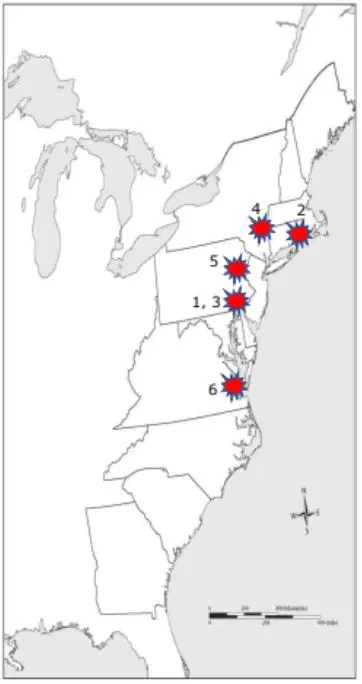
Which location matches the following -
First official battles of the American Revolution Known as the "Shot Heard Around the World"
British officials were sent to arrest leaders of the Sons of Liberty as well as confiscate colonial weapons
Site 1 & 3
Site 4
Site 2
Site 5
Site 6
Which location matches the following -
"Turning Point" battle of the American Revolution.
British forces attempted to seize control of the Hudson River to separate the New England colonies from the other colonial regions.
France joined the war effort with the Americans.
Site 1 & 3
Site 4
Site 2
Site 5
Site 6
Which location matches the following -
Site of the 1st and 2nd Continental Congress.
Location served as the capitol of the United States of America until 1800 when it was moved to Washington D.C.
Site 1 & 3
Site 4
Site 2
Site 5
Site 6
Which location matches the following -
Location of winter camp for the Continental Army. Soldiers experienced various hardships including lack of food, clothing, and supplies training during this time improved soldiers abilities.
Site 1 & 3
Site 4
Site 2
Site 5
Site 6
Which location matches the following -
Last major battle of the American Revolution.
British attempted to invade the colonies from the South, known as the "Southern Strategy".
American and French forces surrounded the British by land and sea to lay siege on the area.
Site 1 & 3
Site 4
Site 2
Site 5
Site 6
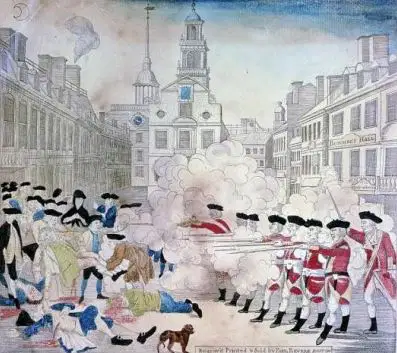
What event in American history is being shown?
Boston Tragedy of 1770
Boston Massacre
Battles of Lexington & Concord
Boston Insurrection
Who was the first to be shot and killed in the Boston Massacre?
Crispus Attucks
Wentworth Cheswell
James Armistead
William Harvey Carney
The Intolerable Acts were a set of 5 different laws passed by King George III and Parliament to punish the colonists of Boston for their participation in the Boston Tea Party.
Which answer choice describes the "Boston Port Bill"
Expanded the original law passed in 1765 that forced colonists to house, feed, and supply British "Redcoat" soldiers.
Shutdown Boston Harbor which prevented commerce and trade in Boston until the damaged tea was repaid.
Banned the Massachusetts legislature which stripped away the ability of Massachusetts to self-govern themselves.
Ceded the lands north of the Great Lakes called Quebec to France
Shutdown the local Massachusetts court houses and required any British official accused of a crime to have their trial in Great Britain
The Intolerable Acts were a set of 5 different laws passed by King George III and Parliament to punish the colonists of Boston for their participation in the Boston Tea Party.
Which answer choice describes the "Massachusetts Government Act"?
Expanded the original law passed in 1765 that forced colonists to house, feed, and supply British "Redcoat" soldiers.
Shutdown Boston Harbor which prevented commerce and trade in Boston until the damaged tea was repaid.
Banned the Massachusetts legislature which stripped away the ability of Massachusetts to self-govern themselves.
Ceded the lands north of the Great Lakes called Quebec to France
Shutdown the local Massachusetts court houses and required any British official accused of a crime to have their trial in Great Britain
The Intolerable Acts were a set of 5 different laws passed by King George III and Parliament to punish the colonists of Boston for their participation in the Boston Tea Party.
Which answer choice describes the "Administration of Justice Act"?
Expanded the original law passed in 1765 that forced colonists to house, feed, and supply British "Redcoat" soldiers.
Shutdown Boston Harbor which prevented commerce and trade in Boston until the damaged tea was repaid.
Banned the Massachusetts legislature which stripped away the ability of Massachusetts to self-govern themselves.
Ceded the lands north of the Great Lakes called Quebec to France
Shutdown the local Massachusetts court houses and required any British official accused of a crime to have their trial in Great Britain
The Intolerable Acts were a set of 5 different laws passed by King George III and Parliament to punish the colonists of Boston for their participation in the Boston Tea Party.
Which answer choice describes the "Quartering Act"?
Expanded the original law passed in 1765 that forced colonists to house, feed, and supply British "Redcoat" soldiers.
Shutdown Boston Harbor which prevented commerce and trade in Boston until the damaged tea was repaid.
Banned the Massachusetts legislature which stripped away the ability of Massachusetts to self-govern themselves.
Ceded the lands north of the Great Lakes called Quebec to France
Shutdown the local Massachusetts court houses and required any British official accused of a crime to have their trial in Great Britain
The Intolerable Acts were a set of 5 different laws passed by King George III and Parliament to punish the colonists of Boston for their participation in the Boston Tea Party.
Which answer choice describes the "Quebec Act"?
Expanded the original law passed in 1765 that forced colonists to house, feed, and supply British "Redcoat" soldiers.
Shutdown Boston Harbor which prevented commerce and trade in Boston until the damaged tea was repaid.
Banned the Massachusetts legislature which stripped away the ability of Massachusetts to self-govern themselves.
Ceded the lands north of the Great Lakes called Quebec to France
Shutdown the local Massachusetts court houses and required any British official accused of a crime to have their trial in Great Britain
What answer choice best describes the policy of Salutary Neglect?
Limiting enforcement of British laws and taxes against the colonies to allow them to practice their own government procedures.
Canceling taxes or laws usually in response to widespread dissatisfaction with the terms of the law or tax.
Method of protest against a business by large groups that refuse to purchase goods or services from that business.
The refusal to comply or obey with certain laws, taxes, or fines as a method of peaceful protest.
Primary author of the Declaration of Independence?
George Washington
John Hancock
Benjamin Franklin
Thomas Jefferson
First and largest signer of the Declaration of Independence?
George Washington
John Hancock
Benjamin Franklin
Thomas Jefferson
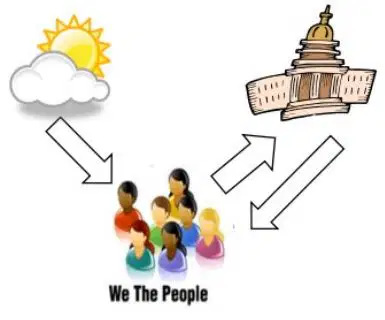
The above diagram is a visual representation of the "Statement of Human Rights" section found in the Declaration of Independence. According to Declaration of Independence, "We the People" are all granted with Unalienable Rights (Life, Liberty, and the Pursuit of Happiness) that no man or government can take away or deny because they are granted at birth by the -
Creator (God)
Federal Government
State Governments
Secretary of Human Rights
According to the Declaration of Independence, the primary function of government is to -
grant rights to only wealthy, landowning, free men.
create laws to protect and not deny natural rights
allow wealthy individuals to purchase certain rights
list out what rights a citizen can exercise on a daily basis

What was the primary reason Parliament passed these acts?
To promote the growth of cottage industries in the colonies
To encourage foreign trade with the colonies
To recover the cost of defending the colonies during the French & Indian War
To fund the establishment of new colonies
What date was the Declaration of Independence signed by the members of the 2nd Continental Congress?
September 17, 1787
January 1, 1865
March 8, 1770
July 4, 1776
According to the terms of the Treaty of Paris, 1783 - what served as the new western border of the United States of America?
Mississippi River
Rocky Mountains
Ohio River
Appalachian Mountains
Which answer choice was NOT a resolution passed by the 1st Continental Congress?
Organize a united protest against England
Organize a united boycott on British imports
Petition King George III to repeal the Intolerable Acts
Train local militia in preparation for war
Ban the exportation of raw materials and cash crops to British factories
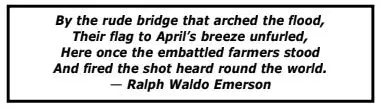
These lines of poetry by Ralph Waldo Emerson refers to the —
Battle at Lexington and Concord
Battle at Saratoga
Winter at Valley Forge
Battle at Yorktown
Which of the following statements best summarizes the winter at Valley Forge? –
Most of the American soldiers deserted the army and returned home due to the harsh conditions.
The Native Americans declared war on the Americans and killed over half of their soldiers.
The leadership of George Washington kept the American soldiers from deserting and helped them survive despite a lack of food, shelter, clothing, medicines, and supplies
The Americans were forced to surrender to the British after running out of food and supplies.
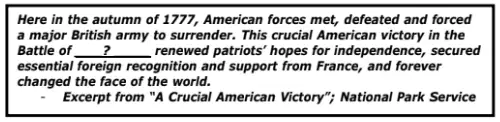
Which of the following battles of the American Revolution does the excerpt above describe? –
Battle of Saratoga
Battle of Trenton
Battle of Lexington & Concord
Battle of Yorktown
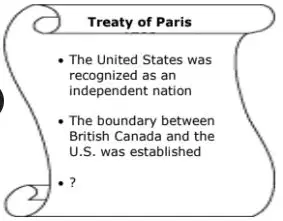
What term of the Treaty of Paris of 1783 is missing from
the scroll to the left? -
The western boundary of the United States would be the
Appalachian Mountains.
The western boundary of the United States would be the
Rocky Mountains.
The western boundary of the United States would be the
Colorado River.
The western boundary of the United States would be the
Mississippi River.
On the morning of April 19, 1775 British General Thomas Gage was commanded to arrest patriot
leaders and seize colonial weapons and ammunition. The British encountered armed colonial militia
resistance, resulting in the first official battles of the American Revolutionary War known as –
Battle of Monmouth
Battles of Lexington and Concord
Battle of Saratoga
Battle of Yorktown

What major era in U.S. History is referred to in the above graphic organizer diagram? —
Exploration and Colonization Era
Early American Republic Era
Revolutionary Era
Industrial Revolution Era
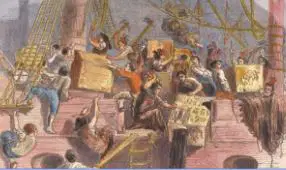
Which colonial patriot leader is responsible for the
organization of the Sons of Liberty who participated in this
act of civil disobedience? –
John Hancock
Samuel Adams
John Adams
Thomas Jefferson
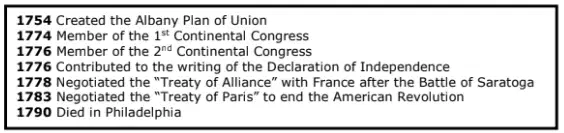
The timeline list featured above describes the life and events of which American patriot? –
George Washington
John Adams
Patrick Henry
Benjamin Franklin

The events that transpired on the night of March 5, 1770 became known as the “Boston Massacre”.
The above image was spread throughout colonial newspapers in the following days. The caskets have the initials of the individuals killed during the “Boston Massacre”. Which colonial individual is known as the first casualties of the “Boston Massacre”? –
Samuel Goodwin
Crispus Attucks
Jacob Green
Stanton Moore
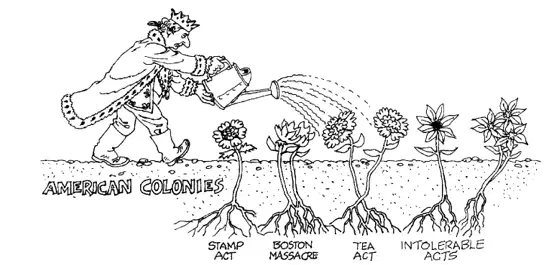
What do the roots of the plants in this political cartoon represent –
Significant events and laws leading to the American Revolution.
Laws passed by the Virginia House of Burgesses and other colonial assemblies.
Loyalists living in Great Britain and Europe.
Northern patriot opposition to the American Revolution.

What member of the Sons of Liberty engraved the image depicting the Boston Massacre?
James Armistead
John Hancock
Paul Revere
George Mason

Which event of the American Revolution best completes the timeline above? –
Stamp Act
First Continental Congress
Boston Tea Party
Battles of Lexington and Concord
General political assembly of British representation responsible for creating and issuing all laws and taxes for Great Britain and its colonies
Parliament
Virginia House of Burgesses
U.S. Congress
Reichstag

