wayground logo

Free Printable Worksheets

Font size

S
M
L
XL
Worksheets

American Revolution Part II Exam Review

Total questions: 130

Worksheet time: 2hrs 52mins
Name
Class
Date
1.
First Battle of the American Revolution 
a)
Saratoga 
b)
Valley Forge 
c)
Lexington and Concord 
d)
Yorktown
2.
OFFICIALLY gives colonists independence 
a)
Declaration of Independence 
b)
Treaty of Paris
c)
Yorktown
d)
2nd Continental Congress 
3.
The French began to support the Americans after this battle
a)
Lexington and Concord
b)
Yorktown
c)
Saratoga
d)
Treaty of French 
4.
Soldiers froze here because of the harsh winter
a)
Paris
b)
Valley Forge
c)
Rio Grande Valley 
d)
Yorktown 
5.
What year does the American Revolution end?
a)
1776
b)
1783
c)
1607
d)
1738
6.
Who was the opponent at Valley Forge?
a)
Winter, starvation, disease
b)
British
c)
French
d)
Indians
7.
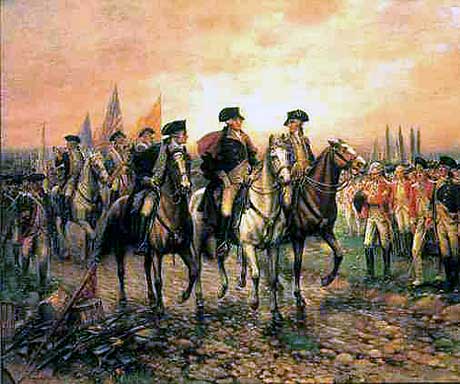
General Cornwallis surrenders to General Washington during this battle 
a)
Yorktown
b)
Lexington and Concord
c)
Saratoga
d)
Bunker Hill
8.
Which battle ended the American revolution?
a)
Battle of Lexington and Concord
b)
Battle of Saratoga
c)
Battle of Yorktown
d)
Battle of Trenton
9.
What was the name of the treaty signed that ended the war?
a)
Treaty of Americans
b)
Treaty of Revolutionary
c)
Treaty of Peace
d)
Treaty of Paris
10.
 Who  was the leader of the Continental Army?
a)
a. Benedict Arnold
b)
b. King George III
c)
c. Paul Revere
d)
d. George Washington
11.
Why was the Battle of Yorktown significant (important)?
a)
It demonstrate how smart the Continental Army was
b)
It showed that Washington could lead his troops well
c)
The last battle of the War of Independence
d)
It was the battle that made King George loose his mind
12.
What was the nickname given to the militia due to their speed in assembling 
a)
Hourmen
b)
Secondmen
c)
Minutemen
d)
Daymen
13.
When Washington crossed the icy Delaware River, where was he planning to attack?
a)
Trenton & Princeton
b)
King's Mountain
c)
Saratoga & Valley Forge
d)
Bunker Hill 
14.

What time did the lexington and concord battle start.

a)

3 am

b)

7 am

c)

5 am

d)

1:05 pm

15.

What were the british called when they were going into battle

a)

british soldiers

b)

regulars

c)

British warriors

d)

random people

16.

how many of the british soldiers died

a)

73

b)

100

c)

53

d)

20

17.

when did the battle start (what day)

a)

April 5th

b)

April 19th

c)

May 6th

d)

Thanksgiving

18.

how long did it last for

a)

65 mins

b)

an hour an a half

c)

2 hours

d)

3 mins

19.

Who won the the battle?

a)

British

b)

America

c)

paris

d)

dog island

20.

How many british was there?

a)

1000

b)

50

c)

700

d)

2000

21.

When did it end?

a)

May 6th 1775

b)

April 19th 1775

c)

June 20th 1775

d)

March 7th 1775

22.

How many American were killed

a)

50

b)

100

c)

29

d)

7

23.

Who was the british lead by

a)

Francis Smith

b)

Bob Roger

c)

George Washington

d)

James Madison

24.

Who won the battle

a)

British

b)

American

25.

All together how many people were killed?

a)

1,000

b)

393

c)

543

d)

2,509

26.

How many people went missing

a)

13

b)

10

c)

20

d)

5

27.

When was it approximately ended?

a)

6

b)

2

c)

7

d)

10

28.

Why did the war started?

a)

Because they wanted Independence

b)

Because they just wanted to have fun

c)

The actually didn't have a reason

d)

The british was doing stuff that they english didn't like.

29.

Who was a Commander for the British

a)

Colonel Smith

b)

King George the 3rd

c)

Benjamin franklin

d)

Thomas Jefferson

30.

What role did Lord perry did for the British.

a)

He was a brave fighter and was always out in the front rows.

b)

Was a general.

c)

He helped British from disaster and led them from the relief column.

d)

He came up the ways that british could have an good victory and so they didn't fail.

31.

Who warned that the British was Coming?

a)

The villagers

b)

Paul Revere

c)

John Peter

d)

John Adams

32.

Who did the citizens of boston respected. During the lexington and concord battle

a)

John Pitcairn

b)

Joe biden

c)

Jake

d)

Petter

33.

What did Barrett do for the British

a)

Help the american win

b)

Guided the british during the town's old north bridge.

c)

Confused the British to think the American was somewhere else

d)

Was just a lead general

34.
Following the battles at Lexington and Concord, where did the Americans surround the British?
a)
New York City
b)
Boston
c)
Philadelphia
35.

Where was the Battle of Bunker Hill fought?

a)

Bunker Hill

b)

Breed's Hill

c)

Boston Hill

d)

Mount Vernon

36.

Who was chosen to lead the first army of the United States?

a)

General Howe

b)

King George III

c)

George Washington

d)

Benjamin Franklin

37.
Who is in charge of the British Army at Bunker Hill?
a)
General William Howe
b)
George Washington
c)
Dr. Ben Franklin
d)
William Prescott
38.

Who took control of the hill during the Battle of Bunker Hill?

a)

The British

b)

Colonists

39.

Why did the colonists back down from the British when they were winning the battle?

a)

The were scared they would lose

b)

George Washington told the colonists to back down.

c)

They were running out of ammunition

40.

Who won the Battle of Bunker Hill?

a)

The British

b)

The colonists

41.

The British commander stated “wait to fire until you see the white in their eyes.

a)

True

b)

False

42.

The Battle of Bunker Hill is near Boston.

a)

True

b)

False

43.

What city did the Continental Congress convene in?

a)

New York City

b)

Boston

c)

Philadelphia

d)

Charleston

44.

What did they mean by "Don't fire til' you see the whites of their eyes?"

a)

Shoot randomly at the enemies eyes

b)

Fire only when they are close enough to hit the mark

c)

Shoot over their heads and at those behind them

d)

Shoot them in the eyes so they can't see

45.

Who died at the Battle of Bunker Hill?

a)

Paul Revere

b)

General Gage

c)

Joseph Warren

d)

Sam Adams

46.

How long did the Battle of Bunker Hill last?

a)

3 hours

b)

3 days

47.

Why was the Battle of Bunker Hill considered a British victory?

a)

The Americans suffered twice as many casualties than the redcoats.

b)

The British captured Sam Adams and John Hancock.

c)

The British pushed the Americans off of the two hills.

d)

The British gained control of the city of Boston.

48.

Why did militia leaders want to build a fort on a hill?

a)

It was easier.

b)

It gave the British an advantage.

c)

It was harder.

d)

It gave the militia an advantage.

49.

Why did the colonists consider the battle a victory?

a)

The colonists won new confidence

b)

They killed a lot of British soldiers

c)

They learned they could fight without George Washington as their leader.

50.

What is a petition?

a)

a paper

b)

a request

c)

talking to someone

51.

Was the Colonist's petition accepted or rejected by the king?

a)

Accepted

b)

Rejected

52.

The British soldiers made __________ attempts to get uphill.

a)

3

b)

4

c)

5

d)

6

53.

Define militia.

a)

Well trained Continental soldiers

b)

Well trained British soldiers

c)

Volunteer British soldiers

d)

Volunteer Patriot soldiers

54.

Define Patriot. Check all that apply.

a)

Someone who believed in the cause for independence

b)

Someone who may choose to fight for the militia

c)

Someone who remained loyal to the King

d)

Someone who fought for the British Army

55.

Which teacher would protect you best in a battle?

a)

Mr. Erenberg

b)

Mr. Bertrand

c)

Mrs. Fetzer

d)

Mrs. Fitzpatrick

e)

Mr. Chapeton

56.

The ______________ was the final attempt by the Continental Congress to avoid war with Great Britain.

a)

Olive Branch Petition

b)

Intolerable Acts

c)

Boycotting of goods

d)

Capture of Fort Ticonderoga

57.

What was the date the Continental Congress adopted the Declaration of Independence?

a)

July 4,1776

b)

August 2, 1776

c)

April 18, 1776

d)

December 16, 1773

58.

Thomas Jefferson borrowed many of his ideas from which Enlightenment Philosopher?

a)

John Locke

b)

Thomas Hobbes

c)

Thomas Paine

d)

John Adams

59.

According to the Declaration of Independence who institutes or creates governments?

a)

The King

b)

The People

c)

The Pope

d)

The President

60.

According to the Declaration of Independence, where does government get its power from?

a)

The King

b)

Religion

c)

The People

d)

The President

61.
To Great Britain, the signing of the Declaration of Independence was
a)
an act of loyalty.
b)
an act of treason.
c)
an act of bravery.
d)
an act of insanity.
62.
Who was the main author of the Declaration of Independence?
a)
Benjamin Franklin
b)
Samuel Adams
c)
Thomas Jefferson
d)
Paul Revere
63.

Which argument most logically follows from Jefferson's expressed ideas in the Declaration of Independence?

a)

The rights of men should be supported over those of women.

b)

Monarchy is a bad form of government because rulers

are not elected.

c)

All forms of government destroy human rights and should be abandoned.

d)

Any form of government that suppresses people's freedoms should be overthrown.

64.

From the Declaration of Independence, what can a reader infer about Jefferson's general attitude toward revolution?

a)

Revolution is a method of last resort.

b)

All cases of injustice justify a revolution.

c)

People often revolt as their first course of action.

d)

Revolution is a very poor way of dealing with conflict.

65.

According to the Declaration of Independence, which of the following statements are among the reasons the colonies determined to break away from British rule? Choose three options.

a)

The majority of Americans were not ethnically or culturally British.

b)

Britain was guilty of many recent abuses of its power in the colonies.

c)

The American and British armies had already clashed on the battlefield.

d)

Britain interfered with the operation of the legislatures in the various colonies.

e)

The British was too weak and undisciplined to effectively protect the colonies.

66.

Which person is the best example of someone who demonstrates tyranny?

a)

a rebel

b)

a dictator

c)

a member

d)

a challenger

67.

Which quotation from the Declaration of Independence best supports the main purpose of a nation's government.

a)

We hold these truths to be self-evident: that all mean are created equal; that they are endowed by their creator with certain unalienable rights, that among these are life, liberty and the pursuit of happiness...

b)

...[To] secure these rights , governments are instituted among men, deriving their just powers from the consent of the governed...

c)

...[G}overnments long established should not be changed for light and transient causes; and accordingly all experience hath show, that mankind are more disposed to suffer, while evils are sufferable,than to right themselves by abolishing the forms to which they are accustomed.

d)

...[A]s free and independent states, they have full power to levy war, conclude peace, contract alliances, establish commerce, and to do all other acts and things which independent states may of right do.

68.

Which of the following is the central idea put forth in the Declaration of Independence?

a)

The American people will fight to the death to protect themselves from attacks by Britain.

b)

The American colonies are justified in rejecting British rule and setting up a new government.

c)

The people of Great Britain should claim their own independence from the rule of the current king.

d)

Americans who support the idea of independence from Great Britain greatly outnumber those who do not.

69.

The Declaration of Independence states that independence has become "necessary" and that Americans "should declare the causes which impel them to the separation." Which of the following statements best expresses the point Jefferson makes with this language?

a)

Jefferson suggest that foreign allies have urged Congress to declare independence.

b)

Jefferson emphasizes that America has been forced into declaring its independence.

c)

Jefferson implies that Britain fully approves of Congress's decision to declare independence.

d)

Jefferson explains that America never considered any action other than declaring independence.

70.
When Thomas Jefferson copied John Locke's ideas about the social contract, what did he say the people had the right to do to a government who was not protecting the people's rights?
a)
Write a letter
b)
Suggest how it could be better
c)
Wait until they started to respect the people's rights
d)
Abolish it
71.
Thomas Jefferson was inspired by a famous man of the Enlightenment.  His name was...?
a)
William Penn
b)
Roger Sherman
c)
John Locke
d)
Robert Livingston
72.
Who was king of great Britain at the time the colonies adopted the declaration of independence?
a)
King George the 2nd
b)
King George the 3rd
c)
King James the 2nd
d)
King James the 3rd
73.
Which of the signers of the Declaration of Independence would later become elected president?
a)
John Adams and John Hancock
b)
John Adams and Thomas Jefferson
c)
Benjamin Franklin and Thomas Jefferson
d)
Thomas Jefferson and James Madison
74.

These people were loyal to the Crown and supported the British cause

a)

Patriots

b)

Loyalists

c)

Neutralists

75.

A colonist who wanted the American colonies to gain independence from Great Britain

a)

Patriot

b)

Loyalist

c)

Neutralist

76.

A document composed by Thomas Jefferson declaring independence from Great Britain

a)

The Constitution

b)

The Declaration of Independence

c)

The Magna Carta

d)

All of the Above

77.

This was a brawl that killed 5 colonists and helped spark the American Revolution

a)

Boston Tea Party

b)

Boston Massacre

c)

Boston Frolic

d)

The French and Indian War

78.

Cliff is a member of the Sons of Liberty and helped with the Boston Tea Party. He is a...

a)

Loyalist

b)

Patriot

c)

Neutralist

79.

Ann sees no reason for war because her family has always been taken care of by the British. She is a...

a)

Patriot

b)

Loyalist

c)

Neutralist

80.

George is friends with both the Patriots and Loyalists because he does business with both. He is a...

a)

Patriot

b)

Loyalist

c)

Neutralist

81.

Michelle is protesting because the British have taxed the everyday goods she purchases. She is a...

a)

Patriot

b)

Loyalist

c)

Neutralist

82.
This is known as the start of the American Revolution. 
a)
Valley Forge
b)
Lexington & Concord
c)
Saratoga
d)
Yorktown
83.
What country would eventually ally with the U.S. by providing soldiers and Naval support?
a)
Spain
b)
France
c)
Portugal
d)
Italy
84.
What is known as the last battle of the American Revolution?
a)
Saratoga
b)
Valley Forge
c)
Yorktown
d)
Lexington & Concord
85.
Under the terms of the Treaty of Paris of 1783, the western border of the United States became the--
a)
Rio Grande
b)
Pacific Ocean
c)
Mississippi River
d)
Appalachian Mountains
86.
What are Unalienable Rights.
a)
Rights given to citizens from other countries
b)
Natural Rights you are born with (God given) and cannot be taken away
87.
What was one of the terms in the Treaty of Paris, 1783.
a)
America received lands west of the Appalachian Mountains
b)
America recognized as an independent nation
88.
What was George Washington's role in the American Revolution
a)
Leader of the Continental Army and successful Military Leader in the Revolution
b)
Philospher and writer of the Revolution
89.
Valley Forge
a)
Was the final major battle of the Revolution
b)
Kept the British from splitting New England from the other colonies
c)
Winter encampment where soldiers suffered from cold, hunger, and disease
d)
Patriots held off the British until they ran out of ammunition
90.
According to the Declaration, what is the main purpose of Gov’t
a)
protect the natural rights of citizens
b)
make treaties with other countries
c)
establish borders 
d)
make sure all people can vote
91.
 Which Enlightenment philosopher had a huge influence on ideas written into the Declaration of Independence?
a)
Voltarie
b)
Rene Descartes
c)
Montesquieu
d)
John Locke
92.
What do the following men have in common
Benardo de Galvez
Haym Salomon
Wentworth Chesswell
Marquis de LaFayette
James Armistead
a)
All were captured and killed at Saratoga
b)
All were spies for the Redcoats
c)
All were Ethnic heroes of the American Revolution
d)
All were spies for the Continental Army
93.
What are your 3 Unalienable Rights, as expressed by Thomas Jefferson?
a)
Peace, Love and Joy
b)
Life, Liberty, and Property
c)
Life, Leadership and Pursuit of Happiness
d)
Life, Liberty and Pursuit of Happiness
94.

Which group is in the chronological correct order?

a)

Yorktown, Valley Forge, Saratoga, Lexington and Concord

b)

Lexington/Concord, Saratoga, Valley Forge, and Yorktown

c)

Lexington/Concord, Valley Forge, Saratoga, and Yorktown

d)

Valley Forge, Yorktown, Lexington/Concord, and Saratoga

95.
Who wrote the Declaration of Independence?
a)
John Adams
b)
George Washington
c)
Thomas Paine
d)
Thomas Jefferson
96.
Where did the Continental Army stay for its winter camp in 1776?
a)
Valley Forge
b)
Princeton
c)
Bunker Hill
d)
Trenton
97.
Who commanded the Continental Army?
a)
Sam Adams
b)
John Hancock
c)
Benedict Arnold
d)
George Washington
98.
What document signaled the official end of the war?
a)
Common Sense
b)
Treaty of Versailles
c)
Treaty of Paris
d)
Rights of Man
99.
"We hold these truths to be self-evident, that all men are created equal... with unalienable rights... life, liberty and the pursuit of happiness." 
Which document includes this quote?"
a)
Articles of Confederation
b)
Constitution of the United States of America
c)
Common Sense
d)
Declaration of Independence
100.
At which battle did Cornwallis surrender? 
a)
Brandywine
b)
Camden
c)
Saratoga
d)
Yorktown
101.
Why was the victory at the Battle of Saratoga so important to the patriot cause?
a)
It allowed the Declaration of Independence to be issued.
b)
It forced the British army to retreat from Boston.
c)
It convinced France to aid the colonies in their fight.
d)
It caused the British government to give up the war.
102.
On December 25th, Washington crossed Delaware River and took advantage of the sleeping Hessians in a surprise attack in a victory for the Continental army.
a)
Battle of Silence Hill
b)
Battle of Trenton
c)
Battle of Saratoga
d)
Battle of Lexington
103.
German soldiers who fought for the British during Revolutionary War
a)
Patriots
b)
Colonists 
c)
Red coats 
d)
Hessians
104.
Which battle is considered the Turning Point of the American Revolution?
a)
Battle of Trenton
b)
Battle of Saratoga
c)
Lexington & Concord
d)
Battle of Bunker Hill
105.
General Cornwallis surrenders to General Washington during this battle 
a)
Yorktown
b)
Lexington and Concord
c)
Saratoga
d)
Bunker Hill
106.
This member of the Continental Congress helped gain French support for American independence.
a)
Thomas Jefferson
b)
Benjamin Franklin
c)
Patrick Henry
d)
John Adams
107.
The role of Thomas Paine during the American Revolution was to 
a)
Serve as a military commander under Washington in the Continental Army
b)
Write persuasive pamphlets to support American independence and troops 
c)
Stop England from attacking and gaining control of Spanish Florida
d)
Spy on British military camps to gather strategic information for Patriots
108.
The unalienable rights are best illustrated by—
a)
the right to a fair and speedy trial.
b)
rights that are guaranteed and cannot be taken away.
c)
right to tax with representation
d)
the right to be secure in your own home
109.
John Paul Jones’ contribution to the American Revolution was to 
a)
lead American patriots in an attack on loyalists.
b)
attack British ships on the open sea. 
c)
 lead the propaganda department.
d)
write moving pamphlets for the cause.
110.
What was the name of the British king during the American Revolution?
a)
Charles III
b)
George III
c)
William III
d)
James III
111.
“We hold these truths to be self-evident, that all men are created equal, that they are endowed by their Creator with certain unalienable Rights, that among these are Life, Liberty and the Pursuit of Happiness.  That to secure these rights, Governments are instituted among Men, deriving their just powers from the consent of the governed.”    
A fundamental truth found in the excerpt above is that all people —
a)
have the right to free speech.
b)
have the right to petition the government.
c)
have equal rights at birth.
d)
have the right to assemble.
112.
John Hancock was one of the Founding Fathers committed to liberty.  How did he demonstrate this commitment?
a)
By writing the Articles of Confederation
b)
By serving as commander and chief of the Continental Army
c)
By organizing Committees of Correspondence
d)
By signing the Declaration of Independence
113.
He said, "I regret that I have but one life to give for my country."
a)
Benedict Arnold
b)
Thomas Paine
c)
Nathan Hale
d)
John Paul Jones
114.
John Paul Jones was also referred to as-
a)
a Loyalist
b)
a coward
c)
a Privateer
d)
a communist
115.
This American naval officer captured the British warship "The Serapis", and became known as the "Father of the American Navy".
a)
Wentworth Cheswell
b)
John Paul Jones
c)
Jean Rochambeau
d)
Charles Cornwallis
116.
What battle showed that the colonists could hold their own against the British even though they lost?
a)
Bunker Hill
b)
Trenton
c)
Yorktown
d)
Saratoga
117.
"Common Sense" was written so that the common man, or the American Colonists, would support the Declaration of Independence. Who was the author?
a)
Thomas Jefferson
b)
Thomas Paine
c)
Patrick Henry
d)
George Washington 
118.
According to the Declaration of Independence, why did American's rebel?
a)
Americans did not believe in the English idea of inalienable rights
b)
Europe had tried to create new colonies in the New World
c)
They believed they had certain rights that England had trampled on
119.
Thomas Jefferson was inspired by a famous man of the Enlightenment.  His name was...?
a)
William Penn
b)
Roger Sherman
c)
John Locke
d)
Robert Livingston
120.
The phrase "No Taxation without Representation" was shouted by colonists who felt what?
a)
They needed a tax collector
b)
That they had no voice in British Parliament
c)
That they wanted their tax check
d)
That Parliament had heard their concerns and responded
121.
We hold these truths to be self-evident, that all men are created equal, that they are endowed by their Creator with certain _______, that among these are Life, Liberty and the pursuit of Happiness. — The Declaration of Independence, July 4, 1776
Which of the following best completes this excerpt?
a)
unalienable rights
b)
equalities of opportunity
c)
duties and responsibilities
d)
repeated injuries and abuses
122.
According to the Declaration of Independence, where does government get its power?
a)
From the King
b)
From the Supreme Court
c)
From God
d)
From the people
123.
The List of Grievances were the part of the Declaration that
a)
detailed the colonists' complaints with King George.
b)
listed a man's natural rights.
c)
introduced the Declaration.
d)
concluded the Declaration, declaring America a free country.
124.
What are our natural rights according to Jefferson?  (He got the idea from John Locke, but he changed the last right.)
a)
Freedom of speech, religion, and press
b)
Life, liberty, and property
c)
Life, liberty, and the pursuit of happiness
d)
Voting, rebelling, and health
125.
My writings helped convince many people to support the Patriots
a)
Wentworth Cheswell
b)
King George III
c)
Crispus Attucks
d)
Mercy Otis Warren
126.
I was a slave, but George Washington trusted me to spy on the British at Yorktown
a)
Bernardo de Galvez
b)
Marquis de Lafayette
c)
James Armistead
d)
John Paul Jones
127.
I was an inventor, writer, printer, diplomat, scientist, humorist, and statesman who helped negotiate the Treaty of Paris
a)
John Adams
b)
Benjamin Franklin
c)
George Washington
d)
Mercy Otis Warren
128.
closing off a port by ships to keep people or supplies from moving in or out
a)
boycott
b)
blockade
c)
repeal
d)
export
129.
What do Valley Forge and Ticonderoga have in common?
a)
They were both in New York
b)
They are both battles in the America Revolution
c)
They are both forts
d)
They both were blockaded by the British
130.
The British blockades were located where?
a)
Atlantic Ocean
b)
Pacific Ocean
c)
North Sea
d)
Gulf of Mexico