wayground logo

Free Printable Worksheets

NEW

Font size

S
M
L
XL
Worksheets

Quarter 1 5th Grade Science

Total questions: 38

Worksheet time: 29mins

Name
Class
Date
1.

Roberto writes down his hypothesis that more salt will dissolve in cold water than in warm water.  He adds salt to different temperatures of water and records his observations including the amount of undissolved salt.  He finds that there is more salt dissolved in warm water than cold water.  What should Rigoberto do next to make sure that his conclusion is valid?

a)
do another investigation with sugar
b)
repeat his investigation using a different liquid than water
c)
repeat his investigation to see if his results are the same
d)
change his results to match his original hypothesis
2.
Which question would be best to answer using a scientific investigation?  
a)
Why are people afraid during thunderstorms?
b)
How easy is it to shovel snow?
c)
Are some clouds prettier than others?
d)
Does temperature affect the amount of rain?
3.
Austin is studying states of matter by heating water in a pan.  Which statement from his notebook is an observation?
a)
It is hard to estimate the size of the bubbles.
b)
Tiny bubbles form on the bottom of the pan.
c)
The bottom of the pan must be very hot.
d)
I think there is air in the bubbles.
4.
How many variables should be changed in a simple experiment?
a)
5
b)
3
c)
1
d)
6
5.
A scientist says that she has made an important discovery about sound waves.  What needs to happen for most other scientists to accept her results?
a)
The scientist has to explain her results to other scientists.
b)
Many scientists need to review the results.
c)
The scientist needs to publish her results in a journals.
d)
Other scientists need to be able to get the same results.
6.
Alejandro wanted to find out which of his friends was the strongest.  He asked each of his friends to come to his lab three different times and lift some weights.  Alejandro wrote down how much weight each person could lift.  How was his investigation different from an experiment?
a)
Alejandro did not test a hypothesis
b)
Alejandro did not make any observations
c)
Alejandro did not repeat his tests.
d)
Alejandro did not collect any data.
7.
A valid scientific investigation must be able to be 
a)
graphed.
b)
predicted.
c)
replicated (which means repeated)
d)
observed.
8.

Delilah followed these steps of an investigation:

• Collect five objects made of different types of metal.

• Place them on a large laboratory table.

• Touch each metal object with a magnet and lift slowly.

• Record observations.

Which of the following statements is Delilah most likely testing?

a)

All types of metals are attracted to magnets.

b)

Each magnet can lift the metal to a specific height.

c)

Larger magnets can pick up heavier objects than smaller magnets can.

d)

Heavier metal objects are more attracted to magnets than lighter metal objects are.

9.

The part of an experiment that doesn't change is a _____.


a)

control

b)

constant

c)

conclusion

10.

Conducting the exact same experiment over and over and over again

a)

replication

b)

repetition

c)

trials

d)

accuracy

11.

When water vapor is cooled and forms droplets-

a)
Condensation
b)
Evaportation
c)
Transpiration
d)
Run-off
12.
When water is heated in the ocean by the sun and turns into water vapor
a)
condensation
b)
evaporation
c)
transpiration
d)
runoff
13.

What is the role of the sun in the water cycle?

a)

provide heat energy for evaporation

b)

provide heat energy for condensation

c)

dry out the soil for runoff to occur

d)

provide thermal energy for accumulation
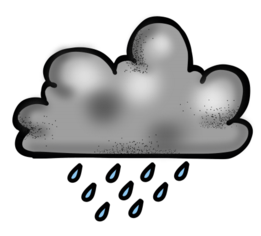
14.
What part of the water cycle does this picture show?
a)
condensation
b)
precipitation
c)
evaporation
15.

If you examine a piece of hail, it might have invisible layers like an onion.  Which answer best explains why this is true?

a)

As hail falls, it picks up layers of dust and dirt from the air.

b)

Hail forms layers because it melts as it falls toward the Earth.

c)

Air pressure increases while the hail falls and it causes ice layers to form.

d)

Hail builds up ice layers as it travels through updrafts in a storm before it falls.

16.
Which stage does the #3 show in the diagram?
a)
condensation
b)
evaporation
c)
precipitation
d)
run off
17.
Where is most water found on Earth?
a)
glaciers
b)
lakes
c)
rivers
d)
oceans
18.

The Sun shining on the surface of a lake can heat up the air just above the water.  What happens if this air gets warmer than the air above it?

a)

The amount of waves on the surface of the lake will increase.

b)

The warm air will evaporate and condense into rain above the lake.

c)

The movement of air will decrease above the lake as the warm air rises.

d)

The warmer air will rise and increase the movement of air across the lake.

19.

Which type of cloud is most often visible during fair weather?

a)

nimbostratus

b)

cirrus

c)

cumulonimbus

d)

stratus

20.

Which type of cloud is most often associated with days of light, continual rain?

a)

cirrus

b)

stratus

c)

cumulus

d)

cumulonimbus

21.

Which type of instrument is used to determine the amount of precipitation for an area?

a)

rain gauge

b)

barometer

c)

thermometer

d)

wind vane

22.
These clouds are puffy and white and sometimes appear to have a flat bottom.
a)
cumulus
b)
cumulonimbus
c)
cirrus
d)
stratus
23.
a)
Low Clouds
b)
Low Temperatures
c)
Light Wind
d)
Low Air Pressure
24.
a)
Warm Front
b)
High Air Pressure
c)
Cold Front
d)
High Temperatures
25.
a)
High Air Pressure
b)
High Temperatures
c)
Heavy Rain
d)
Hail
26.
a)
High Pressure
b)
Warm Front
c)
Cold Front
d)
Mountains
27.
High Pressure is associated with this type of weather...
a)
Cloudy/Overcast Weather
b)
Cold Weather
c)
Warm Weather
d)
Fair Weather
28.
Low Pressure is associated with this type of weather...
a)
Cloudy/Overcast Weather
b)
Cold Weather
c)
Warm Weather
d)
Fair Weather
29.
A cold front moving into an area can bring this type of weather...
a)
Warmer Temperatures, Clear Skies
b)
Colder Temperatures, Clear Skies
c)
Warmer Temperatures, Clouds
d)
Colder Temperatures, Clouds, and Precipitation
30.
A warm front moving into an area can bring this type of weather...
a)
Warmer Temperatures, Clear Skies
b)
Colder Temperatures, Clear Skies
c)
Warmer Temperatures, Clouds, and steady precipitation
d)
Colder Temperatures, Clouds, and Precipitation
31.
Which weather tool measures air pressure?
a)
thermometer
b)
barometer
c)
anemometer
d)
psychrometer
32.

Which answer choice lists the weather conditions that would most likely result in snow?

a)

Warm temperature, light winds, low humidity

b)

Low humidity, freezing temperature, light clouds

c)

Freezing temperature, light clouds, heavy winds

d)

Freezing temperature, heavy clouds, high humidity

33.

The climate zone that is between the Tropic of cancer and the Tropic of Capricorn

a)

Tropical zone

b)

Polar zone

c)

Temperate Zone

34.

The earth is colder where it is --------- from the sun.

a)

nearest

b)

farthest

35.

Which climate zone experiences the greatest variety of weather with the seasons of the year?

a)

polar

b)

temperate

c)

tropical

d)

tundra

36.

What is climate?

a)

the condition of the atmosphere at any given time and place

b)

cloud cover and temperature

c)

precipitation and humidity at a given time and place

d)

weather conditions in an area over a long period of time

37.

Climate is affected by many factors including:

a)

latitude, elevation, and closeness to bodies of water

b)

tides and currents

c)

wind

d)

snow and sleet

38.
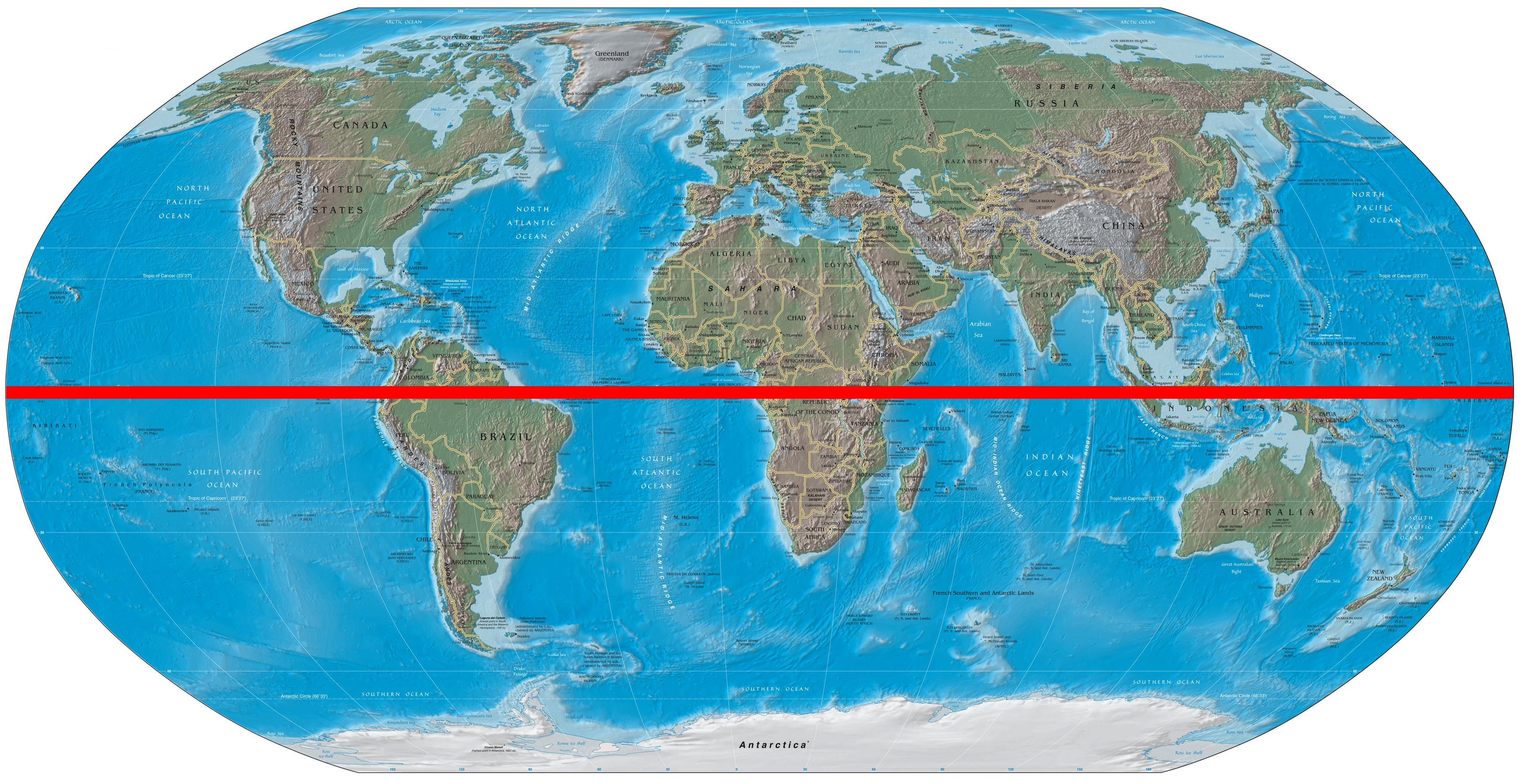
What is the name of this line at 0 degrees latitude?
a)
Prime Meridian
b)
Equator
c)
North Pole
d)
South Pole