

wayground logo

Free Printable Worksheets

Font size

S
M
L
XL
Worksheets

Unit Test Review: Eco Succession/Diversity of Life

Total questions: 32

Worksheet time: 1hrs 5mins
Name
Class
Date
1.
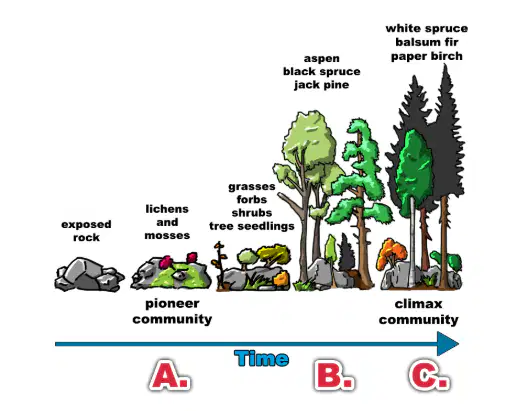
Ecosystem stability can be a factor of species diversity within a community. Which letter above would indicate the stage of success in an ecosystem that represents the greatest potential for stability and resilience?
a)
Letter A because light levels are high and will promote the greatest growth of primary producers.
b)
Letter B because aspen, spruce, and pines can provide the most opportunity for primary consumers to hide from their predator species.
c)
Letter C because the emergence of a mature forest will resist changes to the ecosystem with the greatest success.
d)
All letters represent equal opportunity for stability as the area of land does not change over time.
2.
True or False: All ecosystem that undergo an ecological succession will reach the climax community.
a)
True
b)
False
3.
Weeds growing in a recently burned patch of forest represent the first stage in -?-.
a)
biological magnification.
b)
secondary colonization.
c)
secondary succession.
d)
primary succession.
4.
Which describes an example of ecological succession?
a)
A meadow replacing a pond in its flood plain.
b)
The replacement of a native species of animal with an invasive species.
c)
A caterpillar developing into a butterfly.
d)
A climate gradually changing over many years and becoming colder.
5.

In an ecosystem, there are populations of moose, rabbits, grass, and pine trees. Suddenly, a fire blazes through the area, which kills all of the populations. As the months go on, new species of grass begin to take root. This attracts animals, and eventually the ecosystem is restored.


What type of ecological succession happened?

a)

Primary succession

b)

Secondary succession

c)

Tertiary succession

d)

None of the above

6.

Natural disturbances, such as fires or hurricanes, can result in

a)

A.parasitism.

b)

B.competition.

c)

C.commensalism.

d)

D.succession.

7.

Which of the following is something that can create new land?

a)

Snow

b)

Rain

c)

Volcanic Eruption

d)

Wind

8.

The first species to populate an area after a disturbance is called:

a)

A pioneer species

b)

A pilgrim species

c)

A founder species

d)

A primary species

9.

What is a climax community? Select 2

a)

The final community in an ecosystem

b)

The first species to appear after a forest fire

c)

Moss and lichen

d)

Tall hardwood trees

10.
Lichens are important to the creation of an ecosystem due to the fact that they create soil by
a)
becoming tall
b)
collecting water
c)
reproducing asexually
d)
weather rock
11.

During secondary succession, which of these best describes why decomposing pioneer plants give way to larger, more complex plant species, such as hardwood trees?

a)

Increased amounts of sunlight are able to reach the ground while the pioneer species are decomposing

b)

Increased soil temperatures from decomposing pioneer species help tree seeds germinate more quickly

c)

Increased amounts of decomposing pioneer species remove nutrients that tree seedlings need to grow and mature

d)

Increased amounts of soil from decomposing pioneer species allow plants with more extensive root systems to become established

12.

The final stable community in an ecosystem at the end of succession is called the _____________.

a)

pioneer species

b)

climax community

c)

primary population

d)

carrying capacity

13.

What is the main difference between primary and secondary ecological succession?

a)

Primary begins without soil; Secondary begins with soil.

b)

Both primary and secondary follow a natural disaster.

c)

Primary builds plant community; secondary builds animal community.

d)

Primary begins with soil; Secondary begins without soil.

14.

Discuss the role of decomposers in the nutrient cycle of an ecosystem.

a)

Decomposers produce energy for primary consumers.

b)

Decomposers break down dead organic matter, returning nutrients to the soil.

c)

Decomposers are primary producers in the ecosystem.

d)

Decomposers compete with primary consumers for food.

15.

Which of the following processes is most likely to occur after a volcanic eruption creates a new land surface?

a)

Primary succession

b)

Secondary succession

c)

Climax community formation

d)

Soil erosion

16.

What role do lichens play in primary succession?

a)

They provide shade for other plants.

b)

They break down rocks to form soil.

c)

They compete with pioneer species.

d)

They increase soil fertility by fixing nitrogen.

17.
A paramecium is a single celled organism with a nucleus that consumes other organisms for energy. The offspring are genetically different from its parents.
a)
Prokaryotic
b)
Eukaryotic
18.
Which of the following terms means "a cell that does not have a nucleus"?
a)
Prokaryotic
b)
Eukaryotic
c)
Protista
d)
Archaea
19.
Which of the following determines if an organism is eukaryotic?
a)
having identical offspring
b)
producing their own food
c)
having a nucleus
d)
number of cells
20.
Which of the following describes a heterotrophic organism?
a)
Consumes food
b)
Creates food
c)
Identical offspring
d)
Diverse offspring
21.
Bacteria, mold, humans, oak trees, and amoebas have the following characteristic in common:
a)
They are all eukaryotes
b)
They are all heterotrophs
c)
They are all composed of one or more cells
d)
They all are unicellular
22.
If an organism is a eukaryotic, multicellular heterotroph, it would most likely be classified in Kingdom _____.
a)
Protista
b)
Plantae
c)
Animalia
d)
Bacteria
23.
Green algae, ferns, and pine trees are classified in the plant kingdom. These organisms share certain characteristics. Which of the following is a characteristic used to classify these organisms as plants?
a)
They engage in photosynthesis.
b)
They have an immune system.
c)
They can be found in many different regions on Earth.
d)
They produce flowers.
24.
How many Kingdoms are organisms classified into?
a)
4
b)
6
c)
8
d)
10
25.
The Plantae Kingdom can produce their own food as result of which structure that only they and some bacteria possess.
a)
Photosynthesis
b)
Metabolism
c)
Chloroplasts
d)
Synthesis
26.
The Animalia Kingdom differs from the Plantae kingdom in that animals have cell walls and plants do not. 
a)
TRUE
b)
FALSE
27.
Penguins are a multicellular, eukaryotic organisms that consumes fish for energy. 
Which for the following organisms would belong in the same Kingdom as a penguin?
a)
Worm
b)
Algae
c)
Mushroom
d)
Paramecium
28.
A mushroom is composed of many cells that have a nucleus
In which domain does a mushroom belong?
a)
Archaea
b)
Eukarya
c)
Bacteria
29.
Which of the following is autotrophic?
a)
 a tree
b)
a bird
c)
a worm
d)
a mushroom
30.
In which of the following domains would a lion cub belong?
a)
Protista
b)
Animalia
c)
Eukarya
d)
Archaea
31.
All organisms can be classified into..
a)
3 kingdoms and 6 domains
b)
3 domains and 6 kingdoms
32.
 You would find mushrooms in which kingdom?
a)
Plantae
b)
Protists
c)
Fungi
d)
Animalia
