
 Worksheets
Nuclear Decay
Total questions: 49
Worksheet time: 1hrs 24mins
After the nucleus of a radioactive element undergoes changes, the element can transform into ...
(a) a different isotope of the same element.
(b) an entirely different element.
Both (a) and (b)
Neither (a) nor (b)
Alpha particles.....
a) are positively charged.
b) consist of two protons and four neutrons.
c) can penetrate any thickness of matter
d) All of the above
The process of nuclear change in an atom of radioactive material is called...
nuclear decay
nuclear mass
isotopes
radon
During beta decay, a nucleus ....
gives up two protons and two neutrons.
maintains the same number of protons and neutrons.
loses a proton and gains a neutron.
gains a proton and loses a neutron.
When a nucleus undergoes nuclear decay by gamma rays, the atomic number of the element....
remains the same
decreases by one.
increases by one.
increases by two.
The process of the production of lighter nuclei from heavier nuclei is called
mass energy
magneticism
fusion
fission
Radioactive materials have unstable...
electrons
protons
nuclei
neutrons
The most penetrating type of radiation is the ____.
alpha particle
gamma ray
beta particle
uranium
A helium nucleus with two protons and two neutrons is called a(n) ____.
alpha particle
electroscope
beta particle
gamma ray
Negatively charged particles emitted from a nucleus at a high speed are ____.
alpha particle
gamma rays
beta particles
X rays
The three types of nuclear radiation in increasing order of penetrating power are ____.
alpha, beta, gamma
X ray, beta, gamma
alpha, gamma, beta
X ray, gamma, beta
For which of the following problems would a scientist most likely use carbon-14?
to calculate the age of the Earth's oldest rocks
to calculate the age of a piece of bone
to identify the elements that make up a rock
to identify the elements that make up a bone
Which force holds protons and neutrons together in the atom nucleus?
electric force
gravity
strong nuclear force
weak nuclear force
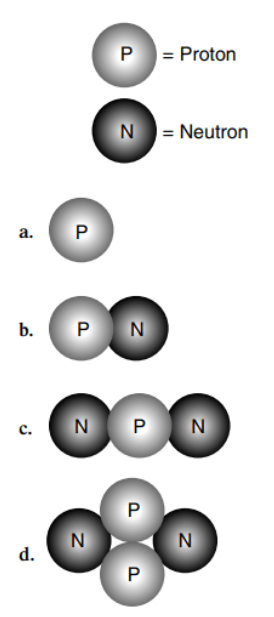
Which of these is an alpha particle?
A
B
C
D
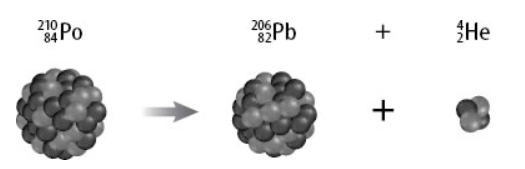
What type of nuclear decay is represented in this illustration?
beta decay
gamma radiation
alpha decay
nuclear fusion
Which happens in a nucleus during gamma decay?
The number of protons increases.
The number of neutrons increases.
The number of protons remains the same.
The total number of neutrons plus neutrons decreases.
Gamma rays _________.
have no mass and no charge
have mass but no charge
have no mass but have charge
have mass and charge
Protons do not repel each other in the nucleus because of the ______.
weak force
electric force
strong force
gravitational force
How does the alpha decay of a nucleus cause the nucleus to change?
Only the number of protons decreases.
Only the number of neutrons decreases.
The number of neutrons and the number of protons decrease.
The number of protons increases and the number of neutrons decreases.
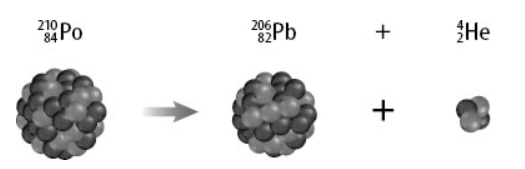
Which of these is a true statement about the products of the decay compared to polonium-210?
The charges are equal but the mass numbers are not equal.
The mass numbers are equal but the charges are not equal.
The mass numbers and charges are equal.
Neither the mass numbers nor the charges are equal.
What type of nuclear decay is shown here
13756Ba →→ 13756Ba + γ rays
alpha
beta
gamma
Finish this equation
20983Bi--> _______ + 20581Tl
42He
0-1e
y
Identify the type of nuclear decay shown here
21483Bi → 0-1e + 21484Po
alpha
beta
gamma
Identify the type of nuclear decay shown here
21483Bi → 0-1e + 21484Po
alpha
beta
gamma
finish the equation
22688Ra --> ____ + 22688Ra
42He
0-1e
y
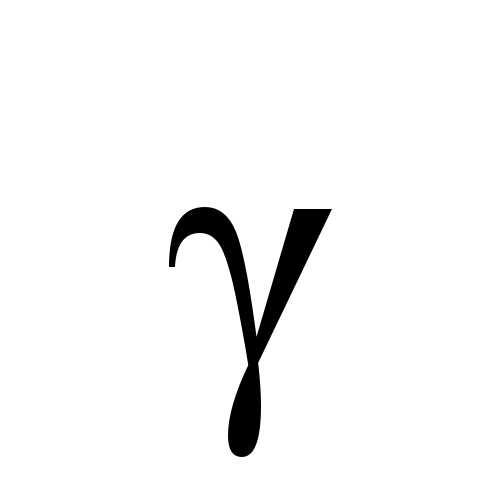
Has the symbol
Alpha
Beta
Gamma
electron
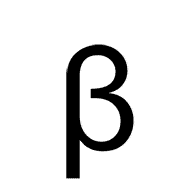
Has the symbol
Alpha
Beta
Gamma
neutron
If we start off with element 5024X after an alpha decay we get another element Y that looks like
5022Y
4622Y
4820Y
5426Y
The splitting of a nucleus into smaller nuclei is
fusion
fission
decay
gamma radiation
This happens naturally due to an unstable nucleus.
fission
fusion
radioactive decay
K-capture

This is an example of...
Chain reaction
Fusion reaction
Decomposition reaction
Decay
Where does fusion occur naturally?
Underwater
All around us
In the radioactive waste
On the sun
Which of the following is true about nuclear fusion?
It is easy to implement.
It produces less energy than nuclear fission.
It produces more energy than nuclear fission.
It has the ability to occur easily in everyday life.
Takes two small nuclei and combines them into a larger nucleus
fission
fusion
In which process does a heavy nucleus split into two lighter nuclei?
freezing
condensation
fission
fusion
What occurs in both fusion and fission reactions?
Small amounts of energy are converted into large amounts of matter.
Small amounts of matter are converted into large amounts of energy.
Heavy nuclei are split into lighter nuclei.
Light nuclei are combined into heavier nuclei.
Which phrase describes a risk associated with producing energy in a nuclear power plant?
depletion of atmospheric hydrogen
depletion of atmospheric carbon dioxide
production of wastes needing long-term storage
production of wastes that cool surrounding water supplies
Which reaction represents fusion?




Which reaction represents fusion?
Which reaction represents fission?




The product of nuclear fission includes
neutrons and electrons
several nuclei and neutrons
several nuclei and electrons
several nuclei and protons
Which of the following is true about nuclear fission?
The mass of the product is greater than the mass of the original nucleus
The mass of the product is less than that of the original nucleus
The mass of the product is the same as the mass of the original nucleus
The mass of the product is 100 times greater than the original nucleus

The nuclear equation shown models which nuclear process?
fusion
fission
beta decay
gamma emission

What nuclear process is shown in the picture?
alpha decay
gamma emission
fusion
fission

Which nuclear process if shown in the picture?
alpha decay
beta decay
fusion
fission
What is a benefit of nuclear fission?
The ability to absorb energy
The ability to release tremendous amounts of energy
The ability to produce more energy than nuclear fusion
There are no beneficial aspects of nuclear fission
One disadvantage of nuclear energy produced through fission is ___.
it is a fossil fuel
it leaves behind radioactive waste
it emits large amounts of pollution into the atmosphere
there are no disadvantages
Which of the following is NOT an example of nuclear fission?
nuclear power plants
the sun
atomic bombs

The nuclear equation shown models which nuclear process?
fission
fusion
alpha decay
beta decay

