
Font size
 Worksheets
CA1 Review of all Concepts
Total questions: 56
Worksheet time: 56mins
Using a calculator and the formula, D=M/V, what is the density of a cube that has a mass of 25 grams and a volume of 125 cm³?
5.0 g/cm³
0.2 g/cm³
625 g/cm³
Using a calculator and the formula, M=DV, sulfur is a nonmetallic mineral that has a density of 2 g/cm³. The volume of a sample of sulfur was measured to be 5.0 cm³. What is the mass of the sample?
2.5 g
0.4 g
10 g
Using a calculator and the formula, D=M/V, a block of wood has a volume of 45 cm³ and a mass of 180 grams, what is the density of the wood?
4 g/cm³
0.25 g/cm³
3600 g/cm³
Using a calculator and the formula, M=DV, what is the mass of the ethanol that exactly fills a 200.0 ml container? The density of ethanol is 0.8 g/ml.
250 g
0.004 g
160 g
Using a calculator and the formula, V=M/D, what volume of silver will weigh exactly 2500.0 g? The density of silver is 10.5 g/cm³.
26250 cm³
238.1 cm³
0.0042 cm³
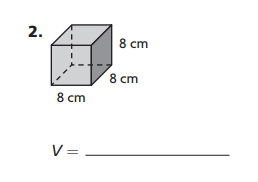
What is the Volume of the Cube shown?
64 cm3
24 cm3
512 cm3
48 cm3

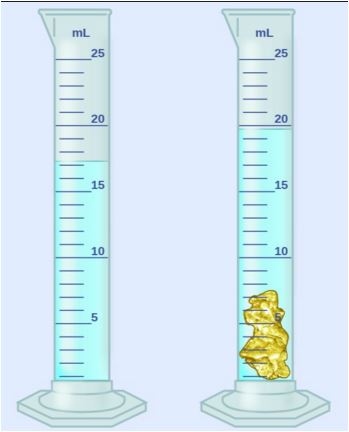
What is the Volume of the Cube shown?
125 cm3
30 cm3
15 cm3
125 cm2


Subatomic particles with a negative charge
Electrons
Neutrons
Protons
Quarks


How many protons does indium have?
49
66
114
115

What is the atomic mass of barium
56
82
137
138

How many neutrons does platinum have?
78
117
195
196


How many valence (outside) electrons are there in this atom?
5
4
6
2
What is a valence electron?
The nucleus
The innermost electrons
The outermost electrons
The ions
An element has a mass of 7 and an atomic number of 3 is...
Hydrogen
Helium
Boron
Lithium

What is the atomic number for this element?
14
14.007
7
9
How many neutrons for this element?
Mass number is 20, protons 10
21
11
10
8
An element with an atomic mass of 28 is...
Carbon
Oxygen
Silicon
Nickel
An element has 2 protons, 2 neutrons, and 2 electrons. What is the overall charge?
0
1
-1
At atom has 18 neutrons, 17 protons and 17 electrons. What is the overall charge?
1
0
-1

What is the atomic number?
5
4
3
2

How many valence electrons are in this element?
7
6
5
2

How many valence electrons does this element have?
3
4
2
1
The vertical (up and down) columns in the Periodic Table are called
groups
towers
periods
atomic numbers

Draw the Bohr model for an element that has 10 Electrons
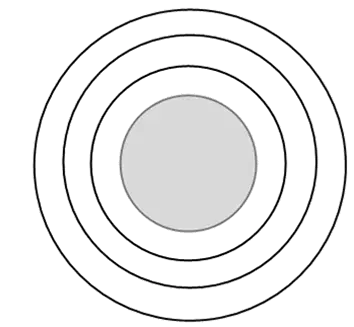
Draw the Bohr model for an element that has 4 Electrons
Neon is colorless, a poor conductor of heat and is not able to be stretched. How would it be classified?
Nonmetal
Metalloid
Metal
None of the above
Manganese is shiny, conducts heat and electricity, and can be hammered into thin sheets. What is is?
Nonmetal
Metal
Metalloid
None of the above
This word is used to describe a substance that breaks apart easily and is weak and fragile
Conductivity
Ductile
Malleable
Brittle
Use your Periodic Table to help you. Boron would be classified as a...
Metal
Nonmetal
Metalloid

I have properties of both metals and nonmetals.
metals
nonmetals
metalloids
Conductivity
how an object reflects light
can be hammered into a shape
transfers heat and/or electricity
Group 1, Row 1
H
He
Ag
Sb
Group 7, Row 5
Tc
Sb
S
He
Use your Periodic Table & Match the following elements to their symbols.
Hydrogen
H
Helium
He
Iron
Fe
Sodium
Na
Potassium
K
Group 13, Period 6
Ti
Ga
S
P
If you are in Group 18 you have how many Valence Electrons?
5
6
7
8
Energy Level of Period 3
1
12
3

