
 Worksheets
8.2.4&5 Waves & Wave Behavior - Long
Total questions: 55
Worksheet time: 29mins
Water waves and light waves are both examples of ___
Longitudinal Wave
Transverse Wave
Frequency wave
Sound Wave
As the wavelength increases, the frequency ____
increases
decreases
remain same
none of the above
The highest point of the transverse wave is called _____
trough
amplitude
crest
wavelength
The lowest point on the transverse wave is called_______
trough
crest
wavelength
frequency

This is the distance from the equilibrium position to the crest or to the trough.
crest
trough
wavelength
amplitude
In a transverse wave, particles vibrate perpendicular to the direction that the wave is traveling.
True
False
none of the above
What do all waves transmit?
energy
matter
frequency
water

The wavelength can be measured from ...
(check all that apply)
crest to crest
crest to trough
trough to crest
trough to trough

What part of the transverse wave is letter A?
trough
crest
wavelength
amplitude

What part of the transverse wave is letter B?
wavelength
amplitude
crest
trough

What part of the transverse wave is letter C?
wavelength
crest
trough
amplitude

What part of the transverse wave is letter D?
trough
wavelength
crest
amplitude
The matter through which waves travel is called a ...
amplitude
wavelength
medium
crest
___________ refers to the number of waves that pass a point in a certain amount of time.
Frequency
Crests
Amplitude
Rarefaction
Waves are movements of _____________?
energy
transverse
longitudinal
money
A disturbance that travels through a medium as a longitudinal wave.

True or False: Sound travels better through solids than through liquids.
A part in a longitudinal wave where the particles are spread apart.
A wave that requires a medium through which to travel.
If you want to change the pitch of a sound, you have to change the ...

How many wavelengths are in the transverse wave?
2.5
7
3
3.5
When our ears pick up sounds, our ears are really sensing...
Transverse waves
Echoes in time and space
Vibrations
Photons
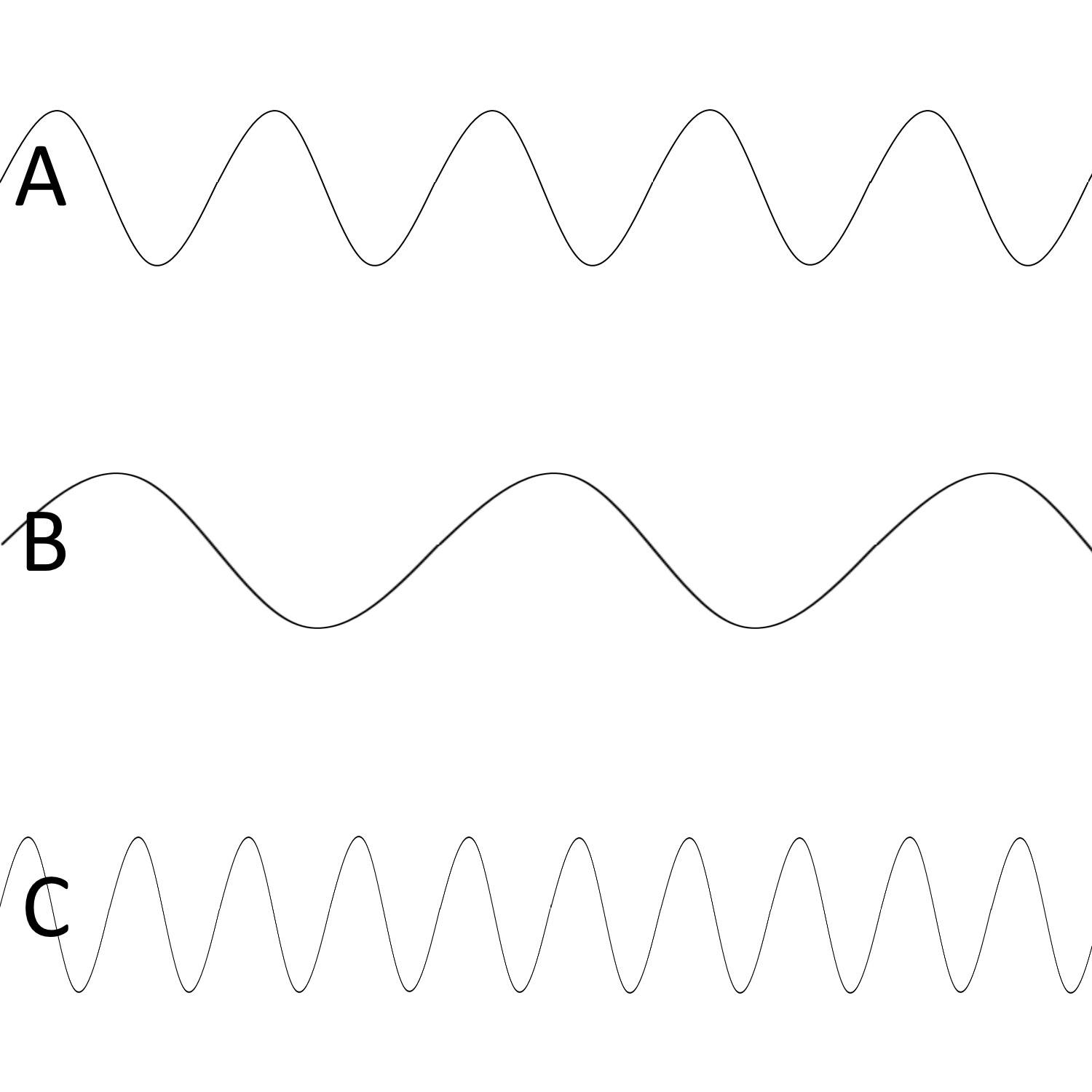

Which image represents a longitudinal wave?
A
B
What is the definition reflection?
The bending of waves as they enter a new medium
Bouncing back of waves from a surface that it can’t pass through
The bending of waves as they pass through openings or around corners
When two interfering waves have a displacement in the same direction, two crests and two troughs overlap. Increased amplitude.
What is the definition of Refraction?
The bending of waves as they enter a new medium
When two interfering waves have a displacement in the opposite direction, crest and trough overlap. Zero amplitude.
When two interfering waves have a displacement in the same direction, two crests and two troughs overlap. Increased amplitude.


Refraction occurs when ...
When a sound wave experiences reflection, we hear ...


How many wavelengths are in this wave?
1
1 & 2/3
2
3 & 2/3

How many wavelengths are in the longitudinal wave?
4
1
2
3.5
When a wave strikes an object and bounces off.
Which of the following CAN be a medium? Select all that apply.
Table
Vacuum
Flag
Slinky
Air
Light waves and sound waves are similar in that...
They are both longitudinal waves
They are both transverse waves
They both transmit energy
They both can travel through space.


We can see through jellyfish because...
light waves are striking the jellyfish and bouncing off of it.
light waves are striking the jellyfish and going into it without passing all the way way through.
light waves are striking the jellyfish and going all the way through it.
light waves are striking the jellyfish and being bent.
Which of the following CANNOT be a medium? Select all that apply.
Table
Vacuum
Flag
Slinky
Air
Which of the following happens when you increase the amplitude of a sound wave? Select ALL that apply.
The energy increases
It travels better
It becomes louder
The pitch changes
What can light waves travel through that sound waves cannot? Select all that apply.
Empty Space
A vacuum
Air
Planets

How many wavelengths are in this wave?
3
1
2.5
6

