
 Worksheets
KAPIHAN
Total questions: 250
Worksheet time: 2hrs 8mins
1. Find the work possess for a helium gas at 20°C.
A. 609 kJ/kg
B. 168 kJ/kg
C. 229 kJ/kg
D. 339 kJ/kg
2. Two kilogram of gas is confined in a 1 m3 tank at 200 kPa and 88°C. What type of gas is in the tank?
A. Helium
B. Ethane
C. Methane
D. Ethene
3. Find the enthalpy of Helium if its internal energy is 200 kJ/kg.
A. 144 kJ/kg
B. 223.42 kJ/kg
C. 333.42 kJ/kg
D. 168 kJ/kg
4. Compute the mass of a 2 m3 propane at 280 kPa and 40°C
A. 6.47 kg
B. 5.1 kg
C. 10.20 kg
D. 9.47 kg
5. Compute the air flow in ft3 /min of mechanical ventilation required to exhaust an accumulation of refrigerant due to leaks of the system capable of revolving air from the machinery for a mass of 4 lbs refrigerant.
A. 200
B. 210
C. 220
D. 230
6. Compute the free aperture cross section in m3 for the ventilation of a machinery room if the mass of refrigerant is 9 kg.
A. 0.314
B. 0.414
C. 0.514
D. 0.614
7. A 29.53” x 39.37” pressure vessel contains ammonia with f = 0.041. Compute the minimum required discharge capacity of the relief device in kg/hr.
A. 106.71 kg/hr
B. 108.71 kg/hr
C. 110.71 kg/hr
D. 112.71 kg/hr
8. Compute the maximum length of the discharge pipe installed on an outlet of a pressure-relief device in feet for internal pipe diameter of 0.5 inch and rated discharge capacity is 8 lb/min of air. The rated pressure of relief valve is 10 psig.
A. 0.286 ft
B. 0.386 ft
C. 0.486 ft
D. 0.586 ft
9. A thermal power plant has the heat rate of 11,363 Btu/kW-hr. Find the thermal efficiency of the plant.
A. 28%
B. 30%
C. 34%
D. 40%
10. What is the hydraulic gradient of a 1 mile, 17 inches inside diameter pipe when 3300 gal/min of water flow with f = 0.03?
A. 0.00714
B. 0.00614
C. 0.00234
D. 0.00187
11. Find the loss of head in the pipe entrance if speed of flow is 10 m/s.
A. 5.10 m
B. 10.2 m
C. 17.4 m
D. 2.55 m
12. Wet material, containing 220% moisture (dry basis), is to be dried at a rate of 1.5 kg/s in a continuous dryer to give a product containing 10% (dry basis). Find the moisture removed in kg/hr.
A. 3543.75 kg/hr
B. 3513.75 kg/hr
C. 3563.75 kg/hr
D. 3593.75 kg/hr
13. Copra enters a dryer containing 70% moisture and leaves 7% moisture. Find the moisture removed on each pound of solid in the final product.
A. 6.258 lbs
B. 1.258 lbs
C. 4.258 lbs
D. 2.258 lbs
14. A 1 m x 1.5 m cylindrical tank is full of oil with SG = 0.92. Find the force acting at the bottom of the tank in dynes.
A. 106.33 x 10³ dynes
B. 106.33 x 10⁴ dynes
C. 106.33 x 10⁵ dynes
D. 106.33 x 10⁶ dynes
15. Find the pressure at the 100 fathom depth of water in kPa.
A. 1,793.96 kPa
B. 1,893.96 kPa
C. 1,993.96 kPa
D. 1,693.96 kPa
16. Find the depth in furlong of the ocean (SG = 1.03) if the pressure at the sea bed is 2,032.56 kPa.
A. 1
B. 2
C. 3
D. 4
17. Find the mass of 10 quartz of water.
A. 10.46 kg
B. 9.46 kg
C. 11.46 kg
D. 8.46 kg
18. Find the mass of carbon dioxide having a pressure of 20 psia at 200°F with 10 ft3 volume.
A. 1.04 lbs
B. 1.14 lbs
C. 1.24 lbs
D. 1.34 lbs
19. Find the heat needed to raise the temperature of water from 30°C to 100°C with 60% quality. Consider an atmospheric pressure of 101.325 kPa. Use the approximate enthalpy formula of liquid.
A. 293.09 kJ/kg
B. 1,772.90 kJ/kg
C. 1,547.90 kJ/kg
D. 1,647.29 kJ/kg
20. Find the enthalpy of water at 212°F and 14.7 psi if the dryness factor is 30%. Use the approximate enthalpy formula of liquid.
A. 461 Btu/lb
B. 471 Btu/lb
C. 481 Btu/lb
D. 491 Btu/lb
21. An air compressor consumed 1200 kW-hr per day of energy. The electric motor driving the compressor has an efficiency of 80%. If indicated power of compressor is 34 kW, find the mechanical efficiency of the compressor.
A. 117.65%
B. 75%
C. 85%
D. 90%
22. A refrigeration system consumed 28,800 kW-hr per month of energy. There is 20% of energy lost due to the cooling system of the compressor and the motor efficiency is 90%. If the COP of the system is 6, find the mechanical efficiency of the compressor.
A. 43.15 TR
B. 46.15 TR
C. 49.15 TR
D. 41.15 TR
23. A 23 ton refrigeration system has a heat rejected of 100 kW. Find the energy efficiency ratio of the system.
A. 13.42
B. 14.42
C. 15.42
D. 16.42
24. A 200 mm x 250 mm, 8-cylinder, 4-stroke diesel engine has a brake power of 150 kW. The mechanical efficiency is 80%. If two of the cylinders were accidentally cut off, what will be the new friction power?
A. 31.50 kW
B. 33.50 kW
C. 35.50 kW
D. 37.50 kW
25. If the energy efficiency ratio of the refrigeration system is 12.6, what is the COP of the system?
A. 3.69
B. 4.23
C. 5.92
D. 6.83
26. An air compressor has a power of 40 kW at 4% clearance. If the clearance will increase to 7%, what is the new power?
A. 70 kW
B. 40 kW
C. 53 kW
D. 60 kW
27. What is the approximate value of temperature of water having enthalpy of 208 Btu/lb?
A. 138.67°C
B. 115.55°C
C. 258.67°C
D. 68.67°C
28. Convert 750°R to K.
A. 390.33 K
B. 395.33 K
C. 410.33 K
D. 416.33 K
29. An Otto cycle has a compression ratio of 8. Find the pressure during compression.
A. 18.38
B. 16.38
C. 14.38
D. 12.28
30. A diesel cycle has a cut off ratio of 2.5 and expansion ratio of 4. Find the clearance of the cycle.
A. 9.11%
B. 5.55%
C. 11.11%
D. 15.15%
31. A dual cycle has an initial temperature of 30°C. The compression ratio is 6 and the heat addition at constant volume process is 600 kJ/kg. If the cut-off ratio is 2.5, find the maximum temperature of the cycle.
A. 3638.50°C
B. 3365.50°C
C. 3565.50°C
D. 3965.50°C
32. A 3-stage air compressor compresses air from 100 kPa to 1000 kPa. Find the intercooler pressure between the 1st and 2nd stage.
A. 505.44 kPa
B. 108.44 kPa
C. 316.23 kPa
D. 215.44 kPa
33. A 10-stage air compressor compresses air from 100 kPa to 800 kPa. Find the intercooler pressure between the 1st and 2nd stage.
A. 282.84 kPa
B. 113.21 kPa
C. 123.11 kPa
D. 333.51 kPa
34. A 3-stage air compressor compresses air from 100 kPa to 700 kPa. Find the intercooler pressure between the 2nd and 3rd stage.
A. 365.88 kPa
B. 375.88 kPa
C. 385.88 kPa
D. 395.88 kPa
35. Carnot cycle A, B and C are connected in series so that the heat rejected from A will be the heat added to B. and heat rejected from B will be added to C. Each cycle operates between 30°C and 400°C. If heat added to A is 1000 kW, find the work output of C.
A. 111.44 kW
B. 549.78 kW
C. 247.53 kW
D. 141.89 kW
36. Air compressed adiabatically from 30°C to 100°C. If the mass of air being compressed is 5 kg, find the change of entropy.
A. 1.039 kJ/K
B. 0.746 kJ/K
C. 0
D. 1.245 kJ/K
37. Two kilogram of air in a rigid tank changes its temperature from 32°C to 150°C. Find the work done during the process.
A. 236
B. 170
C. 195
D. 0
38. Determine the atmospheric pressure at a location where barometric reading is 740 mm Hg and gravitational acceleration is g = 9.7 m/s2 . Assume the temperature of mercury to be 10°C, at which the density is 13,570 kg/m3 .
A. 99.45 kPa
B. 97.41 kPa
C. 95.44 kPa
D. 98.66 kPa
39. The barometer of a mountain hiker reads 930 mbars at the beginning of a hiking trip and 780 mbars at the end. Neglecting the effect of altitude on local gravitational acceleration, determine the vertical distance climbed. Assume g = 9.7 m/s2 .
A. 1274.21 m
B. 1289.00 m
C. 1267.34 m
D. 1583.34 m
40. The lower half of a 10 m high cylindrical container is filled with water and the upper half with oil that has SG = 0.85. Determine the pressure difference between the top and bottom if the cylinder.
A. 90.74 kPa
B. 92.74 kPa
C. 83.38 kPa
D. 98.10 kPa
41. An ideal gas at 0.80 atmospheres and 87°C occupies 0.450 liter. How many moles are in the sample? (R = 0.0821 liter-atm/mole-K).
A. 0.0002 mole
B. 0.0378 mole
C. 0.0122 mole
D. 0.0091 mole
42. A certain gas at 101.325 kPa and 10°C whose volume is 2.83 m3 capacity. Before admission, the storage vessel contained gas at a pressure and temperature of 137.8 kPa and 26°C; after admission, the pressure increased to 1171.8 kPa. What should be the final temperature of the gas in the vessel in Kelvin?
A. 298.0
B. 319.8
C. 180.0
D. 314.2
43. A perfect gas has a value of R = 58.8 ft-lb/lb-°R and k = 1.26. If 20 Btu are added to 10 lbs of this gas at constant volume when initial temperature is 90°F, find the final temperature.
A. 97°F
B. 104°F
C. 154°F
D. 185°F
44. Ammonia weighing 22 kg is confirmed inside a cylinder equipped with a piston has an initial pressure of 413 kPa at 38°C. If 3200 kJ of heat is added to the ammonia until its final pressure and temperature is 413 kPa and 100°C, respectively. What is the amount of work done by the fluid in kJ?
A. 667
B. 304
C. 420
D. 502
45. A tank contains 90 ft3 of air at a pressure of 350 psig; if the air is cooled until its pressure and temperature decreases at 200 psig and 70°F respectively, what is the decrease in internal energy?
A. 6232.09 Btu
B. -5552 Btu
C. 5552 Btu
D. -6232.09 Btu
46. A large mining company was provided with a 3 m3 of compressed air tank. Air pressure in the tank drops from 700 kPa to 150 kPa while the temperature remains constant at 28°C. What percentage has the mass of air in the tank been reduced?
A. 74.09
B. 72.45
C. 76.56
D. 78.57
47. A 4 m3 /hr pump delivers water to a pressure tank. At the start, the gage read 138 kPa until it reads 276 kPa and then the pump was shut off. The volume of the tank is 180 liters. At 276 kPa, the water occupied 2/3 of the tank volume. Determine the volume of the water that can be taken out until the gage reads 138 kPa.
A. 31.20 liters
B. 34.59 liters
C. 16.87 liters
D. 29.50 liters
48. A refrigeration plant is rated at 15 tons capacity. How many pounds of air per hour will it cool from 70°F to 90°F at constant temperature?
A. 50,000 lb/hr
B. 37,500 lb/hr
C. 52,000 lb/hr
D. 45,000 lb/hr
49. An air standard engine has a compression ratio of 18 and a cut-off ratio of 4. If the intake air pressure and temperature are 100 kPa and 27°C, find the work in kJ per kg.
A. 2976
B. 2166
C. 1582
D. 2751
50. Determine the air-standard efficiency of an engine operating on the diesel cycle with a clearance of 6% when the suction pressure is 99.7 kPa and the fuel is injected for 7% of the stroke. Assume k = 1.4.
A. 62.11%
B. 51.20%
C. 73.58%
D. 60.02%
51. Steam at 2 MPa and 250°C in a rigid cylinder is cooled until the quality is 30%. Find the heat rejected from the cylinder. @ 2 Mpa and 250°C: υ = 0.11144 m3 /kg u = 2679.6 kJ/kg @ 2 Mpa, (saturated):υf = 0.0011767 m3 /kg υg = 0.09963 m3 /kg uf = 906.44kJ/kg ug = 1693.8 kJ/kg
A. -423.23 kJ/kg
B. -926.26 kJ/kg
C. -1265.02 kJ/kg
D. 1082.34 kJ/kg
52. At 1.3 MPa, a mixture of steam and water has an entropy of 3 kJ/kg-K, Find the enthalpy of the mixture. @ 1.3MPa: sf = 2.2515 kJ/kg-K sg = 6.4952 kJ/kg-K hf = 814.93 kJ/kg hfg = 1972.7 kJ/kg
A. 1627.71 kJ/kg
B. 1533.33 kJ/kg
C. 1234.45 kJ/kg
D. 1162.40 kJ/kg
53. A mixture with 70% quality at 500 kPa is heated isothermally until its pressure is 300 kPa. Find the heat added during the process. @ 600 kPa: sf = 1.8607 kJ/kg-K sfg = 4.9606 kJ/kg-K @ 300 kPa and 151.86°C: s = 7.0888 kJ/kg-K
A. 745.92 kJ/kg
B. 535.16 kJ/kg
C. 982.44 kJ/kg
D. 765.34 kJ/kg
54. A tank contains exactly one kilogram of water consisting of liquid and vapor in equilibrium at 1 MPa. If the liquid contains one-third and the remaining is vapor of the volume of the tank, what is the enthalpy of the contents of the tank? @ 1MPa: υf = 0.0011273 m3 /kg υfg = 0.19444 m3 /kg hf = 762.81 kJ/kg hfg = 2015.3 kJ/kg
A. 644.40 kJ/kg
B. 774.40 kJ/kg
C. 785.92 kJ/kg
D. 435.29 kJ/kg
55. Water substance at 70 bar and 65°C enters a boiler tube of constant inside diameter of 25 mm. The water leaves the boiler tube at 50 bar and 700 K at velocity of 150 m/s. Calculate the inlet velocity (m/s). From steam tables: @ 70 bar (7Mpa) and 65°C: υ1 = 0.001017 m3 /kg @ 50 bar (5Mpa) and 700 K (427°C): υ2 = 0.06081 m3 /kg
A. 1.56
B. 2.51
C. 1.672
D. 3.230
56. Water substance at 70 bar and 65°C enters a boiler tube of constant inside diameter of 35 mm. The water leaves the boiler tube at 50 bar and 700 K at velocity of 150 m/s. Calculate the inlet volume flow (liters/s). From steam tables: @ 70 bar (7Mpa) and 65°C: υ1 = 0.001017 m3 /kg @ 50 bar (5Mpa) and 700 K (427°C): υ2 = 0.06081 m3 /kg
A. 0.821
B. 1.261
C. 0.344
D. 1.609
57. Steam leaves an industrial boiler at 827.4 kPa and 171.6°C. A portion of the steam is passed through a throttling calorimeter and is exhausted to the atmosphere when the calorimeter pressure is 101.4 kPa. How much moisture is leaving the boiler container if the temperature of the steam at the calorimeter is 115.6°C? @ 827.4 kPa and 171.6°C: hf = 727.25 kJ/kg hfg = 2043.2 kJ/kg @ 101.4 kPa and 115.6°C: h2 = 2707.6 kJ/kg
A. 3.78%
B. 3.08%
C. 4.56%
D. 2.34%
58. A throttling calorimeter is connected to a desuperheated steam line supplying steam to the auxiliary feed pump on a ship. The line pressure measures 2.5 MPa. The calorimeter pressure is 110 kPa at 150°C. Determine the entropy of the steam line. @ 110 kPa and 150°C: h2 = 2775.6 kJ/kg @ 2.5 MPa: hf = 962.11 kJ/kg hfg = 1841 kJ/kg sf = 2.5547 kJ/kg-K sfg = 3.7028 kJ/kg-K
A. 6.8 kJ/kg-K
B. 6.2 kJ/kg-K
C. 6.6 kJ/kg-K
D. 7.5 kJ/kg-K
59. Atmospheric pressure boils at 212°F. At the vacuum pressure at 24 in Hg, the temperature is 142°F. Find the boiling temperature when the pressure is increased by 40 psia from atmospheric.
A. 449.42°F
B. 536.34°F
C. 479.13°F
D. 263.45°F
60. A certain coal has the following ultimate analysis: C = 69% N2 = 5% H = 2.5% S =7% Determine the amount of oxygen if the heating value of fuel is 26,961.45 kJ/kg.
A. 1.5%
B. 2.5%
C. 3.5%
D. 4.5%
61. A diesel engine consumed 945 liters of fuel per day at 35°C. If the fuel was purchased at 15.6°C and 30°API at P29.00/li. Determine the cost of fuel to operate the engine per day.
A. P5,677.50
B. P4,677.50
C. P48,088.90
D. P27,127.76
62. A cylindrical tank 4 m long and 3 m diameter is used for oil storage. How many days can the tank supply the engine having 27°API with fuel consumption of 60 kg/hr?
A. 17.53
B. 5.84
C. 12.84
D. 19.84
63. A logging firm in Isabella operates a Diesel Electric Plant to supply its electric energy requirements. During a 2 hour period, the plant consumed 250 gallons of fuel at 80°F and produced 2900 kW-hrs. Industrial fuel is used at 30°API and was purchased at P30/li at 60°F. Determine the overall thermal efficiency of the plant.
A. 26.08%
B. 34.23%
C. 28.00%
D. 18.46%
64. The dry exhaust gas from the oil engine has the following gravimetric analysis: CO2 = 21.6% O2 = 4.2% N = 74.2% Specific heats at constant pressure for each component of the exhaust gas in kCal/kg-°C are: CO2 = 0.203 O2 = 0.219 N = 0.248 Calculate the specific gravity if the molecular weight of air is 28.97 kg/kg-mol.
A. 0.981
B. 1.244
C. 1.055
D. 0.542
65. A bituminous coal has the following composition: C = 71.5% H = 5.0% O = 7.0% N = 1.3% S = 3% Ash = 7.6% W = 3.4% Determine the theoretical weight of Nitrogen in lb/lb of coal.
A. 2.870
B. 7.526
C. 2.274
D. 6.233

66.
A. 2.130
B. 3.230
C. 1.233
D. 1.130

67.
A. 17.55%
B. 15.55%
C. 12.73%
D. 19.73%

68.
A. 234,019 m3 /hr
B. 215,830 m3 /hr
C. 213,830 m3 /hr
D. 264,830 m3 /hr
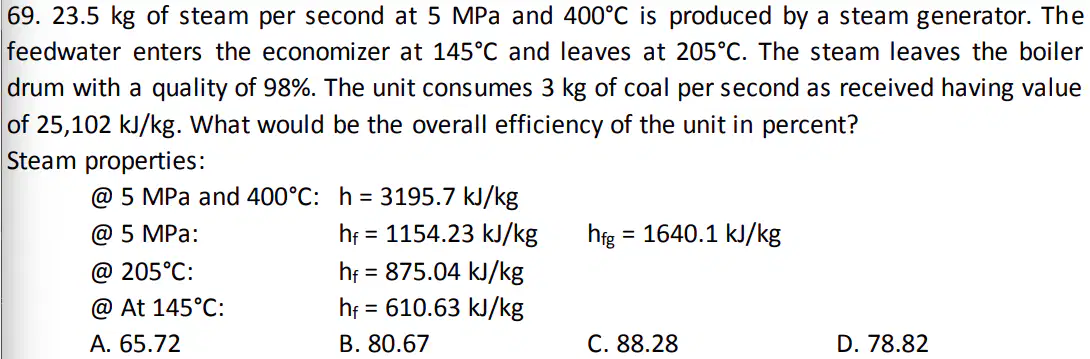
69.
A. 65.72
B. 80.67
C. 88.28
D. 78.82

70.
A. 25.55%
B. 45.23%
C. 34.23%
D. 12.34%
71. A thermal power plant generates 5 MW and the heat generated by fuel is 13,000 kJ/s. If the thermal efficiency is 36.15%, find the power needed for the auxiliaries.
A. 310 kW
B. 300 kW
C. 400 kW
D. 350 kW
72. A superheat steam Rankine cycle has turbine inlet conditions of 17.5 MPa and 530°C expands in a turbine to 0.007 MPa. The turbine and pump polytropic efficiencies are 0.85 and 0.75 respectively. Pressure losses between the pump and turbine inlet are 1.5 MPa. What should be the pump work in kJ/kg?
A. 17.34
B. 27.32
C. 25.32
D. 47.33
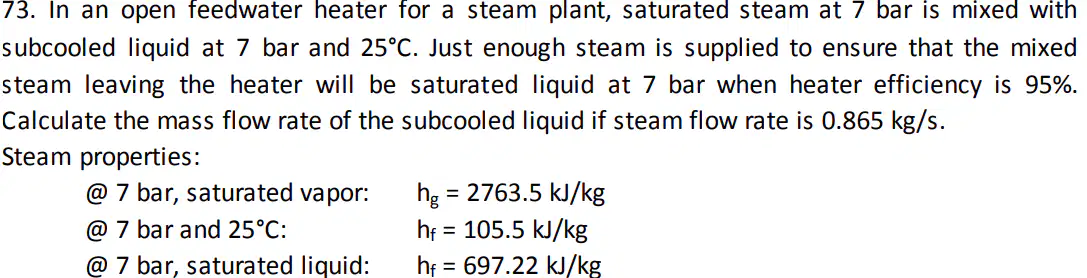
73.
A. 2.725 kg/s
B. 3.356 kg/s
C. 2.869 kg/s
D. 3.948 kg/s
74. A steam condenser receives 10 kg/s of steam with an enthalpy of 2770 kJ/kg. Steam condenses and leaves with an enthalpy of 160 kJ/kg. Cooling water passes through the condenser with temperature increases from 13°C to 24°C. Calculate the water flow rate in kg/s.
A. 583
B. 567
C. 523
D. 528

75.
A. 82
B. 84
C. 79.60
D. 79.46
76. A heat exchanger was installed purposely to cool 0.50 kg of gas per second. Molecular weight is 32 and k = 1.32. The gas is cooled from 150°C to 80°C. Water is available at the rate of 0.30 kg/s and at a temperature of 15°C. Calculate the exit temperature of the water in °C.
A. 44.86
B. 42.86
C. 46.45
D. 40.34
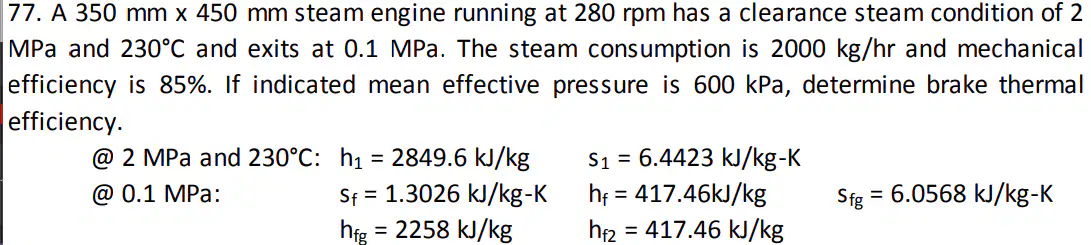
77.
A. 23.34%
B. 15.25%
C. 14.16%
D. 27.34%

78.
A. 1273.29
B. 2173.29
C. 1373.60
D. 7231.29

79.
A. 1,117 kJ/kg
B. 1,132 kJ/kg
C. 1,123.34 kJ/kg
D. 1,054.95 kJ/kg

80.
A. 96.96%
B. 76.34%
C. 82.34%
D. 91.69%
81. An 18,000 kW geothermal plant has a generator efficiency of 90% and 80% respectively. If the quality after throttling is 20% and each well discharges 400,000 kg/hr, determine the number of wells required to produce if the change of enthalpy at entrance and exit of turbine is 500 kJ/kg.
A. 4 wells
B. 2 wells
C. 6 wells
D. 8 wells
82. A liquid dominated geothermal plant with a single flash separator receives water at 204°C. The separator pressure is 1.04 MPa. A direct contact condenser operates at 0.034 MPa. The turbine has a polytropic efficiency of 0.75. For cycle output of 60 MW, what is the mass flow rate of the well water in kg/s? @ 204°C: hf = 870.51 kJ/kg @ 1.04 MPa: hf = 770.38 kJ/kg hfg = 2009.2 kJ/kg hg = 2779.6 kJ/kg 25 sg = 6.5729 kJ/kg-K @ 0.034 MPa: hf = 301.40 kJ/kg hfg = 2328.8 kJ/kg sf = 0.09793 kJ/kg-K sfg = 6.7463 kJ/kg-K
A. 2,933
B. 2,100
C. 1,860
D. 2,444
83. An engine-generator rated 9000 kVA at 80% power factor, 3 phase, 4160 V has an efficiency of 90%. If the overall plant efficiency is 28%, what is the heat generated by the fuel?
A. 18,800 kW
B. 28,800 kW
C. 7,500 kW
D. 25,714 kW
84. The indicated thermal efficiency of a two stroke diesel engine is 60%. If friction power is 15% of heat generated, determine the brake thermal efficiency of the engine.
A. 43%
B. 45%
C. 36%
D. 37%
85. A 305 mm x 457 mm four stroke single acting diesel engine is rated at 150 kW at 260 rpm. Fuel consumption at rated load is 0.56 kg/kW-hr with a heating value of 43,912 kJ/kg. Calculate the break thermal efficiency.
A. 10.53%
B. 27.45%
C. 14.64%
D. 18.23%
86. A waste heat recovery boiler produces 4.8 MPa (dry saturated) steam from 104°C feedwater. The boiler receives energy from 7 kg/s of 954°C dry air. After passing through a waste heat boiler, the temperature of the air has been reduced to 343°C. How much steam in kg is produced per second? Note: @ 4.80 MPa dry saturated, h = 2796 kJ/kg.
A. 1.30
B. 0.92
C. 1.81
D. 3.43
87. A diesel electric power plant supplies energy for Meralco. During a 24-hour period, the plant consumed 240 gallons of fuel at 28°C and produced 3930 kW-hr. Industrial fuel used is 28°API and was purchased at P30 per liter at 15.6°C. What is the cost of fuel to produce one kW-hr?
A. P6.87
B. P1.10
C. P41.07
D. P5.00
88. In a gas unit, air enters the combustion chamber at 550 kPa, 227°C and 43 m/s. The products of combustion leave the combustor at 511 kPa, 1004°C and 180 m/s. Liquid fuel enters with a heating value of 43,000 kJ/kg. For fuel-air ratio of 0.0229, what is the combustor efficiency in percent?
A. 70.38%
B. 79.38%
C. 75.38%
D. 82.38%
89. The specific speed of turbine is 85 rpm and running at 450 rpm. If the head is 20 m and generator efficiency is 90%, what is the maximum power delivered by the generator?
A. 450.51 kW
B. 354.52 kW
C. 650.53 kW
D. 835.57 kW
90. In Francis turbine, the pressure gage leading to the turbine casing reads 380 kPa. The velocity of water entering the turbine is 8 m/s. If net head of the turbine is 45 m, find the distance from the center of the spiral casing to the tailrace.
A. 3.0 m
B. 3.5 m
C. 4.0 m
D. 4.5 m
91. A turbine has a mechanical efficiency of 93%, volumetric efficiency of 95% and total efficiency of 82%. If the effective head is 40 m, find the total head.
A. 48.72 m
B. 40.72 m
C. 36.22 m
D. 34.72 m
92. A Pelton type turbine has 25 m head friction loss of 4.5 m. The coefficient of friction head loss (Morse) is 0.00093 and penstock length of 80 m. What is the penstock diameter?
A. 1,355.73 mm
B. 3476.12 mm
C. 6771.23 mm
D. 1686.73 mm
93. In a 9,000 kW hydro-electric plant, the overall efficiency is 88% and the actual power received by the costumer is 110,000 kW-hrs for that day. What is the secondary power that this plant could deliver during the entire day?
A. 58,960 kW-hrs
B. 80,080 kW-hrs
C. 65,960 kW-hrs
D. 70,960 kW-hrs
94. A Pelton type turbine was installed 30 m below the head gate of the penstock. The head loss due to friction is 12 percent of the given elevation. The length of the penstock is 100 m and the coefficient of friction is 0.00093. Determine the power output in kW. (Use Morse equation).
A. 22,273
B. 23,234
C. 32,345
D. 34,452
95. Water flows steadily with a velocity of 3.05 m/s in a horizontal pipe having a diameter of 25.24 cm. At one section of the pipe, the temperature and pressure of the water are 21°C and 689.3 kPa respectively. At a distance of 304.8 m downstream, the pressure is 516.9 kPa. What is the friction factor?
A. 0.134
B. 0.0050
C. 0.0307
D. 0.641
96. A hydro-electric plant having 30 sq. km reservoir area and 100 m head is used to generate power. The energy utilized by the consumers whose load is connected to the power plant during a five-hour period is 13.5x10⁶ kWh. The overall generation efficiency is 75%. Find the fall in the height of water in the reservoir after the 5-hour period.
A. 5.13 m
B. 1.32 m
C. 3.21 m
D. 2.20 m
97. The gas density of chimney is 0.75 kg /m3 and air density of 1.15 kg /m3 . Find the driving pressure if the height of the chimney is 63.71 m.
A. 0.15 kPa
B. 0.25 kPa
C. 0.35 kPa
D. 0.45 kPa
98. The actual velocity of gas entering in a chimney is 8 m/s. The gas temperature is 25°C with a gas constant of 0.287 kJ/kg-K. Determine the gas pressure for a mass of a gas is 50,000 kg/hr and chimney diameter of 1.39 m.
A. 95 kPa
B. 98 kPa
C. 101 kPa
D. 92 kPa
99. A steam generator with economizer and air heater has an overall draft loss of 25.78 cm of water. If the stack gases are at 177°C and if the atmosphere is at 101.3 kPa and 26°C, what theoretical height of stack in meters is needed when no draft fan is used? Assume that the gas constant for the flue gases is the same as that for air.
A. 611.10
B. 631.10
C. 651.10
D. 671.10
100. A foundation measures 12 ft x 14 ft x 16 ft. Find the number of sacks of cement needed for a 1:2:4 mixture.
A. 302
B. 404
C. 356
D. 598
101. A rectangular foundation cross-section has a bed plate dimension of 8 ft x 10 ft. The uniform clearance on each side is 1 ft. The height of the foundation is 4.5 ft. If the weight of the 31 steel bar reinforcements needed is ½% of weight of foundation, find the weight of the steel bars. Use concrete density of 2400 kg/m3 .
A. 173.47 kg
B. 183.47 kg
C. 163.47 kg
D. 153.47 kg
102. A steam pipe having a surface temperature of 250°C passes through a room where the temperature is 27°C. The outside diameter of the pipe is 100 mm and emissivity factor is 0.8. Calculate the radiated heat loss for 3 m pipe length.
A. 1434.47 W
B. 3746.35 W
C. 2851.82 W
D. 3546.45 W
103. Brine enters a circulating brine cooler at the rate of 60 m3 /hr at -8°C and leaves at -18°C. Specific heat of brine is 1.072 kJ/kg-K and a specific gravity of 1.12. Determine the tons of refrigeration.
A. 53.5 TR
B. 65.3 TR
C. 33.5 TR
D. 56.9 TR
104. A turbo-charged, 16 cylinder, Vee-type diesel engine has an air consumption of 3,000 kg/hr per cylinder at rated load and speed. This air is drawn in through a filter by a centrifugal compressor directly connected to the exhaust gas turbine. The temperature of the air from the 32 compressor is 135°C and a counter flow air cooler reduces the air temperature to 45°C before it goes to the engine suction header. Cooling water enters the air cooler at 30°C and leaves at 40°C. Calculate the log mean temperature difference.
A. 47.23°C
B. 87.82°C
C. 43.34°C
D. 65.24°C
105. Water is flowing in a pipe with radius of 30 cm at a velocity of 5 m/s at the temperature in the pipe. The density and viscosity of the water are as follows: density = 997.9 kg/s viscosity = 1.131 Pa-s. What is the Reynolds number for this situation?
A. 2647
B. 96.2
C. 3100
D. 1140
106. Compute the amount of condensate formed during a 10 minute warm-up of 180 meter pipe conveys the saturated steam with enthalpy of vaporization, hfg = 1947.8 kJ/kg. The minimum external temperature of pipe is 2°C. The final temperature of pipe is 195°C. The specific heat of pipe material is 0.6 kJ/kg-°C. The specific weight is 28 kg/m.
A. 240.69 kg
B. 982.45 kg
C. 299.64 kg
D. 423.45 kg
107. The discharge pressure of an air compressor is 5 times the suction pressure. If volume flow at suction is 0.1 m3 /s, what is the suction pressure if compressor work is 19.57 kW (use n = 1.35).
A. 97 kPa
B. 98 kPa
C. 99 kPa
D. 100 kPa
108. The initial condition of air in an air compressor is 98 kPa and 27 °C and discharges air at 450 kPa. The bore and stroke are 355 mm and 381 mm, respectively with percent clearance of 8% running at 300 rpm. Find the volume of air at suction.
A. 541.62 m3 /hr
B. 551.62 m3 /hr
C. 561.62 m3 /hr
D. 571.62 m3 /hr
109. An air compressor has a suction volume of 0.35 m3 /s at 97 kPa and discharges at 650 kPa. How much power is saved by the compressor if there are two stages?
A. 18.27 kW
B. 16.54 kW
C. 13.86 kW
D. 11.58 kW
110. A two stage air intercooler has an intercooler pressure of 4 kg/cm2 . What is the discharge pressure if suction pressure is 1 kg/cm2 ?
A. 3 kg/cm2
B. 9 kg/cm2
C. 12 kg/cm2
D. 16 kg/cm2
111. A two-stage air compressor at 100 kPa and 22°C discharges to 750 kPa. If the intercooler intake is 105°C, determine the value of n.
A. 1.400
B. 1.326
C. 1.345
D. 1.288
112. A single acting compressor has a volumetric efficiency of 89%, operates at 500 rpm. It takes in air at 100 kPa and 30°C and discharges it at 600 kPa. The air handled is 8 m3 /min measured at discharged condition. If compression is isentropic, find the effective mean pressure in kPa.
A. 233.34
B. 973.17
C. 198.34
D. 204.82
113. A water-jacketed air compressor handles 0.343 m3 /s of air entering at 96.5 kPa and 21°C and leaving at 480 kPa and 132°C; 10.9 kg/hr of cooling water enters the jacket at 15°C and leaves at 21°C. Determine the compressor brake power.
A. 23.163 kW
B. 62.65 kW
C. 34.44 kW
D. 19.33 kW
114. A double suction centrifugal pump delivers 20 ft3 /s of water at a head of 12 m and running at 650 rpm. What is the specific speed of the pump?
A. 5014.12 rpm
B. 6453.12 rpm
C. 2770.73 rpm
D. 9968.73 rpm
115. Determine the number of stages needed for a centrifugal pump if it is used to deliver 400 gal/min of water and pump power of 15 hp. Each impeller develops a head of 30 ft.
A. 6
B. 4
C. 5
D. 7
116. The suction pressure of a pump reads 3 in. of mercury vacuum and discharge pressure reads 140 psi is used to deliver 120 gpm of water with specific volume of 0.0163 ft3 /lb. Determine the pump work.
A. 4.6 kW
B. 5.7 kW
C. 7.4 kW
D. 8.4 kW
117. A submersible pump delivers 350 gpm of water to a height of 5 ft from the ground. The pump where installed 150 ft below the ground level and a drawdown of 8 ft during the operation. If water level is 25 ft above the pump, determine the pump power.
A. 7.13 kW
B. 4.86 kW
C. 7.24 kW
D. 9.27 kW
118. A vacuum pump is used to drain a flooded mine shaft of 20°C water. The pump pressure of water at this temperature is 2.34 kPa. The pump is incapable of lifting the water higher than 16 m. What is the atmospheric pressure?
A. 159.30
B. 132.33
C. 196.22
D. 171.9
119. A submersible, multi-stage, centrifugal deep well pump 260 gpm capacity is installed in a well 27 ft below the static water level and running at 3000 rpm. Drawdown when pumping at rated capacity is 10 feet. The pump delivers the water into a 25,000 gallons capacity overhead storage tank. Total discharge head developed by pump, including friction in piping is 243 ft. Calculate the diameter of the impeller of this pump in inches if each impeller diameter developed a head of 38 ft.
A. 3.28
B. 5.33
C. 3.71
D. 6.34
120. A fan draws 1.42 m3 per second of air at a static pressure of 2.54 cm of water through a duct 300 mm diameter and discharges it through a duct of 275 mm diameter. Determine the static fan efficiency if total fan is 75% and air is measured at 25°C and 760 mm Hg.
A. 50.11%
B. 53.69%
C. 65.67%
D. 45.34%
121. A water cooler uses 50 lb/hr of melting ice to cool running water from 80°F to 42°F. Based on the inside coil area, Ui = 110 Btu/hr-ft2 -°F. Find the gpm of water cooled.
A. 0.10 GPM
B. 0.21 GPM
C. 0.38 GPM
D. 0.45 GPM
122. The charge in a Diesel engine consists of 18.34 grams of fuel, with lower heating value of 42,571 kJ/kg, and 409 grams of fuel and products of combustion. At the beginning of compression, T1 = 60°C. Let rk = 14. For constant cp = 1.11 kJ/kg-°C, what should be the cut-off ratio in the corresponding ideal cycle?
A. 2.05
B. 2.34
C. 5.34
D. 2.97
123. The gain of entropy during isothermal nonflow process of 5 lb of air at 60°F is 0.462 Btu/°R. Find the V1/V2.
A. 3.85
B. 0.259
C. 1.0
D. 0.296
124. An auditorium seating 1500 people is to be maintained at 80°F dry bulb and 60°F wet bulb temperature when outdoor air is at 91°F dry bulb and 75°F wet bulb. Solar heat load is 110,000 Btu/hr and supply air is at 60°F, determine the amount of supply air.
A. 93,229.17 lb/hr
B. 83,229.17 lb/hr
C. 73,229.17 lb/hr
D. 63,229.17 lb/hr
125. In a Brayton cycle that operates between temperature limits of 300 K and 1773 K with k = 1.4, determine the temperature at the end of compression (isentropic) for maximum work of the cycle.
A. 780 K
B. 690.5 K
C. 730 K
D. 350 K
126. A 35% solution leaves the absorber and 30% solution enters the absorber. The heat removed from the absorber by cooling water is 547.6 Btu and ammonia is superheated by 10°. Find the pound per pound of ammonia gas from the evaporating coils.
A. 11
B. 12
C. 13
D. 14
127. A Carnot refrigeration system operates at Tmax/Tmin = 1.5. Find the kW per ton of refrigeration.
A. 1.91
B. 2.15
C. 1.76
D. 1.55
128. Assume 8 ft3 of air at 100 psi and 100°F are compressed isothermally to a volume of 2 ft3 . For each end state of the process, find the bulk modulus.
A. 400 and 100 psi
B. 400 and 110 psi
C. 400 and 120 psi
D. 400 and 130 psi
129. Predict the pressure of nitrogen gas at T = 200 K and υ = 0.00385 L/g and b = 0.00141 L/g; a = 0.178 L2 -kPa/g 2 . Use Van der Waals equation.
A. 15,331 kPa
B. 14,331 kPa
C. 13,331 kPa
D. 12,331 kPa
130. A Francis turbine is to be operated at a speed of 600 rpm and with discharge of 4 m3 /s. If r1 = 0.6 m, β = 110°, and the blade height B is 10 cm, what should be the guide vane angle α1 for nonseparating flow condition at the runner entrance?
A. 14.4°
B. 15.4°
C. 16.4°
D. 17.4°
131. The total head of fan is 187 m and has a static pressure of 210 mm of water gage, what is the velocity of air flowing if the density of air is 1.15 kg/m3 ?
A. 6.85 m/s
B. 3.45 m/s
C. 4.39 m/s
D. 9.28 m/s
132. A fan delivers 5.7 m3 /s at a static pressure of 5.08 cm of water when operating at a speed of 400 rpm. The power input required is 2.963 kW. If 7.05 m3 /s are desired in the same fan and installation, find the pressure in cm of water.
A. 7.77
B. 17.14
C. 11.43
D. 5.08
133. A rigid container is closed at one end and measures 8 in diameter by 12 in long. The container is held vertical and is slowly moved downward until the pressure in the container is 17 psia. What will be the depth of the top of the container from the free water surface?
A. 42.36 in
B. 59.29 in
C. 63.69 in
D. 69.82 in
134. An empty, open can is 30 cm high with a 15 cm diameter. The can, with the open end down, is pushed under water with a density of 1000 kg/m3 . Find the water level in the can when the top of the can is 50 cm below the surface.
A. 17.20 cm
B. 2.12 cm
C. 4.20 cm
D. 5.87 cm
135. A cylindrical pipe with water flowing downward at 0.03 m3 /s having top diameter of 0.08, bottom diameter of 0.04 m and height of 1.5 m. Find the pressure inside the pipe.
A. 154.63 kPa
B. 197.93 kPa
C. 252.44 kPa
D. 243.92 kPa
136. Determine the size of pipe which will deliver 8 liters of medium oil (ν = 6.10x10⁻⁶ m 2 /s) assuming laminar flow conditions.
A. 622 mm
B. 754 mm
C. 950 mm
D. 835 mm
137. The type of flow occupying in a 1 cm diameter pipe which water flows at a velocity of 2.50 m/s. Use ν = 1.13x10⁻⁶ m 2 /s for water.
A. turbulent
B. constant
C. laminar
D. none of these
138. What force is exerted by a water jet, 60 mm in diameter, if it strikes a wall at the rate of 15 m/s?
A. 636.17 N
B. 442.62 N
C. 764.23 N
D. 563.34 N
139. A 300 mm diameter pipe discharges water at a rate of 200 li/s. Point 1 on the pipe has a pressure of 260 kPa and 3.4 m below point 1 is point 2 with a pressure of 300 kPa. Compute the head loss between points 1 and 2.
A. 4.29 m
B. 2.59 m
C. 6.32 m
D. 1.87 m
140. Water flowing at the rate of 10 m/s from an orifice at bottom of a reservoir. Find the pressure at the bottom of reservoir.
A. 30 kPa
B. 40 kPa
C. 50 kPa
D. 60 kPa
141. Steam flows through a nozzle at 400°C and 1 MPa (h = 3263.9 kJ/kg) with velocity of 300 m/s. Find the stagnation enthalpy.
A. 3300 kJ/kg
B. 3290 kJ/kg
C. 3320 kJ/kg
D. 3309 kJ/kg
142. Air flows through a nozzle at a speed of 350 m/s. Find the stagnation temperature if the entrance temperature is 200°C.
A. 241.25°C
B. 251.25°C
C. 261.25°C
D. 271.25°C
143. Carbon dioxide flows through a nozzle with a speed of 400 m/s. Compute the dynamic temperature.
A. 92.56 K
B. 94.56 K
C. 96.56 K
D. 98.56 K
144. Carbon dioxide flows through a nozzle with speed of 380 m/s. The entrance condition of nozzle is 250°C and 1200 kPa. Find the stagnation pressure.
A. 2,136.34 kPa
B. 2,146.34 kPa
C. 2,156.34 kPa
D. 2,166.34 kPa
145. Air enters a diffuser with a velocity of 200 m/s. Determine the velocity of sound if air temperature is 30°C.
A. 349 m/s
B. 359 m/s
C. 369 m/s
D. 379 m/s
146. Air flows through a nozzle with temperature of entrance of 420 K stagnation temperature of 468 K. Find the Mach number.
A. 0.744
B. 0.754
C. 0.764
D. 0.774
147. Air at 300 K and 200 kPa is heated at constant pressure to 600 K. Determine the change of internal energy.
A. 245.58 kJ/kg
B. 235.58 kJ/kg
C. 225.58 kJ/kg
D. 215.58 kJ/kg
148. An insulated rigid tank initially contains 1.5 lb of helium at 80°F and 50 psia. A paddle wheel with power rating of 0.02 hp is operated within the tank for 30 min. Determine the final temperature.
A. 159.22°F
B. 169.22°F
C. 179.22°F
D. 189.22°F
149. A 4 m2 asphalt pavement with emissivity of 0.85 has a surface temperature of 50°C. Find the maximum rate of radiation that can be emitted from the surface.
A. 2,068 .32 watts
B. 2,078.32 watts
C. 2,088.32 watts
D. 2,098.32 watts
150. Air at 10°C and 80 kPa enters a diffuser of a jet engine steadily with a velocity of 200 m/s. The inlet area of diffuser is 0.40 m2 . Determine the mass flow rate of air.
A. 72.79 kg/s
B. 74.79 kg/s
C. 76.79 kg/s
D. 78.79 kg/s
151. Consider a refrigerator whose 40 watts light bulb remains on continuously as a result of a malfunction of the switch. If the refrigerator has a COP of 1.3 and the cost of electricity is 8 cents per kW-hr, determine the increase in the energy consumption of the refrigerator and its cost per year if the switch is not fixed.
A. P 49.59
B. P 47.59
C. P 45.59
D. P 43.59
152. A 75 hp motor that has an efficiency of 91% is worn out and is replaced by a high-efficiency motor that has an efficiency of 95.4%. Determine the reduction in heat gain of the room due to higher efficiency under full-load conditions.
A. 2.24 kW
B. 2.44 kW
C. 2.64 kW
D. 2.84 kW
153. A household refrigerator that has a power input of 450 watts and a COP of 2.5 is to cool five large watermelons, 10 kg each, to 8°C. If the watermelons are initially at 20°C, determine how long it will take for the refrigerator to cool them. The watermelons can be treated as water whose specific heat is 4.2 kJ/kg-K.
A. 2220 seconds
B. 2230 seconds
C. 2240 seconds
D. 2250 seconds
154. When a man returns to his wall-sealed house on a summer day, he finds that the house is at 32°C. He returns on the air conditioner which cools the entire house to 20°C in 15 minutes. If COP is 2.5, determine the power drawn by the air conditioner. Assume the entire mass within the house is 800 kg of air for which cv = 0.72 kJ/kg-K, cp = 1.0 kJ/kg-K
A. 1.072 kW
B. 2.072 kW
C. 3.072 kW
D. 4.072 kW
155. A heat source at 800 K losses 2000 kJ of heat to a sink at 500 K. Determine the entropy generated during this process.
A. 1.5 kJ/K
B. 2.5 kJ/K
C. -2.5 kJ/K
D. 4 kJ/K
156. Helium gas is compressed in an adiabatic compressor from an initial state of 14 psia and 50°F to a final temperature of 320°F in a reversible manner. Determine the exit pressure of Helium.
A. 38.5 psia
B. 40.5 psia
C. 42.5 psia
D. 44.5 psia
157. Air passes thru a nozzle with efficiency of 90%. The velocity of air at the exit is 600 m/s. Find the actual velocity at the exit.
A. 382 m/s
B. 540 m/s
C. 458 m/s
D. 568 m/s
158. A 50 kg block of iron casting at 500 K is thrown into a large lake that is at a temperature of 285 K. The iron block eventually reaches thermal equilibrium with the lake water. Assuming average specific heat of 0.45 kJ/kg-K for the iron, determine the entropy generated during this process.
A. -12.65 kJ/K
B. 16.97 kJ/K
C. 4.32 kJ/K
D. 6.32 kJ/K
159. A windmill with a 12 m diameter rotor is to be installed at a location where the wind is blowing at an average velocity of 10 m/s. Using standard condition of air (1 atm, 25°C), determine the maximum power that can be generated by the windmill.
A. 68 kW
B. 70 kW
C. 72 kW
D. 74 kW
160. Consider a large furnace that can supply heat at a temperature of 2000°R at a steady rate of 3000 Btu/s. Determine the exergy of this energy. Assume an environment temperature of 77°F.
A. 2305.19 kW
B. 2315.19 kW
C. 2325.19 kW
D. 2335.19 kW
161. A heat engine receives heat from a source at 1200 K at a rate of 500 kJ/s and rejects the waste heat to a medium at 300 K. The power output of the engine is 180 kW. Determine the irreversibility rate for this process.
A. 190 kW
B. 195 kW
C. 200 kW
D. 205 kW
162. A dealer advertises that he has just received a shipment of electric resistance heaters for residential buildings that have an efficiency of 100 percent. Assuming an indoor temperature of 21°C and outdoor temperature of 10°C, determine the second law efficiency of these heaters.
A. 8.74%
B. 6.74%
C. 3.74%
D. 4.74%
163. A thermal power plant has a heat rate of 11,363 Btu/kW-hr. Find the thermal efficiency of the plant.
A. 34%
B. 24%
C. 26%
D. 30%
164. A rigid tank contains 2 kmol of N2 and 6 kmol of CO2 gases at 300 K and 115 MPa. Find the tank volume using the ideal gas equation.
A. 7.33 m3
B. 5.33 m3
C. 3.33 m3
D. 1.33 m3
165. A spherical balloon with a diameter of 6 m is filled with helium at 20°C and 200 kPa. Determine the mole number.
A. 9.28 kmol
B. 10.28 kmol
C. 11.28 kmol
D. 13.28 kmol
166. The air in an automobile tire with a volume of 0.53 ft3 is at 90°F and 20 psig. Determine the amount of air that must be added to raise the pressure to the recommended value of 30 psig. Assume the atmospheric pressure to be 14.7 psia and the temperature and the volume to remain constant.
A. 0.026 lb
B. 0.046 lb
C. 0.066 lb
D. 0.086 lb
167. A rigid tank contains 20 lbm of air at 20 psia and 70°F. More air is added to the tank until the pressure and temperature rise to 35 psia and 90°F, respectively. Determine the amount of air added to the tank.
A. 11.73 lb
B. 13.73 lb
C. 15.73 lb
D. 17.73 lb
168. A rigid tank contains 5 kg of an ideal gas at 4 atm and 40°C. Now a valve is opened, and half of mass of the gas is allowed to escape. If the final pressure in the tank is 1.5 atm, the final temperature in the tank is?
A. -38°C
B. -30°C
C. 40°C
D. 53°C
169. The pressure of an automobile tire is measured to be 200 kPa (gage) before the trip end 220 kPa (gage) after the trip at a location where the atmospheric pressure is 90 kPa. If the temperature of the air in the tire before the trip is 25°C, the air temperature after the trip is?
A. 45.6°C
B. 54.8°C
C. 27.5°C
D. 26.7°C
170. Water is boiling at 1 atm pressure in a stainless steel pan on an electric range. It is observed that 2 kg of liquid water evaporates in 30 min. The rate of heat transfer to the water is?
A. 2.07 kW
B. 0.47 kW
C. 2.51 kW
D. 3.12 kW
171. Consider a person standing in a breezy room at 20°C. Determine the total rate of heat transfer from this person if the exposed surface area and the average outer surface temperature of the person are 1.6 m2 and 29°C, respectively, and the convection heat transfer coefficient is 6 W/m2 with emissivity factor of 0.95.
A. 86.40 watts
B. 81.70 watts
C. 198.1 watts
D. 168.1 watts
172. Water is boiler in a pan on a stove at sea level. During 10 minutes of boiling, it is observed that 200 grams of water has evaporated. Then the rate of heat transfer to the water is:
A. 0.84 kJ/min
B. 45.1 kJ/min
C. 41.8 kJ/min
D. 53.5 kJ/min
173. An aluminum pan whose thermal conductivity is 237 W/m-°C has a flat bottom whose diameter is 20 cm and thickness of 0.4 cm. Heat is transferred steadily to boiling water in the pan through its bottom at a rate of 500 watts. If the inner surface of the bottom of the pan is 105°C, determine the temperature of the surface of the bottom of the pan.
A. 95.27°C
B. 105.27°C
C. 115.27°C
D. 125.27°C
174. For heat transfer purposes, a standing man can be modeled as a 30 cm diameter, 170 cm long vertical cylinder with both the top and bottom surfaces insulated and with the side surface at an average temperature of 34°C. For a convection heat transfer coefficient of 15 W/m2 -°C, determine the rate of heat loss from this man by convection in an environment at 20°C.
A. 316.46 watts
B. 326.46 watts
C. 336.46 watts
D. 346.46 watts
175. A 5 cm diameter spherical ball whose surface is maintained at a temperature of 70°C is suspended in the middle of a room at 20°C. If the convection heat transfer coefficient is 15 W/m2 -°C and the emissivity of the surface is 0.8, determine the total heat transfer from the ball.
A. 23.56 watts
B. 32.77 watts
C. 9.22 watts
D. 43.45 watts
176. A frictionless piston-cylinder device and a rigid tank contain 1.2 kmol of an ideal gas at the same temperature, pressure and volume. Now heat is transferred, and the temperature of both systems is raised by 15°C. The amount of extra heat that must be supplied to the gas in the cylinder that is maintained at constant pressure is?
A. 0
B. 50 kJ
C. 100 kJ
D. 150 kJ
177. A supply of 50 kg of chicken at 6°C contained in a box is to be frozen to -18°C in a freezer. Determine the amount of heat that needs to be removed. The latent heat of the chicken is 247 kJ/kg, and its specific heat is 3.32 kJ/kg-°C above freezing and 1.77 kJ/kg-°C below freezing. The 53 container box is 1.5 kg, and the specific heat of the box material is 1.4 kJ/kg-°C. Also the freezing temperature of chicken is -2.8°C.
A. 15,206.4 kJ
B. 50.4 kJ
C. 15,156 kJ
D. 1,863 kJ
178. Water is being heated in a closed pan on top of a range while being stirred by a paddle wheel. During the process, 30 kJ of heat is transferred to the water, and 5 kJ of heat is lost to the surrounding air. The paddle wheel work amounts to 500 N-m. Determine the final energy of the system if its initial energy is 10 kJ.
A. 35.5 kJ
B. 40.5 kJ
C. 25.5 kJ
D. 14.5 kJ
179. A classroom that normally contains 40 people is to be air-conditioned with window airconditioning units of 5 kW cooling capacity. A person at rest may be assumed to dissipate heat at a rate about 360 kJ/hr. There are 10 light bulbs in the room, each with a rating of 100 watts. The rate of heat transfer to the classroom through the walls and the windows is estimated to be 15,000 kJ/hr. If the room is to be maintained at a constant temperature of 21°C, determine the number of window air-conditioning units required.
A. 1 units
B. 2 units
C. 3 units
D. 4 units
180. A 4 m x 5 m x 6 m room is to be heated by a baseboard resistance heater. It is desired that the resistance heater be able to raise the air temperature in the room from 7 to 23°C within 15 minutes. Assuming no heat losses from the room and an atmospheric pressure of 100 kPa, determine the required power of the resistance heater. Assume constant specific heats at room temperature.
A. 2.34 kW
B. 1.91 kW
C. 4.56 kW
D. 6.34 kW
181. A student living in a 4 m x 6 m x 6 m dormitory room turns on her 150 watts fan before she leaves the room on a summer day, hoping that the room will be cooler when she comes back in the evening. Assuming all the doors and windows are tightly closed and disregarding any heat transfer through the walls and the windows, determine the temperature in the room when she comes back 10 hours later. Use specific heat values at room temperature, and assume the room to be at 100 kPa and 15°C in the morning when she leaves.
A. 28.13°C
B. 38.13°C
C. 48.13°C
D. 58.13°C
182. A piston-cylinder device whose piston is resting on top of a set of stops initially contains 0.50 kg of helium gas at 100 kPa and 25°C. The mass of the piston is such that 500 kPa of pressure is required to raise it. How much heat must be transferred to the helium before the piston starts rising?
A. 1557.13 kJ
B. 1657.13 kJ
C. 1757.13 kJ
D. 1857.13 kJ
183. In order to cool 1 ton (1000 kg) of water at 20°C in an insulated tank, a person pours 80 kg of ice at -5°C into the water. Determine the final equilibrium temperature in the tank. The melting temperature and the heat of fusion of ice at atmospheric pressure are 0°C and 333.7 kJ/kg, respectively.
A. 12.43°C
B. 14.43°C
C. 16.43°C
C. 16.43°C
184. A fan is powered by 0.5 hp motor and delivers air at a rate of 85 m3 /min. Determine the highest value for the average velocity of air mobilized by the fan. Take the density of air to be 1.18 kg/m3 .
A. 18.23 m/s
B. 21.12 m/s
C. 25.34 m/s
D. 32.23 m/s
185. An Ocean-Thermal Energy Conversion power plant generates 10,000 kW using a warm surface water inlet temperature of 26°C and cold deep-water temperature of 15°C. On the basis of a 3°C drop in the temperature of the warm water and a 3°C rise in the temperature of the cold water due to removal and addition of heat, calculate the power required in kW to pump the cold-deep water to the surface and through the system heat exchanger if the required pumping pressure increase is 12 kPa. Assume a Carnot cycle efficiency and density of cold water to be 100 kg/m3 .
A. 108
B. 250
C. 146
D. 160
186. A plate-type solar energy collector with an absorbing surface covered by a glass plate is to receive an incident radiation of 800 W/m2 . The glass plate has a reflectivity of 0.12 and a 56 transmissivity of 0.85. The absorbing surface has an absorptivity of 0.90. The area of the collector is 5 m2 . How much solar energy in watts is absorbed by the collector?
A. 2500
B. 2880
C. 3510
D. 3060
187. A tank contains liquid nitrogen at -190°C is suspended in a vacuum shell by three stainless steel rods of 0.80 cm in diameter and 3 meters long with a thermal conductivity of 16.3 W/m2 - °C. If the ambient air outside the vacuum shell is 15°C, calculate the magnitude of the conductive heat flow in watts along the support rods.
A. 0.168
B. 0.0587
C. 0.182
D. 0.176
188. An elastic sphere containing gas at 120 kPa has a diameter of 1.0 m. Heating the sphere causes it to expand to a diameter of 1.3 m. During the process the pressure is proportional to the sphere diameter. Calculate the work done by the gas in kJ.
A. 41.8
B. 50.6
C. 87.5
D. 35.4
189. An ideal gas with a molecular weight of 7.1 kg/kg mol is compressed from 600 kPa and 280 K to a final specific volume of 0.5 m3 /kg. During the process the pressure varies according to P = 620 + 150υ + 95 υ 2 where p is in kPa and υ in m3 /kg. Calculate the work of compression in kJ/kg.
A. 32.8
B. 28.7
C. 35.6
D. 33.3
190. A one cubic meter container contains a mixture of gases composed of 0.02 kg-mol of oxygen and 0.04 kg-mol of helium at a pressure of 220 kPa. What is the temperature of this ideal gas mixture in Kelvin?
A. 441
B. 350
C. 400
D. 450
191. Methyl alcohol (CH3OH) is burned with 25% excess air. How much unburned oxygen in kgmoloxygen/kg-molfuel will there be in the products if the combustion is complete?
A. 0.35
B. 0.45
C. 0.37
D. 0.65
192. A 12 DC electrical motor draws a current of 15 amps. How much work in kJ does this motor produce over a 10-minute period of operation?
A. 108.0
B. 129.6
C. 216.0
D. 318.2
193. A 4 liter (2-liter per revolution at standard pressure and temperature) spark ignition engine has a compression ratio of 8 and 2200 kJ/kg heat addition by the fluid combustion. Considering a cold air-standard Otto cycle model, how much power will the engine produce when operating at 2500 rpm?
A. 166.53 hp
B. 73.12 hp
C. 97.4 hp
D. 148 hp
194. A simple Rankine cycle produces 40 MW of power, 50 MW of process heated and rejects 50 MW of heat to the surroundings. What is the utilization factor of this cogeneration cycle neglecting the pump work?
A. 50%
B. 60%
C. 64%
D. 80%
195. The rate of heat transfer to the surroundings from a person at rest is 400 kJ/hr. Suppose that the ventilation system fails in an auditorium containing 120 people and assuming that the energy goes into the air of volume 1500 m3 initially at 300 K and 101 kPa, calculate the rate in °C /min of air temperature change.
A. 0.81
B. 0.53
C. 0.63
D. 1.0
196. An insulated box containing helium gas falls from a balloon 4.5 km above the earth’s surface. Calculate the temperature rise in °C of the helium when box hits the ground.
A. 15.2
B. 12.6
C. 25.3
D. 14.1
197. Consider two Carnot heat engines operating in series. The first engine receives heat from the reservoir at 2400 K and rejects the waste heat to another reservoir at temperature T. The second engine receives heat by the first one, convert some of it to work, and rejects the rest to 59 a reservoir at 300 K. If thermal efficiencies of both engines are the same, determine the temperature T.
A. 849 K
B. 578 K
C. 763 K
D. 978 K
198. An ideal gas mixture consists of 2 kmol of N2 and 6 kmol of CO2. The mass fraction of CO2 is?
A. 0.175
B. 0.250
C. 0.825
D. 0.750
199. An ideal gas mixture consists of 2 kmol of N2 and 6 kmol of CO2. The apparent gas constant of mixture is?
A. 0.208
B. 0.231
C. 0.531
D. 0.825
200. A Carnot cycle operates between the temperature limits of 300 K and 1500 K, and produces 600 kW of net power. The rate of entropy change of the working fluid during heat addition process is?
A. 0
B. 0.4
C. 0.5
D. 2.0
201. Air in an ideal Diesel cycle is compressed from 3 L to 0.15 L and then it expands during the constant pressure heat addition process to 0.3 L. Under cold air standard conditions, the thermal effieciency of this cycle is?
A. 35%
B. 44%
C. 65%
D. 70%
202. Helium gas in an ideal Otto cycle is compressed from 20°C and 2 L to 0.25 L and its temperature increases by an additional 800°C during the heat addition process. The temperature of Helium before the expansion process is?
A. 1700°C
B. 1440°C
C. 1240°C
D. 880°C
203. In an ideal Otto cycle, air is compressed from 1.20 kg/m3 and 2.2 L to 0.26 L and the net work output of the cycle is 440 kJ/kg. The mean effective pressure for the cycle is?
A. 612 kPa
B. 599 kPa
C. 528 kPa
D. 416 kPa
204. An ideal Brayton cycle has a net work output of 150 kJ/kg and backwork ratio of 0.4. if both the turbine and the compressor had an isentropic efficiency of 80%, the net work output of the cycle would be?
A. 60 kJ/kg
B. 75 kJ/kg
C. 98 kJ/kg
D. 120 kJ/kg
205. Air enters a turbojet engine at 200 m/s at a rate of 20 kg/s and exits at 800 m/s relative to the aircraft. The thrust developed by the engine is?
A. 6 kN
B. 12 kN
C. 16 kN
D. 20 kN
206. A thermal power has a net power of 10 MW. The backwork ratio of the plant is 0.005. Determine the compressor work.
A. 50.15 kW
B. 50.35 kW
C. 50.25 kW
D. 50.45 kW
207. A heat engine receives heat from a source at 1200 K at a rate of 500 kJ/s and rejects the wasted heat to a sink at 300 K. If the power output of the engine is 200 kW, the second law efficiency of this heat engine is?
A. 35%
B. 40%
C. 53%
D. 75%
208. A water reservoir contains 100,000 kg of water at an average elevation of 60 m. The maximum amount of electric power that can be generated from this water is ?
A. 8 kWh
B. 16 kWh
C. 1630 kWh
D. 58,800 kWh
209. A house is maintained at 22°C in winter by electric resistance heaters. If the outdoor temperature is 5°C, the second law efficiency of the resistance heaters is ?
A. 0%
B. 5.8%
C. 34%
D. 77%
210. A thermoelectric refrigerator that resembles a small ice chest is powered by a car battery, and has a COP of 0.10. If the refrigerator cools a 0.350 L canned drink from 20°C to 4°C in 30 min, determine the average electric power consumed by the thermoelectric refrigerator
A. 130 watts
B. 110 watts
C. 120 watts
D. 140 watts
211. A Carnot refrigerator operates in a room in which the temperature is 25°C and consumes 2 kW of power when operating. If the food compartment of the refrigerator is to be maintained at 3°C, determine the rate of heat removal from the food compartment.
A. 1504.8 kJ/min
B. 12.86 kJ/min
C. 1625 kJ/min
D. 9.57 kJ/min
212. A household refrigerator with EER 8.0 removes heat from the refrigerated space at a rate of 90 kJ/min. Determine the rate of heat transfer to the kitchen air.
A. 101.25 kJ/min
B. 63.05 kJ/min
C. 128.46 kJ/min
D. 80 kJ/min
213. An air-conditioning system is used to maintain a house at 75°F when the temperature outside is 95°F. The house is gaining the heat through the walls and windows at a rate of 1250 Btu/min, and the heat generation rate within the house from people, lights, and appliances amounts to 350 Btu/min. Determine the minimum power input required for this airconditioning system.
A. 10.06 hp
B. 1.36 hp
C. 1.41 hp
D. 7.94 hp
214. A refrigeration system is to cool bread loaves with an average mass of 450 g from 22°C to - 10°C at a rate of 500 loaves per hour by refrigerated air. Taking the average specific and latent heats of bread to be 2.93 kJ/kg-°C and 109.3 kJ/kg, respectively, determine the product load.
A. 541.7 kJ/min
B. 351.6 kJ/min
C. 761.5 kJ/min
D. 409.9 kJ/min
215. A house that was heated by electric resistance heaters consumed 1200 kWh of electric energy in a winter month. If this house were heated instead by a heat pump that has an average performance factor, PF of 2.4, determine how much money the homeowner would be saved that month. Assume a price of 0.085 $/kWh for electricity.
A. $42.5
B. $59.50
C. $102
D. $97.75
216. An ammonia simple saturation cycle operates with a suction pressure of 291.6 kPa and a condenser pressure of 1204 kPa develops 15 tons of refrigeration. Determine the theoretical horsepower of the compressor. The following enthalpies have been found: condenser entrance = 1653 kJ/kg, exit = 346.6 kJ/kg; compressor entrance = 1450.2 kJ/kg, exit = 1653 kJ/kg.
A. 7.23 hp
B. 13 hp
C. 15 hp
D. 8.23 hp
217. An ammonia ice plant operates between a condenser temperature of 35°C and evaporator of -15°C. It produces 10 metric tons of ice per day from water at 30°C to ice at -5°C. Assuming simple saturation cycle, determine the horsepower of the motor if the adiabatic efficiency of the compressor nc = 0.85 and mechanical efficiency nm = 0.95. The specific heat of ice is 2.094 kJ/kg-°C and the latent heat is 335 kJ/kg. From the table for ammonia the following enthalpies are: condenser entrance = 1703 kJ/kg, exit = 366.1 kJ/kg; compressor entrance = 1443.9 kJ/kg, exit = 1703 kJ/kg.
A. 17.68 hp
B. 18.61 hp
C. 15.5 hp
D. 21.9 hp
218. A Freon 22 air conditioning under standard operating conditions of 35°C condensing and 5°C evaporating temperatures. The volume flow rate entering the compressor is 23.72 L/s. Determine the refrigerating capacityif the refrigerating effect is 164 kJ/kg. From the table for R22 the specific volume at the compressor entrance is 40.46 L/kg.
A. 339.3 TR
B. 79.3 TR
C. 96.4 TR
D. 27.4 TR
219. The refrigerant volume flow rate at the entrance of compressor were obtained from a test on a twin cylinder, single acting 15 cm x 20 cm, 320 rpm compressor ammonia refrigerating plant to be 33 L/s. Determine the volumetric efficiency of the compressor.
A. 77.65%
B. 87.6%
C. 97.6%
D. 65.65%
220. A twin cylinder ammonia compressor with volume displacement of 14,726 cm3 operates at 300 rpm. Condenser and evaporator pressure are 1200 kPa and 227 kPa respectively. Specific volume of refrigerant at the entrance of compressor is 528.26 L/kg. Compression process is polytropic with n = 1.20 and clearance factor of compressor is 2 percent. Determine the horsepower required.
A. 60 hp
B. 70 hp
C. 80 hp
D. 90 hp
221. A reversed Carnot has a refrigerating COP of 2.5. Determine the ratio TH/TL.
A. 1.4
B. 1.5
C. 1.25
D. 1.2
222. Three thousand cubic feet per minute of air are circulated over an air-cooled condenser. If the load on the condenser is 64,800 Btu/hr, compute the temperature rise of the air passing over the condenser. Specific volume of standard air (13.34 ft3 /lb).
A. 10°F
B. 15°F
C. 20°F
D. 25°F
223. Saturated vapor ammonia at -16°C (hT = 1442.60 kJ/kg) leaves the evaporator and enters the compressor at -6°C (h1 = 1465 kJ/kg). The refrigerant leaves the condenser as saturated liquid at 40°C (h4 = 390.6 kJ/kg) and enters the expansion valve at 35°C (h5 = 366.1 kJ/kg). Heat rejected from the condenser amount to 50 kW. The work to compressor is 208 kJ/kg, while the heat loss from compressor is 33 kJ/kg. If 95 kJ/kg of heat are lost in the piping between the compressor discharge and condenser inlet, determine the refrigerating capacity of the system.
A. 49.5 TR
B. 46.61 TR
C. 12.88 TR
D. 13.24 TR
224. In an actual refrigeration cycle using R12 as working fluid, the refrigerant flow rate is 0.05 kg/s. Vapor enters the expansion valve at 1.15 MPa, 40°C (h = 238.5 kJ/kg) and leaves the evaporator at 175 kPa, -15°C (h = 345 kJ/kg). The electric iput to motor driving the compressor is measured and found 3.0 kW. Motor efficiency at this load 92% and mechanical efficiency 82%. Determine the actual coefficient of performance for this cycle.
A. 1.58
B. 2.36
C. 1.78
D. 1.34
225. In an ammonia refrigeration system, the temperature in the evaporator is -12°C and the ammonia at the evaporator entry 0.1511 dry while at exit is 0.95 dry. If the rate of ammonia circulation is 5.64 kg/min, determine the refrigerating capacity of the system. Enthalpy of saturated liquid and vapor at -12°C is 144.929 kJ/kg and 1447.74 kJ/kg respectively.
A. 17.82
B. 34.82
C. 27.82
D. 4.82
226. A two stage cascade vapor compression refrigeration system uses ammonia in the lowtemperature loop and R-12 in the high-temperature loop. The ammonia provides 15 tons of cooling. If the high-loop temperature requires 10.12 kW compressor power and low loop 15.93 kW, determine the COP of the system.
A. 2.027 TR
B. 5.22 TR
C. 3.314 TR
D. 9.1 TR
227. When a man returns to his well-sealed house on a summer day, he finds that the house is at 32°C. He turns on the air conditioner, which cools the entire house to 20°C in 15 min. If COP of the air conditioner system is 2.5, determine the power drawn by the air conditioners. Assume the entire mass within the house is equivalent to 800 kg of air for which c = 0.72 kJ/kg - °C.
A. 7.08 kW
B. 3.07 kW
C. 19.2 kW
D. 12.08 kW
228. It is desired to double the COP of a reversed Carnot engine for cooling from 5.0 by raising the temperature of heat addition while keeping the temperature of heat rejection constant. By what percentage must the temperature of heat addition be raised?
A. 10.1%
B. 9.1%
C. 8.1%
D. 7.1%
229. An ammonia water-cooled compressor receives the refrigerant at specific volume 62 L/kg. It has a piston displacement rate of 5 m3 /min. If a squirrel cage motor running at 1200 rpm drives the compressor and average piston speed is 490 m/min, calculate size of cylinder bore.
A. 20.4 cm
B. 26.0 cm
C. 16.13 cm
D. 13.6 cm
230. If the initial volume of an ideal gas is compressed the one-half its original volume and to twice its temperature, the pressure:
A. Doubles
B. Quadruples
C. Remains constant
D. Halves
231. If the gage pressure of a medium is 30 kPa (vacuum) and the atmospheric pressure is 101.3 kPa, the absolute pressure will be?
A. 131.3 kPa
B. -71.3 kPa
C. 71.3 kPa
D. -131.3 kPa
232. If a particle has a velocity of 4 meters per second and a kinetic energy of 144 Joules, then the mass, in kilograms of this particle must be?
A. 44
B. 16
C. 18
D. 24
233. A condenser vacuum gauge reads 715 mm Hg when the barometer stands at 757 mm Hg. State the absolute pressure in the condenser in kN/m2 or kPa.
A. 5.6 kPa
B. 5.9 kPa
C. 6.5 kPa
D. 5.2 kPa
234. Determine the force in newton in a piston of 465 mm2 area with a pressure of 0.172 MPa.
A. 65 N
B. 72 N
C. 80 N
D. 111 N
235. One piston of a hydraulic press has an area of 1 cm2 . The other piston has an area of 25 cm2 . If a force of 150 N is applied on the smaller piston, what will be the total force on the larger piston if both piston surfaces are on the same level?
A. 6 N
B. 175 N
C. 3750 N
D. 4250 N
236. The work done on air is 10.86 kJ/kg, determine the compressor power if it is receiving 272 kg/min of air.
A. 36.72 hp
B. 49.23 hp
C. 2954 hp
D. 66 hp
237. A water tank 18 ft wide, 14 ft long, and 4 ft high, calculate the pressure at the bottom of the tank.
A. 1.733 psi
B. 1.999 psi
C. 2.337 psi
D. 3.773 psi
238. What is the pressure of 750 mm Hg in kN/m2 ?
A. 90
B. 100
C. 103
D. 110
239. A double purpose tank 18 ft wide, 24 ft long and 4 ft depth is filled with water. What is the weight of water in the tank in long tons?
A. 49 tons
B. 48 tons
C. 54 tons
D. 50 tons
240. Oil flows through a 16 tube single cooler with a velocity of 2 m/s. The internal diameter of the tube is 30 mm and oil density is 0.85 gm/ml. Find the volume flow in liters per sec.
A. 22.62
B. 32.22
C. 62.22
D. 42.62
241. A substance temperature was 620°R. What is the temperature in °C?
A. 50.7
B. 45.54
C. 71.11
D. 91.44
242. An unknown volume of container gas of 1 atmosphere is allowed to expand to another container of 10 m3 volume at 500 mmHg at constant temperature. Find the unknown volume.
A. 6.58 m3
B. 6.75 m3
C. 5.67 m3
D. 7.65 m3
243. An iron block weighs 5 Newton and has a volume of 200 cm3 . What is the density of the block?
A. 2458 kg/m3
B. 2485 kg/m3
C. 2584 kg/m3
D. 2549 kg/m3
244. If air is at a pressure of 22.22 psia and at a temperature of 800°R, what is the specific volume?
A. 11.3 ft3 /lbm
B. 33.1 ft3 /lbm
C. 13.3 ft3 /lbm
D. 31.3 ft3 /lbm
245. The Specific gravity of mercury is 13.55. What is the specific weight of mercury?
A. 123.9 kN/m3
B. 139.2 kN/m3
C. 132.9 kN/m3
D. 193.2 kN/m3
246. The equivalent weight of mass 10 kg at a location where the acceleration of gravity is 9.77 m/s 2 ?
A. 97.7 N
B. 79.7 N
C. 77.9 N
D. 977 N
247. A transportation company specializes in the shipment of pressurized gaseous materials. An order is received from 100 liters of a particular gas at STP (32°F and 1 atm). What minimum volume tank is necessary to transport the gas at 80°F and maximum pressure of 8 atm?
A. 16 liters
B. 14 liters
C. 10 liters
D. 12 liters
248. 100 g of water are mixed with 150 g of alcohol (density = 790 kg/m3 ). What is the specific volume of the resulting mixtures, assuming that the fluids mixed completely?
A. 0.82 x 10⁻³ m 3 /kg
B. 0.88 x 10⁻³ m 3 /kg
C. 0.63 x 10⁻³ m 3 /kg
D. 1.16 x 10⁻³ m 3 /kg
249. How much does 30 lbm weigh on the moon? (gmoon = 5.47 ft/s2 ).
A. 2.0 lbf
B. 3.2 lbf
C. 3.4 lbf
D. 5.096 lbf
250. A 10 kg block is raised vertically 3 meters. What is the change in potential energy?
A. 320 J
B. 350 km-m 2 /s2
C. 294 J
D. 350 N-m

