wayground logo

Free Printable Worksheets

Font size

S
M
L
XL
Worksheets

Newton's 2nd Law

Total questions: 81

Worksheet time: 3hrs 31mins

Name
Class
Date
1.

An 10 kg object is moving with an acceleration of 2 m/s squared. What is the force of the object? (F=ma)

a)

20 N

b)

10 N

c)

2 N

d)

5 N

2.

A 5 kg object is moving with an acceleration of 2 m/s squared. What is the force of the object? (F=ma)

a)

20 N

b)

10 N

c)

2 N

d)

5 N

3.

A 5 kg object is moving with an acceleration of 10 m/s squared. What is the force of the object? (F=ma)

a)

20 N

b)

10 N

c)

50 N

d)

5 N

4.

A 4 kg object is moving with an acceleration of 2 m/s squared. What is the force of the object?

a)

8 N

b)

2 N

c)

4 N

d)

10 N

5.

A 10 N force is on a 2 kg object. What is the acceleration of the object? (a = F/m)

a)

5 m/s squared

b)

20 m/s squared

c)

10 m/s squared

d)

1 m/s squared

6.

A 20 N force is on a 5 kg object. What is the acceleration of the object? (a = F/m)

a)

5 m/s squared

b)

4 m/s squared

c)

10 m/s squared

d)

20 m/s squared

7.

A -10 N force is on a 1 kg object. What is the acceleration of the object? (a = F/m)

a)

5 m/s squared

b)

4 m/s squared

c)

-10 m/s squared

d)

20 m/s squared

8.

A -2 N force is on a 1 kg object. What is the acceleration of the object? (a = F/m)

a)

5 m/s squared

b)

4 m/s squared

c)

-10 m/s squared

d)

-2 m/s squared

9.

A -8 N force is on a 4 kg object. What is the acceleration of the object? (a = F/m)

a)

5 m/s squared

b)

4 m/s squared

c)

-10 m/s squared

d)

-2 m/s squared

10.

A 10 N force is causing a 10 m/s squared acceleration on an object. What is the mass of the object? (m = F/a)

a)

10 kg

b)

1 kg

c)

2 kg

d)

20 kg

11.

A 6 N force is causing a 2 m/s squared acceleration on an object. What is the mass of the object? (m = F/a)

a)

3 kg

b)

12 kg

c)

2 kg

d)

20 kg

12.

A 10 N force is causing a 2 m/s squared acceleration on an object. What is the mass of the object? (m = F/a)

a)

3 kg

b)

12 kg

c)

5 kg

d)

-5 kg

13.

A -10 N force is causing a -2 m/s squared acceleration on an object. What is the mass of the object? (m = F/a)

a)

3 kg

b)

12 kg

c)

5 kg

d)

-5 kg

14.

A -20 N force is causing a -10 m/s squared acceleration on an object. What is the mass of the object? (m = F/a)

a)

3 kg

b)

2 kg

c)

5 kg

d)

-5 kg

15.
A greater applied force is required to move an object with a greater mass than one with a smaller mass.
a)
True
b)
False
16.
The SI units for force are...
a)
Kilograms
b)
Newtons
c)
Meters per second
d)
Pounds
17.
If a baseball and a cannonball are dropped from the same height at the same time, which ball will hit the ground first?
a)
the cannonball
b)
the baseball
c)
The balls land at the same time.
d)
the ball with the larger volume
18.
A crumpled piece of paper hits the ground before a flat sheet of paper because
a)
the acceleration of gravity is greater on the  crumpled paper.
b)
there is more air resistance against the flat paper.
c)
the crumpled paper is more massive
d)
the crumpled paper is less massive.
19.

A hiker’s velocity begins at 1.8 m/s uphill and changes to 1.5 m/s uphill. How do you know that the hiker has a negative acceleration?

a)

His direction changed.

b)

His direction was unchanged.

c)

His velocity increased.

d)

His velocity decreased.

20.
Acceleration is caused by a force acting on a mass.
a)
Newton’s first law of motion
b)
Newton’s second law of motion
c)
Newton’s third law of motion
21.

If a force of 26 N is exerted on two balls, one with a mass of 0.52 kg and the other with a mass of 0.78 kg, which ball will have the greater acceleration? (F=ma)

a)

The one with a mass of .78 kg will have the greatest acceleration.

b)

The one with a mass of .52 kg will have the greatest acceleration.

c)

They will both accelerate at the same rate.

22.

A 20 kg bike accelerates at 10 m/s2. what was the force?

F = m x a

a)

25 Newtons

b)

20 Newtons

c)

200 Newtons

d)

10 Newtons

23.
A student pushes a box to right with a force of 10N while a young boy pushes the box to the left with a force of 8N. What is the sum of all forces on the box? 
a)
18N left
b)
18N right
c)
2N right
d)
2N left
24.
If net force acting on object is 0, then the force is considered to be..
a)
Balanced
b)
Unbalanced
c)
Equal in Direction
d)
Distance/Time
25.
Which type of force(s) will cause a change in an object's motion?
a)
gravity
b)
zero net force
c)
balanced forces
d)
unbalanced forces
26.
45 m/s2 is the... 
a)
Mass
b)
Force 
c)
Acceleration
d)
weight
27.
Unit of mass
a)
m/s 2
b)
m/s
c)
newtons
d)
kg
28.
The masses of four objects are given in this table. If all objects are struck with the same amount of force, which one will have the greatest acceleration?
a)
Object 1
b)
Object 2
c)
Object 3
d)
Object 4
29.
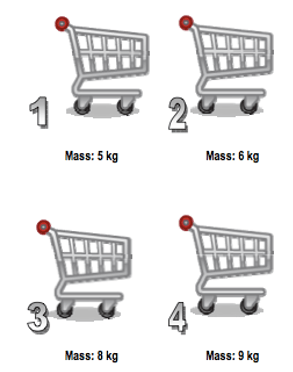
A force of 90N is applied to each cart below, which one will accelerate the fastest?
a)
Cart 1
b)
Cart 2
c)
Cart 3 
d)
Cart 4
30.

What is force?

a)

it's a Star Trek thing

b)

push or pull

c)

movement to the right or left

d)

acceleration due to gravity

31.

What would be the units for Force?

a)

Kilograms (Kg)

b)

Minutes (min)

c)

Meters per Second Squared (m/s²)

d)

Newtons (N)

32.

What could be a unit for acceleration?

a)

Kilograms (Kg)

b)

Minutes (min)

c)

Meters per Second Squared (m/s²)

d)

Newtons (N)

33.

What could be a unit for mass?

a)

Kilograms (Kg)

b)

Minutes (min)

c)

Meters per Second Squared (m/s²)

d)

Newtons (N)

34.

Find the acceleration of an object with 1 kg and 1 N.

a)

10 N

b)

1 N

c)

1 m/s²

d)

10 m/s2

35.

A force of 20 N acts upon a 5 kg block. Calculate the acceleration of the object.

a)

4 m/s²

b)

0.25 m/s²

c)

100 m/s²

d)

2 m/s²

36.

Find the force of an object with 8 kg and 3 m/s².

a)

12 N

b)

0.38 N

c)

2.7 N

d)

24 N

37.

What is the acceleration of a 50 kg object pushed with a force of 500 Newtons?

a)

1 m/s²

b)

10 m/s²

c)

0.1 m/s²

d)

25,000 m/s²

38.

It takes _______ force to move a larger/more massive object.

a)

more

b)

less

c)

same

d)

an equal amount of

39.
Which type of force(s) will cause a change in an object's motion?
a)
gravity
b)
zero net force
c)
balanced forces
d)
unbalanced forces
40.

_______ is the amount of matter in an object (location doesn't matter)

a)

Weight

b)

force

c)

Mass

d)

friction

41.
A student pushes a box to right with a force of 10N while a young boy pushes the box to the left with a force of 8N. What is the sum of all forces on the box? 
a)
18N left
b)
18N right
c)
2N right
d)
2N left
42.

Objects that INCREASE in mass (heavier), causes the acceleration to....

a)

increase

b)

decrease

c)

stay the same

d)

not move

43.

What is the formula for the 2nd law of motion?

a)

a = lw

b)

F = mama

c)

F = ma

d)

F = llama

44.
The masses of four objects are given in this table. If all objects are struck with the same amount of force, which one will have the greatest acceleration?
a)
Object 1
b)
Object 2
c)
Object 3
d)
Object 4
45.
You pull a wagon with your younger sister in it. Which of these would accelerate the rate at which you can pull the wagon?
a)
pull the wagon with less force
b)
Pull the wagon with more force
c)
Have your sister push down on the wagon
d)
Put another of your siblings in the wagon
46.

Match the following units to what they measure.

a)

Force

1.

Newtons (N)

b)

Mass

2.

Kilograms (kg)

c)

Acceleration

3.

Meters per second squared (m/s2)

47.

Mr. Austin pushes a box to the right with a force of 200 N. There's 50 N of friction.

The net force is ​ (a)   to the ​ (b)   .

Choose from the below words
150 N
right
250 N
4 N
left
48.

Match the equations to what they're used to calculate.

a)

F=maF=m\cdot a

1.

Force

b)

m=Fam=\frac{F}{a}

2.

Mass

c)

a=Fma=\frac{F}{m}

3.

Acceleration

49.
Newton’s first law of motion is also called the law of ________?
a)
Mass
b)
Inertia
c)
Force
d)
Velocity
50.
For every _______ there is an equal and opposite ________. 
a)
reaction, action
b)
action, action
c)
reaction, reaction
d)
action, reaction
51.
Why is it harder to push a van filled with bowling balls than it is to push a van with basketballs?
a)
The mass of the car is greater than the mass of the basketballs
b)
The mass of the bowling balls is greater than the mass of the basketballs
c)
The van with the basketballs is bigger than the van with the bowling balls
d)
It should be equally as hard to push the two vans
52.
A cup of coffee sits on the dashboard of an automobile. The car goes around a sharp curve. Even though you hold the cup still, coffee splashes out. This is explained due to 
a)
density
b)
friction
c)
gravity
d)
inertia 
53.
The acceleration produced by the net force on an object is in the same direction as the net force and  _____________________.
a)
Directly proportional to both the net force and the mass of the object
b)
Inversely proportional to both the net force the mass of the object
c)
Directly proportional to the mass of the object and inversely proportional to the net force
d)
Directly proportional to the net force and inversely proportional to the mass of the object
54.
Pressure is defined as:
a)
Force per unit of time
b)
Force per unit of area
c)
Time per unit of area
d)
Distance per unit of time
55.
Which of the following exerts the most pressure on the ground?
a)
A woman standing on snow shoes
b)
A woman standing in high heels shoes
c)
A woman standing in running shoes
d)
A woman lying down
56.
The combination of all forces acting on an object is called the ________.
a)
Sum force
b)
Newtonian force
c)
Net force
d)
Matrix force
57.
When all of the forces acting on an object add up to zero, it is called:
a)
equilibrium
b)
status quo
c)
inertia
d)
normal
58.
Friction is caused by:
a)
Irregularities between two surfaces
b)
Forces in conflict
c)
Heat
d)
Little green men
59.
Which of the following affect the size of the force of friction?
a)
weight of object
b)

the types of materials/

surface area in contact
c)
All of these
d)
how much the surfaces are pressed together
60.
The unit of pressure is the ________.
a)
Newton
b)
Pascal
c)
Ampere
d)
Galileo
61.
Two physics book with the same weight rest on the table.  One sits on its back, the other stands on its edge.  Which of the following statements are true?
a)
The one on its back will have a larger force of friction.
b)
The one on its back will have a smaller force of friction.
c)
The one on its back exerts a larger pressure on the table.
d)
The one on its back exerts a smaller pressure on the table.
62.
What is true when the parachuter first jumps out of a plane?
a)
His velocity is zero or almost zero.
b)
His acceleration is -10m/s2 at most
c)
He has almost no air resistance
d)
All of these are true
63.
After the parachuter has fallen a while, he reaches terminal velocity. Which is true now?
a)
His velocity is zero or almost zero
b)
His acceleration is the most it can be – 10 m/s2
c)
His velocity is constant
d)
All of these are true
64.
The parachuter pulls his ripcord and deploys the parachute. As soon as the parachute opens, what is true?
a)
His acceleration is upward
b)
He has almost no air resistance
c)
His velocity is upwards
d)
All of these are true
65.
What is the terminal velocity of a parachuter with an open parachute compared to one with a closed parachute?
a)
The open parachute has a zero velocity
b)
The open parachuter has the same constant velocity as the closed parachute
c)
The open parachuter has a slower constant velocity than the closed parachute
d)
The open parachuter is accelerating
66.

If you jump out of an airplane, which two forces are acting on you?

a)

Gravity and friction

b)

Force and gravity

c)

Gravity and Air Resistance

67.

When you drop a hammer and a feather on the moon what will happen? There is no air on the moon.

a)

They will hit at the same time

b)

The hammer will hit first

c)

The feather will hit first

68.

Friction is a force that __________ motion.

a)

opposes

b)

promotes

c)

increases

d)

starts

69.

Friction depends on _____ surfaces in contact.

a)

1

b)

2

c)

3

d)

4

70.

You can represent the direction of force using a __________.

a)

signal

b)

vector

c)

diagram

71.

Sliding friction increases with __________.

a)

weight

b)

mass

c)

density

72.

True or False.

It is impossible to totally eliminate friction.

a)

True

b)

False

73.

Select all of the ways to reduce friction.

a)

lubricants

b)

heat

c)

cold

d)

ball bearing

74.
Wheels on a skateboard most likely experiences-
a)
Rolling Friction
b)
Sliding Friction
c)
Fluid Friction
d)
Static Friction
75.
Sally experiences-
a)
Rolling Friction
b)
Sliding Friction
c)
Fluid Friction
d)
Static Friction
76.
Wheels of a shopping cart experience-
a)
Rolling Friction
b)
Sliding Friction
c)
Fluid Friction
d)
Static Friction
77.
Swimming fish experience-
a)
Rolling Friction
b)
Sliding Friction
c)
Fluid Friction
d)
Static Friction
78.
Objects balanced on Timmy's head experiences-
a)
Rolling Friction
b)
Sliding Friction
c)
Fluid Friction
d)
Static Friction
79.
How can friction be reduced?
a)
reduce the force acting between the 2 surfaces
b)
reduce the roughness of the 2 surfaces coming in contact
c)
use wax, grease or oil
d)
all of the above are ways of reducing friction
80.
What are 2 factors that determine the amount of friction between 2 objects?
a)
Force and roughness between surfaces
b)
hills and valleys and how smooth or rough the surface is
c)
Amount of force and amount of surface the comes in contact
d)
The force and the weight exerted on the surfaces
81.
When two surfaces rub, the irregularities of one surface get caught on those of the other surface?
a)
True
b)
False