Wayground logo

Free Printable Worksheets

Font size

S
M
L
XL
Worksheets

Giffin 1st 9-weeks exam review (Sci Proc, Motion, Forces)

Total questions: 70

Worksheet time: 55mins

Name
Class
Date
1.

Which of the following answers the scientific question or problem?

a)

Claim

b)

Evidence

c)

Reasoning

2.

Which of the following is the best definition of "evidence?"

a)

Data/facts that support your claim

b)

Reasoning that justifies your evidence

c)

All data or facts about a subject

d)

A statement that answers a question

3.

Xbox has the best multiplayer games.

a)

Claim

b)

Evidence

c)

Reasoning

4.

You should eat a banana every day. Bananas have nutrients like potassium and magnesium. Because our bodies need potassium and magnesium to work, it is a good idea to eat a banana every day. 


Which is the evidence? 

a)

Bananas have nutrients like potassium and magnesium.

b)

Because our bodies need potassium and magnesium to work, it is a good idea to eat a banana every day.

c)

You should eat a banana every day because they have nutrients.

d)

Bananas are sweeter when they are ripe.

5.

The flower is 8 cm tall.

a)

qualitative data

b)

quantitative data

6.

What are observations made using our five senses called?

a)

qualitative data

b)

quantitative data

7.

The center of the flower is yellow and fuzzy.

a)

qualitative data

b)

quantitative data

8.

The flower has 25 petals.

a)

qualtitative data

b)

quantitative data

9.

Using your senses to gather information is called an _____?

a)

observation

b)

inference

c)

question

10.

Explaining or interpreting the observations is called _____?

a)

observation

b)

inference

c)

question

11.
When experimenting with the growth of a plant, a scientist uses three (of the same type of) plants, two different fertilizers, equal light, and equal water. What type of variable is the fertilizer?
a)
Dependent
b)
Independent
c)
Control
d)
Compound
12.
How many variables should you change in an experiment?
a)
none
b)
1
c)
2 or more
d)
depends on the type of experiment
13.
The variable in an experiment deliberately changed by the scientist. The variable being tested.
a)
dependent variable
b)
independent variable
c)
data
d)
control group
14.
If you were testing how well different dish soaps cleaned grease, the independent variable would be the:
a)
dish type
b)
amount of grease
c)
dish soap type
d)
grease type
15.
Dory set up an experiment to see how the mass of a ball affects the distance it rolls off a ramp. What is the dependent variable?
a)
distance traveled by the ball
b)
height of the ramp
c)
mass of the ball
d)
ball type
16.
What is the control group?
a)
amount of time the spray stays on the shower
b)
the half of the shower sprayed with water
c)
the half of the shower sprayed with coconut juice
d)
the amount of slime
17.
The part of the experiment that does not contain the independent variable. Used for comparison.
a)
Control Group
b)
Experimental Group
c)
Results
d)
Data
18.
What are all the things that are kept the same in an experiment?
a)
controls
b)
data
c)
constants
d)
independent variables
19.

Object is...

a)

constant speed

b)

speeding up

c)

slowing down

d)

stopped

20.

Object is...

(hint: equal distance... equal time)

a)

constant speed

b)

speeding up

c)

slowing down

d)

stopped

21.

Object is...

a)

(1) speeding up,

(2) constant speed,

(3) speeding up

b)

(1) constant speed.

(2) stopped,

(3) constant speed

22.

Object is ...

(check that "y" axis!)

a)

stopped

b)

constant speed

c)

speeding up

23.

Object is ...

a)

stopped

b)

constant speed

c)

speeding up

24.

Object ...

a)

accelerates... then goes constant speed... then accelerates again

b)

goes constant speed... stops... goes constant speed

25.
Which runner was faster?
a)
Runner A
b)
Runner B
26.

What is a plausible story for this graph?

a)

A student was jogging from school to home. She stopped to tie her shoe and take a drink from her water bottle, then continued at the same pace as before.

b)

A student was jogging from school to home. She walked for a while, then continued jogging.

c)

A sled rider was going down a hill. The hill was steep at first, then kind of flat. At the end, it was steep again.

d)

A car was slowing down, then contued moving at a constant rate. Finally, it slowed to a stop,
27.
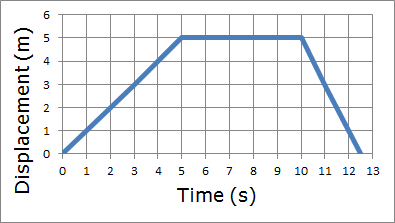
According to the graph how far does the person travel in the first 5 seconds?
a)
2 m
b)
10 m
c)
0 m
d)
5 m
28.
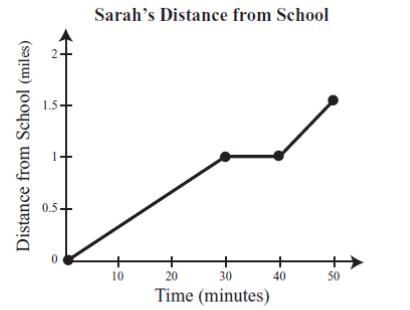
What is happening in the graph between 30 and 40 minutes?
a)
Sarah is accelerating
b)
Sarah is not moving
c)
Sarah is slowing down
d)
Sarah is travelling at a constant speed
29.
What is the speed of a car that travels 400 m in 20 minutes?
a)
20 miles/hr
b)
20 m/min
c)
800 m/min
d)
200 miles/hr
30.
Which of the following is a unit of speed ?
a)
sec
b)
mi
c)
m/s
d)
min
31.
What is happening at D?
a)
Stationary
b)
Accelerating
c)
Fast steady speed; moving away from the starting position
d)
Slower steady speed; moving away from the starting position
32.
A runner races in the 100 meter dash.  It takes her 10 seconds to finish.  What is her average speed?
a)
10 m/s
b)
1000 m/s
c)
100 seconds
d)
10 seconds
33.

Read the statement and decide if it's an observation or inference:

The man is wearing a striped tie.

a)

Observation

b)

Inference

34.

Read the statement and decide if it's an observation or inference:

The car seems to be a VW Buggy

a)

Observation

b)

Inference

35.

It's December.

a)

Observation

b)

Inference

36.
If there are two forces going in the same direction how would you find the net force?
a)
Subtract
b)
Add
c)
Neither
d)
Multiply
37.

Find the net force: 15 N to the right, and another 15 Newtons to the right.

a)
0 N Right
b)
0 N Left
c)
30 N Left
d)
30 N Right
38.

8 N to the left and 4 N to the right. Find the net force. Is this balanced?

a)

12 N Right No

b)

4 N Left No

c)

12 N Right Yes

d)

4 N Left Yes

39.
What is force?
a)

mass of an object

b)
A push or pull exerted on an object
c)

acceleration of an object

d)
Nothing
40.

Forces that have a net force of zero.

a)
Balanced force
b)
Unbalanced force
41.

The attraction force that pulls things toward earth.

a)

Speed

b)

Gravity

42.
If the net force is 0 the object is... 
a)

accelerating

b)

not accelerating

43.
You and your dad are moving the couch from one side to another. Your dad pushes with a force of 35 N to the right and you push with a force of 25 N right. What is the net force on the couch?
a)
60 N right
b)
10 N left
c)
60 n right
d)
50 N left
44.
__________ is the sum of all forces acting on an object. It is capable of accelerating a mass. 
a)
velocity
b)
gravity
c)
net force
d)
distance
45.
What is the unit of measurement for force?
a)
AMP
b)
Seconds
c)
Newtons
d)
Miles
46.
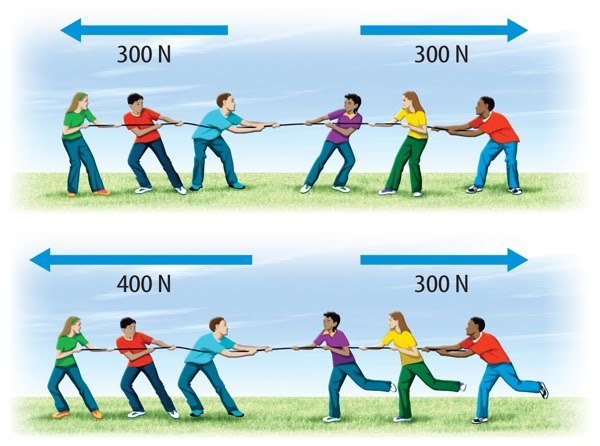
Which one is balanced?
a)
top
b)
bottom
c)
both
47.
What is the magnitude (size) and direction of the net force?
a)
15 N to the left
b)
15 N to the right
c)
1 N to the left
d)
1 N to the right
48.

Neglecting air friction, if you dropped a bowling ball and a golf ball from the top of a building, which one would hit the ground first?

a)

bowling ball

b)

baseball

c)

they will both hit at the same time

49.

Total distance divided by total time, for an object shows:

a)

acceleration

b)

the size of one's toupee

c)

absolute speed

d)

average speed

50.
What is speed?
a)
how far you go
b)
how much distance is covered over a period of time
c)
how fast you accelerate
d)
the change in the location of a object
51.
What is velocity?
a)
the quickness of an object
b)
the location of an object
c)
acceleration
d)
speed in a specific direction
52.
Can be measured in meters per second (m/s)
a)
Distance
b)
Time
c)
Speed
d)
Acceleration
53.
Cheryl cycles at an average speed of 8km/h. How far has she traveled if she cycles for 4 hours?
a)
55km
b)
32km
c)
43km
d)
32miles
54.

Calculate the velocity of a car that travels 556 kilometers northeast in 3.4 hours.

a)

163.52 km/hr northeast

b)

163.52 km/hr

c)

0.006 km/hr

d)

0.006 km/hr northeast

55.

  How far will a train moving at 5.7 km/min go in 45 minutes?

a)
256.5 km
b)
0.12 km
c)
7.89 km
56.
If a man runs at a speed of 70 m/s, and has a time of 30 s. What is the distance he ran?
a)
2100 m
b)
0.233 m
c)
2.33 m
d)
300m
57.
If a robot chases you down at a speed of 900 m/s for a distance of 200 m. How long has the robot been chasing you?
a)
0.22 s
b)
4.5 s
c)
180000 s
58.
Wind blowing at 20 mph.Vector or scalar?
a)
Scalar
b)
Vector
59.

Is 30 m/s East a Scalar or Vector quantity?

a)
Scalar
b)
Vector
c)
Neither
60.

Is a deer running 15 meters per second west a vector or scalar quantity?

a)
Scalar
b)
Vector
61.

A plane flying 300 mph west toward California is an example of...

a)

Speed

b)

Velocity

c)

Acceleration

d)

Direction

62.

Pick all of the following that are velocities.

a)

4 km/s west

b)

5 cm/h south

c)

2 mph

d)

8 cm/left

e)

5 m/s up

63.
In each of the following cases, determine where the car has no acceleration ?
a)
A car shortly after a stoplight turns green.
b)
A car approaching a red light
c)
A car with the cruise control set at 80 km/h
d)
A car turning a curve at a constant speed
64.
A negative acceleration means that your object is _____. 
a)
not accelerating
b)
not moving
c)
speeding up 
d)
slowing down 
65.
Acceleration only takes place when things speed up. 
a)
True
b)
False
66.
A ball of clay is thrown at a wall at a velocity of 28.0 m/s.  After it hits the wall, it takes 0.020 s to stop.  What is the acceleration of the clay when it hits the wall?
a)
1400 m/s2
b)
-1400 m/s2
c)
0.56 m/s2
d)
-0.56 m/s2
67.
You are walking in a straight line at a consistent speed. Do you have acceleration? 
a)
no
b)
yes 
68.

What type of force is the BLUE arrow indicating?

a)

Applied Force

b)

Gravity

c)

Friction

d)

Normal Force

69.

What is the type of force that both the ground and the wall exerts on the sitting man?

a)

Friction

b)

Gravity

c)

Applied Force

d)

Normal Force

70.

The sky diver is currently accelerating due to gravity, what is the other force at work?

a)

Normal Force

b)

Friction

c)

Air Resistance

d)

Applied Force