
 Worksheets
Staley Edisto midterm Fall 2023
Total questions: 76
Worksheet time: 55mins
Name
Class
Date
1.
What are the states of matter?
a)
solid, liquid, and juice
b)
solid and liquid
c)
solid and gas
d)
solid, liquid, and gas
2.
a type of matter that can be found on earth as a solid, liquid, and gas
a)
gold
b)
water
c)
oxygen
d)
rock
3.
A description of objects that can be measured and observed.
a)
gas
b)
mustangs
c)
physical properties
d)
melting point
4.
Example for Physical Property
a)
Taste
b)
explodes
5.
A physical property can be observed with your
a)
Eyes
b)
Ears
c)
Tastes
d)
All of the above
6.
Cutting an orange is a physical change.
a)
True
b)
False
7.
An example of a physical property is
a)
flammability
b)
acidic
c)
color
d)
ability to rust
8.
Which change can occur when you add heat energy to water?
a)
The water can change from a liquid to a solid
b)
The water can change from a gas to a liquid
c)
The water can change from a liquid to a gas
d)
The water can change from a solid to a liquid
9.
Changing the way matter looks without changing it into NEW matter is a:
a)
Chemical change
b)
Physical change
c)
Energy change
d)
BOTH a chemical and a physical change
10.
Which term means "the ability to cause change?"
a)
Matter
b)
Heat
c)
Energy
d)
physical change
11.
Which term means "the ability to cause change?"
a)
Matter
b)
Heat
c)
Energy
d)
physical change
12.
Chopping wood is an example of a:
a)
Physical change
b)
Chemical change
13.
Water freezing to ice is an example of a:
a)
Physical change
b)
Chemical change
14.
Burning wood to ash is an example of a:
a)
Physical change
b)
Chemical change
15.
A physical change does not need energy to occur.
a)
True
b)
False
16.
Adding HEAT to matter causes its particles to:
a)
move faster and farther apart
b)
Move slower and farther apart
c)
Move faster and closer together
d)
Move slower and closer together
17.
Anything that takes up space and has mass is...
a)
Matter
b)
Work
c)
Power
d)
Newton's 1st Law
18.
The classification of matter as a solid, liquid, or a gas.
a)
Matter
b)
Mass
c)
Physical State
d)
Thermal Energy
19.
The amount of stuff in something, measured in kg
a)
Matter
b)
Mass
c)
Solubility
d)
Conductor
20.
Students place ice cubes outside on the ground, on a hot summer day. Which best describes how the ice cubes change over time?
a)
Gas to solid to liquid
b)
Liquid to gas to solid
c)
Solid to liquid to gas
d)
Solid to gas to liquid
21.
What is happening at the boiling point?
a)
liquid to gas
b)
gas to liquid
c)
solid to liquid
d)
liquid to solid
22.
What is happening at freezing point?
a)
gas to liquid
b)
solid to liquid
c)
liquid to solid
d)
liquid to gas
23.
What is water's melting point?
a)
32 C
b)
0 C
c)
32 F
d)
0 F
24.
What is happening at water melting point?
a)
liquid to gas
b)
solid to liquid
c)
gas to liquid
d)
liquid to soild
25.
When does condensation happen?
a)
solid to liquid
b)
liquid to gas
c)
gas to liquid
d)
solid to gas
26.
A combination of two or more substances that cannot easily be separated--
a)
mixture
b)
solution
c)
solute
d)
solvent
27.

All are solutes except
a)
sugar
b)
pepper
c)
salt
d)
powdered chocolate
28.
To separate a mixture of salt and water what separation tool/method is used?
a)
Filter
b)
Screen
c)
Magnet
d)
Evaporation
29.

What number indicates the nucleus?
a)
1
b)
2
c)
3
d)
4
30.

Oxygen’s atomic number is 8. This means that an oxygen atom must have
a)
8 electrons
b)
8 protons
c)
8 neutrons
d)
a mass number of 8
31.

What number indicates an electron?
a)
1
b)
2
c)
3
d)
4
32.
What number indicates the nucleus?
a)
1
b)
2
c)
3
d)
4
33.
Oxygen’s atomic number is 8. This means that an oxygen atom must have
a)
8 electrons
b)
8 protons
c)
8 neutrons
d)
a mass number of 8
34.
What number indicates an electron?
a)
1
b)
2
c)
3
d)
4
35.
Which statement best describes an electron?
a)
Smaller mass than a proton and a negative charge
b)
Smaller mass than a proton and a positive charge
c)
Greater mass than a proton and a negative charge
d)
Greater mass than a proton and a positive charge
36.

What number indicates the nucleus?
a)
1
b)
2
c)
3
d)
4
37.
What is at the center of every atom?
a)
An electron
b)
A compound
c)
A molecule
d)
A nucleus
38.
Which two particles make up the nucleus of an atom?
a)
Protons and Electrons
b)
Protons and Neutrons
c)
Molecules and Compounds
d)
Neutrons and Electrons
39.
What is the role of an electron in an atom?
a)
Electrons live inside the nucleus and carry a neutral charge.
b)
Electrons circle the nucleus and have a positive charge.
c)
Electrons circle the nucleus and have a negative charge.
d)
Electrons live inside the nucleus and have a negative charge.
40.
In an atom, what is the number of protons equal to?
a)
The number of electrons.
b)
The number of neutrons.
c)
The number of molecules.
d)
The number of nuclei.
41.

The particles with no charge in an atom are the _______.
a)
electrons
b)
neutrons
c)
protons
d)
protons and neutrons
42.

The positively charged particles of an atom are the ________.
a)
electrons
b)
protons
c)
neutrons
d)
protons & neutrons
43.

The negatively charged particles of an atom are the ______.
a)
electrons
b)
protons
c)
neutrons
d)
protons & neutrons
44.
An electron has this charge
a)
positive
b)
negative
c)
neutral
45.
A neutron has this charge
a)
negative
b)
positive
c)
neutral
46.
A proton has this charge
a)
negative
b)
positive
c)
neutral
47.
Most of the atom is filled with
a)
electrons
b)
empty space
c)
the nucleus
d)
protons
48.
An atom with atomic number 6 would have how many protons?
a)
6
b)
12
c)
3
d)
cannot be determined
49.
How many electrons are in the element, Oxygen, with the atomic number of 8?
a)
7
b)
10
c)
8
d)
9
50.
The word atom comes from a Greek word "atomos" that means
a)
Invisible
b)
Indivisible
c)
Undivided
d)
Indestructable
51.
The first person to propose a theory about an atom was
a)
Democritus
b)
Rutherford
c)
Dalton
d)
Aristotle
52.

Rutherford's gold foil experiment provided evidence that...
a)
Negative and positive charges are spread evenly throughout the atom.
b)
Alpha particles have a positive charge.
c)
Gold is not a dense as previously thought.
d)
There is a dense positively charged nucleus at the center of an atom.
53.

J.J. Thomson provided evidence that an atom...
a)
is the smallest particle of matter
b)
contains negatively and positively charged particles
c)
has an overall negative charge
d)
has an overall positive charge
54.

What contribution did John Dalton make to atomic theory?
a)
He discovered that every atom was positively charged.
b)
He discovered that every element consisted of one type of atom.
c)
He discovered that atoms had nuclei.
d)
He discovered that atoms could be divided into smaller parts.
55.
How did Rutherford discover the proton?
a)
Cathode tube ray experiment
b)
Gold Foil Experiment
c)
Planetary Model
d)
Plum Pudding Model
56.
Who stated that all atoms of the same element are exactly alike?
a)
Democritus
b)
Dalton
c)
Thomson
d)
Borh
57.
What is the simplest form of matter?
a)
elements
b)
molecules
c)
compounds
d)
particles
58.
Which of the following is an example of a compound?
a)
Si (Silicon)
b)
NaCl (Salt)
c)
O (Oxygen)
d)
H (Hydrogen)
59.
A substance made of two or more different elements chemically combined
a)
Elements
b)
Atoms
c)
Compounds
d)
Substances
60.
Which of the following is NOT an example of an element?
a)
Ne (Neon)
b)
S (Sulfur)
c)
Fr (Francium)
d)
NaCl (Salt)
61.
Pure substance that can't be broken down into any other substance
a)
Elements
b)
Atoms
c)
Compounds
d)
Molecules
62.
Atomic Mass - Atomic Number = ???
a)
Number of protons
b)
Number of electrons
c)
Number of neutrons
d)
Atomic Number
63.

This is an example of what?
a)
element
b)
compound
c)
substance
d)
atom
64.
Which of the following is an example of a compound?
a)
Table Salt
b)
Hydrogen
c)
Oxygen
d)
Calcium
65.

This is an example of...
a)
molecules
b)
atoms
c)
substance
d)
compound
66.
Which of these compounds has the most atoms?
a)
CO2
b)
C6,H12,O6
c)
O2
d)
Na,Cl,He,O3
67.
What is the difference between elements and compounds?
a)
elements have more than one kind of atom while compounds have only one kind of atom
b)
elements can separate by physical means while compounds cannot
c)
compounds have more than one kind of atom while elements have only one kind of atom
d)
elements are acids while compounds are bases
68.
The Modern Periodic Table of Elements is arranged by
a)
atomic mass
b)
atomic number
c)
valence electrons
d)
number of isotopes
69.
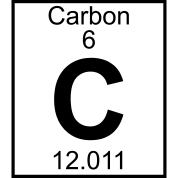
What does the 6 represent?
a)
atomic mass
b)
atomic number
c)
element name
d)
chemical symbol
70.
These are found on the Periodic Table.
a)
Compounds
b)
Elements
c)
Mixtures
71.
the basic structural unit of matter
a)
atom
b)
matter
c)
element
d)
nucleus
72.
a subatomic particle, contained in the nucleus of an atom, having the same mass as a proton but no electrical charge
a)
proton
b)
neutron
c)
electron
d)
matter
73.
a negatively charged subatomic particle that orbits the nucleus of an atom
a)
proton
b)
neutron
c)
electron
d)
matter
74.
one or two letters that represent the name of an element
a)
element name
b)
element symbol
c)
atomic number
d)
atomic mass
75.
a grouping of elements based on similar properties, arranged by columns in the periodic table; also known as a group
a)
family
b)
period
c)
row
d)
isotope
76.

Which is an electron?
a)
A
b)
B
c)
C
100 %

