
 Worksheets
Physical Science 1st Semester Mid-Term Review
Total questions: 72
Worksheet time: 2hrs 18mins
The base measurement for mass is...
kilogram
liters
grams
meters
What is the basic unit of mass in the metric system?
Liter
Meter
Gram
Kilometer
Select the largest unit.
kilogram
centigram
decigram
decagram
Which unit is NOT used in the metric system?
Meter
Gram
Liter
Pound

What is this tool to get mass?
triple beam balance
thermometer
ruler
graduate cylinder
speed of an object in a particular direction
motion
velocity
speed
acceleration
total distance traveled divided by total time taken to travel that distance
velocity
motion
acceleration
average speed

The formula for calculating speed is...(x means multiply; / means divide)
time x distance
distance x speed
distance / time
time / distance
Objects with greater _________ also have greater inertia.
speed
mass
force
friction
Inertia refers to ___________
(select all the apply)
the tendency of moving objects to remain in motion
the force which keeps moving objects in motion with a constant velocity
the force that keeps stationary objects at rest
the tendency of stationary objects to remain at rest
Acceleration can be... (select all that apply)
speeding up
slowing down
staying at constant speed
changing directions
Select the equation for acceleration.


A horse accelerates from a velocity of 0m/s to 20 m/s in 3 seconds. What is the acceleration of the horse?
60 m/s2
6.67 m/s2
0.15 m/s2
30 m/s2

A train decelerates from a velocity of 90 m/s to 80m/s in over 10 seconds. What is the train's acceleration?
-1 m/s2
1 m/s2
10 m/s2
-10 m/s2
Colin skateboards down the sidewalk in front of the school, traveling at 24 km/h. How much time would it take him to travel 6.0 km?
0.25 h
0.4 h
5.4 h
12 h
Sharis decides to be brave and go skydiving. If she accelerates at 9.81 m/s2 (m/s2 = m/s/s) for 4.9 s, what would her speed be at that time?
48.1 m/s
0.6 m/s
0.0015 m/s
7.1 m/s
If 1 ft = 30.48cm, how many centimetres are there is 9.2ft?
2.8041cm
2.8041m
280.416cm
280.416m
A train travels at 52 km/h. How far does it travel in
15 min?
780 m
780 km
13 m
13 km

It takes more force to accelerate the iron man on the left than the iron man on the right because the iron man on the left has more mass. This best describes
Newton's first law, the law of inertia
Newton's second law, the law of acceleration
Newton's third law, the law of action reaction
The law of universal gravitation

What is Newton's 1st law?
Law of Force and Acceleration
Law of Inertia
Law of Action-Reaction
Law of motion
Newtons 3rd Law of Motion states:
An object at rest will remain at rest unless acted upon by an outside force.
For every action, there is an equal and opposite reaction
The greater the mass of an object, the more force it will take to accelerate the object
A fireman turns on his hose and is knocked backwards is an example of...
Newton's 1st Law
Newton's 2nd Law
Newton's 3rd Law
Newton's 4rth Law

Which law would we think of when we see the flames of a rocket shooting down so the rocket can go up?
1st
2nd
3rd
Which law can be simply described with the equation:
F = MxA
1st
2nd
3rd


This person bought coffee and put it on the seat next to them. When they stopped quickly and the coffee spilled which law would that be?
Newton's 1st Law
Newton's 2nd Law
Newton's 3rd Law


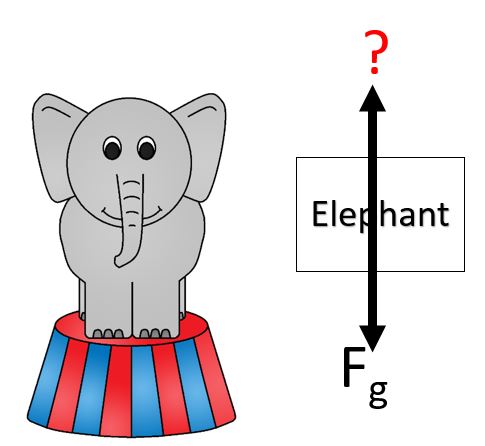
A downward-moving skydiver who has just opened the parachute is slowing down.


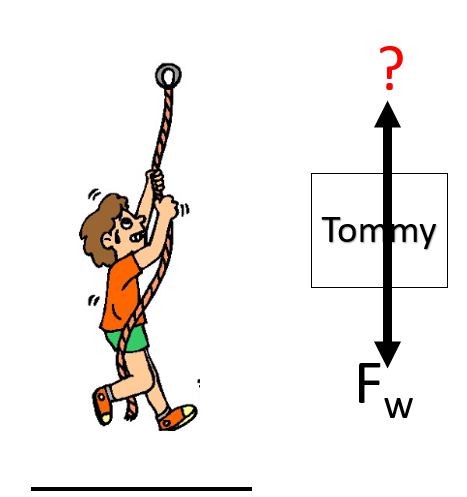
A leftward force is applied to a crate to push it across the floor at a constant speed. Which is the correct force diagram?


A hockey puck glides to the right across the ice at a constant speed.


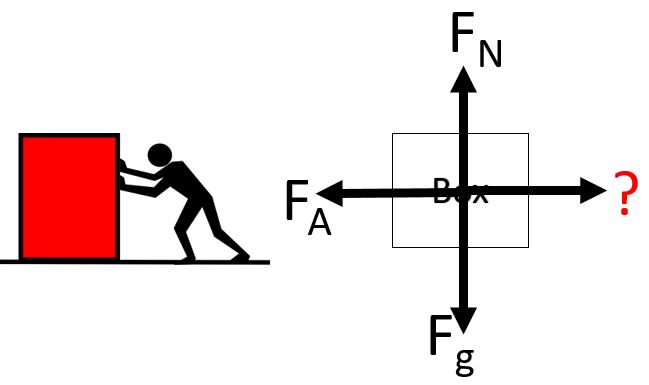
The force that keeps objects on top of surfaces instead of letting them sink into the surface is known as:
normal
abnormal
static
inertia
In a force diagram the size/length of the arrow tells you this about the force:
the strength of the force
the distance of the force
the direction of the force
A rightward force is applied to a dresser to accelerate it to the right across the bedroom floor.


What is the net force?
40 N left
0 N Balanced
400 N right
40 N right

Which way is the object moving?
it's either not moving or moving at a constant speed due to balanced forces
to the right
to the bottom
up
When determining the NET force on an object you should (TWO correct answers):
subtract forces in opposite directions
add forces in the same direction
subtract forces in the same direction
add forces in the opposite direction
multiply the forces in the same direction
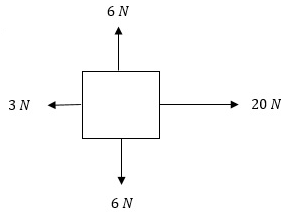
What is the NET FORCE of this diagram?
17 N, right
17 N, left
23 N, right
12 N, up

the force that pulls objects toward each other
gravity
free fall
weight
Universal Law of Gravitation
If a student pushes with 500 N of force on a cart against a wall. The cart doesn't move. Why?
The wall is sturdy
The wall pushed back with a force of 500 N
The wall pushed back with a force of 650 N
The wall pushed back with a force of 350 N
Football A has a greater mass than football B. Which football will have greater acceleration when both are thrown with the same force in the same direction?
Football A
Football B
They will have the same acceleration
Mass has no effect on acceleration
When force is 20 N, mass is 5 kg, what is acceleration?
25 m/s/s
5 m/s/s
100 m/s/s
4 m/s/s
What Unit do we Measure Force in?
Newtons
Joules
Volts
Lumens
An object accelerates 5 m/s2 when a force of 20 newtons is applied to it. What is the mass of the object?
4 kg
20 kg
0.5 kg
2 kg
An object accelerates 8 m/s2 when a force of 40 newtons is applied to it. What is the mass of the object?
4 kg
20 kg
5 kg
0.2 kg

