wayground logo

Free Printable Worksheets

Font size

S
M
L
XL
Worksheets

PBS 2.2 Test Review

Total questions: 75

Worksheet time: 1hrs 21mins

Name
Class
Date
1.
In DNA, Adenine pairs with ___________. 
a)
Guanine
b)
Cytosine
c)
Thymine
d)
Uracil
2.
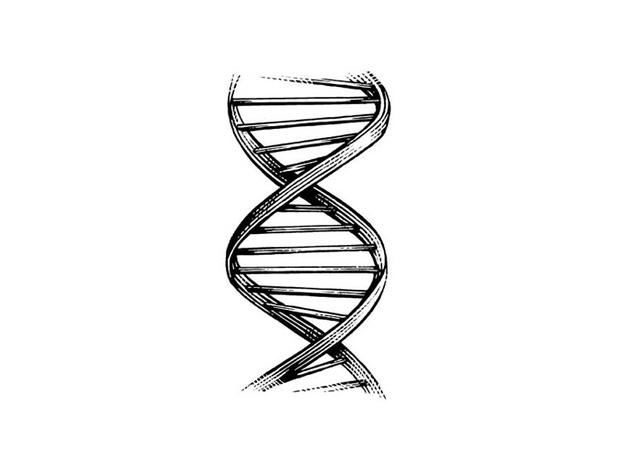
DNA has a _____________ structure. 
a)
double helix
b)
single strand
c)
ring 
d)
chain
3.
In RNA, Uracil pairs with ______. 
a)
cytosine
b)
adenine
c)
guanine
d)
thymine
4.
The mRNA leaves the ________ to find the ribosome to make proteins.
a)
cell
b)
nucleotide
c)
nucleus
5.

DNA holds the code for making

a)

lipids

b)

carbohydrates

c)

proteins

d)

sugars

6.

Choose the sequence of the mRNA strand that would be match up with to the following strand:

GTAGTCA

a)

UATUAGA

b)

ACGACTG

c)

CAUCAGU

d)

CATCAGT

7.
The main function of tRNA is to...
a)
carry a message that, when translated, forms proteins
b)
form a portion of ribosomes
c)
string together complementary RNA and DNA strands
d)
bring amino acids from the cytoplasm to the ribosomes
8.
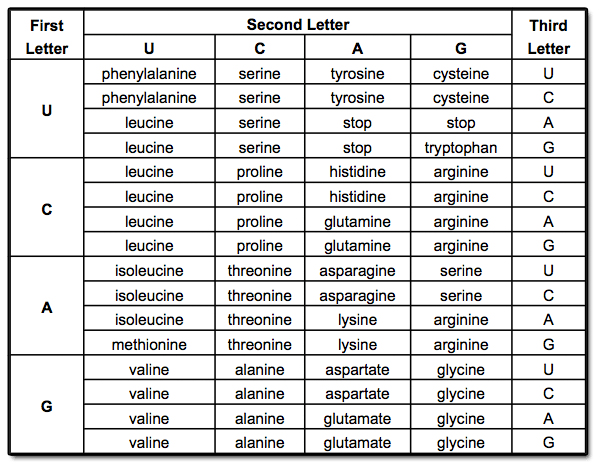
What amino acid is represented by the codon UUA?
a)
Phenylalanine
b)
Tyrosine
c)
Leucine
d)
Stop codon
9.

What is the correct amino acid sequence for the mRNA code AUGCCAGUAUGA

a)

Met-Pro-Ala-Val

b)

Met-Pro-Val

c)

Tyr-Gly-His

d)

Tyr-Gly-Arg-His

10.

Which is the mRNA molecule that would be created from this DNA template:

TGGCAAGTACGT

a)

ACCGTTCATGCA

b)

UGGCAAGUACGU

c)

UCCGUUCUUGCU

d)

ACCGUUCAUGCA

11.
Contains the bases adenine, uracil, cytosine and guanine
a)
DNA
b)
RNA
c)
Both
12.
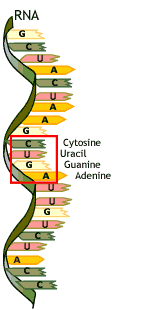
What part of protein synthesis does this diagram represent?
a)
mRNA
b)
tRNA
c)
rRNA
d)
RNA
13.
Guanine bonds with ______________.
a)
Adenine
b)
Guanine
c)
Cytosine
d)
Thymine
14.
DNA travels outside of the nucleus.
a)
true
b)
false
15.
Messenger RNA carries a copy of the DNA code.
a)
true
b)
false
16.
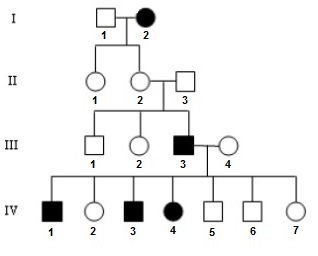
What does a filled in square represent?
a)
Not affected Female
b)
Not affected Male
c)
Affected Male
d)
Affected Female
17.
How many generations are shown in this pedigree?
a)
1
b)
2
c)
3
d)
4
18.
How many kids did the mother and father from the first generation have?
a)
2
b)
4
c)
5
d)
6
19.
This pedigree represents the inheritance of hemophilia in this family. How many of the females have the hemophilia trait?
a)
8
b)
5
c)
2
d)
3
20.
What do half colored symbols represent?
a)
The individual is a carrier (heterozygous).
b)
The individual expresses the trait.
c)
The individual has both recessive alleles.
d)
The individual has both dominant alleles.
21.
What does an open circle represent?
a)
Not Affected Male
b)
Not Affected Female
c)
Affected Male
d)
Affected Female
22.
In the second generation-how many people are carriers of the trait?
a)
2
b)
3
c)
5
d)
6
23.
How many people in this whole pedigree have the trait/disease?
a)
2
b)
3
c)
4
d)
6
24.
How many females are in this pedigree?
a)
3
b)
4
c)
6
d)
7
25.

In this pedigree, which gender can be carriers of colorblindness and not have it?

a)

Just males

b)

Just females

c)

Both genders

26.
If this pedigree shows an autosomal recessive disorder, what MUST the genotype of individual II-3 be?
a)
HH
b)
Hh
c)
hh
d)
None of the above
27.

Objective #13

This is a pedigree that follows blue eyes which is a recessive trait. What is the genotype of the father (square) in generation 1?

a)

Aa

b)

AA

c)

aa

d)

A?

28.

In this pedigree, the shading represents people in the family with dark hair while the unshaded represents blondes. Is dark hair controlled by a dominant or recessive allele?

a)

Dominant

b)

Recessive

29.
Homozygous is when...
a)
the alleles are the same
b)
the alleles are different
c)
the alleles are absent
d)
the alleles are present
30.
Heterozygous is when...
a)
the alleles are the same
b)
the alleles are different
c)
the alleles are absent
d)
the alleles are present
31.
In a heterozygous genotype, the ___________ allele takes over in the phenotype.
a)
recessive
b)
dominant
c)
lower case letter
d)
both 
32.
T - tall and t = short
In the punnett square below, what belongs in the missing square
a)
tt
b)
Tt
c)
Bb
d)
TT
33.
B = brown fur  b = white fur
In the punnett square, what is the probability for white fur? 
a)
0%
b)
25%
c)
50%
d)
75%
34.
In the punnett square shown, what must the genotype of the missing parent be?
a)
BB
b)
Bb
c)
bb
d)
Tt
35.
Which of the following is a phenotype?
a)
Aa
b)
black hair
c)
heterozygous genes
d)
mutated DNA
36.
Dominant or recessive?
tt
a)
Dominant 
b)
Recessive
37.
What is a dominant allele?
a)
A trait that is always shown (capital letter)
b)
A trait that can be hidden (lower case letter)
c)
Alleles that are the same
d)
Alleles that are different
38.
What does heterozygous mean?
a)
An organism that has the same genes for a trait (TT or tt)
b)
An organism that has different genes for a trait (Tt)
c)
When neither gene is fully dominant; offspring is a mixture of both
d)
the different forms of a trait (hair color--> brown, blonde, red
39.
Which of the following genotypes is heterozygous?
a)
Bb
b)
BB
c)
bb
d)
B
40.

Brown eyes are dominant over blue eyes. What is the probability that the offspring will have brown eyes in this cross?

a)

25%

b)

50%

c)

75%

d)

100%

41.

What are the "X" shaped things in the drawing.

a)

PMATs

b)

Chromosomes

c)

Ribosomes

d)

Telophase

42.

During what phase of Mitosis do the chromosomes line up in the Middle

a)

Metaphase

b)

Prophase

c)

Telophase

d)

Anaphase

43.

PMAT helps us remember the correct order of the phases of Mitosis. Which of the following has the phases of Mitosis in the correct Order

a)

Interphase, Mitosis, Cytokinesis

b)

Prophase, Metaphase, Anaphase, Prophase

c)

Anaphase, Telophase, Prophase, Telophase

d)

Prophase, Metaphase, Anaphase, Telophase

44.

In which phase of Mitosis do the Chromosomes pull Apart

a)

Metaphase

b)

Prophase

c)

Anaphase

d)

Telophase

45.

What stage of mitosis is depicted here

a)

Prophase

b)

Metaphase

c)

Anaphase

d)

Telophase

46.
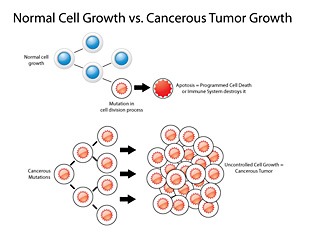
Cancer is best and fully described by ...
a)
Uncontrolled cell growth
b)
Cells which grow abnormally and no longer function correctly
c)
Cells which have lost the ability to reproduce
d)
Cells which create abnormal tissues
47.
Identify the stage of mitosis.
a)
interphase
b)
prophase
c)
metaphase
d)
anaphase
48.
Metastasis is
a)
the spread of cancer from one part of the body to another.
b)
the growth of tumors in the lungs
c)
cancer of the blood cells
d)
cancer that is found in connective tissues
49.
What is is called when a tumor proves to be NON cancerous?
a)
malignant
b)
benign
c)
oncogene
d)
byogene
50.

Which of the followings describes a cancerous cells?

a)

Atypical arrangement

b)

maintains organization

c)

specialized

d)

Single nuclei

51.
a)
Anaphase
b)
Cytonkinesis
c)
Interphase
d)
Prophase
52.
the two halves of the doubled chromosome structure 
a)
centromeres
b)
sister chromatids
c)
spindle
d)
tissues
53.
The structure that holds two chromosomes together until they separate for cell division is the
a)
chromatid
b)
chromatin
c)
centromere
d)
cytoplasm
54.
When cancer spreads to other tissues of the body, it is called...
a)
Metastasis
b)
Invasiveness
c)
Angiogenesis
d)
Chemotherapy
55.
This image shows the epidermis of a human. The blood cells are growing out of control. These are _______ cells.
a)
cancerous
b)
blood cells
c)
in the middle of apoptosis
d)
stem
56.

A mutation on which chromosome would lead to NF1?

(a)  

57.

Is NF1 hereditary? (passed through genetics)

a)

yes

b)

no

c)

maybe so

58.

A _______ is a picture of an individuals chromosomes. It helps scientists see if there are extra or missing chromosomes.

a)

genome

b)

gel electrophoresis

c)

karyotype

d)

PCR

59.

A karyotype for a typical human should have _____ chromosomes.

a)

46

b)

23

c)

22

d)

47

60.

Look at the Karyotype below. Is this a male or a female?

a)

Male

b)

Female

61.

This type of cell division creates the gametes.

a)

Mitosis

b)

Meiosis

62.

How many cells are created at the end of Meiosis?

a)

2

b)

6

c)

4

d)

8

63.

When the homologous chromosomes or sister chromatids fail to separate in Meiosis or Mitosis, this is called _____.

a)

tetrad

b)

crossing over

c)

independent assortment

d)

non-disjunction

64.

In a _____, one chromosome is missing and in a ______, there is one extra chromosome in the pair.

a)

trisomy, monosomy

b)

monosomy, monosomy

c)

trisomy, trisomy

d)

monosomy, trisomy

65.

The image below shows which type of chromosomal mutation?

a)

Inversion

b)

Insertion

c)

Deletion

d)

Translocation

66.

The image below shows which type of chromosomal mutation?

a)

Duplication

b)

Insertion

c)

Deletion

d)

Translocation

67.
Which structure is labeled as B in the diagram?
a)
Centromere
b)
Chromosome
c)
Sister chromatids
68.

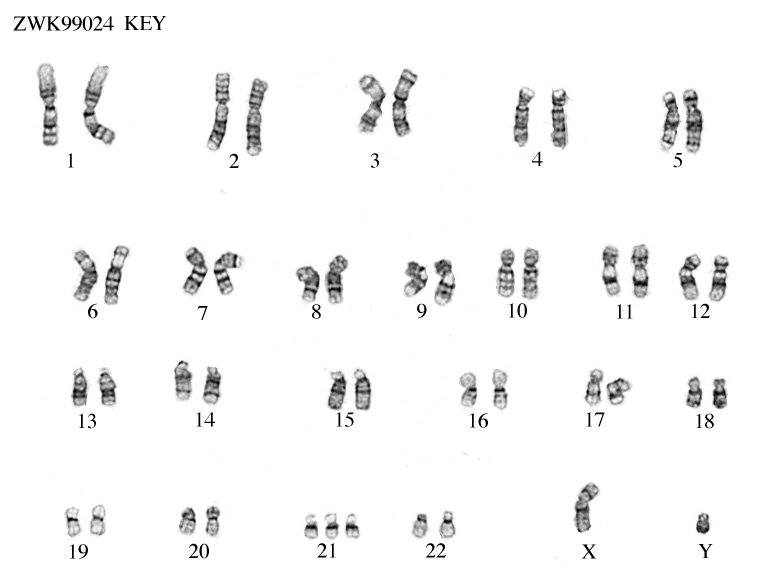
What is the mutation in this persons chromosomes?

a)

There is only one X

b)

7 is shaped like a hockey stick

c)

There's an extra 21

d)

1 is too curved

69.

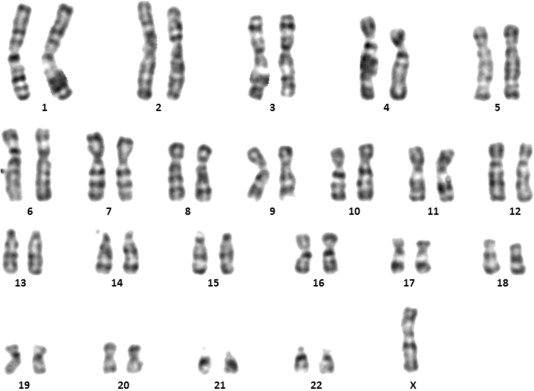
This is called Turners syndrome, can you notice the mutation in the chromosomes?

a)

Both chromosomes 1 are bent

b)

There are too many chromosomes

c)

There are too many of chromosome 3

d)

There is no Y chromosome

70.

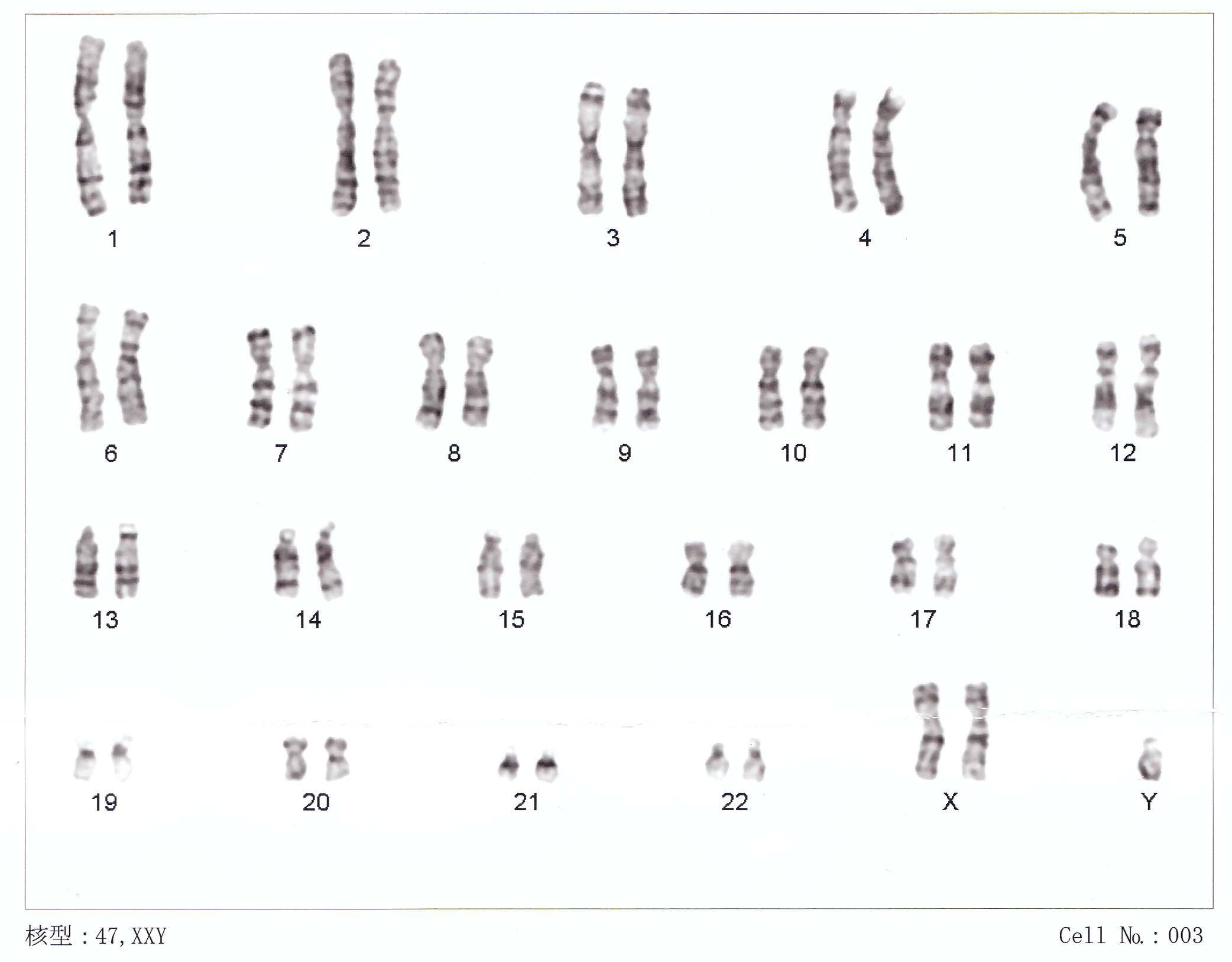
These are the chromosomes of someone with Kleinfelters syndrome. What is different about their chromosomes?

a)

There is only one Y chromosome

b)

One of the 5th chromosomes is too curved

c)

There is an extra X chromosome

d)

There are too few chromosomes

71.

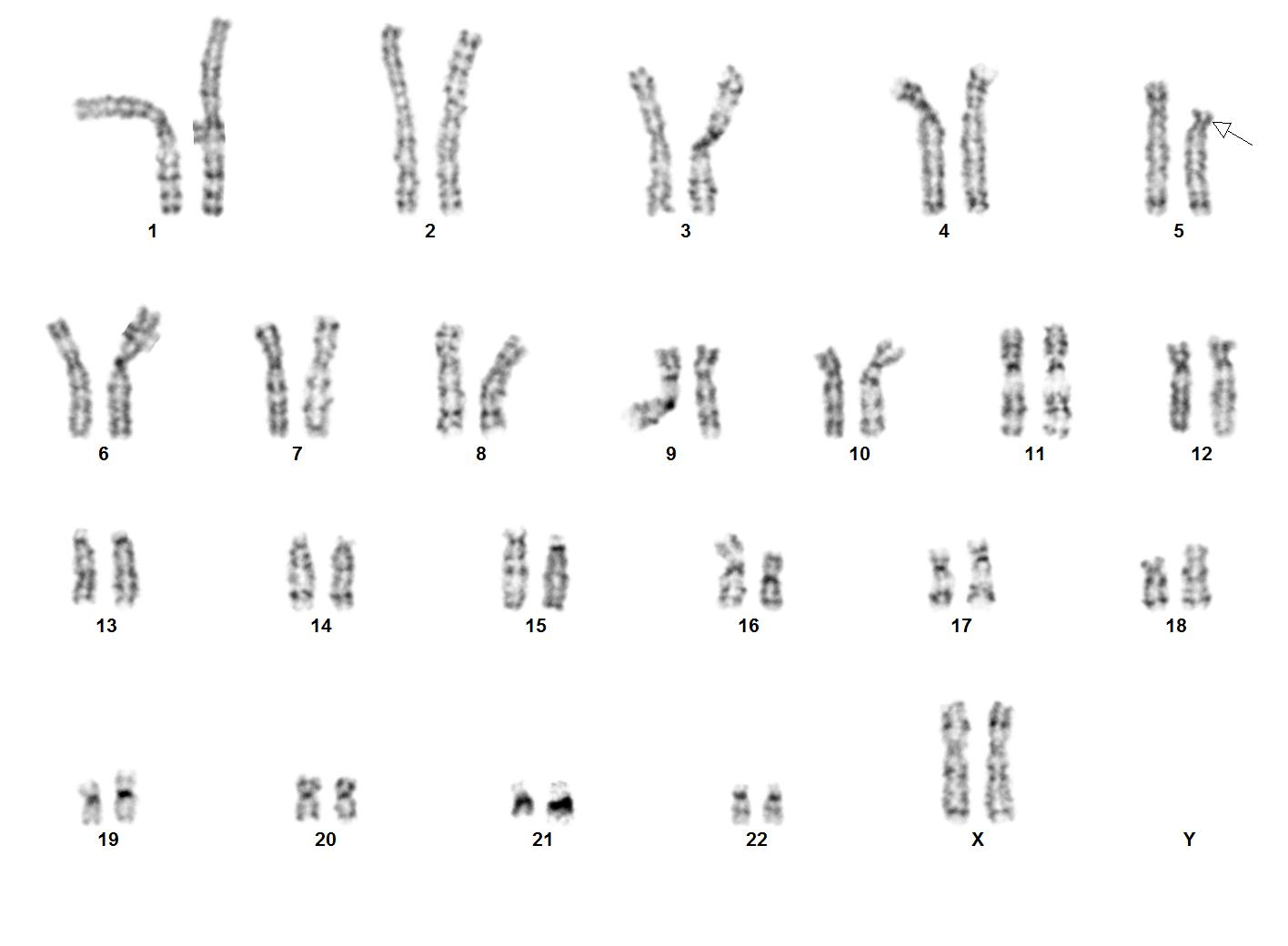
This disorder is called "Cry of the cat", can you find the chromosomal mutation?

a)

There are too many chromosomes

b)

They are missing the Y chromosome

c)

Chromosome 1 is bent

d)

Chromosome 5 is too short (missing a piece)
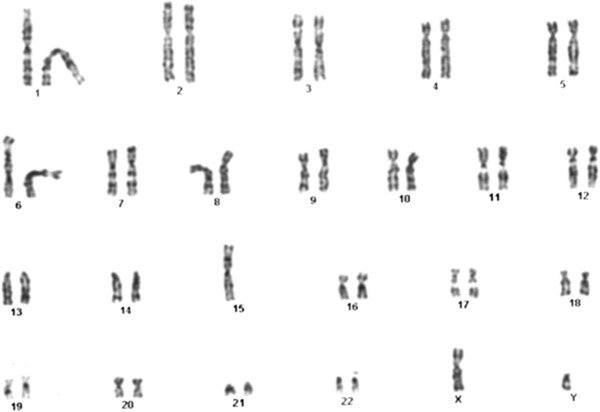
72.

This person has Angel Mans syndrome. What is different about their chromosomes?

a)

Chromosome 1 is misshapen

b)

Chromosomes 21 is too small

c)

They are missing one of chromosome 15

d)

Chromosomes 7 and 8 look weird

73.

Part of a chromosome is repeated

a)

Gene Mutation

b)

Point Mutation

c)

Deletion Mutation

d)

Duplication Mutation

74.

Part of a chromosome is reversed.

a)

Inversion Mutation

b)

Deletion Mutation

c)

Translocation

d)

Point Mutation

75.

Failure of homologous chromosomes

to separate during meiosis.

Results in gametes with either one extra or one missing chromosome.

a)

Translocation

b)

Nondisjunction

c)

Replication

d)

Transcription