

wayground logo

Free Printable Worksheets

NEW

Font size

S
M
L
XL
Worksheets

Unit 5 AP Biology : Heredity

Total questions: 80

Worksheet time: 1hrs 27mins

Name
Class
Date
1.

If an organism's diploid cells contain 20 chromosomes, its gametes would contain how many?

a)

10

b)

20

c)

30

d)

40

2.

Which of the following is an example of a gamete?

a)

neuron

b)

chromosome

c)

somatic cell

d)

egg

3.

What separates when cells divide in Meiosis 2

a)

Sister Chromatids

b)

Homologous Chromosomes

c)

Analogous Chromosomes

4.
A recessive trait will be observed in individuals that are ________ for that trait.
a)
heterozygous
b)
homozygous or heterozygous
c)
homozygous
d)
diploid
5.
Imagine you are performing a cross involving seed color in garden pea plants. What F1 offspring would you expect if you cross true-breeding parents with green seeds and yellow seeds? Yellow seed color is dominant over green.
a)
100 percent yellow-green seeds
b)
100 percent yellow seeds
c)
50 percent yellow, 50 percent green seeds
d)
25 percent green, 75 percent yellow seeds
6.
When an area of a chromatid is exchanged with the matching area on a chromatid of its homologous chromosome, _________________ occurs
a)
crossing over
b)
mutagenesis
c)
hybridization
d)
fertilization
7.
The observable outward manifestation of the genes of an individual is referred to as its
a)
blueprint
b)
genotype
c)
phenotype
d)
genetic map
8.
Unlike Mendel's experiments, when a very tall person and a very short person mate, the children are variable in height. Why is one trait (tall or short) not dominant over the other?
a)
the gene for height in humans has incomplete dominance
b)
the gene for height has multiple co-dominant alleles
c)
height in not controlled by genes in humans
d)
human height is controlled by multiple genes
9.
One of the main reasons genes assort independent of one another  is that 
a)
they produce unrelated traits
b)
they produce related traits
c)
they are on the same chromosome
d)
they are on different chromosomes.
10.

Chromosomes that do NOT play a role in determining the sex of an individual are called

a)

sex chromosoems

b)

X and Y

c)

autosomes

11.
In humans, hemophilia is an X-linked recessive trait. If a man and a woman have a son who is affected with hemophilia, which of the following is definitely true?
a)
The mother carries an allele for hemophilia
b)
The father carries an allele for hemophilia
c)
The father is afflicted with hemophilia
d)
both parents carry an allele for hemophilia
12.

A person with Turner syndrome has only one X chromosome. This means one of their gametes was missing a chromosome. Which of the following could cause this?

a)

Incomplete dominance

b)

Nondisjunction

c)

Inversion mutation

d)

Substitution mutation

13.
Hemophilia is a recessive x-linked disorder.
Which genotype represents a male with hemophilia?
a)
XHXh
b)
XhXh
c)
XHY
d)
XhY
14.
The range of human skin colors is caused by a variety of genes, each of which has at least 2 alleles.  This is an example of:
a)
incomplete dominance
b)
codominance
c)
multiple alleles
d)
polygenic inheritance
15.
Gametes are _________.
a)
Diploid
b)
Haploid
c)
Aneuploid
d)
variably ploidy
16.
The physical appearance of an organism based on traits
a)
Genotype
b)
Phenotype
c)
Meiosis
d)
Genetics
17.
What fraction of offspring from the cross AaBB x Aabb will be heterozygous for both traits?
a)
1/16
b)
4/16
c)
8/16
d)
3/16
18.
In Drosophila, the genes for eye colour (pr), wing shape (vg), and body colour (eb) are all found on the same chromosome. The following crossover frequencies for these genes were determined by experimentation. Determine the sequence of genes on the chromosome.
a)
eb - vg - pr
b)
vg - eb - pr
c)
vg - pr - eb
d)
pr- vg - eb
19.
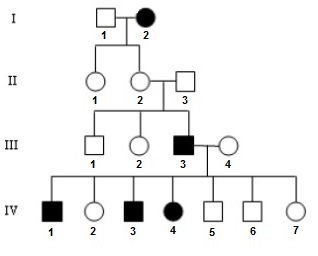
What type of heredity is shown in the pedigree?
(hint: check your notes - "modes of inheritance")
a)
Sex-Linked Dominant
b)
Sex-Linked Recessive
c)
Autosomal Dominant
d)
Autosomal Recessive 
20.

What is the genotype of the great-grandfather? (top row)

a)

A_

b)

aa

c)

Aa

d)

AA

21.
X-linked conditions are more common in men than in women because
a)
The genes associated with the  X linked conditions are linked to the X chromosome, which determines maleness.
b)
Men need to inherit only one copy of the recessive allele for the condition to be fully expressed
c)
Women simply do not develop the disease regardless of their genetic composition
d)
The sex chromosomes are more active in men than in women
22.
How would the DNA in a horse muscle cell compare with the DNA in a horse sperm cell?
a)
The sperm cell would have twice the DNA as the muscle cell.
b)
The sperm cell would have half as much DNA as the muscle cell.
c)
The sperm cell and muscle cell would contain the same amount of DNA.
d)
The muscle cell would have four times the DNA as the sperm cell.. 
23.
Fruit fly body cells have 8 chromosomes. After mitosis, you would expect a resulting fruit fly daughter cell to have ...
a)
16 chromosomes.
b)
46 chromosomes.
c)
8 chromosomes.
d)
4 chromosomes.
24.
Which genes would show the highest frequency of crossing over?
a)
A-B
b)
A-D
c)
D-C
d)
B-C
25.

What is a karyotype?

a)

The combination of chromosomes found in a gamete

b)

A display of every pair of homologous chromosomes within a cell, organized according to size and shape

26.

In animals, meiosis results in gametes, and fertilization results in

a)

spores

b)

gametophytes

c)

zygotes

d)

clones

27.

The F1 offspring of Mendelʹs classic pea cross always looked like one of the two parental varieties because

a)

one phenotype was completely dominant over another.

b)

each allele affected phenotypic expression.

c)

the traits blended together during fertilization.

28.

What was the most significant conclusion that Gregor Mendel drew from his experiments with pea plants?

a)

There is considerable genetic variation in garden peas.

b)

Traits are inherited in discrete units, and are not the results of ʺblending.ʺ

c)

Recessive genes occur more frequently in the F1 than do dominant ones.

29.

Two plants are crossed, resulting in offspring with a 3:1 ratio for a particular trait. This suggests

a)

that the parents were true-breeding for contrasting traits.

b)

incomplete dominance

c)

that the parents were both heterozygous

30.

When crossing an organism that is homozygous recessive for a single trait with a heterozygote, what is the chance of producing an offspring with the homozygous recessive phenotype?

a)

0%

b)

25%

c)

50%

d)

75%

31.

The fact that all seven of the pea plant traits studied by Mendel obeyed the principle of independent assortment most probably indicates which of the following?

a)

None of the traits obeyed the law of segregation.

b)

The diploid number of chromosomes in the pea plants was 7.

c)

All of the genes controlling the traits behaved as if they were on different chromosomes.

32.

Black fur in mice (B) is dominant to brown fur (b). Short tails (T) are dominant to long tails

(t). What fraction of the progeny of the cross BbTt × BBtt will have black fur and long tails?

a)

1/16

b)

3/16

c)

3/8

d)

1/2

33.

In a cross AaBbCc × AaBbCc, what is the probability of producing the genotype AABBCC?

a)

1/4

b)

1/8

c)

1/16

d)

1/64

34.

A woman has six sons. The chance that her next child will be a daughter is

a)

1

b)

1/2

c)

0

d)

1/6

35.

When Thomas Hunt Morgan crossed his red-eyed F1 generation flies to each other, the F2 generation included both red- and white-eyed flies. Remarkably, all the white-eyed flies were male. What was the explanation for this result?

a)

The gene involved is on the X chromosome.

b)

The gene involved is on the Y chromosome.

c)

The gene involved is on an autosome.

36.

Which of the following statements is true?

a)

The closer two genes are on a chromosome, the lower the probability that a crossover will occur between them.

b)

The observed frequency of recombination of two genes that are far apart from each other has a maximum value of 100%.

37.

What is the reason that linked genes are inherited together?

a)

They are located close together on the same chromosome.

b)

The number of genes in a cell is greater than the number of chromosomes.

38.
In humans, if a non-disjunction event leads to an individual that is XXY, they would
a)
be female because they have 2 X chromosomes
b)
be male because they have a Y chromosome
c)
not survive
d)
have both male and female characteristics
39.
Chromosomes that do NOT play a role in determining the sex of an individual are called
a)
sex chromosoems
b)
X and Y
c)
autosomes
d)
A and B are correct
40.
Chromosomes that do NOT play a role in determining the sex of an individual are called
a)
sex chromosoems
b)
X and Y
c)
autosomes
d)
A and B are correct
41.

If a particular pedigree follows a sex-linked recessive trait, you would expect to see

a)

more affected females

b)

all carrier males

c)

more affected males

d)

an equal number of affected males and females

42.
Which stages show is most responsible for the variation caused by independent assortment
a)
A
b)
D
c)
H
d)
J
43.
Which genetic abnormality does this baby have?
a)
Partial Deletion
b)
Partial Addition
c)
Trisomy
d)
Monosomy
44.
The red and blue pair of chromosomes in the bottom row are
a)
genetically identical
b)
carrying the same  genes, but different alleles
c)
carrying completely different genes
d)
carrying the same genes and the same alleles
45.
A person with Turner syndrome has only one X chromosome. This means one of their gametes was missing a chromosome.
Which of the following is why gametes sometimes lack a complete chromosome?
a)
Incomplete dominance
b)
Nondisjunction
c)
Inversion mutation
d)
Substitution mutation
46.
Give the genotype for person III-3
a)
GG
b)
Gg
c)
gg
d)
Cannot determine
47.
Tendency for alleles of genes on the same chromosome to be inherited together
a)
genetic linkage
b)
genetics
c)
Punnett square
d)
gene locus
48.
What is the genotype of the great-grandfather? (Individual 2)
a)
A_
b)
aa
c)
Aa
d)
AA
49.
Which of the following best explains why the chromosome number is an even number in organisms?
a)
It is only by coincidence, many organisms have an odd number
b)
The diploid number is always even so that when mitosis occurs each cell gets the same number of chromosmes
c)
The diploid chromosome number represents pairs of chromosomes, one from ech parent, so that it is always an even number
d)
Chromosomes double very time the cell divides, so after the first division, the number is always even
50.

Australian Shepherds are a breed of dogs whose coat color is directly impacted by two different genes. The gene that determines basic coat color exhibits a dominant allele (B) for black coat color and a recessive allele (b) for red coat color. Additionally, these dogs can have a solid coat color (mm) or a mixed pattern coat color called merle (Mm). The homozygous dominant coat color is called a lethal white (MM) which produces pups that are deaf and blind. What is the probability that two red Australian shepherds will produce a black pup?

a)

0

b)

1/4

c)

1/2

d)

3/4

51.

Australian shepherd dogs can have a solid coat color (mm) or a mixed pattern coat color called merle (Mm). The homozygous dominant coat color is called a lethal white (MM) which produces pups that are deaf and blind. The Australian Shepherds of America Club discourages from mating two merles. Which of the following best explains why merle-to-merle matings are undesirable?

a)

The cross has the probability of producing litters with 50% solid coat color pups.

b)

The cross produces all homozygous recessive pups

c)

The cross has the probability of producing litters with 25% merle coat pups.

d)

The cross has a 25% chance of producing homozygous dominant pups.

52.
In horses, the grey coat color (G) is dominant to non-grey coat color (g). Additionally, some horses have a genetic disorder called hyperkalemic periodic paralysis or HYPP. HYPP is an inherited autosomal dominant disorder that affects the sodium channels in muscle cells. HYPP (H) is dominant to the normal condition (h). If a non-grey, normal stallion sires a foal that is not grey and does not have HYPP, which of the following genotypes are possible genotypes for the mother?
a)
GGhh and ggHH
b)
ggHH and GgHh
c)
GGHH and GGHh
d)
GgHh and gghh
53.
What are the blood types of the possible children that a woman (type O) and man (type AB) can have?
a)
O and AB
b)
O and A
c)
O and B
d)
A and B
54.

One true-breeding line of mice is obese and dark and another is lean and light. Dark is dominant to light, but obese and lean exhibit incomplete dominance. What proportion of offspring from a dihybrid cross should be dark and obese?

a)

1/16

b)

3/16

c)

1/4

d)

3/8

55.
In a sex-linked inheritance pedigree you would expect to see
a)
more affected females
b)
all carrier males
c)
more affected males
d)
an equal number of affected males and females
56.
Which of Mendel's laws states that alleles are separated during meiosis?
a)
Law of Dominance
b)
Law of Segregation
c)
Law of Independent Assortment
d)
Law of Meiosis
57.
The letters on the TOP AND SIDE of a punnett square represent ______________.
a)
The combination of alleles in offspring.
b)
The possible alleles given by the parents following meiosis.
c)
The genotype and phenotype of offspring.
d)
The results of genetic mutations in offspring.
58.

Examine the image. Which of the following would be the respective autosomal chromosome count for each organism?

a)

46, 48, 50, 78

b)

44, 46, 48, 76

c)

23, 24, 25, 39

d)

92, 96, 100, 156

59.
The pedigree shown indicates the expression pattern of VHL in a specific family. Genetic counselors told the affected female that she and her non-carrier husband had a 50% chance of producing children with VHL.  Based on this information, which of the following best describes the inheritance pattern for this disorder?
a)
X-linked recessive
b)
Incomplete dominance
c)
Autosomal dominance
d)
Autosomal recessive
60.
 CROSS I. Purebred lines of wild-type fruit flies (gray body and normal wings) are mated to flies with black bodies and vestigial wings.    F1 offspring all have a normal phenotype. 
 CROSS II. F1 flies are crossed with flies recessive for both traits (a testcross).
 Result. Offspring          Normal   Percent
 
Gray body; normal wings  575     25.1
Black body; vestigial wings 571   24.9
Black body; normal wings  577    25.2
Gray body; vestigial wings  568   24.8
Based on the above information, choose the best answer for the following statement:
Vestigial wings are a recessive trait
a)
CROSS I results give evidence supporting the statement.
b)
CROSS I results give evidence against the statement.
c)
CROSS II results give evidence supporting the statement.
d)
CROSS II results give evidence against the statement.  
61.
 CROSS I. Purebred lines of wild-type fruit flies (gray body and normal wings) are mated to flies with black bodies and vestigial wings.    F1 offspring all have a normal phenotype. 
 CROSS II. F1 flies are crossed with flies recessive for both traits (a testcross).
 Result. Offspring          Normal   Percent
 
Gray body; normal wings  575     25.1
Black body; vestigial wings 571   24.9
Black body; normal wings  577    25.2
Gray body; vestigial wings  568   24.8
Based on the above information, choose the best answer for the following statement:
The genes for body color and wing shape are linked. 
a)
CROSS I results give evidence supporting the statement.
b)
CROSS I results give evidence against the statement.
c)
CROSS II results give evidence supporting the statement.
d)
CROSS II results give evidence against the statement.  
62.
 CROSS I. Purebred lines of wild-type fruit flies (gray body and normal wings) are mated to flies with black bodies and vestigial wings.    F1 offspring all have a normal phenotype. 
 CROSS II. F1 flies are crossed with flies recessive for both traits (a testcross).
 Result. Offspring          Normal   Percent
 
Gray body; normal wings  575     25.1
Black body; vestigial wings 571   24.9
Black body; normal wings  577    25.2
Gray body; vestigial wings  568   24.8
Based on the above information, choose the best answer for the following statement:
An F1 cross should produce flies that will fall into a Mendelian 9:3:3:1 ratio.  
a)
CROSS I results give evidence supporting the statement.
b)
CROSS I results give evidence against the statement.
c)
CROSS II results give evidence supporting the statement.
d)
CROSS II results give evidence against the statement.  
63.
A normal vision man with Huntington's disease marries a color blind woman who does not have Huntington's.  Huntington's is an autosomal dominant disorder.  Color blindness is a sex-linked recessive disorder.  What is the probability of the couple having a colorblind son with Huntington's? 
a)
0 %
b)
25 %
c)
50 %
d)
100 %
64.
A normal vision man with Huntington's disease marries a color blind woman who does not have Huntington's.  Huntington's is an autosomal dominant disorder.  Color blindness is a sex-linked recessive disorder.  What is the probability of the couple having a colorblind daughter with Huntington's? 
a)
0 %
b)
25 %
c)
50 %
d)
100 %
65.
A recessive allele on the X chromosome is responsible for red-green color blindness in humans. A woman with normal vision whose father is color-blind marries a color-blind male. What is the probability that a son of this couple will be color-blind?
a)
0
b)
1/4
c)
1/2
d)
3/4
66.
The recombination frequency between gene F and gene G is 10.4%, the recombination frequency between gene F and gene H  is 8.0%, and the recombination frequency between gene G and gene H is 18.4%. Which is the correct arrangement of these genes?  
a)
FGH
b)
FHG
c)
GHF
d)
HFG 
67.
What do the circles represent in a pedigree chart?
a)
males
b)
females
c)
individuals with a disease
d)
children of either gender
68.

In tomatoes, tall is dominant to dwarf, and smooth fruits are dominant to hairy fruits. A plant homozygous for both dominant traits is crossed with a plant homozygous for both recessive traits. The F1 progeny are crossed with the following results: 93 tall with smooth fruits; 87 dwarf with hairy fruits; 11 tall with hairy fruits; and 9 dwarf with smooth fruits. These data indicate that the genes are

a)

on different chromosomes.

b)

linked and show 5 percent recombination.

c)

linked and show 10 percent recombination.

d)

linked and show 20 percent recombination.

69.

Locus A and locus B recombine with 10 percent frequency. Locus A and locus C recombine with 23 percent frequency. Locus B and locus D recombine with 4 percent frequency. Locus D and locus E do not recombine. Based on this information, which pairs of loci are most likely to be closest together?

a)

A and B

b)

A and C

c)

B and D

d)

D and E

70.

Elongated and Five are two genes in a housefly that are 24 centimorgans (map units) apart. The E allele of Elongated produces elongated wings, and the e allele produces small wings (E is dominant). The F allele of Five produces five stripes on the back of the fly, and the f allele produces four stripes (F is dominant). In a cross of EfeF to efef, what percentage of the offspring should have elongated wings and five stripes?

a)

0

b)

12

c)

24

d)

76

71.

A human female is heterozygous for a recessive X-linked trait. She has children with a male who does not have the trait. Their sons have a _______ probability of expressing the trait, while their daughters have a probability of _______ of expressing the trait.

a)

0; 0

b)

0.25; 0.25

c)

0.5; 0

d)

0.5; 0.5

72.
Red x white = pink
a)
codominance
b)
multiple alleles
c)
incomplete dominance
d)
epistasis
73.
In peas, the trait for tall plants is dominant (T) and the trait for short plants is recessive (t).  The trait for yellow seeds is dominant (Y) and the trait for green seeds is recessive (y).
A cross between two plants results in 292 tall, yellow plants and 103 short, green plants.  What are the most likely genotypes of the parents?
a)
TtYY x Ttyy
b)
TTYy x TTYy
c)
TTyy x TTYy
d)
TtYy x TtYy
74.
The gene for albinism interferes with the expression of other pigment genes so that even an individual that inherits dark alleles will be white.
a)
pleiotropy
b)
epistasis
c)
sex linked
d)
multiple alleles
75.
The gene for albinism interferes with the expression of other pigment genes so that even an individual that inherits dark alleles will be white.
a)
pleiotropy
b)
epistasis
c)
sex linked
d)
multiple alleles
76.
Cystic fibrosis affects the lungs, the pancreas, the digestive system, and other organs, resulting in symptoms ranging from breathing difficulties to recurrent infections. Which of the following terms best describes this?
a)
incomplete dominance
b)
epistasis
c)
multiple alleles
d)
pleiotropy
77.
This pedigree represents the inheritance of hemophilia in this family. How many of the females have the hemophilia trait?
a)
8
b)
5
c)
2
d)
3
78.

The process depicted in the image above is best summarized by which of the following descriptions?

a)

During the synthesis phase of the cell cycle, DNA molecules replicate to generate identical daughter cells

b)

Centromeres align specific gene sequences of homologous chromosomes during mitotic divisions.

c)

The spindle apparatus attaches at chiasma during metaphase of mitosis.

d)

During meiosis, crossing over leads to recombination of alleles between homologous chromosomes

79.

In garden peas, a single gene controls stem length. The recessive allele (t) produces short stems when homozygous. The dominant allele (T) produces long stems. A short-stemmed plant is crossed with a heterozygous long-stemmed plant. Which of the following represents the expected phenotypes of the offspring and the ratio in which they will occur?

a)

3 long-stemmed plants: 1 short-stemmed plant

b)

1 long-stemmed plant: 1 short-stemmed plant

c)

1 long-stemmed plant: 3 short-stemmed plants

d)

Long-stemmed plants only

80.

A male fruit fly (Drosophila melanogaster) with red eyes and long wings was mated with a female with purple eyes and vestigial wings. All of the offspring in the F1 generation had red eyes and long wings. These F1 flies were test crossed with purple-eyed, vestigial-winged flies. Their offspring, the F2 generation, appeared as indicated below.


Based on the F1 generation, what was the phenotype of the male fruit fly?

a)

RRLL

b)

RrLl

c)

rrll

d)

RRll
