Wayground logo

Free Printable Worksheets

Font size

S
M
L
XL
Worksheets

MIDTERM 24 Review

Total questions: 43

Worksheet time: 2hrs 57mins

Name
Class
Date
1.
Solve for n:
23n = 4
a)
2
b)
3
c)
2/3
d)
4
2.
Change to Exponential Form:
log636 = 2
a)
26=36
b)
62=36
c)
362=6
d)
366=2
3.
Write logb(x/y) as two logs
a)
logbx-logby
b)
logbx+logby
c)
logbx*logby
d)
logbx/logby
4.
Use multiple log properties to write as a sum or difference of two logs: log(4x3) 
a)
log 4 + 3log x
b)
3log 4 + 3log x
c)
3log 4 + log x
d)
log 12 + log x
5.
Use multiple log properties to write as a single log:
log2x -  5log2y
a)
log2(x/y5)
b)
log2(xy5)
c)
log2(x/y)5
d)
log2(x/5y)
6.

Name the Sequence:

300, 150, 75, 37.5.....

a)

A. Arithmetic

b)

B. Geometric

c)

C. Recursive

d)

D. Explicit

7.

Name the Sequence:

18, 22, 26, 30, 34.....

a)

A. Arithmetic

b)

B. Geometric

c)

C. Recursive

d)

D. Explicit

8.

Given the sequence, identify the a1a_1  and the common difference:

30, 39, 48, 57....

a)

A. a1 = 57; d =48a_{1\ }=\ 57;\ d\ =48  

b)

a1 = 30; d = 9a_{1\ }=\ 30;\ d\ =\ 9  

c)

a1 = 39; d = 57a_{1\ }=\ 39;\ d\ =\ 57  

d)

a1 = 30; d=−9a_{1\ }=\ 30;\ d=-9  

9.

Given the sequence, identify the a1a_1 and the common ratio:

30, 60, 120, 240....

a)

A. a1 = 20; r =12a_{1\ }=\ 20;\ r\ =\frac{1}{2}  

b)

a1 = 30; r = 2a_{1\ }=\ 30;\ r\ =\ 2  

c)

a1 = 240; r = 2a_{1\ }=\ 240;\ r\ =\ 2  

d)

a1 = 240; d=12a_{1\ }=\ 240;\ d=\frac{1}{2}  

10.
The first term in an arithmetic sequence is 142 and the common difference is 55.  What is the 12th term?
a)
747
b)
605
c)
1617
d)
802
11.
The first term in an arithmetic sequence is -8 and the common difference is 14.  What is the 28th term?
a)
378
b)
1024
c)
-324
d)
370
12.

This is an example of:

a)

Linear Growth

b)

Linear Decay

c)

Exponential Growth

d)

Exponential Decay

13.

This is an example of:

a)

Linear Growth

b)

Linear Decay

c)

Exponential Growth

d)

Exponential Decay

14.

This is an example of: f(x)= 25 ( 0.20)xf\left(x\right)=\ 25\ \left(\ 0.20\right)^x  

a)

Linear Growth

b)

Linear Decay

c)

Exponential Growth

d)

Exponential Decay

15.

This is an example of: f(x)= 0.25 ( 1.3)xf\left(x\right)=\ 0.25\ \left(\ 1.3\right)^x  

a)

Linear Growth

b)

Linear Decay

c)

Exponential Growth

d)

Exponential Decay

16.
Find the horizontal asymptote.
a)
y = -2
b)
none
c)
y = 0
d)
y = 1/2
17.
What are the asymptotes?
a)
x=-2 and y=-1
b)
x=-2 and y=1
c)
x=2 and y=1
d)
x=2 and y = -1
18.
What are the equations of the asymptotes of the given graph
a)
x=1, x= 2, y =1, y= 2
b)
x= 2, x= -2, y = 1
c)
x=2 and  y= -1
d)
x=1, y =2, y = -2
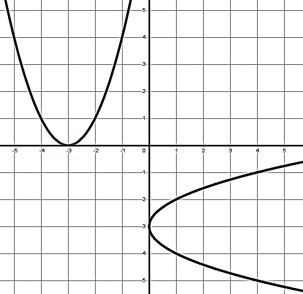
19.
Graph
a)
A
b)
B
c)
C
d)
D
20.
Solve by factoring.
z2 - 6z - 27 = 0
a)
z = 3 or z = 9
b)
z = 3 or z = -9
c)
z = -3 or z = 9
d)
z = -3 or z = -9
21.
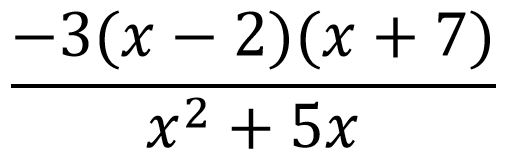
What are the Vertical Asymptotes of...
a)
x = 0, -5
b)
x=0, 5
c)
x = 2, -7
d)
x = -2, 7
22.
Find the zero(s) of the function.
a)
x = 1
b)
x = -3
c)
x = {-1, 3}
d)
x = 2
23.
Find the root(s) of the function.
a)
x = 3
b)
x = {-3, -1, 2}
c)
x = {-3, 2}
d)
x = -1
24.

What are the zeros of this function? (image: cis.stvincent.edu)

a)

-2, 3, and 1

b)

this is not a function

c)

-3, 0, and 2

25.

If f(x) = 5x and g(x) = 2x-1,

what is the composition f(g(x)) ?

a)

10x-1

b)

10x-5

c)

5x2-1

d)

5x2-5

26.

If f(x) = x-1 and g(x) = 2x,

what is and g(f(x)) ?

a)

2x2-1

b)

2x-1

c)

2x-2

d)

x-2

27.
f(x) = 3x + 10
g(x) = x - 2
Find f(g(5))
a)
19
b)
23
c)
-10
d)
None of these.
28.

Find g(- 2).

a)

12

b)

-2

c)

-24

d)

18

29.
What are the local maxima of this graph?
a)
local maximum at (2.2, 3.9)
b)
local maximum at (-8, 5)
c)
local maximum at (5, -8)⋃(3.9, 2.2)
d)
local maximum at (-8, 5)⋃(2.2, 3.9)
30.
Find the inverse of f(x) = -4x - 12
a)
f-1(x) = 4x - 3
b)
f-1(x) = -1/4x - 3
c)
f-1(x) = 1/4x + 3
d)
f-1(x) = -4x - 3
31.
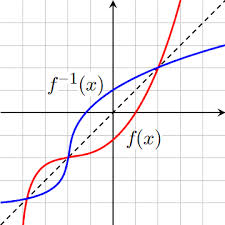
The inverse has been reflected over which line?
a)
y = x
b)
x = 0
c)
y = 0
d)
x = -y
32.
The inverse of the function f(x) is written as ...
a)
f -1(x)
b)
f 2(x)
c)
f '(x)
d)
f +(x)
33.

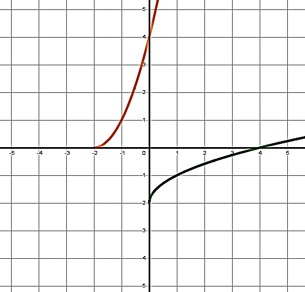
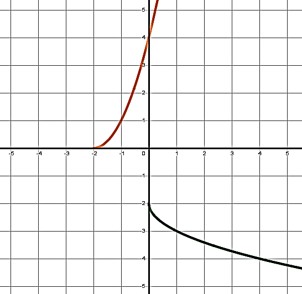
Which graph represents the functions f(x) and f-1(x)?
a)
b)
c)
d)
34.

The linear parent function, f(x) = x, is transformed to g(x) = f(x) + 3. Describe the transformation.

a)

g(x) is shifted up 3 units

b)

g(x) is shifted down 3 units

c)

g(x) is shifted left 3 units

d)

g(x) is shifted right 3 units

35.
How did the equation shift from the parent function? y = f(x + 7)
a)
Up 7
b)
Down 7
c)
Left 7
d)
Right 7
36.

Which represents the parent function shifted down two units?

a)

f(x) = -2x

b)

f(x) = x - 2

c)

f(x) = x + 2

d)

f(x) = 2x

37.

How did the equation shift from the parent function? y = f(x - 4)

a)

Shift right by 4

b)

Shift left by 4

c)

Horizontal Stretch by 4

d)

Vertical Stretch by 4

e)

Shift down by 4

38.
What is the degree?
a)
Positive
b)
Negative
c)
Odd
d)
Even
39.

Identify the function that belongs to the following graph.

a)

f(x)=(x+2)(x+3)(x-1)

b)

f(x)=(x+1)(x-4)(x-2)

c)

f(x)=(x+2)(x-2)(x+1)

d)

f(x)=(x-3)(x-2)(x+1)

40.
How many zeros does the polynomial function
 P(x) = 3x4+4x-8 have?
a)
1
b)
2
c)
3
d)
4
41.

All even functions have symmetry to the x-axis.

a)

True

b)

False

42.

All odd functions have symmetry with respect to the origin.

a)

True

b)

False

43.

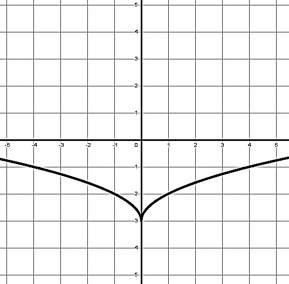
The function with the graph depicted is an even function.

a)

True

b)

False