
 Worksheets
Anat201 Exam 3
Total questions: 130
Worksheet time: 1hrs 15mins
What makes up the Central Nervous System?
sensory division
brain
motor division
spinal cord
What makes up the Peripheral Nervous System?
sensory division
brain
motor division
spinal cord
What is the sensory division of PNS further divided into?
skeletal sensory division
visceral sensory divison
somatic sensory division
autonomic sensory division
What is the motor division of PNS further divided into?
visceral motor divison
autonomic motor division
somatic motor division
skeletal motor division
What is the visceral motor division of PNS further divided into?
skeletal division
sympathetic division
parasympathetic division
autonomic division
Which division accelerates respiration and inhibits digestion?
autonomic
sympathetic
parasympathetic
somatic
Which division stimulates digestion and inhibits respiration?
autonomic
sympathetic
parasympathetic
somatic
Which of the following is NOT a function of the nervous system?
perception (sensory input)
communication (signals between cells)
integration (interpreting sensory information and deciding what to do)
motor output (response to stimulus)

What are the orange sticky things called? (at the front of the neuron)
myelin
dendrites
axon
cell body
What is the long string/path called that is connecting the two ends
myelin
dendrites
axon
cell body
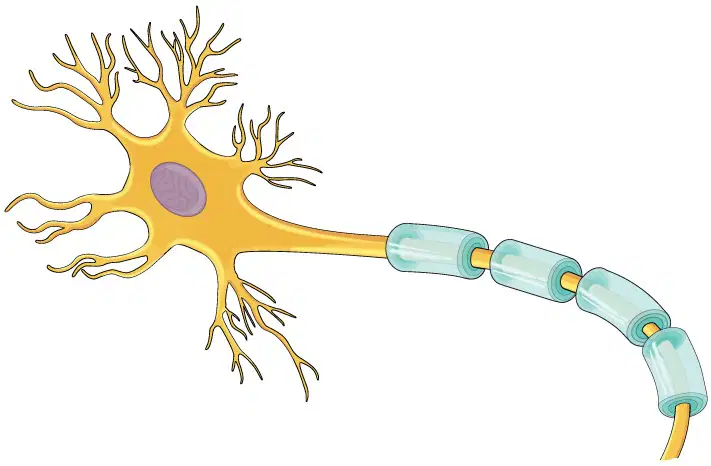
What is the yellow part? It is what surrounds the nucleus
axon
myelin
cell body
dendrites
What do the signals of the neuron travel down?
dendrites
axon
myelin
soma
What type neuron has many dendrites, but one
axon (are the most common in
the CNS)?
Anaxonic
bipolar
multipolar
unipolar
What type of neuron has one dendrite and one axon
Anaxonic
multipolar
unipolar
bipolar
What type of neuron has no dendrites, but one
axon (most abundant in the
afferent division)?
unipolar
multipolar
biopolar
Anaxonic
What type of neuron has many dendrites but no axon?
bipolar
Anaxonic
unipolar
multipolar
What detects stimuli and conducts signals from receptors TO CNS?
motor neurons/pathways
afferent neurons/pathways
efferent neurons/pathways
sensory neurons/pathways
What sends signals to muscles or glands and conducts signals FROM the CNS to effectors?
efferent neurons/pathways
motor neurons/pathways
afferent neurons/pathways
sensory neurons/pathways
What CNS glial cells is abundant, star-shaped cell, brace neurons, form a tight seal barrier between capillaries and neurons
(blood-brain barrier), and control the chemical environment of the brain?
Ependymal cells
astrocytes
Microglia
Oligodendrocytes
What glial CNS cell is spiderlike phagocytes, and dispose of debris
Oligodendrocytes
Ependymal cells
microglia
astrocytes
What type of glial CNS cell lines cavities of the brain and spinal cord and has cilia assist with the circulation of cerebrospinal
fluid
astrocytes
oligodendrocytes
microglia
ependymal cells
What type of CNS glial cell wraps around nerve fibers in CNS, produce myelin sheaths, and responsible for myelination?
oligodendrocytes
ependymal cells
microglia
astrocytes
What glia cell in PNS protects cell bodies?
astrocytes
Satellite cells
Schwann cells
microglia cells
What glial cell in PNS forms myelin sheath and responsible for myelination in the PNS?
microglia
oligodendrocytes
Satellite
Schwann cells
Why is myelin important?
communicates signals to other neurons
prevents the electrical charge from leaking across the membrane
serves as protection for axon
speeds nerve transmission by allowing electrical
charges to spread more quickly down the axon
Which neural pool/circuit is when one nerve fiber branches and synapses with several postsynaptic cells and each of those
may synapse with several more?
Parallel after discharge
diverging
converging
reverberating
Which neuron pool/circuit is when input from many different sources are funneled to
one neuron or neural pool?
Parallel after discharge
reverberating
diverging
converging
What neuron pool/circuit is when neurons stimulate each other in sequence: A stimulates B, B stimulates C...
diverging
converging
reverberating
parallel after discharge
What neural pool/circuit is when input neuron diverges to stimulate several chains of neurons. Chains eventually
reconverge on the same output neuron.
reverberating
diverging
parallel after discharge
converging
Which is NOT a function of the spinal cord?
reflexes (Involuntary stereotyped responses to)
conduction
neural integration
locomotion (Central pattern generators coordinate simple repetitive
movements)
stability (holds the muscles of the back and is what keeps the body standing)
What tracts carry sensory information to the brain?
efferent
ascending
afferent
descending
What tracts carry motor information from the brain?
efferent
ascending
descending
afferent
What protects neural tissue in CNS and has 3 layers?
bones
muscles
spinal meninges
vertebrae
What are the 3 layers of spinal meninges?
white matter
Pia mater
dura mater
arachnoid mater
Which is the tough, outside layer of Spinal Meninges and is like a dural sheath?
arachnoid mater
dura mater
pita mater
Which is the middle layer of Spinal Meninges?
dura mater
Pia mater
arachnoid mater
Which is the inner, delicate layer of Spinal Meninges?
Pia mater
dura mater
arachnoid mater
Which matter is mostly cell bodies, has dorsal horns that house interneurons and has ventral horns that house motor neurons?
gray matter
white matter
What type of matter is responsible for conduction tracts (dorsal, lateral, ventral columns, and sensory/afferent and motor/efferent tracts)
grey matter
white matter
What tract orgin exists when tracts cross at the midline at decussation?
ipsilateral
contralateral
When a right brain stroke impairs left side of body’s
function what kind of tract orgin has occurred
ipsilateral
crossed at midline at a decusation
contralateral
What tract origin has occurred if tracts do not cross the midline to its destination
contralateral
ipsilateral
What is a cluster of cell bodies outside the CNS?
nerve
muscle fiber
fasicles
ganglion
What wraps around 1 axon?
Fascicles
Endoneurium
Perineurium
Epineurium
What wraps a fascicle of axons?
Epineurium
Fascicles
Endoneurium
Perineurium
What wraps entire nerve?
Endoneurium
Epineurium
Fascicles
Perineurium
What are bound together by epineurium?
Fascicles
Perineurium
Endoneurium
What serves the skin and muscles of the posterior trunk?
ventral rami
dorsal rami
What forms a complex of networks (plexus) for the anterior?
ventral rami
dorsal rami
Which is not part of the spinal nerve plexus?
Femoral nerve
Sciatic nerve
Phrenic nerve
Musculocutaneous nerve
Axillary nerve
What is an area of the skin innervated by a particular spinal nerve
dermatome map
dermatomes
cutaneous intervention
What are reflexes that occur over neural pathways
reflex bridges
reflex arcs
reflex pathways
reflex paths
What type of reflexes stimulate skeletal muscles?
sensory
visceral
somatic
What type of reflexes regulate activity of smooth muscles like the heart and glands
somatic
visceral
sensory
autonomic
Pulling your hand away from a hot surface is an example of what kind of reflex?
sensory
somatic
visceral
autonomic
Regulation of smooth muscles, heart and blood pressure, glands, and digestive system are examples of what type of reflexes?
sensory
visceral
autonomic
somatic
Which of the following contains the right steps of reflex arcs and in the right order?
First, the sensory receptor reacts to the stimulus, and then the sensory neuron carries the message to the motor neuron and then to an effector. An effector is the brain or organ. The integration center (CNS) processes the information and directs it to motor output.
First, the sensory receptor reacts to the stimulus, then the integration center (CNS) processes the information and the sensory neuron carries the message and directs it to motor output. The motor neuron carries the message to an effector, and then last the effector organs are stimulated
First, the sensory receptor reacts to the stimulus, then the sensory neuron carries the message to the integration center. The integration center (CNS) processes the information and directs it to motor output. The motor neuron carries the message to an effector, and then last the effector organs are stimulated
First, the neuron reacts to the stimulus, then the motor neuron carries the message to the integration center. The integration center (CNS) processes the information and directs it to sensory output. The sensory neuron carries the message to an effector, and then last the effector organs are stimulated
Which reflex category is sensory input and motor output on same side?
Intersegmental
Contralateral
Ipsilateral
Which reflex category is sensory input from opposite side as motor output?
Contralateral
Ipsilateral
Intersegmental
What category of reflexes is sensory signal in one level; motor output at a higher or lower level?
Ipsilateral
Contralateral
Intersegmental
What is a syndrome of paralysis and absence of reflexes after transection of cord?
Quadriplegia
spinal shock
neurogenic shock
Paraplegia
Hemiplegia
What is a dangerous drop in blood pressure due to lack of sympathetic nervous system activity
neurogenic shock
spinal shock
Paraplegia
Quadriplegia
Hemiplegia
What is paralysis of both lower limbs due to lesions from T1 to L1?
Quadriplegia
neurogenic shock
spinal shock
Paraplegia
Hemiplegia
What is paralysis of all four limbs due to lesions above C5?
neurogenic shock
spinal shock
Hemiplegia
spinal shock
Quadriplegia
What is paralysis on one side of body usually due to stroke or brain lesions?
Hemiplegia
spinal shock
neurogenic shock
Paraplegia
Quadriplegia
What is the cerebrum divided into?
cerebral tracts (left and right)
cerebral hemispheres (left and right)
cerebral fissures (left and right)
Providing buoyancy, protection, and chemical stability is the function of what?
(a)
What is the diencephalon further divided into?
hypothalamus
forebrain
thalamus
diencephalon
epithalamus
What are the functions of the midbrain?
visual attention (superior colliculus)
sense of smell awareness (white matter)
pain awareness (central gray matter)
auditory attention (inferior colliculus)
What are the functions of the pons?
control of respiration
control of chewing
control of sleep
facial sensation and expression
control of movement
What are the functions of the medulla oblongata?
centers for circulatory control
centers respiratory control
sensory functions for the head and neck
motor functions for the head and neck
somatic functions for the head and neck
What are the functions of the cerebellum?
fine sensory control
fine motor control
muscular coordination
respiration
varied cognitive functions
What major regions of the brain make up the brainstem?
midbrain
forebrain
pons
cerebrum
medulla oblongata
What helps maintain the weight of the brain?
the brainstem
the skull
the cerebrum
buoyancy
What extends from the foramen magnum to the pons?
medulla oblongata
midbrain
pons
cerebellum
What important nuclei does the medulla oblongata have control over?
cardiac center (sneezing and coughing)
visual center
vasomotor center
respiratory center
auditory center
What type of tract is the tectospinal tract in the CNS?
ascending
descending
What type of tract is the posterior spin-cerebella tract?
ascending
descending
What is it called where all the signals come up to? The signals go through the pons, hypothalamus then it radiates to the cortex.
reticular formation
cerebrum
forebrain
brainstem
Where is all analysis done?
cortex
forebrain
brainstem
medulla oblongata
pons
Which one has all the functions of the reticular formation
somatic motor control, cardiovascular control, pain modulation, sleep and consciousness, habituation, and varies sensory, motor, and involuntary function
somatic motor control, respiratory control, pain modulation, sleep and consciousness, habituation, and varies sensory, motor, and involuntary function
somatic motor control, cardiovascular control, pain modulation, sleep and consciousness, and habituation
autonomic motor control, respiratory control, pain modulation, sleep and consciousness, habituation, and varies sensory, motor, and involuntary function
Injury to which part can result in irreversible coma?
cerebellum
brainstem
reticular formation
medulla oblongata
Which pathways is input to the cerebellum?
afferent
efferent
What pathways are output from the cerebellum and back to the brain. (the brain is an effector)
afferent
efferent
What are the functions of the thalamus?
sleep
sensation
movement
memory
emotion
Which has all the functions of the hypothalamus listed?
control center of autonomic NS and endocrine system, hormone secretion, autonomic effects, thermoregulation, food and water intake, sleep and circadian rhythms, emotional responses, and memory
control center of somatic NS and endocrine system, hormone secretion, somatic effects, thermoregulation, respiratory control, sleep and circadian rhythms, emotional responses, and memory
control center of autonomic NS and endocrine system, hormone secretion, autonomic effects, thermoregulation, cardiovascular regulation, sleep and circadian rhythms, emotional responses, and memory
control center of autonomic NS and endocrine system, hormone secretion, autonomic effects, thermoregulation, food and water intake, circadian rhythms, and memory
What are the cerebral hemispheres separated by
longitudinal fissures
corpus callosum
What are the cerebral hemispheres connected by?
longitudinal fissures
corpus callosum
Functions of the frontal lobe?
speech
cognition
motor control
sensory control
sleep
what is the function of the parietal lobe?
logic and analysis
thinking and cognition
movement of muscles and bones
interprets signals of general sense
What is the function of the occipital lobe?
auditory center
visual center
respiration center
control of sense of smell
What are the functions of the temporal lobe?
hearing
learning
sleep
smell
memory
What are the functions of the insula?
emotion
taste
visceral sensation
language
somatic sensation
What type of tracts travel vertically to carry information between the cerebrum and the rest of the body?
commissural
projection
association
What type of tracts cross between 2 hemispheres
commissural
projection
association
What type of tracts connect regions within the same hemisphere?
commissural
association
projection
Where does neural integration take place?
gray matter of cerebrum (cerebral cortex)
white matter
gray matter of cerebellum
in the integration center
What 3 places is the cerebral cortex found in?
cerebral cortex
basal nuclei
limbic system
reticular formation
What contains the cingulate gyrus, hippocampus, and amygdala?
midbrain
respiratory system
limbic system
forebrain
What are the functions of the limbic system?
emotion
learning
sleep
cognition
In what areas is language carried out by?
cerebral area
wernicke area
brainstem area
broca area
Which area is posterior to lateral sulcus of the left brain and is responsible for recognition of written and spoken area?
wernicke area
broca area
brainstem area
What area is inferior prefrontal cortex to the left brain and is responsible for speech?
broca area
wernicke area
brainstem area
What is hemispheric lateralization
concept that different brain function can and do occur on one side of the brain
concept that different brain function can and do occur on one different sides of the brain
concept that the same brain function can and do occur on one side of the brain
concept that the same brain function can and do occur on the same side of the brain
Which hemisphere if for language skills, analytical tasks, and logic
left
right
Which hemisphere is for analyzing sensory input and relating it to the body, emotional content
left
right
Which cranial nerve is motor only, innervates 4 of the 6 extrinsic eye muscles, and innervates the intrinsic eye muscles that control the size of the pupil
Optic
olfactory (I)
oculomotor (III)
trochlear (IV)
Which cranial nerve is the smallest and innervates the superior oblique extrinsic muscles of the eyes
Olfactory (I)
trochlear (IV)
Trigeminal (V)
Optic
Which cranial nerve innervates only the lateral rectus extrinsic eye muscles and uses the nucleus in the pons?
Trigeminal (V)
Olfactory (I)
Optic
abducens (VI)
Which cranial nerves is sensory input vital to autonomic control of the viscera, motor control that includes the soft palate, pharynx, and esophagus, and a major pathway for ANS output to cardiac muscles, smooth muscle, and glands
Hypoglossal (XII)
Vagus (X)
Vestibulocochlear (VIII)
Glossopharyngeal (IX)
Which cranial nerve has 2 components: vestibular and cochlear
Olfactory (I)
Glossopharyngeal (IX)
Vagus (X)
Vestibulocochlear (VIII)
Which component of the Vestibulocochlear nerve is for balance and position?
vestibular
cochlear
Which component of the Vestibulocochlear nerve is for sound waves and hearing?
vestibular
cochlear
Which cranial nerve is mixed, and emerge from the pons, sensory fibers monitor proprioception in the face, motor fibers provide facial expressions; and control tear and
salivary glands
Optic
Olfactory (I)
Facial (VII)
Trigeminal (V)
What structure produces cerebrospinal fluid?
brainstem
cerebrum
choroid plexus
ventricles
The nuclei of the vestibulocochlear nerve are in what structures?
medulla oblongata
hypothalamus
cerebellum
pons
The pons contains the sensory and motor nuclei for which cranial nerves?
VIII
V
X
VI
VII
Other nuclei of the pons influences which of the following?
sleep and consciousness
rate and depth of respiration
digestion
thinking and memory
Which nerve supplies the diaphragm and plays an essential role in breathing?
phrenic nerve
musculotaneuous nerve
femoral nerve
sciatic nerve
Which nerve supplies the quadriceps femoris, sartorius, and iliopsoas
phrenic nerve
musculotaneuous nerve
femoral nerve
sciatic nerve
Which plexus is the phrenic nerve in?
lumbar
cervical
brachial
Which plexus is the femoral nerve in?
lumbar
cervical
brachial
Which of the following terms is a network of nerves serving motor and sensory needs of the limbs?
neuron
pathway
plexus
dendrites
Select what makes us the Nervous Syste,
Central Nervous System
Center Nervous System
Peripheral Nervous System
Distal Nervous Syste,
Which plexus innervates the head and neck and plays a role in essential breathing
lumbar
cervical
brachial
sacral and coccygeal
Which plexus's nerves supply the upper limb and supplies the muscles of the anterior arm and the skin part of the forearm
lumbar
cervical
brachial
sacral and coccygeal
Which plexus's nerves supply the lower abdomen, thigh, and skin of the leg which supplies the quadriceps femoris, sartorius, and iliopsoas muscles
lumbar
cervical
brachial
sacral and coccygeal
What produces cerebrospinal fluid?
frontal lobe
brainstem
cerebellum
cerebrum
Which type of matter is the outer part of the cerebrum (the cortex) and the cerebellum and contains neurosomas, dendrites, and synapses
gray matter
white matter
Which type of matter is deep in the brain and contains tracts (bundles of myelinated axons)
gray matter
white matter

