
 Worksheets
Week 1 Lectures: Clinical decision making, perfusion/EKG
Total questions: 125
Worksheet time: 1hrs 16mins
the transference of responsibility and authority for an activity to a competent individual
(a)
After I delegate a task, I am no longer responsible for any consequences that follow.
True
False
Sometimes
All of the following are the five rights of delegation except for:
-Right task
-Right time
-Right circumstance
-Right person
-Right medication
-Right assessment
-Right communication
-Right Supervision
Right time
Right task
Right medication
Right assessment
Right communication
Terrific Care Promotes Client Safety stands for...
Delegation tasks to LPNs
Rights of delegation
Rights of medication administration
Rights of nursing care
Which of the following are rights of delegation?
Right task
Right circumstance
Right person
Right communication
Right supervision
Which of the following are delegable tasks to a qualified LPN?
Teaching your patient ostomy care for the first time
Administering medications
Inserting a urinary catheter
Tracheostomy care and suctioning
Completing a head to toe assessment on your new admit
Which of the following are delegable tasks to a qualified UAP?
Assisting a post-op patient to the restroom
Obtaining vital signs on an unstable patient
Measuring urine output from a catheter
Feeding a patient
Recording what an oncology patient ate for lunch
Tasks can be delegated if the client is unstable as long as it is supervised.
Tasks should never be delegated for an unstable client.
Never delegate what you can...
Evaluate
Assess
Teach
Administer
Document
The registered nurse (RN) is caring for a client with chronic obstructive pulmonary disease (COPD). Which intervention is
Appropriate for the RN to delegate to an unlicensed assistive personnel (UAP)?
A. Evaluate patient’s ability to cough effectively.
B. Assist patient to sitting position on the side of the bed.
C. Listen to breath sounds every 4-hours
D. Instruct the patient on use incentive spirometer.
A
B
C
D
The nurse is caring for a client who has cirrhosis of the liver and has had multiple episodes of sticky black stool and hematemesis. Client reports nausea, weakness, and dizziness. Extremities are cool to touch and capillary refill is sluggish. Vital signs: T 94.l F, HR 126, RR 28, BP 84/44, SpO2 88% on room air.
Which of the following actions are appropriate to delegate?
Ask the licensed practical nurse (LPN) to check the client’s mental status.
Instruct the Health Unit Coordinator (HUC) to
activate the hospital emergency response team.
Instruct the unlicensed assistive personnel
(UAP) to retrieve 1-unit of packed red blood
cells (RBCs) from the blood bank.
Ask the charge nurse to insert a peripheral
intravenous (PIV) access device.
Instruct another registered nurse to initiate
oxygen therapy
Can the following tasks be delegated or must they be carried out by the RN?
-Administer IV push medication
-Review glucose results for patients needing insulin
-Give preop report to the operating room
-Administer packed red blood cell transfusion
Can the following tasks be delegated or must they be carried out by the RN?
-Administer oral meds to stable patients
-Reinforce education that was previously taught
Both tasks can be delegated to an LPN.
Both tasks can be delegated to the UAP.
Can the following tasks be delegated or must they be carried out by the RN?
-Pass meal trays to stable patients
-Collect intake and output data
-Assist patients with toileting and hygiene
-Obtain vital signs on stable patients
A documentation that outlines the individualized care and interventions required for each patient.
(a)
Which of the following are purposes of the nursing care plan?
Conveys essential clinical information about each patient's diagnosis, treatment, and outcomes
Serves as a communication tool between clinicians, other providers, and payers
Provides a systematic approach to care delivery
Allows patients to view their personal health information
Which of the following are some disadvantages of standardized care plans?
Reduced flexibility
Lack of personalization
Potential oversight of individual patient needs
Types of care plans include:
Column plan
Concept map
Standardized plan
Clinical pathway
Physician-centered plan
The process nurses' use in the clinical setting to evaluate and select the best actions to meet desired goals.
(a)
Case Study: Afternoon in the E.R. An accidental poisoning at a local warehouse has resulted in several patients being admitted with a range of symptoms. In which order should the nurse see the following clients?
Client 1: LOC is diminished and Gurgling heard when auscultating Lung sounds
Client 2: Having SOB, difficulty speaking and Intercostal retractions seen on assessment.
Client 3: Skin cool and clammy, and client is tachycardic
Which level of prioritizing care levels is described below?
-airway, breathing, circulation, VS changes/concerns
Level 2
Level 1
Level 3
Which level of prioritizing care levels is described below?
Mental Status Changes, Acute Pain, Acute Urinary Elimination Problems, Untreated Medical Problem Requiring Immediate Attention, Abnormal Lab Values, Risks of Infection, Safety or Security
Level 2
Level 3
Level 1
Which prioritizing care level is described below?
Lack of Knowledge, Coping, Family Coping, Activity, Rest
Level 2
Level 1
Level 3
For each scenario, determine whether the following conditions would be considered critical, urgent, or non-urgent.
Chronic pain, Radiating chest pain, Deformed fracture with edema
3, 1, 2
2, 1, 3
1, 2, 3
3, 2, 1
For each scenario, determine whether the following conditions would be considered critical, urgent, or non-urgent.
Minor cut-needs stiches, sudden headache-blurry vision, severe allergic reaction
3, 2, 1
1, 2, 3
2, 1, 3
For each scenario, determine whether the following conditions would be considered critical, urgent, or non-urgent.
-Unconscious, pulseless
-Nondisplaced fracture
-Change in LOC
1, 2, 3
3, 2, 1
2, 1, 3
When considering only one patient, a useful prioritization strategy includes
Rank activities (Urgent, important, nice to do)
The following is which level of priority for your client?
-SOB, uncontrolled pain, altered LOC, anxiety
P1
P2
P3
Which level of prioritization is described?
-it has a high probability of harm (infection risk, falls)
P1
P2
P3
Which level of prioritization is described?
-Keeps patient from moving to the next phase of wellness, it delays a patient's discharge
P3
P2
P1
Mrs. Right is an 87-y/o with a 3-day history of GI disturbance. She presented to the emergency department with dehydration, flank pain, and a fever related to urosepsis. IV access was obtained and she has now been admitted to your floor. Cognition is reportedly baseline.
You are the nurse assigned to Mrs. Right, and you receive the following orders:
• Acetaminophen 650 mg po, every 6 hours as needed for pain or fever
• Ceftriaxone 1 g IVPB, administer after blood and urine cultures obtained
• Morphine 2 mg IV push every 2 hours PRN for moderate to severe pain
• Collect and send aerobic and anaerobic blood cultures
• Collect urine for culture and urinalysis
• 0.9% NS bolus, 1000 mL administered over 4 hours
Which of these orders should be implemented first? What is your rationale?
Give bolus.
Collect and send aerobic and anaerobic blood cultures and Collect urine for culture and urinalysis first..
____ Check MAR for medication administration times for all of your patients
____ Take bedside report from night shift between 0700-0730.
____ Perform Safety Checks and introduce yourself to patients.
____ Hang four IV medications that are all due at 0900.
____ Give 0845 pre-op report on patient who’s going to surgery at 0900.
____ Pass the 0830 breakfast trays.
____ In-depth review of charts for the patients who are new to you.
____ Check 0600 glucose results for patients who need 0730 insulin
____ Administer 0900 pre-operative antibiotic to surgery patient
Prioritize the following list of tasks that will need to be accomplished as you begin your shift. Use a “1” for the first thing you will do, and a “10” for the last.
5, 7, 8, 4, 3, 2, 9, 1, D
2, 5, 8, 7, 4, 9, 1, D, 3
3, 1, 2, 7, 5, D, 8, 4, 6
An essential function of the cardiovascular and pulmonary systems providing a continuous supply of oxygenated blood to every cell in the body
(a)
Perfusion happens at the level of the
(a)
Perfusion depends on proper function of the cardiovascular system.
True
False
The nurse is reviewing the concept of perfusion. Which circulatory systems does the nurse know to be crucial to tissue perfusion?
Select all that apply.
A. Coronary Circulation
B. Cerebral Circulation
C. Systemic Circulation
D. Peripheral Circulation
E. Pulmonary Circulation
F. Renal Circulation
A
B
C
D
E
The nurse is assessing a patient’s heart sounds and recognizes that the S1 sound occurs at the beginning of ___1___ , defined as ___2___ of the ventricles. S1 is heard due to the closing of the ____3____ valves.
Blank #1 : Systole or Diastole?
Blank #2 : Filling or Contraction?
Blank #3 : Atrioventricular or Semilunar?
Heart rate X stroke volume=
(a)
Which of the following manifestations of decreased cardiac output will consider your pt unstable?
Hypotension
Chest pain
LOC
Restlessness
Which of the following are manifestations of decreased cardiac output?
Dizziness
Cool, clammy, pale skin
Fatigue
Dysrhythmias
Hypertension
WHAT ARE SOME FACTORS THAT AFFECT HEART RATE?
BMI
Age
Fitness level
Hormones
Stroke volume is affected by three main factors:
Blood volume in ventricles at end of diastole
Preload
A stronger contraction gets better output
Contractility
Preload
Afterload
Resistance the ventricle must overcome
The greater the afterload, the greater the cardiac workload
Perfusion is affected by:
Factors affecting heart rate
Factors affecting stroke volume
Factors affecting BMI
Factors affecting pt LOC
Factors affecting stroke volume:
Age
Heart size
Gender
Contractility
Preload and Afterload
Factors affecting heart rate:
Autonomic innervation
Hormones
Fitness level
Age
Heart size
The exchange of water, oxygen, electrolytes, nutrients, wastes, small proteins, and hormones are all completed at the...
Which of the following are NOT a sign of poor perfusion?
-pain, pallor, pulselessness, pneumonia, poor mobility, paraesthesia, paralysis, poikilothermia
Pain
Paraesthesia
Poor mobility
Pneumonia
We must consider both the ____ and ________ when assessing perfusion.
heart and circulation
Cardiac cells have the following characteristics:
Cardiac cells have automaticity, conductivity, contractility excitability, refractoriness.
Cardiac cells ability to repeatedly initiate impulses without an outside stimulus
Cardiac cells ability to respond to stimulus and initiate an impulse
Cardiac cells ability to transmit the impulse along cell membranes
Automaticity
Contractility
Conductivity
When muscle fiber in the cardiac cells shortens in response to a stimulus
Refractoriness
Contractility
Conductivity
When the cardiac cells muscle fiber is unable to respond to another stimulus during an interval following contraction
Refractoriness
What is the conduction pathway of the heart?
Bundle of His paraesthesiaPurkinje fibers → Atrioventricular node → Right and Left Bundle Branches → Sinoatrial node.
Sinoatrial node → Internodal Pathways → Atrioventricular node → Bundle of His → Right/left Bundle Branches → Purkinje Fibers
Which is the normal pacemaker of the heart:
60-100 bpm
Which of the following pacemakers is 40-60 bpm
Which of the following pacemakers is 20-40 beats per minute
Sinoatrial node
Purkinkje Fibers
An EKG has a ______ view from negative lead to positive lead
directional

A
B
C
D
Which of the following represents one cardiac cycle on an EKG?
Atrial depolarization (contraction)
T Wave
QRS Complex
P Wave
Ventricular depolarization
QRS Complex
P Wave
T Wave
Ventricular repolarization (reset)
The extent to which a cell can respond to a stimulus
Refractoriness
Onset of QRS complex to approximately the peak of T wave
• Cardiac cells are fully depolarized and cannot be stimulated to conduct any additional electrical
impulse, no matter how strong the stimulus
Corresponds with the downslope of the T wave
• Cardiac cells are only partially full of electricity.
• Cells can be stimulated to depolarize if the electrical stimulus is strong enough
• Patient at high risk for lethal rhythms if another stimulus occurs
What is the most dangerous part of the cardiac cycle
-heart is only partially reset, so it can malfunction if stimulated there
Relative refractory period
Absolute refractory period
EKG paper divided into small and big squares:
Small square = _._ seconds
Big square = __ seconds
What are the five steps to interpreting EKG rhythm strips
If the R-to-R intervals vary by less than 0.06 seconds (1.5 small boxes), the rhythm is considered
If the intervals vary by more than 0.06 seconds (1.5 small boxes), the rhythm is
represents the SA node firing at regular intervals (referred to as a sinus rhythm)
• First deviation from the isoelectric line
• Should be rounded and upright
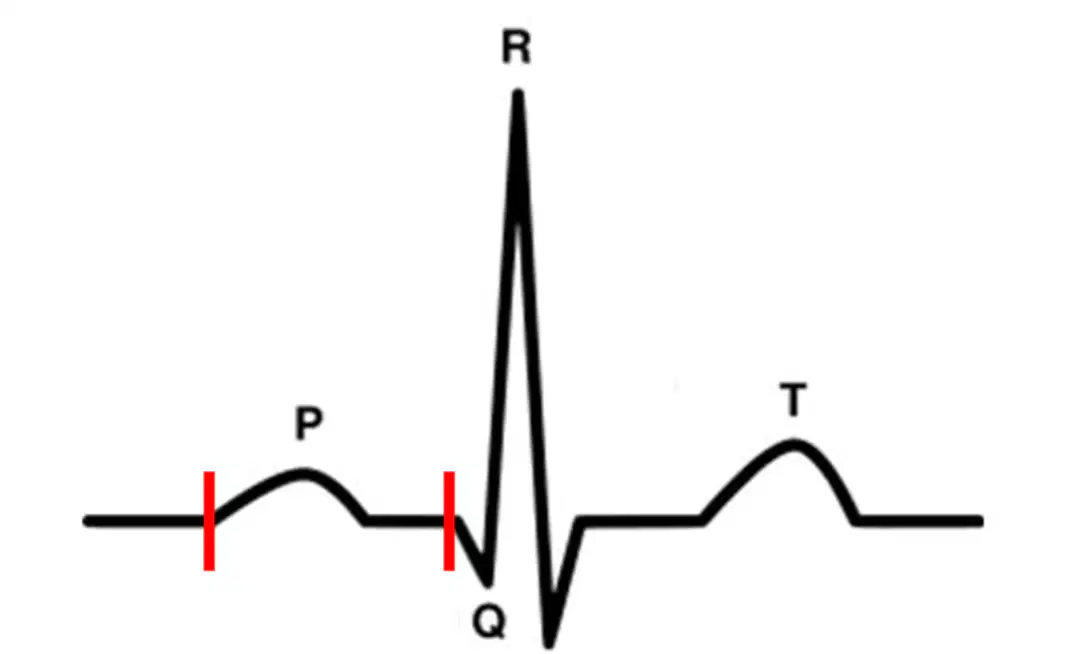
Measures time from start of atrial contraction to start of ventricular contraction
• Measured from start of P wave to start of the QRS complex
Normal PR interval is
0.12-0.20 seconds (3-5 small squares)
0.06-0.12 seconds (1.5-3 small boxes)
Which of the following represents the PR interval
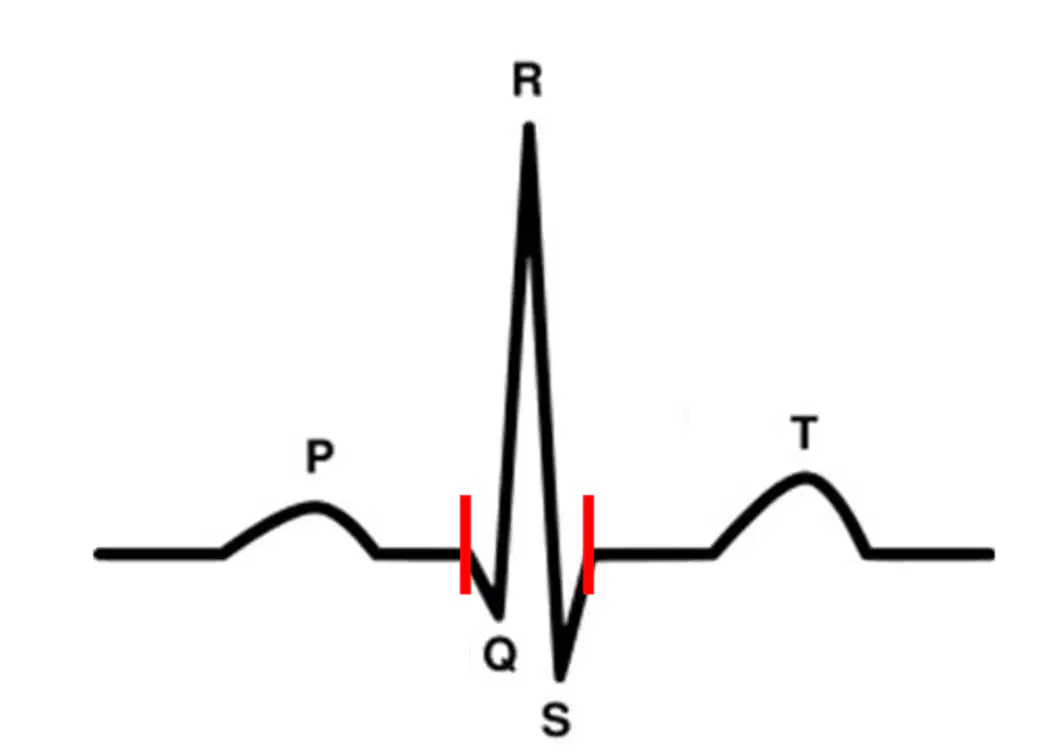
complex represents depolarization (contraction) of the ventricles
QRS Complex
P Wave
T Wave
First negative (downward) deflection of this large complex
S Wave
Q Wave
R Wave
First upward (positive) deflection after the P wave
R Wave
The sharp, negative deflection that follows the R wave
Normal interval for QRS Complex is
0.06 to 0.12 seconds (1.5-3 small boxes)
0.10 to 0.12 seconds (5 small boxes)
0.04 to 0.06 seconds (1.5-3 small boxes)
When interpreting EKG rhythm strips, what do we assess about the P-wave?
Presence
Occurring regularly before every QRS
Smooth, rounded, upright
Sharp, jagged, tall
Produced by ventricular repolarization (relaxation or reset)
-Commonly seen as the first upward or positive deflection following the QRS complex
-Not part of the 5 steps, but can give us some information
T Wave
P Wave
QRS Complex
PR Interval
ECG waveforms from sources outside the heart Interference is seen on the monitor or ECG strip
Causes:
-Patient movement (most common)
-Loose or defective electrodes (fuzzy baseline)
-Improper grounding (60 cycle interference)
-Faulty ECG apparatus
Sinus Rhythms
EKG Artifact
Accurate EKG Reading
Irregular rhythm
Rhythms that originate in the SA node
Common variations of a sinus rhythm include:
Sinus tachycardia
Sinus bradycardia
Sinus flutter
Sinus arrhythmia
Sinus block
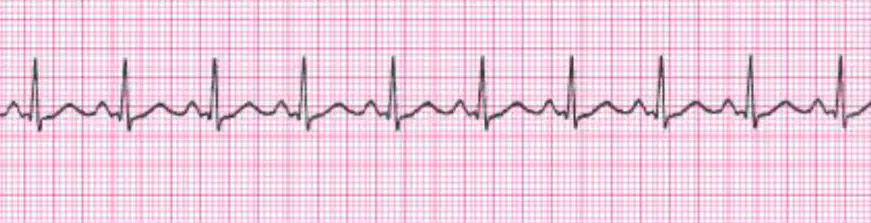
Normal cardiac impulses start at sinoatrial node and are transmitted through the atria and down to the ventricles.
Normal Sinus Rhythm
Sinus Bradycardia
Sinus Tachycardia
Sinus Arrhythmia
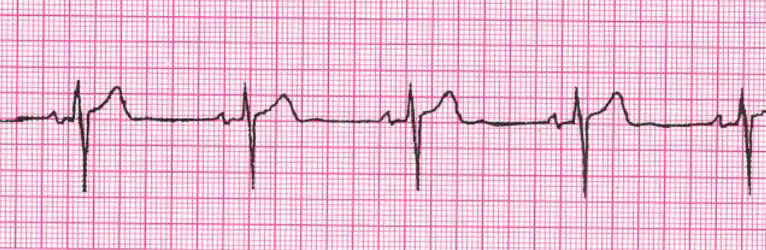
Starts at the SA node but is unusually slow (less than 60 bpm).
Sinus bradycardia is a normal variation in:
Adolescent patients who are awake and calm
Which of the following are possible causes of bradycardia?
Dehydration due to exercise, Excessive caffeine intake, High blood pressure
Fever, stress, excess alcohol
Hyperglycemia, hyperthermia, hyperthyroidism, high stress, dehydration
Hypoglycemia, hypothermia, hypothyroidism, previous cardiac history, medications, toxic exposure
Which of the following are signs and symptoms of sinus bradycardia?
Syncope
Dizziness
Shortness of breath
Cool, clammy skin
Dehydration
Which of the following are risks of sinus bradycardia?
Headache
Improved circulation
Enhanced stamina
Reduced cardiac output
Decreased perfusion
Which of the following are nursing interventions for sinus bradycardia?
Assess patient
Monitor oxygen saturation and give oxygen if needed
Monitor blood pressure and heart rate
Notify HCP
Call a code and begin CPR
What are the medical treatments of sinus bradycardia?
Temporary pacing if patient is symptomatic and unstable
Atropine (anticholinergic) if patient is symptomatic and stable
Based on if patient is symptomatic and stable/unstable
faster than normal heartbeat related to a rapid firing of the sinoatrial (SA) node
Sinus Bradycardia
Sinus Arrhythmia
Sinus Tachycardia
Sinus Palpitations
Which of the following are causes of sinus tachycardia?
Hypotension, dehydration, anemia, stress, fever, hyperthyroidism, electrolyte imbalance, certain medications.
Hypothyroidism, hypoglycemia, hypothermia, toxic exposure, myocardia infarction
Which of the following are risks of sinus tachycardia?
Increased blood pressure
Decreased perfusion
Increased cardiac output
Reduced Cardiac output
Which of the following are nursing interventions for sinus tachycardia?
Call a code
Assess patient for symptoms and stability
Monitor BP and HR
Start an IV if not already established
Disregard O2 saturation and only give oxygen if ordered by HCP
What is the treatment of tachycardia?
Which of the following are possible treatments for sinus tachycardia?
Giving acetaminophen or ibuprofen for fever
Giving pain medication/nonpharm management for pain
Stop use of caffeine, OTC meds, herbs, illicit drugs
Give reassurance or anti-anxiety medication
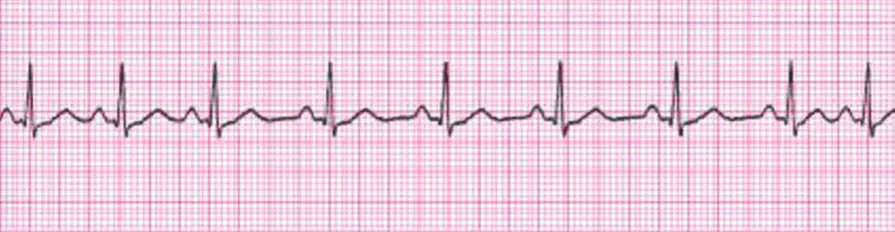
irregular impulse from the sinoatrial node.
• The rate usually increases with inspiration and decreases with expiration
Sinus Atrophy
Sinus Arrhythmia
Sinus Bradycardia
Sinus Tachycardia
What are the causes of sinus arrhythmia?
Causes of sinus arrhythmia include heart disease, stress, consumption of alcohol, caffeine, nicotine, and medications.
Signs and symptoms of sinus arrhythmia?
Chest pain
Shortness of breath
Anxiety
Patients are usually asymptomatic
What is the treatment of sinus arrhythmia?
Placement of temporary pacemaker
If patient is symptomatic, find and treat the cause!
Electrolyte supplements
Beta Blockers
Ventricular standstill
• No electrical activity
• No cardiac output
• No perfusion
Apnea
Bradycardia
Tachypnea
Asystole
Which of the following are causes of asystole?
Cardiac Tamponade
Myocardial damage secondary to acute myocardial infarction
Failure of all higher pacemakers
Prolonged V-fib
Pulmonary embolism
What are signs and symptoms of asystole?
Loss of consciousness, no measurable BP, no palpable pulse
Your patient suddenly becomes asystolic. You enter their room and note that they do not have a DNR. What is your next step?
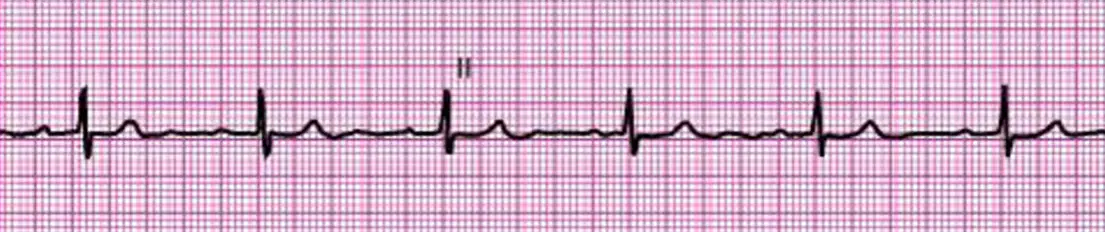
Your patient just received an EKG. Based on the image, how do you interpret the rhythm?

Your patient's EKG is displayed. How would you interpret this rhythm?
Sinus arrhythmia tachycardic
Sinus arrhythmia bradycardic

Your pt EKG is displayed. How will you treat this pt?
Assess and treat if symptomatic.
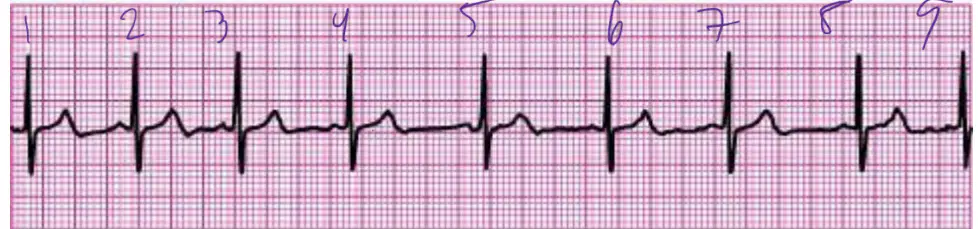
Your pt's EKG is displayed. What is their rhythm interpretation?
Sinus arrythmia
The nurse is aware that stroke volume can be affected by which factors?
Heart size
Hormones
Contractility
Autonomic innervation
Preload
The nurse is performing a cardiovascular assessment on a patient and is aware that which factor can affect heart rate?
Contractility
Preload
Age
Afterload
The nurse is assessing a patient's perfusion status and recognizes that cardiac output has a direct effect on perfusion. Which manifestations would be present in a patient with decreased cardiac output?
Cool, clammy skin
Capillary refill <3 sec.
Flushing
Hypotension
Restlessness
The nurse is aware that the T wave on the EKG represents what?
Atrial depolarization
Atrial repolarization
Ventricular repolarization
Ventricular depolarization
The nurse is aware that an electrocardiogram measures what?
Cardiac output
Electrical activity of the heart
Blood pressure
A view of the heart between three heart points
The nurse is interpreting the EKG rhythm for a patient and is aware that the most important next step is what?
Determining if the rhythm is new
Assessing the patient for signs and symptoms related to the rhythm
Checking the MAR for any medications indicated for that rhythm
Calling the cardiologist to report an abnormal rhythm
The nurse is assessing the perfusion status of a patient and is aware that which manifestations indicate altered perfusion?
Pink skin
Palpable pulses
Pallor
Pain
Parasthesia
The nurse is aware that the QRS complex on an ECG represents what?
Atrial depolarization
Atrial repolarization
Ventricular repolarization
Ventricular depolarization
The nurse is aware that the P wave on an EKG represents
Atrial depolarization
Ventricular repolarization
Ventricular depolarization
Atrial repolarization

