wayground logo

Free Printable Worksheets

NEW

Font size

S
M
L
XL
Worksheets

Unit 1 Practice Quizizz

Total questions: 50

Worksheet time: 2hrs 40mins

Name
Class
Date
1.

A nucleotide is composed of

a)

A phosphate, sugar and nitrogenous base

b)

A protein, sulfur and Guanine

c)

A phosphate, something and a base

d)

A protein, sugar and nitrogenous base

2.

Which of the following is a base pair?

a)

Adenine - Cytosine

b)

Cytosine - Thymine

c)

Deoxyribose - Cytosine

d)

Cytosine - Guanine

3.
Which 2 molecules forms the sides (backbone) of the DNA ladder?
a)

deoxyribose and a base

b)

phosphate and a base

c)

base pairs

d)
deoxyribose (sugar) and phosphate
4.

Where is DNA located?

a)

blood

b)

hair

c)

everywhere

d)

nucleus of cells

5.

Which bases will pair with this side of DNA: ATG TGA CAG

a)
ATG TGA CAG
b)
TAC ACT GTC
c)
GTA AGT GAC
d)
CAT TCA CTG
6.

What makes up the rungs (steps) of a DNA ladder?

a)

sugars & phosphates

b)

nitrogen bases

c)

sugars

d)

genes & chromosomes

7.

Challenge- How many TOTAL NUCLEOTIDES are there in the DNA molecule pictured?

a)

5

b)

10

c)

2

d)

20

8.

Which process is used to make mRNA from the DNA in the nucleus?

a)

transcription

b)

translation

c)

replication

9.
Which RNA bases would pair with TACGAA in transcription
a)
AUGCUU
b)
ATGCTT
c)
GCATCC
d)
GCAUCC
10.
How many amino acids are coded for by this sequence of nucleotides:
ATG GGA ACT CCA
a)
4
b)
2
c)
6
d)
12
11.
What is occurring in this picture?
a)
Translation
b)
Replication
c)
Translocation
d)
Transcription
12.
Which of the following statements is true?
a)
DNA is single-stranded
b)
RNA is single-stranded
c)
DNA contains uracil
d)
RNA contains deoxyribose
13.
Amino acids are the building blocks of... 
a)
DNA
b)
RNA
c)
Atoms
d)
Proteins
14.

Nucleic acids are the building blocks of...

a)

DNA

b)

RNA

c)

Atoms

d)

Nucleotides

15.

Which organelle is the location where protein is made?

a)

Ribosome

b)

Nucleus

c)

Cytoplasm

d)

Nucleotide

16.
The process to go from mRNA to a protein is called ____
a)
transcription
b)
rRNA
c)
replication
d)
translation
17.
Genetic info flows in one direction. Which best represents this flow?
a)
DNA-protein-RNA
b)
Protein-RNA-DNA
c)
RNA-protein-DNA
d)
DNA-RNA-protein
18.

How many nucleotides code for 1 amino acid?

a)

1

b)

2

c)

3

d)

4

19.
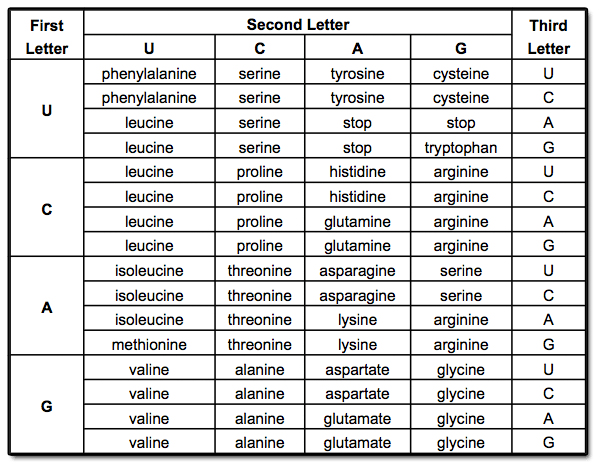
What amino acid is represented by the codon UUA?
a)
Phenylalanine
b)
Tyrosine
c)
Leucine
d)
Stop codon
20.
which process is shown?
a)
diffusion
b)
repiration
c)
recombination
d)
translation
21.
What kind of transport does not require energy?
a)
Active 
b)
Vacuole 
c)
Passive 
d)
Na/K Pump 
22.
What is facilitated diffusion?
a)
Transport that uses proteins to help move molecules across the membrane. 
b)
Movements of substances through a membrane. 
c)
When molecules spread from High to Low concentration on their own. 
d)
When pressure pushes something through a membrane. 
23.

What macromolecule is A?

a)

phospholipid

b)

carbohydrate

c)

protein

d)

nucleic acid

24.
Which means of particle transport is shown in this diagram?
a)
endocytosis
b)
exocytosis
c)
facilitated diffusion
d)
protein pump
25.
In this situation, where the solute is illustrated by red dots, predict if will WATER move into or out of the cell, and how that will affect the cell.
a)
Water will move into the cell and the cell will expand.
b)
Water will move into the cell and the cell will shrink.
c)
Water will move out of the cell and the cell will expand.
d)
Water will move out of the cell and the cell will shrink.
26.

Particle of movement from an area of lower concentration to an area of higher concentration.

a)

Active transport

b)

Passive transport

27.

Active transport across a cell membrane from low to high concentration, requires

a)

energy (ATP)

b)

no energy

c)

water

d)

oxygen

28.
What is diffusion?
a)
when molecules move from a low concentration to a high concentration 
b)
when molecules move from a high concentration to a low concentration.
c)
no movement 
d)
molecules move everywhere
29.
The function of the plasma membrane is....
a)
to regulate what enters and leaves the cell.
b)
fight bacteria and viruses that enter the cell.
c)
provide rigid support and protection to the cell.
d)
make sure each cell can move
30.
Maintaining a constant internal state in a changing environment.
a)
Homeostasis
b)
Active Transport
c)
Mitosis
d)
Photosynthesis
31.

The basic unit of living things is called

a)

nucleus

b)

organism

c)

lysosome

d)

cell

32.
Every living organism is made up of one or more cells
a)
True
b)
False
33.

Which protein structure describes the sequence of amino acids?

a)

Primary

b)

Secondary

c)

Tertiary

d)

Quaternary

34.
DNA molecule segment is : TTACGCAAG
The mutated DNA segment is TTCGCAAG. This is an example of ___ mutation.
a)
Substitution
b)
Deletion
c)
Insertion
d)
Inversion
35.
Normal-
GAG-CTC-GAC-AGA
Mutant
GAG CTC-CAC-AGA
a)
no mutation
b)
substitution
c)
insertion
d)
deletion
36.
Are all mutations bad?
a)
Yes
b)
No
37.

Which type of mutation is MOST LIKELY to cause the greatest disruption?

a)

Frameshift

b)

Silent

c)

Point

38.
What is a Gene?
a)
A segment of RNA that encodes for a protein
b)
A chromosome
c)
A segment of DNA that encodes for a protein
d)
Your genome
39.
What forms the channels and pumps in the phospholipid bilayer?
a)
carbohydrates
b)
proteins
c)
hydrophilic heads 
d)
lipids
40.

Structures in a cell that have specialized jobs.

Similar concept to organs for the human body.

a)

Tissue

b)

Molecule

c)

Atom

d)

Organelles

41.

Groups of cells with similar functions.

a)

Organs

b)

Molecules

c)

Tissues

d)

Organelles

42.

Group of tissues with similar functions.

a)

Organelles

b)

Cells

c)

Tissues

d)

Organs

43.

Group of organs with similar functions.

a)

Organism

b)

Cell

c)

Organ

d)

System

44.

True or False: Our organ systems work separately and do not interact with each other at all in our bodies

a)

True

b)

False

45.

When you get cut, your skin cells release hormones that signal platelets to come and stop the bleeding. Platelets then release more hormones that signal even more platelets to help stop bleeding. The hormone signals continue until the cut is closed. This is an example of what type of feedback?

a)

Negative Feedback

b)

Positive Feedback

46.

When glucose levels in the blood rise, your brain sends a signal to your pancreas. The pancreas releases insulin, which opens channels in cell membranes to allow glucose to enter the cell, lowering blood sugar levels. This is an example of a:

a)

Negative Feedback Loop

b)

Positive Feedback Loop

47.
Steve wanted to see if the type of fertilizer made sunflowers grow larger. What is the independent variable 
a)
Type of fertilizer
b)
Size of sunflower
c)
type of sun flower
48.
Ms. S set up an experiment to see how the mass of a ball affects the distance it rolls off a ramp. Identify the independent variable.
a)
Distance traveled by the ball
b)
Height of the ramp
c)
Mass of the ball
d)
Who set up the experiment (Ms. S, etc)
49.
 A comprehension test was given to students after they had studied textbook material either in silence or with the television turned on. What is the dependent variable?
a)
silence
b)
television turned on
c)
score on test
d)
textbook material
50.

Which characteristic is shown: A plant switches position and follows the sunlight throughout the day.

a)

Grow and develop

b)

Respond to a stimulus

c)

Acquire and use energy

d)

Reproduce