
 Worksheets
Unit 2&3 Exam Review 23
Total questions: 48
Worksheet time: 25mins

Plant cells have chloroplasts and cell walls where animal cells do not.
What are the two main differences between plant cells and animal cells
Animal cells have a cell membrane, plants do not.
Animal cells have mitochondria, plant cells do not.
Plant cells are eukaryotic, animal cells are not.
Plant cells have large water filled vacuoles, chloroplasts and a cell wall where animal cells have small food vacuoles, with no cell wall or chloroplasts
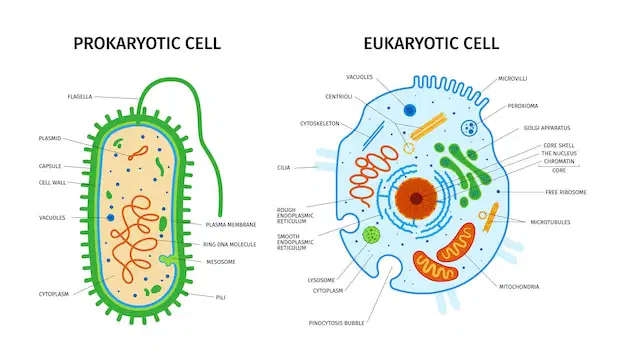
The main difference between a prokaryotic and eukaryotic cell is that eukaryotic cells have (a) __________ and prokaryotic cells do not.
Cell membrane
ribosomes
nucleus
genetic material

Both eukaryotic and prokaryotic cells have: _________.
cell membrane, genetic material, ribosomes
nucleus, membrane bound organelles
vacuoles, mitochondria, chloroplasts
centrioles, golgi apparatus, endoplasmic reticulum
"Euks have nukes and pro have no nukes". Examples of membrane bound organelles are chloroplasts, mitochondria, endoplasmic reticulum, vacuoles, nucleus and golgi apparatus. All eukaryotic cells have_______ where prokaryotic cells do not.
Genetic material and ribosomes
cell membrane and ribosomes
membrane bound nucleus and amembrane bound organelles
proteins and lipids
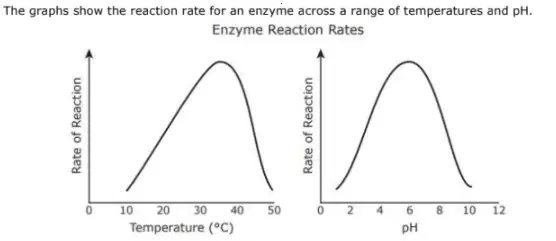
Enzymes work best at an optimum pH and temperature.
According to the graph what is the optimum temperature and pH for this enzyme?
20 degrees
pH of 2
35 degrees
pH of 6
45 degrees
pH of 9
Data not sufficient

Prokaryotic cells are bacterial cells, they are more simple than eukaryotic cells. Eukaryotic cells are complex with membrane bound organelles including a nucleus.
Which of the following is found in both prokaryotic and eukaryotic cells?
Mitochondria
Chloroplasts
Vacuoles
Nucleus
Golgi Apparatus
Endoplasmic reticulum
Centrioles
Vacuoles
Cell membrane
Ribosomes
Genetic material
cytoplasm
Chloroplasts
Cell Wall
Cell Membrane
Nucleus

For an enzyme to be able to work it must have a shape that _________ the _________.
fits, substrate
deactivates, substrate
substrates the deactivator
equalizes the substrate
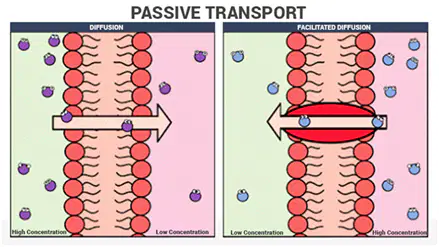
Cell transport, that is, the movement of molecules across the cell membrane, involves homeostasis (i.e. balance in the cell). Notice that the movement of molecules goes from a high concentration to a low concentration here, this is considered passive transport. Active transport would be going from low to high.
What would you call the process that is happening here?
energy is converted as well as new molecules are formed
new molecules are formed and ATP is produced
Active transport is required and homeostasis (balance) is achieved
Molecules are moved and homeostasis (balance) is achieved
Cell transport (i.e. the movement of molecules across the cell membrane) involves homeostasis (i.e. balance in the cell). Notice that the movement of molecules goes from a high concentration to a low concentration here, this is considered passive transport. Active transport would be going from low to high.
Which biomolecule is involved during "facilitated diffusion" on the right?
Carbohydrates
Proteins
Lipids
Nucleic Acids

Which biomolecule would you choose to eat if you needed lots of energy (like preparing for a marathon)?
Carbohydrates
Proteins
Lipids (fats)
Nucleic Acids

Which biomolecule would you consume if you were trying to build muscle by lifting weights?
Carbohydrates
Proteins
Lipids (fats)
Nucleic Acids
Which biomolecule stores energy for times that it is needed for later.
Carbohydrates
Proteins
Lipids (fats)
Nucleic Acids
Which biomolecule stores genetic information (genes, DNA, RNA)?
Carbohydrates
Proteins
Lipids (fats)
Nucleic Acids

Passive transport involves movement of molecules from an area of high concentration to an area of low concentration (like air freshener in an aerosol can when sprayed).
Select the answers below that apply to passive transport (there is more than one and less than 4).
A carrier protein with molecules going from a high concentration to a low concentration (with the concentration gradient).
Water flowing into a cell via osmosis
Molecules being pumped against the concentration gradient with the use of ATP
Molecules moving through the phospholipid bilayer from high to low (with the concentration gradient).
Which of the following involves active transport? (more than 1 answer less than 3)
ATP Required
Osmosis
A carrier protein moving molecules from high to low
Exocytosis (removing molecules from the cell- using energy)

I say "energy" you say:
Carbohydrate
Protein
Lipid
Nucleic Acid
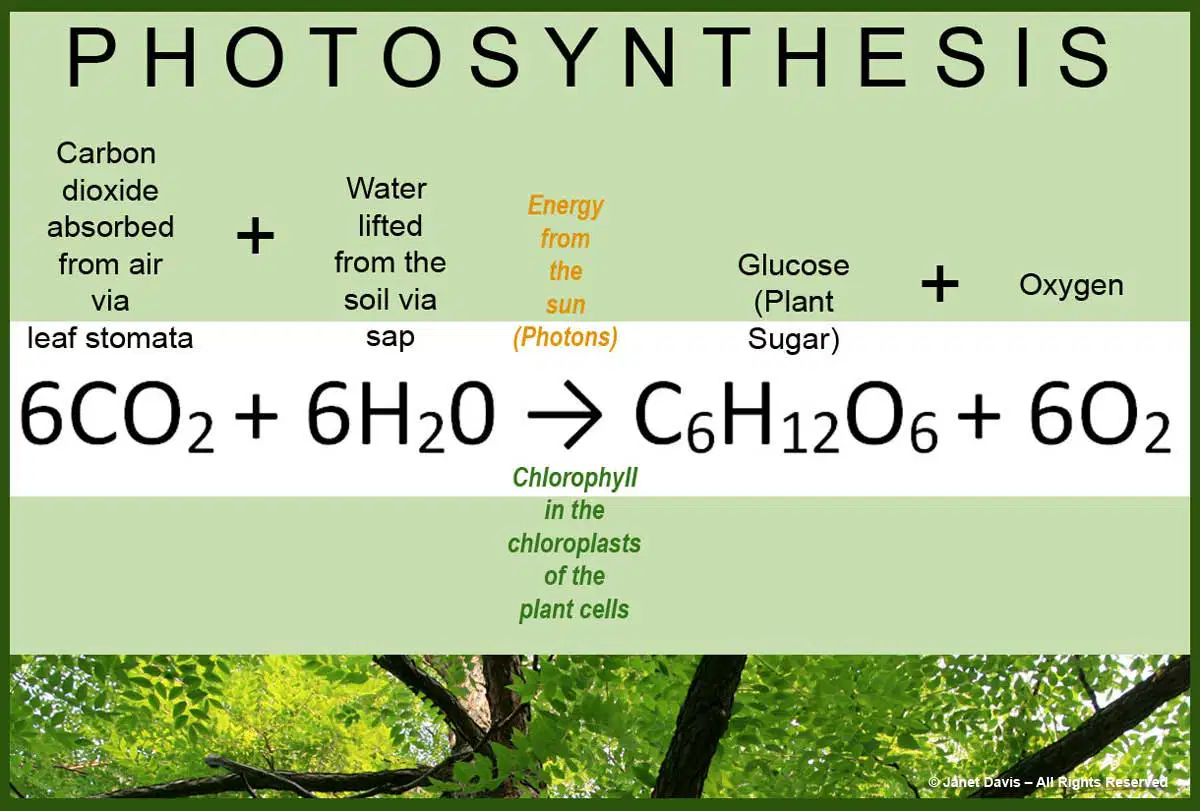
The product of photosynthesis that is used for "energy" in cellular respiration is ______.
Carbon dioxide
Oxygen
Glucose
Water
The product of photosynthesis that is used for "energy" in cellular respiration is ______. Which biomolecule is this?
Carbohydrate
Protein
Lipid (fat)
Nucleic Acid
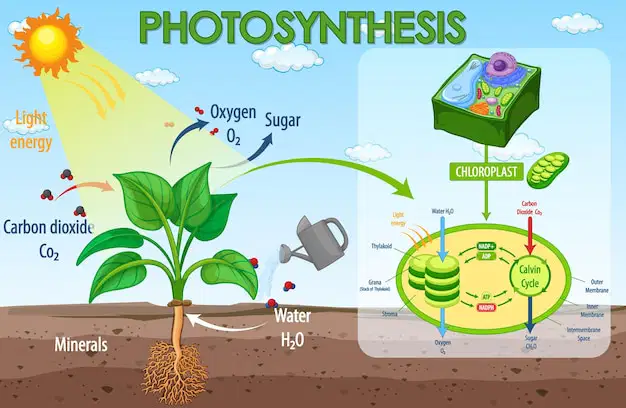
The formula for photosynthesis is:
Carbon dioxide + Water = Glucose + Oxygen
or
6CO2 + 6H2O = C6H12O6 + 6O2
What are the reactants of photosynthesis?
Glucose and Oxygen
ATP and Water
Oxygen and Carbon Dioxide
Carbon dioxide and Water
The formula for photosynthesis is:
Carbon dioxide + Water = Glucose + Oxygen
or
6CO2 + 6H2O = C6H12O6 + 6O2
What are the products of photosynthesis?
Glucose and Oxygen
ATP and Water
Oxygen and Carbon Dioxide
Carbon dioxide and Water
The formula for photosynthesis is:
Carbon dioxide + Water = Glucose + Oxygen
or
6CO2 + 6H2O = C6H12O6 + 6O2
What drives the process of photosynthesis?
Sunlight Energy
Glucose
Fructose
Mrs. Daisy

What are the missing molecules?
Glucose & Oxygen
Hydrogen & Nitrogen
Oxygen & CO2
Water & CO2
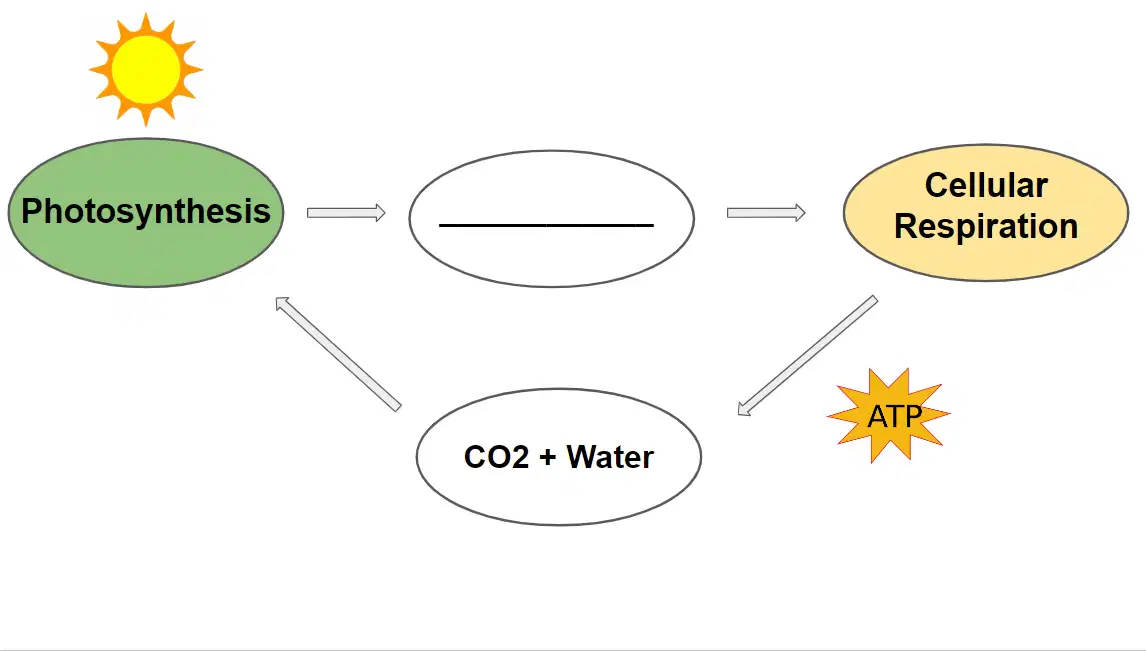
What are the missing molecules?
Glucose & Oxygen
Hydrogen & Nitrogen
Oxygen & CO2
Water & CO2
The _______ of photosynthesis are the products of cellular respiration.
Products
Reactants
Catalysts
Cofactors
The _______ of cellular respiration are the products of photosynthesis.
Products
Reactants
Catalysts
Cofactors
The _______ of cellular respiration are the reactants of photosynthesis.
Products
Reactants
Catalysts
Cofactors
The _______ of photosynthesis are the reactants of cellular respiration.
Products
Cofactors
Catalysts
Reactants
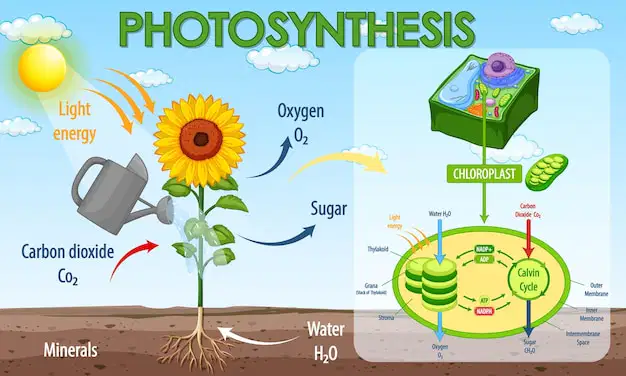
Finish the equation below: note: (C6H12O6 = Glucose)
Photosynthesis:
_____ + ____ = C6H12O6 + 6O2
C6H12O6 + 6O2
6CO2 + 6O2
6H20 + 6O2
6CO2 + 6H2O
Finish the equation below: note: (C6H12O6 = Glucose)
Photosynthesis:
6CO2 + 6H2O = _____ + ____
C6H12O6 + 6O2
6CO2 + 6O2
6H20 + 6O2
6CO2 + 6H2O
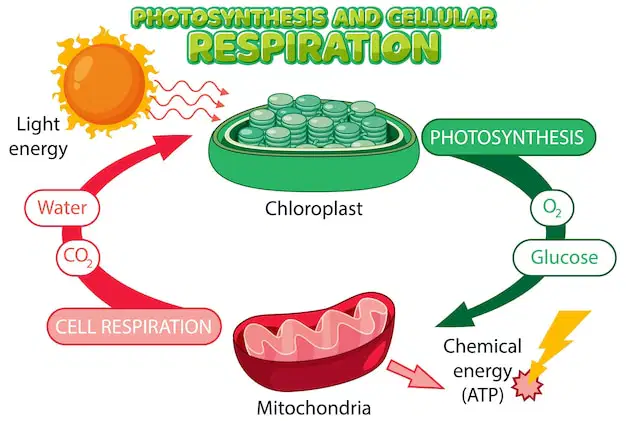
Finish the equation below: note: (C6H12O6 = Glucose)
Cellular Respiration:
(Think about what gas you exhale)
C6H12O6 + 6O2 = _____ + ____
C6H12O6 + 6O2
6CO2 + 6O2
6H20 + 6O2
6CO2 + 6H2O
Finish the equation below: note: (C6H12O6 = Glucose)
Cellular Respiration:
_____ + ____ = CO2 + 6H2O
C6H12O6 + 6O2
6CO2 + 6O2
6H20 + 6O2
6CO2 + 6H2O
The main purpose of the cell membrane is to _______.
Maintain homeostasis
Produce ATP Energy
Provide rigidity to the cell
control cellular respiration

Which structure in the cell is responsible for maintaining homeostasis?
Mitochondria
Nucleus
Chloroplasts
Cell membrane
Two words to describe homeostasis?
Balance
Cool
Aight
Stability
What does "semipermeable" mean?
A membrane that will not allow anything to come in or go out
Weather patterns off the coast of Alaska
A porous membrane that allows certain things to come in or out
Impermeable
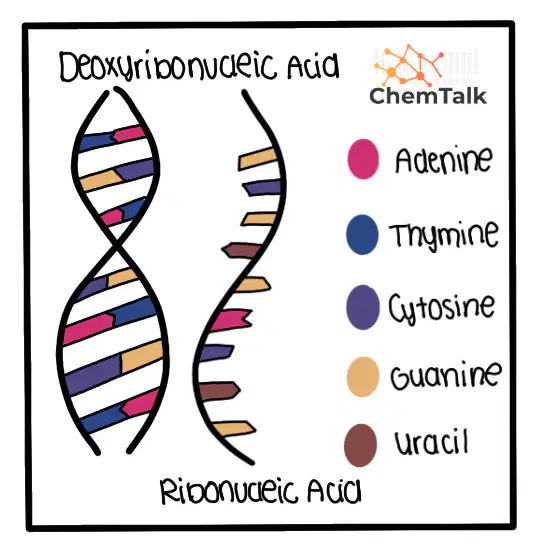
Nucleic acids are biomolecules that store genetic material such as DNA and RNA.
What structure do viruses and bacteria (prokaryotes) have in common?
Genetic material (nucleic acids)
Ribosomes
Cell membrane
Organelles
Bacteria are:
prokaryotes
eukaryotes
mekaryotes
themkaryotes
Prokaryotes are:
Animals
Plants
Bacteria
Protists

Prokaryotes are bacteria and bacteria are:
Theykaryotes
Eukaryotes
Hekariedotes
Prokaryotes
Nucleic acids are: (pick 3)
DNA
Genetic material
RNA
USDA

What is happening here?
Endocytosis: transporting proteins into the cell
Endocytosis: transporting proteins outside the cell
Exocytosis: transporting proteins outside the cell
Exocytosis: transporting proteins inside the cell
Which process produces oxygen?
Photosynthesis
Cellular Respiration
Exocytosis
Endocytosis
Which process uses oxygen as a reactant?
Photosynthesis
Cellular Respiration
Exocytosis
Endocytosis

Which process uses chemical energy (a chemical to fuel the process) and what is that chemical?
Photosynthesis, Glucose
Photosynthesis, Light
Cellular Respiration, Glucose
Cellular Respiration, Light
The average person has about 9 grams of salt to 35 oz of water in their cells.
If a person was given an IV that was pure water, the IV would be _________ to the person's cells.
hypertonic
hypotonic
isotonic
supersonic
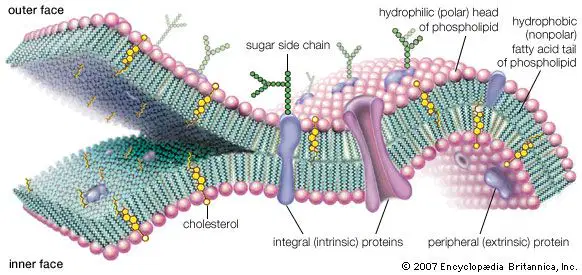
Another name for the "cell membrane" is:
Plasma Membrane
Tubular Membrane
Nictitating Membrane
Nuclear Membrane
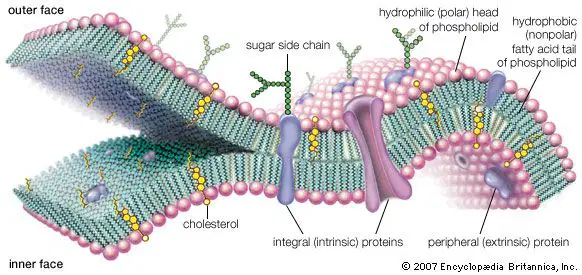
Another name for the "plasma membrane" is:
Cell Membrane
Tubular Membrane
Nictitating Membrane
Nuclear Membrane
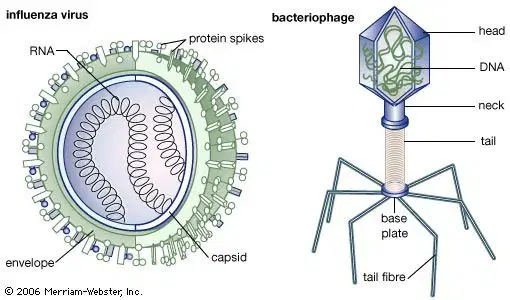
Note: "Genome" is genetic material (in viruses DNA or RNA, not both)
Select structures below that are in viruses.
Envelope
Genome (DNA or RNA)
Protein Spikes (projections)
Nucleus

