
 Worksheets
Genetics 7.14a
Total questions: 70
Worksheet time: 1hrs 10mins
The genotype for a yellow plant is...
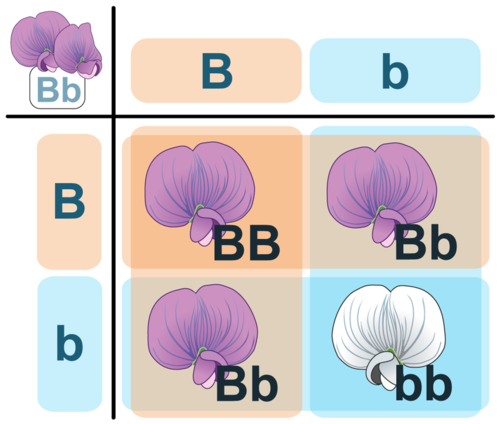
The B stands for bud.
w= non-white hair
If you cross a horse with WW and a horse with ww what fraction of the offspring would be expected to have white hair?

Two identical alleles for a trait is known as
homozygous
heterozygous
mutation
codominance

A physical appearance is
genotype
heterozygous
phenotype
codominance
Who studied different characteristics of pea plants by cross-pollinating plants?
Gregor Mendel
Albert Punnett
Sir Isaac Newton
David Kuster
What is the probability of producing a tall pea plant from a cross between two hybrid tall pea plants?
25%
50%
75%
100%
What does a Punnett Square determine?
all of Mendel's discoveries about genetic crosses
all the outcomes of a genetic cross
only the recessive allele combinations
only the dominant allele combinations
Genotype is
stem height
feather color
physical appearance
genetic makeup
The term that relates to physical characteristics that are studied in genetics.
traits
offspring
generations
hybrids
Scientists call an organism with two different alleles for a trait
factor
purebred
trait
hybrid
Which term refers to physical characteristics that are studied in genetics
traits
offspring
generations
hybrids
An organisms's allele combination is known as
phenotype
mutation
hybrid
genotype
If a homozygous black cat (BB) is crossed with a homozygous white cat (bb), what is the probability of having a cat with white fur?
100%
0%
75%
25%
What does RR mean
two dominant alleles
heterozygous alleles
at least one dominant allele
one dominant and one recessive allele

Which of the following is the best definition for heredity?
Heredity is the passing of particles from high concentration to low concentration.
Heredity explains how DNA copies itself.
Heredity is the passing of traits from parent to offspring.
Heredity is the forming of clones.

This scientist studied pea plants and was considered to be the "Father of Genetics".
Reginald Punnett
Gregor Mendel
Charles Darwin
Rosalind Franklin

A human body cell contains:
46 chromosomes
23 chromosomes
21 chromosomes
40 chromosomes

Which of the following is true regarding genes and chromosomes?
Genes and chromosomes do not have any connection.
Chromosomes make up genes.
Chromosomes are made up of genes which are located in the cytoplasm of the cell.
Genes are sections of the DNA strand and are located on chromosomes.
The term that relates to physical characteristics that are studied in genetics.
traits
offspring
generations
hybrids
Which of these are characteristics of inherited traits?
being able to speak in front of a crowd
having green eyes and brown hair
mastering your multiplication facts
becoming a teacher
What is a trait?
A type of organelle found within a cell.
Our talents that make us behave the way we do
Traits are the physical things that make us look the way we do, they may influence how we behave, and also our talents, abilities, and disease risks.
Inheritable talents that are passed on in our families

Scientists like to study identical twins in genetics because..
They are identical in every single way so scientists like to find out why.
They have the same talents and that must therefore be part of their DNA.
They have almost exactly the same DNA and this helps scientists figure out what traits come from the environment or from DNA
Their environment always stays the same so they are useful to find out what diseases people can get.

How many Chromosomes do we inherit from our parents?
23 from dad and 23 from mom, or 46 total
13 from dad and 13 from mom, or 26 total
13 from dad and 33 from mom, or 46 total

What are chromosomes?
They are thread like structures containing DNA found inside the nucleus of our cells
They are X shaped blobs made of ribosomes
They are the inherited traits we recieve from our parents
They are types of alleles found in the mitochondria of a cell

What is a gene?
An entire chromosome.
A small part of DNA found in a chromosome that gives our body instructions to build for a specific trait that we have
Things that are sometimes refered to as XX and XY inside of our cell membranes
Kind of like a "flavor" because there are 23 kinds from each parent.

What is a Chromosome?
a threadlike structure found in the nucleus of most living cells, carrying genetic information in the form of genes.
An X shaped thing found in the mitochondria of the cell that helps create energy in the form of ATP.
A threadlike structure found in the lysosome carrying genetic information in the form of proteins.
A colorful and fluorescent type of sugar that our body uses to break down and get energy.4

Pigeons have Chromosomes.
True
False
Our genes are ______ % the same when compared to another human
99
99.9
50-60
80
Select the living organism that has DNA
Pigeons
Humans
Trees
All the other answers
What is a trait?
A physical characteristic passed down from your mom
A behavioral characteristic passed down from your dad
A physical or behavioral characteristic passed down from your parents
A behavioral characteristic passed down by your mom
What is an allele?
A trait
Different forms of a gene
DNA
Different types of parents
What is a genotype?
Pair of alleles that determine a specific trait
Observable physical trait
A trait that is observed with only one copy of an allele
What is a phenotype?
Pair of alleles that determine a trait
Observable physical trait
Different forms of a gene
What is a dominant gene?
A trait that is observed when there are one OR two copies of the allele
A trait that is observed only when there are two copies of the allele
A trait that can be hidden in a generation
A person who is homozygous for a trait can have a genotype of....
AA, Aa
Aa, aa
AA, aa
aa
If a person is heterozygous for a trait, their genotype can be...
Aa
AA, aa
AA, Aa
AA
If "B" represents brown hair, and "b" represents blond hair, what will the genotype be for a homozygous brown haired person?
BB
Bb
bb
If "B" is brown and "b" is blond, what is the phenotype of someone who's genotype is "bb"
Brown Hair
Blond Hair
Red Hair
If a person is heterozygous for brown hair, what is their genotype?
BB
Bb
bb
Heterozygous: Different, Homozygous:_____________
The same
Less Than
Greater Than
4 copies
P= purple petals and p= white petals. What genotype(s) would result in purple petals?
pp
Pp, pp
PP, Pp
PP, pp
How many copies of the recessive gene must there be for that phenotype to show up?
1
2
3
4

What is the missing pairing?
AA
Aa
aa

Based on the missing letter, what is the parent's genotype?
AA
Aa
aa
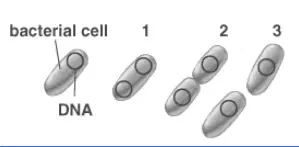
The diagram shows asexual reproduction in a bacterial cell. Based on this information, you can conclude that _____.
cells resulting from this process have half the DNA of the original cell
the cells resulting from this process have twice as much DNA as the original cell
the cells resulting from this process have traits that are very different from the original cell
the cells resulting from this process have traits that are identical to the original cell
Of the following, the organism that will produce offspring most like itself is _____.
a bacterial cell that produces new offspring by splitting in two
an animal that must mate with another of its species to produce young
a female frog whose eggs are fertilized by a male frog
a black-spotted cat mates with an orange and white striped cat to produce kittens.
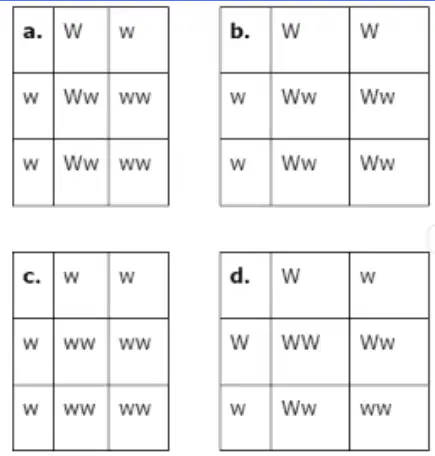
Dimples in a child are a dominant trait. A mother and father with dimples have an offspring with no dimples. How is this possible?
A
B
C
D
Which of these occurs in sexual reproduction, but not in asexual reproduction?
Genes carry genetic information.
Cells from two organisms combine.
An offspring inherits a set of traits.
An offspring is made of cells.
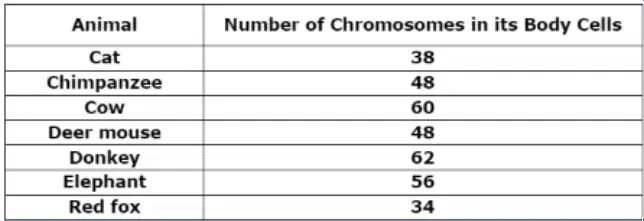
The data table above lists the number of chromosomes found in the body cells of some animals. Which animal has a sex cell that contains 28 sets of chromosomes?
elephant
cow
donkey
deer mouse
An individual inherits alleles, or different forms of a gene, from his or her parents. The alleles for dimples are D, which causes the presence of dimples, and d, which results in the absence of dimples. An individual with the alleles Dd would _____
be considered homozygous for dimples.
not be able to pass on the d allele to her offspring.
have dimples.
not have dimples.
Which of the following is an advantage of asexual reproduction?
Two parents are needed.
The organism can increase its number quickly.
It is a slow process.
It introduces genetic diversity in the offspring.

The diagram is an example of Mendel’s pea plant crosses.
What percentage of the offspring will be a hybrid plant according to Mendel’s theory?
25%
50%
75%
100%
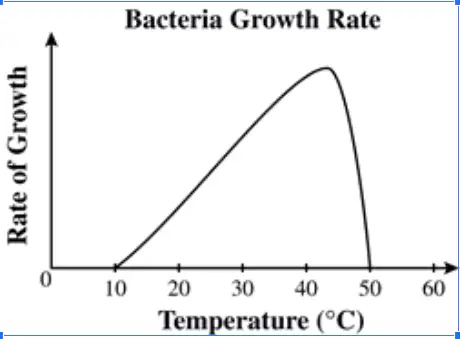
The graph shows the data from an experiment studying a bacteria population. Which conclusion should the researcher draw from the data?
The size of the population always decreases as the temperature changes rapidly over a short period of time.
The size of the population always decreases as the temperature of the culture decreases.
The size of the population increases as temperature increases, but declines after a certain temperature.
The size of the population is unaffected by very low and very high temperatures.
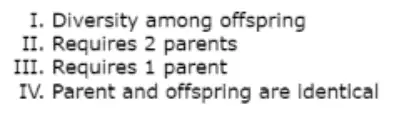
Which of the following descriptions are characteristics of sexual reproduction?
I and II
III and IV
I, II, and IV
I, II, III, and IV
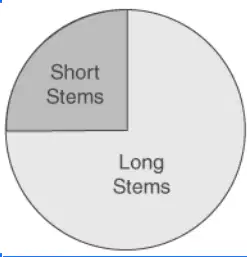
A scientist studied inherited traits in pea plants. He knew that the trait for long stems is dominant and the trait for short stems is recessive. The scientist cross-pollinated two long-stemmed pea plants; the circle graph provided shows the offspring. Which of the following explains how the results occurred?
Neither of the parent pea plants had genes for short stems.
Only one of the parent pea plants had a recessive gene for short stems.
One of the parent pea plants was a purebred for short stems.
Each of the parent pea plants had a recessive allele for short stems.
Which best describes an advantage of sexual reproduction over asexual reproduction?
Sexual reproduction increases the distribution of a population.
Sexual reproduction creates uniformity in the gene pool.
Sexual reproduction increases the genetic variability in a population.
Sexual reproduction produces many more offspring.

