
 Worksheets
Unit 3 Practice
Total questions: 38
Worksheet time: 59mins
The electron configuration of an atom determines how the atom reacts with other atoms. Examine the periodic table and determine which of the following substances is least likely to react with another substance.
Bromine (Br)
Gold (Au)
Neon (Ne)
Sodium (Na)
How many energy levels does Xenon have?
2
3
5
6

According to periodic trends, hydrogen would have it's valence electrons in what sublevel?
S
P
D
F

According to periodic trends, most transition metals (mainland metals) have their valence electrons in what sublevel?
S
P
D
F
1s2 2s2 is which element?
Lithium
Beryllium
Helium
Boron
Which element is 1s2 2s2 2p6 3s2 3p6 4s2 3d7?
Cobalt
Nickel
Manganese
Chromium
Write the configuration for Oxygen
1s2 2s2 1p4
2s2 2p4
1s2 2s2 3p4
1s2 2s2 2p4
Which element is 1s2 2s2 2p6 3s2 3p6 4s1?
Sodium (Na)
Lithium (Li)
Potassium (K)
Calcium (Ca)
Choose the correct configuration for Zinc
1s2 2s2 2p6 3s2 3p6 4s2 3d10
1s2 2s2 2p6 3s2 3p6 4s2 3d9
1s2 2s2 2p6 3s2 3p6 3s2 3d10
1s2 2s2 2p6 3s2 3p6 4s2 3d8
Choose the correct element for 1s2 2s2 2p6 3s2 3p6 4s2 3d10 4p5
Chlorine
Bromine
Krypton
Sulfur
What is the electronic configuration of iron (Fe)?
Which of the following is the electron configuration for Fluorine


Light is emitted when electrons
move from one atom to another.
collide with one another, releasing energy.
move from a lower energy level to a higher energy level.
move from a higher energy level to a lower energy level.

Describe the waves the arrow is pointing at.
long wavelength / low energy
long wavelength / high energy
short wavelength / low energy
short wavelength / high energy

Describe the waves the arrow is pointing at.
long wavelength / low energy
long wavelength / high energy
short wavelength / low energy
short wavelength / high energy
As the wavelength of a wave gets longer, what is also true?
Frequency of the wave will increase
Energy of the wave with increase
Frequency of the wave will decrease
The wave will travel at a slower speed

What atom matches this electron configuration?
1s2 2s2 2p6 3s2
Neon (Ne)
Magnesium (Mg)
Aluminum (Al)
Potassium (K)

Given the frequencies, which color has the highest energy?
Violet
Red
Green
Cl or Al?


What is the correct lewis dot diagram for Boron?


What is the missing part of the sequence for the electron configuration of Neon
1s2 , _, 2p6
2s2
3s2
2s6
1s1

Order the elements S, Cl, and F in terms of increasing atomic radius.
S, Cl, F
Cl, F, S
F, S, Cl
F, Cl, S
S, F, Cl
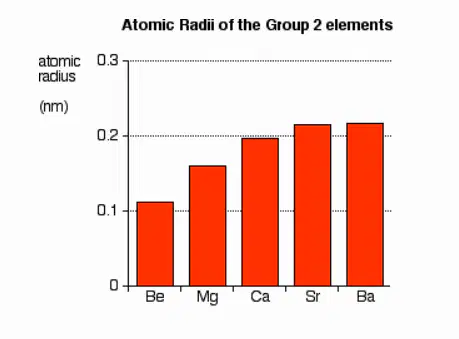
Which statement regarding these Group 2 elements best supports the data?
More energy levels, electrons in lower energy levels shield electrons in higher energy levels so the radius gets larger
More energy levels, electrons in higher energy levels shield electrons in the lower energy levels so the radius gets smaller
the mass of the atom is bigger
the mass of the atom is smaller
Which element in the pair of adjacent elements, Mg and Na,has a higher first ionization energy?
Na
Mg

Which group of elements has the lowest ionization energies?
Alkali Metals (Group 1)
Alkaline Earth Metals (Group 2)
Halogens (Group 17)
Noble Gases (Group 18)
Select the element with the lowest ionization energy.
Barium
Beryllium
Magnesium
Strontium
How many valence electrons are represented here?
1s2 2s2 2p6 3s2 3p6 4s2 3d10 4p2
2
12
4
10

