wayground logo

Free Printable Worksheets

NEW

Font size

S
M
L
XL
Worksheets

second semester final,ab,nuc,gas,h2o

Total questions: 40

Worksheet time: 1hrs 20mins

Name
Class
Date
1.
If a substance has a pH of 10 it is considered
a)
Acidic
b)
Basic
c)
Neutral
2.
When found in food, acids are ________
a)
Sour
b)
Bitter
c)
Salty
d)
Slippery
3.
What are properties of a base?
a)
Slippery, bitter, does not react with metals, pH above 7.
b)
Slippery, bitter, reacts with metals, pH below 7.
c)
Sour, reacts with metals, pH below 7
d)
Sour, reacts with metals, pH above 7.
4.
What might happen if you mixed a strong acid with an equally strong base?
a)
You would see an explosive chemical reaction.
b)
The acid would destroy the base.
c)
The base would destroy the acid.
d)
You'd wind up with a pH-neutral substance.
5.
Acid + Base ₋--> 
a)
salt + hydrogen
b)
salt + water
c)
salt + carbon dioxide + water
d)
salt
6.
a)

weak base

b)

strong acid

c)

strong base

d)

weak acid

7.
a)

weak acid

b)

strong acid

c)

weak base

d)

strong base

8.

Which describes an Electrolyte?

a)

Substance that give out ions when dissolved in water, which are able to conduct electricity

b)

Substances that prehibit electricity from traveling across a solvent

c)

A chemical used to combust flames in a laboratory setting

d)

A type of current that is utilized to determine if there is a blockage anywhere in the system.

9.

Which of the following is the strongest acid?

a)

oven cleaner - 13.5

b)

lemon juice - 2.5

c)

soap - 10

d)

blood - 7.4

10.
a)

detergents

b)

milk

c)

bleach

d)

orange juice

11.

A scientist runs tests on an unknown substance. He finds that it is extremely corrosive. It produces H+ ions in solution. And, it has a pH of 1. What type of substance has he identified?

a)

weak acid

b)

strong acid

c)

weak base

d)

strong base

12.

Arrhenius acids produce

a)

OH- in an aqueous solution

b)

H+ in an aqueous solution

c)

Cl- in an aqueous solution

d)

Li+ in an aqueous solution

13.
Balance the following equation:
146C --> 0-1e + ________
a)
145B
b)
146C
c)
147N
d)
42He
14.
Type of radiation that requires thick layers of concrete or lead in order to be stopped
a)
Gamma
b)
They are equal
c)
Beta
d)
Alpha
15.
a)
42He
b)
0-1 e
c)
00Y
d)
178O
16.
The splitting of a nucleus into smaller nuclei is
a)
fusion
b)
fission
c)
decay
d)
gamma radiation
17.
Gamma rays damage human cells/tissue.
a)
True
b)
False
18.
Solve this equation for alpha decay.
88226Ra = ___ + 24He
a)
86222Rn
b)
89226Ac
c)
84224Po
d)
88225Ra
19.
Classify this process.
a)
Nuclear fission
b)
Nuclear fusion
c)
Alpha decay
d)
Beta decay
20.
What is the symbol of alpha radiation (α)?
a)
24He
b)
-10e
c)
00γ
d)
01n
21.
When two light nuclei join together at extremely high temperatures, it is called what?
a)
radiation
b)
radioactivity
c)
fission
d)
fusion
22.

Compare a 1 mole sample of hydrogen at 273K at 1 atmosphere to a 1mole sample of hydrogen at 298k and 1 atmosphere. The second sample has

a)

more molecules

b)

fewer molecules

c)

molecules having a higher average kinetic energy

d)

molecules having lower average kinetic energy

23.

Which graph shows the pressure-temperature relationship expected for an ideal gas?

a)
b)
c)
d)
24.

As the volume of a fixed mass of a gas increases at constant temperature, the pressure of the gas

a)

decrease

b)

increase

c)

remains the same

25.

At temp of 273K, 400 mL a sample has a pressure of 760atm. If pressure changed to 380atm, at what temp will the sample have 551mL

a)

188.03

b)

30400

c)

0.053

d)

209380

26.

Sample of air has a volume of 140mL at 67C. At what temp will its volume be 50mL at constant pressure

a)

23.92

b)

121.43

c)

17000

d)

140

27.

These properties describe a ___.

a)

solid

b)

liquid

c)

gas

28.

These properties describe a ___.

a)

solid

b)

liquid

c)

gas

29.
a)
Flask 1 contain the most molecules
b)
Flask 2 contain the most molecules
c)
Flask 3 contain the most molecules
d)
Flask 4 contain the most molecules
30.

A quantity of gas has a volume of 250 L, at 290 K and 303.98 kPa of pressure. What volume must the gas be for the gas to be at 273 K and 101.33 kPa?

a)

78.4 L

b)

88.5 L

c)

706 L

d)

771 L

31.
What causes pressure?
a)
The walls of the container
b)
The vacuum in the container
c)
The collisions of the particles
d)
Atmospheric pressure acting on the outside walls
32.

molecule in which opposite ends have opposite electric charges

a)

cohesion

b)

nonpolar molecule

c)

solution

d)

polar molecule

33.

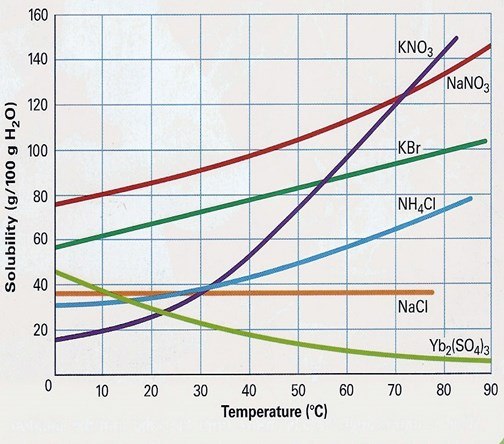
Identify if the following solution would be saturated, unsaturated, or supersaturated: 103 g KBr at 70'C.

a)

Unsaturated

b)

Saturated

c)

Supersaturated

34.

State whether the following compound is soluble or insoluble: Potassium bromide (KBr)

a)

Soluble

b)

Insoluble

35.

State whether the following compound is soluble or insoluble: Potassium hydroxide (KOH)

a)

Soluble

b)

Insoluble

36.

What does "polar" mean?

a)

A molecule is cold

b)

A molecule has ionic bonds

c)

A molecule has covalent bonds

d)

A molecule has areas of positive and negative charge due to unequal sharing of electrons

37.
How many grams of SOcan dissolve at 50 ⁰C?
a)
5 g
b)
10 g
c)
20 g
d)
39 g
38.
How many grams of K2Cr2O7, are soluble in 100 g of water at 95 ºC?
a)
83 grams
b)
75 grams
c)
40 grams
d)
12 grams
39.
Which of the following factors does not effect solubility?
a)
Temperature
b)
Agitation (stirring)
c)
Color
d)
Surface Area of solute (size)
40.
Water is a universal solvent because it...
a)
It can be found anywhere
b)
It freezes when it gets cold
c)
floats when frozen
d)
Dissolves most substances