
 Worksheets
Population and Intro to Ecology Practice Quiz 2023
Total questions: 38
Worksheet time: 1hrs 6mins


Which limiting factor is independent of the number of individuals in a population or their density?

The growth of a population is shown in the graph below. Which letter indicates the carrying capacity of the environment for this population?
A
B
C
D

Ten breeding pairs of rabbits are introduced onto an island with no natural predators and a good supply of water and food. What will most likely happen to the rabbit population initially (first)?
It will remain relatively constant due to equal birth and death rates
It will increase but then level out (logistic growth).
It will increase at an increasing rate (exponential growth).
It will decrease.
What does abiotic mean?
living
never alive
dead
one biotic

The average number of people per square mile is an example of a
Birth rate
Land area
population density
population size
The largest number of individuals of a population that the environment can support long-term ("sustainably") is known as
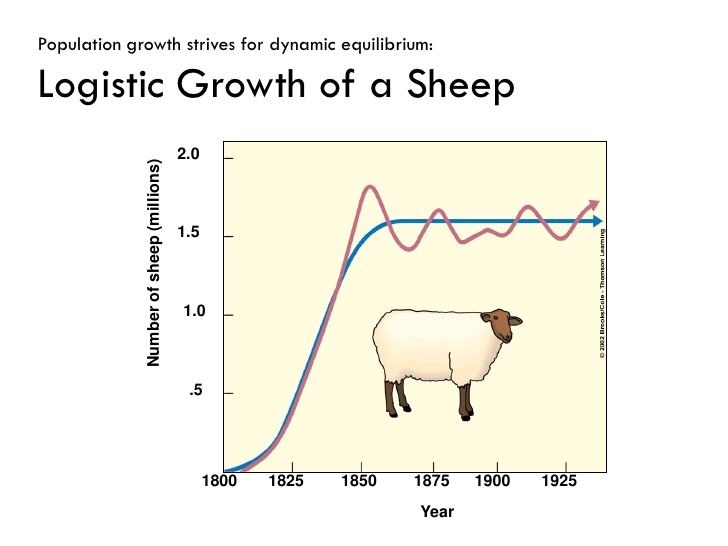
1.0 million
Dividing the population size by the area gives you what value?
population distribution
population carrying capacity
population density
microscope field of view
What are the three types of distribution patterns?
uniform, clumped, random
uniform, uneven, random
uneven, clumped, random
uniform, clumped, uneven

The most commonly seen population distribution pattern. This pattern can be caused because needed resources are also unequally spread across their habitat.
Example: wolves live in packs.
What is this pattern called?
Random
Uniform
Clumped
Uneven
This type of growth happens when an organism reaches its carrying capacity.
Exponential growth
Logistic growth
infinity growth
none of the above
Something that controls/ limits the size of a population and that can be more important at higher or lower population densities.
Density dependent limiting factors
Limiting factors
Density independent limiting factors
Environmental Resistance
Which of the following would NOT be an example of a density-dependent limiting factor?
hurricane
disease
lack of food
lack of space for nests
Which of the following is a density-independent factor?
competition for resources
predation
disease
natural disasters
A population of 100 bears experience the following changes in a year:
20 births, 15 deaths, 10 emigrants, and 2 immigrants.
What is the new bear population?
97
-3
+3
103
What method of determining population size is it when I take the population of dandelions in a small part of the meadow and then multiply it by the number of those small parts that would fit in the entire meadow?
Estimate by quadrat sampling
Count every Individual (census)
Mark and Recapture
Population Density
What type of population measurement is it when a census is taken?
Estimate by sampling
Count each Individual
Mark and recapture
Population Density
There are 200 ants on my kitchen counters. My kitchen counters have an area of 50 square feet. What is the population density of ants on my counters?
4 ants / sq ft
4 sq ft /ant
0.25 ants/sq ft
1000 ants

If the population stays the same but the area it is in shrinks (goes down), how does the population density change?
stays the same
goes up (more dense)
goes down (less dense)
the field of view changes
Your sampling quadrat is 1 m x 2 m. You found 16 of your target plant. What is the population density of your plant?
8 plants / sq m
0.125 plants / sq m
8 sq m / plants
5.3 plants / sq m

Connecticut has a population of 3,552,821 people and a land area of 14,357 km2.
Colorado has a population of 5,893,634 people and a land area of 269,601 km2. What is true? (calculators allowed)
Colorado has a LARGER population and a HIGHER population density.
Colorado has a LARGER population but a lower population density.
Colorado has a smaller population but a HIGHER population density.
Colorado has a smaller population and a lower population density.
What are 3 reasons why CLUMPED (also called clustered or aggregated) is the most common population distribution pattern?
Maddy can't easily count all the paramecia quickly cruising around the microscope image, so she takes a picture, divides the image up evenly into 10 sections, and then counts the paramecia in one of the sections.
She finds 3 paramecia in that one section.
What should Maddy estimate as the total paramecia population of that image?
30 paramecia
0.3 paramecia
This is an unreasonable way to estimate the paramecia population.
3 paramecia
Name one method of estimating the size of a biological population BESIDES simply counting the organisms.
Provide one advantage AND one disadvantage of this method.
Which of the following are all biotic?
Temperature, Light, Rain, Gravity, Heat
Water, Fish, Insects, Lily Plants
Dogs, Meat, Cats, Catnip
Lion, Pride Rock, Warthog, Meerkat
Which of the following are all abiotic?
Temperature, Light, Rain, Gravity, Heat
Water, Fish, Insects, Lily Plants
Dogs, Meat, Cats, Catnip
Lion, Pride Rock, Warthog, Meerkat
Which definition best fits the term Population?
A group or organisms of the same species that live in the same area and interact with one another.
A group of many populations (of different species) that live and interact with one another
A group of populations of many different species that live and interact with both one another and all of the abiotic factors in their environment.
A set of different ecosystems that acer connected by similar geographic features and share the same or similar climate.
Anywhere on earth that life exists.
Which definition best fits the term community?
A group or organisms of the same species that live in the same area and interact with one another.
A group of many populations (of different species) that live and interact with one another
A group of populations of many different species that live and interact with both one another and all of the abiotic factors in their environment.
A set of different ecosystems that acer connected by similar geographic features and share the same or similar climate.
Anywhere on earth that life exists.
Which definition best fits the term ecosystem?
A group or organisms of the same species that live in the same area and interact with one another.
A group of many populations (of different species) that live and interact with one another
A group of populations of many different species that live and interact with both one another and all of the abiotic factors in their environment.
A set of different ecosystems that acer connected by similar geographic features and share the same or similar climate.
Anywhere on earth that life exists.

Which level of organization is depicted in this image?
Population
Community
Ecosystem
Biome
Biosphere


