wayground logo

Free Printable Worksheets

Font size

S
M
L
XL
Worksheets

Unit 1 A Building Blocks of Chemistry

Total questions: 63

Worksheet time: 51mins

Name
Class
Date
1.

Which of the following is an accurate observation of the image?

a)

The Fish is red

b)

This is a Clown Fish

c)

The fish is swimming

d)

The fish has white stripes.

2.

Using your senses to gather information is called an _____?

a)

observation

b)

inference

c)

question

3.

Explaining or interpreting the observations is called _____?

a)

observation

b)

inference

c)

question

4.

It's December.

a)

Observation

b)

Inference

5.
There are 5 boys.
a)
Observation
b)
Inference
6.
Which of the following statements is an inference about the picture
a)
The vase is broken.
b)
The girls' bow is blue and purple.
c)
The girl broke the vase.
d)
The girl has blonde hair.
7.
What is an observation for this picture?
a)
The man is scared
b)
The man is going to get eaten
c)
There is a man in a kayak
d)
The man is paddling fast
8.
Which observation is quantitative?
a)
It is 5 cm long
b)
It is smooth
c)
It looks red
d)
It is dry
9.

An observation that uses words without numbers or amounts is called a _________ observation?

a)

quantitative

b)

qualitative

c)

observation

d)

inference

10.

The color of the foal is brown and white.

a)

quantitative

b)

qualitative

c)

inference

11.

There are 10 puppies in the picture. This is an example of a

a)

quantitative observation

b)

qualitative observation

c)

inference

12.
What is matter?
a)
a pure substance
b)
anything that occupies space and possesses mass
c)
an element
d)
a compound
13.
Which of the following is not a chemical property? 
a)
rusting 
b)
boiling 
c)
rotting 
d)
burning 
14.
Which one of these is a chemical property?
a)
melting point
b)
boiling point
c)
color
d)
flammability
15.
Which is an example of a physical property?
a)
ability to react with acid
b)
 state of matter
c)
flammability
d)
ability to react with oxygen
16.
Which of the following is a chemical change?
a)
human digestion
b)
cutting a tree down
c)
melting a chocolate bar
d)
Has a density of 1 gm/mL
17.
What kind of properties can only be observed when a substance changes into a different substance?
a)
physical properties
b)
chemical properties
c)
liquid properties
d)
real properties
18.
Properties that can be observed without trying to change the identity of the substance.
a)
Physical
b)
Chemical
19.
is this a chemical or physical change?
a)
chemical
b)
physical 
20.
is a fried egg a chemical or physical change?
a)
chemical
b)
physical
c)
none of the above
d)
all of the above
21.
a chemical change can be easily reversed 
a)
TRUE 
b)
FALSE
22.
with a physical change, no new substance is formed
a)
TRUE
b)
FALSE
23.
Which is a chemical change?
a)
Coloring a picture with crayons
b)
Squeezing juice from an orange
c)
Toasting bread
d)
Washing your hands
24.
Which is a physical change?
a)
burning match 
b)
vinegar in baking soda 
c)
melting butter
d)
cooking an egg
25.

What does the subscript tell us in a chemical formula? (For example, the 2 in H2O)

a)

Type of element

b)

Amount of atoms

c)

Amount of compounds

26.

Which of the following is NOT an element in the formula: MgSO4?

a)

Mg

b)

S

c)

O

d)

Si

27.

How many S atoms are in the formula: MgSO4?

a)

1

b)

2

c)

4

d)

5

28.
What you can say about the CaCO3?
a)
It is made of calcium and oxygen
b)
it contains one calcium and three oxygen
c)
It contains one carbon atom
d)
It has combination ratio of 1:3
29.
Which of the following formulas contains 4 different kinds of elements?
a)
NaCl
b)
CaNO3
c)
NH4Br
d)
CO(NH2)2
30.
Which of the following evidences shows that chemical change is taking place?
a)
Change in size
b)
Change in shape
c)
Change in color
d)
Change in properties
31.
What are the substances that are formed in chemical change?
a)
Products
b)
Chemicals
c)
Reactants
d)
Reactions
32.
Element or compound?
H2O
a)
element
b)
compound
33.
A compound ___.
a)
is a pure element
b)
has the same properties as its parts
c)
is a combination of two or more elements
d)
is composed of only metals
34.

CaCO3 represents a

a)

Symbol

b)

Formula

c)

Subscript

d)

Coefficient

35.

How many molecules of the compound are in the following formula? 3C2H6

a)

3

b)

6

c)

12

d)

18

36.
What is the left part of a chemical equation called?
2H2 + O2 --> 2H2O
a)
Reactants
b)
Products 
c)
Yields 
d)
Chemical Equation 
37.
What is the right part of a chemical equation called...
2H2 + O2 --> 2H2O
a)
Reactants
b)
Products 
c)
Yields 
d)
Chemical Equation 
38.
How many Sodium (Na) are in 6NaCl?
a)
1
b)
12
c)
6
39.
This tells what elements and how many atoms are in a compound.
a)
Chemical Formula
b)
Chemical Stability
c)
Ionic Bond
d)
Covalent Bond
40.
The blue atoms are called 
a)
metals
b)
nonmetals
c)
metalloids
d)
noble gases
41.
The atoms along the staircase are called 
a)
metals
b)
nonmetals
c)
metalloids
d)
noble gases
42.

____ is a substance that can't be broken down. It's made of one kind of atom.

a)

atom

b)

element

c)

mixture

d)

product

43.

What do we call the number 2 in the chemical formula O2 ?

a)

subscript

b)

coefficient

c)

number

d)

4

44.
Classify the picture with the correct label.
a)
Element
b)
Compound
c)
Mixture of Elements
d)
Mixture of Compounds
45.

This picture represents which of the following?

a)

A single element

b)

Mixture of molecules

c)

mixture of atoms

d)

mixture of compounds

46.

What does this illustrate

a)

Elements

b)

Compunds

c)

Mixture of Elements and Compunds

d)

Mixture of Compounds

47.
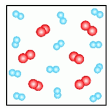
This diagram represents a _____.
a)
pure substance that is a compound
b)
mixture of elements
c)
pure substance that is an element
d)
mixture of compounds
48.

Zinc

a)

Z

b)

Zi

c)

ZN

d)

Zn

49.

Hydrogen

a)

Hy

b)

H

c)

Hr

d)

Hn

50.

Iron

a)

Ir

b)

In

c)

Fe

d)

FE

51.

Which compound is best represented by this particle diagram?

a)

NH3

b)

H2O

c)

CH4

d)

HCl

52.

Which compound is best represented by this particle diagram?

a)

C2H6

b)

C6H12O6

c)

CO2

d)

NaCl

53.
Which of these is a property of metals?
a)
It's malleable
b)
It can't conduct electricity
c)
They are used in food
d)
It's very brittle
54.
Which of the following is NOT a characteristic of most metals?
a)
Brittle
b)
Good conductor
c)
Ductile
d)
Malleable
55.
Which of these grouping of elements could have the characteristic of luster (shiny)?
a)
Metal
b)
Nonmetal
c)
metalloids
d)
Both metals and metalloids
56.
All of the following would classify an element as a metal except?
a)
Dull
b)
Luster
c)
Malleable
d)
Hard
57.
I have an object that is dull, brittle, and an insulator, what is it?
a)
metalloid
b)
non-metal
c)
metal
d)
matter
58.

If you have a material that can conduct electricity well it is probably a...

a)

Metalloid

b)

Matter

c)

Non-metal

d)

Metal

59.
The elements argon, krypton, and xenon are all non-metals. What property would these elements have in common?
a)
Good conductor of thermal energy
b)
Poor conductor of electricity
c)
Shiny, lustrous surface
d)
Soft and malleable
60.
Which of these grouping of elements could have the characteristic of brittle?
a)
Metal
b)
Nonmetal
61.
Which of the following would help a student classify an unknown element as a metal, metalloid, or non-metal?
a)
Measure its conductivity
b)
Determine its density
c)
Find its melting point
d)
Observe its color
62.
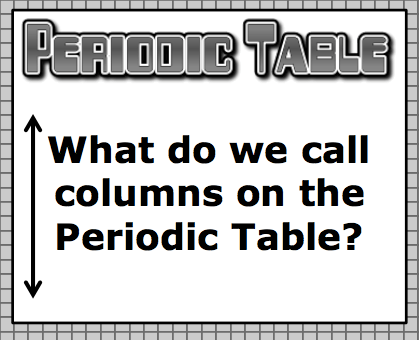
a)
Periods
b)
Groups
63.
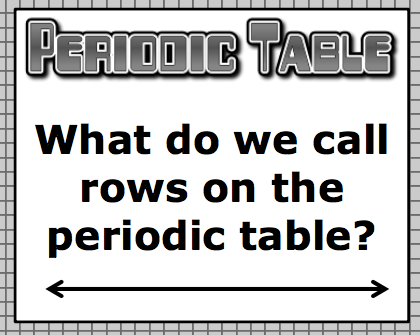
a)
Periods
b)
Groups