wayground logo

Free Printable Worksheets

Font size

S
M
L
XL
Worksheets

Applied Science - Electrostatics

Total questions: 62

Worksheet time: 40mins

Name
Class
Date
1.
The electric potential at a distance of 4 m from a certain point charge is 200 V relative to infinity. What is the potential (relative to infinity) at a distance of 2 m from the same charge?
a)
600 V
b)
50 V
c)
200 V
d)
400 V
2.
The electric potential at a distance of 4 m from a certain point charge is 200 V relative to infinity. What is the potential (relative to infinity) at a distance of 2 m from the same charge?
a)
600 V
b)
50 V
c)
200 V
d)
400 V
3.
A region of space contains a uniform electric field, directed toward the right, as shown in the figure. Which statement about this situation is correct?
a)
The potential at point A is the highest, the potential at point B is the second highest, and the potential at point C is the lowest.
b)
The potential at points A and B are equal, and the potential at point C is lower than the potential at point A.
c)
The potential at all three locations is the same.
d)
The potentials at points A and B are equal, and the potential at point C is higher than the potential at point A.
4.
Two protons are released from rest, with only the electrostatic force acting. Which of the following statements  is NOT true about them as they move apart? 
a)
Their electric potential energy keeps decreasing.
b)
Their electric potential energy keeps increasing.
c)
Their acceleration keeps decreasing.
d)
Their kinetic energy keeps increasing.
5.
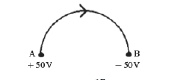
How much work must we do on an electron to move it from point A, which is at a potential of +50V, to point B, which is at a potential of -50 V, along the semicircular path shown in the figure? Assume the system is isolated from outside forces. (e = 1.60 × 10⁻¹⁹ C)
a)
1.60 × 10⁻¹⁷ J
b)
-1.6 J
c)
1.6 J
d)
-1.60 × 10⁻¹⁷ J
6.

A and B are two conducting spheres of the same radius A being solid and B hollow, both have same charge. What will be the relation between their electric fields inside the two spheres at depth of half of their radius?

a)

EA=EB

b)

EA=2EB

c)

2EA=EB

d)

EA=KQ/r2 ;EB=0

7.

What is the electrostatic potential at equatorial point of a dipole?

a)

twice of the axial point

b)

half of the axial point

c)

zero

d)

not defined

8.

Why must electrostatic field at the surface of a charged conductor be normal to the surface at every point?

a)

As electric field inside conductor is always zero

b)

If not normal than it will have component parallel to the surface and perpendicular to the surface

c)

parallel component of the field will generate current along the surface, which is not possible

d)

work done in moving the charge along the surface ha to be zero

9.

Two charges – q and + q are located at points A (0, 0, -a) and B (0, 0, +a) respectively. How much work is done in moving a test charge 2 µC from point P (7, 0, 0) to Q (-3, 0, 0)?

a)

Kq2100\frac{Kq^2}{100}

b)

Kq216\frac{Kq^2}{16}

c)

Kq210\frac{Kq^2}{10}

d)

zero

10.

A test charge q is moved without acceleration from A to C along the path from A to B and then B to C in electric field E as shown in the figure. At which point of the three is the electric potential more ?

a)

A

b)

B

c)

C

d)

All are at same potential

11.

Relation between the electric field and the electrostatic force due to a source charge Q at a point 'r' distance away from the charge on test charge q0 is

a)

F=Eq0

b)

F=E/Q

c)

F=E/q0

d)

F=EQ

12.
A tiny sphere carrying a charge of 6.5 µC sits in an electric field, at a point where the electric potential is 240 V. What is the sphere’s potential energy?
a)
2.7 x 10⁻⁸
b)
6.5 x 10⁻⁶
c)
1.6 x 10⁻³ J
d)
240 J 
13.
If 500 J of work are required to carry a 40-C charge from one point to another, the potential difference between these two points is: 
a)
12.5 V 
b)
20,000 V 
c)
0.08 V 
d)
depends on the path 
14.

Charge Q is distributed uniformly throughout a spherical insulating shell. The net electric flux through the inner surface of the shell is:

a)

0

b)

Q/e0

c)

2Q/e0

d)

Q/4*Pi*e0

15.
The flux of the electric field (24 N/C)i  + (30 N/C)j  + (16 N/C)k  through a 2.0 m2 portion of the xz plane is: 
a)
32 N × m2/C 
b)
34 N × m2/C 
c)
42 N × m2/C 
d)
60 N × m2/C 
16.
The electric potential in a region of space is given by the function V=3x+ 2y3. what is the x-component of the electric field in this area?
a)
6x
b)
-6x
c)
x3
d)
-x3
17.
1 Coulomb is equivalent to
a)
6 x 10^17 Charges
b)
6 x 10^18 Charges
c)
6 x 10^19 Charges
d)
6 x 10^20 Charges
18.

The net force on an electric dipole in an uniform electric field is

a)

0

b)

>0

c)

<0

d)

varies from negative to positive value from negative to positive charge.

19.

The expression for Torque on an electric dipole in an uniform electric field is __________

a)

 τ =E ×p \overrightarrow{\ \tau\ }=\overrightarrow{E}\ \times\overrightarrow{p}\

b)

 τ =pE \overrightarrow{\ \tau\ }=\frac{\overrightarrow{p}}{\overrightarrow{E}}\

c)


 τ =p ×E\overrightarrow{\ \tau\ }=\overrightarrow{p}\ \times\overrightarrow{E}

d)

τ=p.E\overrightarrow{\tau}=\overrightarrow{p}.\overrightarrow{E}

20.

Electric field of a thin spherical shell of charge density σ and radius R at a point r>R, r=R and r<R respectively are

a)


σϵ0R2r2, 0 ,σϵ0 \frac{\sigma}{\epsilon_0}\frac{R^2}{r^2},\ 0\ ,\frac{\sigma}{\epsilon_0}\

b)

 σϵ0, 0, σϵ0R2r2\ \frac{\sigma}{\epsilon_0},\ 0,\ \frac{\sigma}{\epsilon_0}\frac{R^2}{r^2}

c)

σϵ0, σϵ0R2r2, 0\frac{\sigma}{\epsilon_0},\ \frac{\sigma}{\epsilon_0}\frac{R^2}{r^2},\ 0

d)

σϵ0, 0, σ2ϵ0\frac{\sigma}{\epsilon_0},\ 0,\ \frac{\sigma}{2\epsilon_0}

21.

Dimensional formula of the permittivity of free space  ϵ0\epsilon_0 is 


a)

[M1L3T4A2][M^1L^3T^{-4}A^{-2}]  

b)

[M1L3T2A2][M^{-1}L^{-3}T^2A^2]  

c)

[M1L3T4A2][M^{-1}L^{-3}T^4A^2]  

d)

[M1L2T4A2][M^{-1}L^{-2}T^4A^2]  

22.
Electrostatic force F exists between two point charges. If the both charges are doubled, the force between the charges will be
a)
F
b)
4F
c)
2F
d)
F/4
23.

The electric field inside a charged conducting sphere of radius R is

a)

14πϵ0 qR2\frac{1}{4\pi\epsilon_0}\ \frac{q}{R^2}

b)

14πϵ0 qr2\frac{1}{4\pi\epsilon_0}\ \frac{q}{r^2}

c)

14πϵ0 qR\frac{1}{4\pi\epsilon_0}\ \frac{q}{R}

d)

0

24.
Which of the following is a false statement about electrostatic force.
a)
Bringing charges closer together strengthen the force.
b)
The electrostatic constant remains the same.
c)
The values of the two charges is always the same.
d)
Electrostatic force can be attractive or repulsive
25.
Two similar metal spheres, A and B, have charges of +2.0 x 10⁻⁶ coulomb and +1.0 x 10⁻⁶ coulomb, respectively. The magnitude of the electrostatic force on A due to B is 4.0N newtons. What is the magnitude of the electrostatic force on B due to A?
a)
2.0N
b)
4.0N
c)
8.0N
d)
1.0N
26.
The SI unit of charge is
a)
the ampere
b)
the newton
c)
the coulomb
d)
the joule
27.

When the distance between two charges is halved, the electrical force between the charges

a)

quadruples

b)

reduces to one fourth

c)

halves

d)

doubles

28.

2 charges feel a force of 40 N. if we cut the distance between them in half, what is the new force they feel

a)

20

b)

80

c)

160

d)

10

29.

The force of attraction between two charges is given by

a)

14πϵ0 q1q2r2\frac{1}{4\pi\epsilon_0}\ \frac{q_1q_2}{r^2}

b)

14πϵ0 qr2\frac{1}{4\pi\epsilon_0}\ \frac{q_{ }}{r^2}

c)

14πϵ0 q1q2r\frac{1}{4\pi\epsilon_0}\ \frac{q_1q_2}{r^{ }}

d)

14πϵ0 q1q2r3  r \frac{1}{4\pi\epsilon_0}\ \frac{q_1q_2}{r^3}\ \overrightarrow{\ r}\

30.

What is the electric field inside a spherical shell?

(a)  

31.

The potential inside a uniformly charged spherical shell of radius R and surface charge density σ\sigma  is

a)

R2σϵ0z\frac{R^2\sigma}{\epsilon_0z}  

b)

Rσϵ0\frac{R\sigma}{\epsilon_0}  

c)

00  

d)

14πϵ0 σR\frac{1}{4\pi\epsilon_0}\ \frac{\sigma}{R}  

32.

The value of ×E\nabla\times E  

a)

dEdr\frac{\text{d}E}{\text{d}r}  

b)

Er\frac{\partial E}{\partial r}  

c)

0

d)

1

33.

Electric field due to an infinite plane sheet having surface charge density σ\sigma  is

a)

σϵ0\frac{\sigma}{\epsilon_0}  

b)

2σϵ0\frac{2\sigma}{\epsilon_0}  

c)

σϵ0z\frac{\sigma}{\epsilon_0z}  

d)

σ2ϵ0\frac{\sigma}{2\epsilon_0}  

34.

Gauss law in differential form is given by

a)

E.ds=Qenclϵ0\oint E.ds=\frac{Q_{encl}}{\epsilon_0}

b)

2V=ρϵ0\nabla^2V=-\frac{\rho}{\epsilon_0}

c)

.E=ρϵ0\nabla.E=\frac{\rho}{\epsilon_0}

d)

0

35.
Electrostatic force F exists between two point charges. If the both charges are doubled, the force between the charges will be
a)
F
b)
4F
c)
2F
d)
F/4
36.

The electric field inside a charged conducting sphere of radius R is

a)

14πϵ0 qR2\frac{1}{4\pi\epsilon_0}\ \frac{q}{R^2}

b)

14πϵ0 qr2\frac{1}{4\pi\epsilon_0}\ \frac{q}{r^2}

c)

14πϵ0 qR\frac{1}{4\pi\epsilon_0}\ \frac{q}{R}

d)

0

37.
Which of the following is a false statement about electrostatic force.
a)
Bringing charges closer together strengthen the force.
b)
The electrostatic constant remains the same.
c)
The values of the two charges is always the same.
d)
Electrostatic force can be attractive or repulsive
38.
Two similar metal spheres, A and B, have charges of +2.0 x 10⁻⁶ coulomb and +1.0 x 10⁻⁶ coulomb, respectively. The magnitude of the electrostatic force on A due to B is 4.0N newtons. What is the magnitude of the electrostatic force on B due to A?
a)
2.0N
b)
4.0N
c)
8.0N
d)
1.0N
39.
The SI unit of charge is
a)
the ampere
b)
the newton
c)
the coulomb
d)
the joule
40.

When the distance between two charges is halved, the electrical force between the charges

a)

quadruples

b)

reduces to one fourth

c)

halves

d)

doubles

41.

2 charges feel a force of 40 N. if we cut the distance between them in half, what is the new force they feel

a)

20

b)

80

c)

160

d)

10

42.

The force of attraction between two charges is given by

a)

14πϵ0 q1q2r2\frac{1}{4\pi\epsilon_0}\ \frac{q_1q_2}{r^2}

b)

14πϵ0 qr2\frac{1}{4\pi\epsilon_0}\ \frac{q_{ }}{r^2}

c)

14πϵ0 q1q2r\frac{1}{4\pi\epsilon_0}\ \frac{q_1q_2}{r^{ }}

d)

14πϵ0 q1q2r3  r \frac{1}{4\pi\epsilon_0}\ \frac{q_1q_2}{r^3}\ \overrightarrow{\ r}\

43.

What is the electric field inside a spherical shell?

(a)  

44.

The potential inside a uniformly charged spherical shell of radius R and surface charge density σ\sigma  is

a)

R2σϵ0z\frac{R^2\sigma}{\epsilon_0z}  

b)

Rσϵ0\frac{R\sigma}{\epsilon_0}  

c)

00  

d)

14πϵ0 σR\frac{1}{4\pi\epsilon_0}\ \frac{\sigma}{R}  

45.

The value of ×E\nabla\times E  

a)

dEdr\frac{\text{d}E}{\text{d}r}  

b)

Er\frac{\partial E}{\partial r}  

c)

0

d)

1

46.

Electric field due to an infinite plane sheet having surface charge density σ\sigma  is

a)

σϵ0\frac{\sigma}{\epsilon_0}  

b)

2σϵ0\frac{2\sigma}{\epsilon_0}  

c)

σϵ0z\frac{\sigma}{\epsilon_0z}  

d)

σ2ϵ0\frac{\sigma}{2\epsilon_0}  

47.

Gauss law in differential form is given by

a)

E.ds=Qenclϵ0\oint E.ds=\frac{Q_{encl}}{\epsilon_0}

b)

2V=ρϵ0\nabla^2V=-\frac{\rho}{\epsilon_0}

c)

.E=ρϵ0\nabla.E=\frac{\rho}{\epsilon_0}

d)

0

48.
a)

A1 and A2

b)

B1 and B2

c)

Both directions

d)

No stable

49.
a)

5

b)

1/5

c)

11/25

d)

25/11

50.

Which charge configuration Produces a uniform electric field?

a)

Point charge

b)

Uniformly charged infinite line

c)

Uniformly charged infinite plane

d)

Uniformly charged spherical shell

51.
a)

4 mC

b)

5 mC

c)

7 mC

d)

8 mC

52.
a)

D<C<B<A

b)

D>C>B>A

c)

A<B=C<D

d)

C<A=B<D

53.

Total electric flux for the following closed surface which is kept inside water

a)

A

b)

B

c)

C

d)

D

54.
a)

Less than before

b)

Same as before

c)

More than before

d)

Zero

55.
a)

1=4<2<3

b)

2=4<3<1

c)

2=3<1<4

d)

3<1<2<4

56.
a)

A

b)

B

c)

C

d)

D

57.

An electric field E= 10xi exist in certain region of space. Then the potential difference V = Vo-Va where Vo is the potential at orgin and Va is the potential at x= 2 m is

a)

10 V

b)

-10 V

c)

20 V

d)

-20 V

58.
a)

A

b)

B

c)

C

d)

D

59.
a)

Q remains the same ,C is doubled

b)

Q is doubled , C doubled

c)

C remains same, Q doubled

d)

Both Q and C are remain same

60.
a)

1 uF

b)

3 uF

c)

2 uF

d)

1/4 uF

61.
a)

A

b)

B

c)

C

d)

D

62.

A parallel plate capacitor stores a charge Q at a voltage V. Suppose the area of the parallel plate capacitor and Distance between the plates are each doubled then which is the quantity that will change?

a)

Capacitance

b)

Charge

c)

Voltage

d)

Energy density