
 Worksheets
Unit 2 Review: Biosphere
Total questions: 61
Worksheet time: 3600secs


What is an advantage of a biodiverse ecosystem?
Can withstand changes in resources
Can recover more quickly from a natural disaster
Can withstand the immigration of a new predator
all of the above
Biodiversity leads to
Increased Stability
Decreased Stability
Increased Exctintions
Increased Endangered Species
What is an ecosystem?
all the living and nonliving factors in an area
a system of pipes and drains in a field
all the living organisms in an environment
an organization system used by scientists
What is a niche?
a stinging insect found in Utah's deserts
a strange smelling marsh
the only mysterious fish that lives in the Great Salt Lake
an organisms specific role in its environment
What is competition?
an interaction between two species where both benefit
an interaction that occurs when two species compete for the same resource
when one animal eats another
a soccer game
What is a limiting factor?
any factor that helps a living thing grow
the opposite of multiplication
any factor that limits population growth
any factor that makes a population grow
What is an invasive species?
a species that is helpful to the environment
a species that has been introduced to an area and causes harm to the ecosystem
both a and b
neither a nor b
An organisms ability to withstand change is called its?
Limit
Tolerance
Niche
Habitat Range
A relationship between two organisms in which one organism benefits and the other is not affected...
Mutualism
Competition
Parasitsm
Commensalism
A relationship between two organisms in which both organisms benefit
Mutualism
Competition
Parasitsm
Commensalism
A relationship between 2 organisms in which one organism benefits and the other is harmed
commensalism
parasitism
mutualism
predation
What do the arrows in a food web represent?
mass
energy flow
matter
organisms
What happens as you move higher in the energy pyramid?
more organisms
fewer organisms
number of organisms does not change
organisms die
What type of organism is at the beginning of every food chain?
predator
carnivore
producer
herbivore
an organism that makes its own food
consumer
producer
herbivore
omnivore
an organism that gets energy from eating other things
consumer
producer
energy pyramid
decomposer
The formation of a new species is called
Natural selection
Struggle for existence
Speciation
Darwinism
A new river forms and splits two populations, causing ______________ speciation
Sympatric
Allopatric
Extreme
Convergent
A speciation in which new species evolve from a single ancestral species while inhabiting the SAME geographic region.
Sympatric speciation
Allopatric speciation
Complex speciation
Divergent speciation

All of these

What are survivorship curves?
curves that describe the number of survivors over time
curves that tell us what the limiting factors are
curve that tells us about the carrying capacity
Why don't populations grow indefinitely?
limiting factors
only biotic factors
only abiotic factors
none of the above
parasites, disease, predators, are examples of what type of limiting factors?
density dependent
density independent
competition
weather, disasters, and pollution are examples of what type of limiting factors?
density dependent
density independent
natural selection
A mouse with a short life span, produces more offspring than can survive, and gives little or no parental care is a
R-strategist species
K-strategist species
An elephant that has only 1 offspring at a time, has a long life span, and provides parental care throughout maturity is a
K- strategist species
R-strategist species

A pattern of survival over time in which there is high survival throughout most of the life span, but then individuals start to die in large numbers as they approach old age.
Type i survivorship
Type ii survivorship
Type iii survivorship

A pattern of survival over time in which there is a relatively constant decline in survivorship throughout most of the life span.
Type ii survivorship
Type i survivorship
Type iii survivorship

A pattern of survival over time in which there is low survivorship early in life with few individuals reaching adulthood.
Type III survivorship
Type II survivorship
Type I survivorship

This graph represents the _______ growth curve.
Exponential
Logistic

This graph represents a _____ growth curve
Logistic
Exponential

Which population is growing faster?
Mexico
The US
It's impossible to tell from this graph

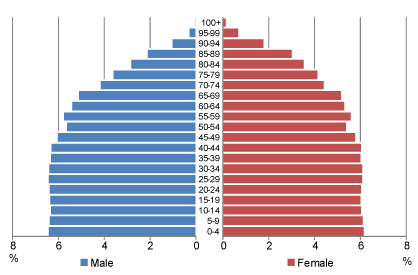
Age structure pyramids

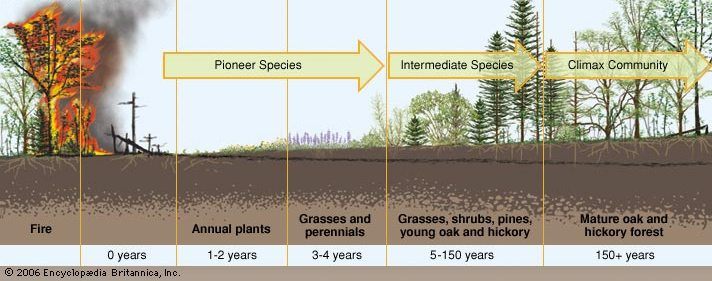
What would happen if a forest fire destroyed a community?
The land will remain unchanged by this event.
Soil formation will cause a change in ecosystem.
A new community of vegetation will establish, that is similar to the original.
A change in species of vegetation will occur, that is different from the original species

The two main abiotic factors that determine where organisms live are
temperature and latitude
altitude and precipitation
temperature and precipitation
soil type and precipitation
The variations of weather conditions over long periods of time.
weather
climate
The current state of the atmosphere right now
climate
weather
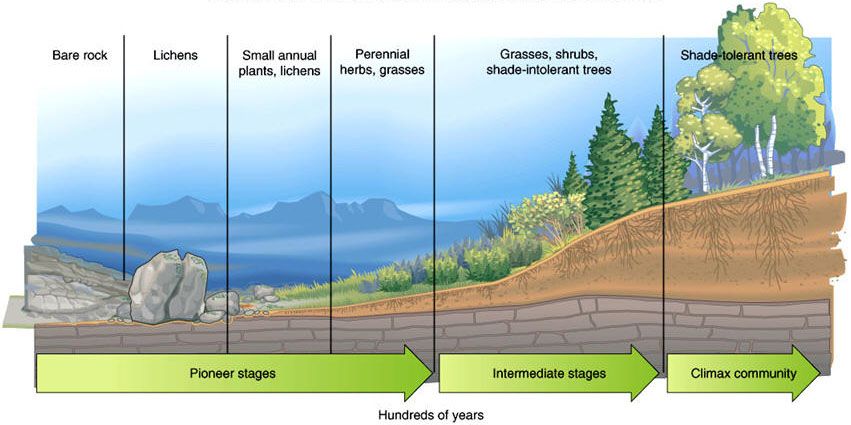
A species that plays a far more important in its community than its relative abundance might suggest.
Keystone Species
Pioneer Species
Indicator Species
Exotic Species
They can live in many different places, eat a variety of foods, and tolerate a wide range of environmental conditions.
generalist species
specialist species
strategist species
pioneer species
They may be able to live in only one type of habitat, tolerate only a narrow range of climatic and other environmental conditions, or use only one type or a few types of food.
generalist species
specialist species
invasive species
strategist species

