
 Worksheets
US - Unit 2 Review
Total questions: 61
Worksheet time: 54mins
What innovation contributed to the rapid industrialization (growth of factories) of the United States?
Railroads
Telephone
Dry farming
Sewing machine
Many immigrants found work as-
unskilled labor in factories
farmers on the Great Plains
skilled craftsmen
Educators
Which idea summarizes the Gilded Age?
Many Americans moved west to farm
Native Americans were placed on Reservations
The discovery of Gold increased western migration
Industrialists used their wealth to influence politics
What is one positive about the laissez-faire politics?
Immigrants were exploited by political machines
Entrepreneurs started businesses without government interference
American workers formed labor unions
Many immigrants lived in tenements

What was an important effect of the invention of the light bulb?
Machines were able to be more efficient
Products were created on the assembly line
Factories could extend working hours
Businesses hired more skilled workers

What is the main idea of the cartoon?
Political Corruption
Laissez Faire
Monopoly
Social Darwinism
What factor most led to the growth of the steel industry?
Laissez faire economics
New production techniques
Labor unions
The need for a new building material
What statement about tenements was true during the Gilded Age?
The living conditions of tenements improved greatly
The number of people living in tenements declined
Many immigrants lived in crowded tenements
Tenements were torn down and rebuilt
What term attempted to assimilate people of different cultures?
Americanization movement
Nativism
Patronage System
Labor unions
What was one way workers tried to get better working conditions?
By homesteading on the Great Plains
By joining labor unions
By working for Political bosses
Through better education
What was one positive of wealthy industrialists?
Paying their workers low wages
Philanthropic donations to charity
Supporting social darwinism
Working with political machines
This invention created steel, which was used to build railroads and skyscrapers:
the telegraph
the Bessemer Process
the Model T
The light bulb
Andrew Carnegie and John D Rockefeller created monopolies. What is a monopoly?
When one person or company controls a market
a board game created by Rockefeller and Carnegie
a law that gave them advantages in business
Andrew Carnegie and John D Rockefeller were know as robber barons because:
they were like nobility, but they trampled on people to get rich.
they robbed trains to get rich.
they made their fortune by working through the night.
When a single group of people makes decisions for multiple companies and trade stocks, it is known as a:
stock
corporation
monopoly
trust
What Supreme Court case set the precedent for "Separate but Equal", which would last until the Civil Rights Movement of the mid 1900s?
Plessy v Ferguson
Brown v Board of Education
Marbury v Madison
Roe v Wade
This period, during 1877 to 1900, is known for the rise of railroads, big business, industrialization and social problems in the United States.
World War I
Progressive Era
Gilded Age
Roaring Twenties
In 1882, the Government passed this legislation that restricted immigration for 10 years from a certain group into the United States.
Nativist Act
Mexican Reparition Act
Dawes Act
Chinese Exclusion Act
What is the anti-immigration sentiment called?
Nativism
Native Americans
Political Machines
Republicans
What industry did John D Rockefeller create a monopoly in?
Oil Refineries
Automobiles
Telephones
Steel

By the 1890's, a new political party emerged. This party was made up largely of farmers and workers.
Green Party
Populist Party
Labor Party
What is Nativism
Individuals who are born from immigrants
Individuals born in the U.S.
An Extreme dislike for immigrants by native born people
Natives who like immigrants

What is this a criticism of in the 19th century
monopolization
industrialism
horizontal integration
laissez-faire capitalism
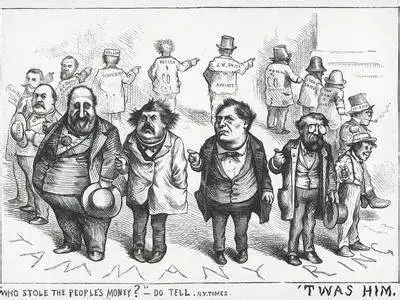
The Cartoon below by Thomas Nast was published in 1871.
Which problem is addressed in the cartoon?
New citizens were often unable to exercise their voting rights
City governments were providing inadequate services to residents
Political machines were profiting from kickbacks on public contracts
The deadlock between political parties was costing taxpayers money
Who wrote The Jungle?
Jane Addams
Charles Darwin
Upton Sinclair
Chester Arthur
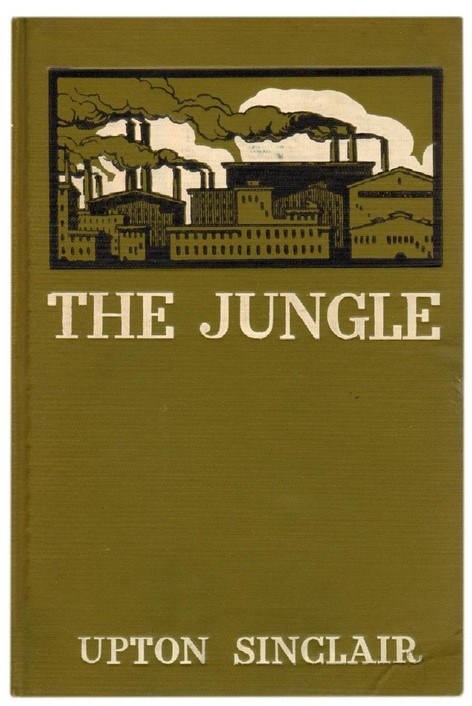
What government change occurred because of The Jungle?
Regulation of cash crops used for food for cattle
Unionization of meat industry
Creation of a federal health department
Federal Meat Inspection Act
Define muckraker.
Radicals who despised any kind of immigrant
Investigative journalists who desired social change
Economists who predicted the Panics of 1877 and 1893
Immigrants who went from rags to riches due to laissez faire economics
Muckrakers were
Social Reformers
Social Darwinists
Socialists
Nativists

What is this political cartoon referencing?
The Gentlemen's Agreement
The Chinese Exclusion Act
The Federal Meat Inspection Act
Black Codes and Jim Crow Laws

What was the purpose of the Chinese Exclusion Act?
To prevent Chinese immigrants from entering the United States
To prevent Southeast Asian immigrants from entering the United States
To prevent discrimination of Chinese students in West coast schools
To prevent Chinese immigrants from registering to vote
Journalist who focused on the housing issues of New York City
Ida Barnett
Jacob Riis
Ida Wells
Upton Sinclair
Founder of the Tuskegee Institute
Horace Mann
Booker T Washington
WEB Dubois
Carter Woodson
Term for the party that formed to help farmers with their economic situation
Democrats
Republicans
Populist
None of the above
Which muckraker used photography to reveal life in urban slums?
Lincoln Steffens
Jacob Riis
Frank Norris
Upton Sinclair
Which novel exposed the unsafe and unsanitary conditions of Chicago meatpacking plants?
The Octopus
The Jungle
The Settlement House
The Social Gospel
What type of laws were passed to end child labor and break up monopolies and trusts?
Labor laws
Antitrust laws
Immigration laws
Tax laws
Which movement believed that society would improve if people followed the Bible's teachings about charity and justice?
Progressivism
Muckraking
The Social Gospel
Settlement House Movement
Who outlined the Progressive reforms of the American public and gave his presidential campaign the name "Square Deal?"
William Howard Taft
Woodrow Wilson
William McKinley
Theodore Roosevelt
16th Amendment
Women's Suffrage
Direct Election of Senators
Federal Income Tax
Prohibition
17th Amendment
Women's Suffrage
Direct Election of Senators
Federal Income Tax
Prohibition
18th Amendment
Women's Suffrage
Direct Election of Senators
Federal Income Tax
Prohibition
19th Amendment
Women's Suffrage
Direct Election of Senators
Federal Income Tax
Prohibition
Look at the following list, which shows the goals of a movement from the early 1900's , and answer the question below.
-Abolish child labor
-Restrict working hours for mothers
-Enact public health programs
-Raise wages for workers
These goals are MOST closely associated with which movement?
Civil Rights
isolationist
Social Gospel
temperance

In the cartoon above, President Theodore Roosevelt is depicted doing which of the following?
Standing guard to protect big business
Enforcing the Sherman Anti-Trust Act
Leading a government take-over of large industries
Putting an end to industries that might harm the environment
A major purpose of the Progressive movement (1900-1917) was to....
stimulate the economy
support government control of factory production
encourage immigration from southern and eastern Europe
correct the economic and social abuses of industrial society

The cartoon was most likely a reaction to...
Formation of labor unions.
Lack of government regulation of industry.
Philanthropy of the robber barons.
U.S. imperialism.
The creation of monopolies in the late 1800s were made possible by the...
Effects of laissez-faire policies.
Passage of federal antitrust laws.
Elimination of the free-enterprise system.
Adoption of socialist economic practices.
Which of the following Populist demands was NOT achieved?
Coinage of silver.
Secret ballot.
Income tax.
Fear that New Immigrants would have a hard time assimilating into American culture was a concern of...
Nativists.
Settlement houses.
Industrialists.
Fellow immigrants.
Which of the following was the BEST reason that millions immigrated to cities?
Entertainment
Jobs
Higher Wages
Better Living Conditions
Which combination of author and work is correct?
Jacob Riis; How the Other Half Lives
Jacob Riis; The Jungle
Upton Sinclair; How the Other Half Lives
Upton Sinclair; Truth about Standard Oil
What did the 19th Amendment guarantee?
Congress can collect taxes
Prohibition
Direct election of U.S. senators
Women's suffrage (right to vote)
What was a characteristic of the Progressive Era?
Government reforms to better protect working class Americans
Paranoia over nuclear aggression
A downsizing of federal government
The elimination of income tax
What civil rights activist thought the push for racial equality should move slowly to avoid severe backlash?
Booker T. Washington
W.E.B. Du Bois
Dr. Martin Luther King, Jr.
Robert Kennedy
Which amendment gives Congress the power to tax income?
16th
17th
18th
19th
Who was NOT one of the "Progressive Presidents"?
William H. Taft
T. Woodrow Wilson
Jimmy Carter
Theodore Roosevelt
What president was known for being a "trustbuster" because he broke up so many monopolies?
Theodore Roosevelt
William McKinley
Herbert Hoover
Adlai Stevenson

