
NEW
Font size
 Worksheets
3N SciBio EOY MCQ
Total questions: 20
Worksheet time: 3600secs
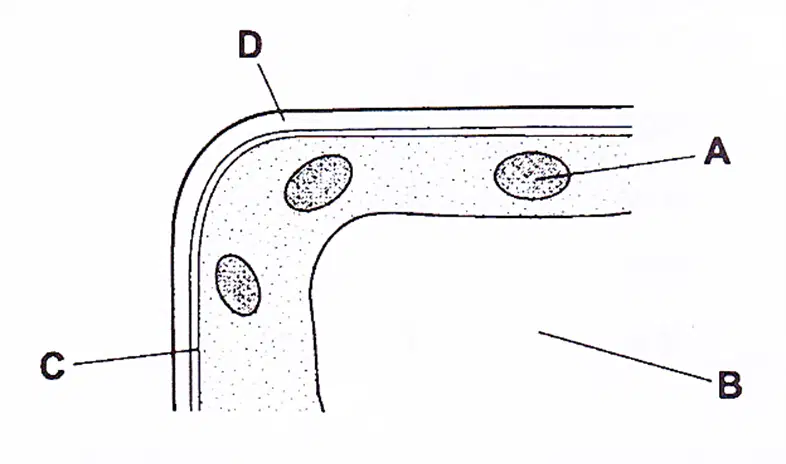
The diagram shows part of a plant cell.
Which part controls the movement of substances into and out of the cell?
A
B
C
D

Which organelle is not correctly paired with its function?
A
B
C
D
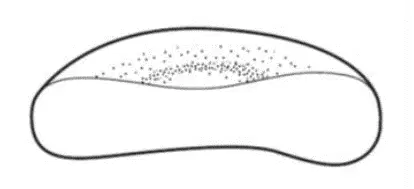
The diagram shows the cross-section of a specialised cell.
What description of this cell is not correct?
It has biconcave shape to increase the surface area to volume ratio for diffusion of oxygen.
It contains haemoglobin to bind to oxygen.
It does not contain a nucleus to pack more haemoglobin.
It has a low water potential to allow easy diffusion of oxygen.

A human red blood cell is placed in a concentrated salt solution.
Which row is correct?
A
B
C
D

A student cuts out four cylinders of potato, each measuring 30 mm long with identical diameter.
The potato cylinders are placed in sugar solutions of different concentrations. After one hour, the lengths of the cylinders are measured again. The results are shown in the following table.
Which sugar solution has a water potential closest to that of the potato cell sap?
A
B
C
D

A Visking tubing was immersed into a liquid in a boiling tube. The Visking tubing and boiling tube were weighed separately before the experiment.
After half an hour, the Visking tubing was removed and both were weighed again.
Which row best describes the results?
mass of tubing: decreased
mass of boiling tube: increased
mass of tubing: decreased
mass of boiling tube: remained the same
mass of tubing: increased
mass of boiling tube: decreased
mass of tubing: remained the same
mass of boiling tube: remained the same
Before a marathon, athletes usually eat bananas.
What is the main nutrient in bananas that sustain athletes?
carbohydrate
fat
fibre
protein
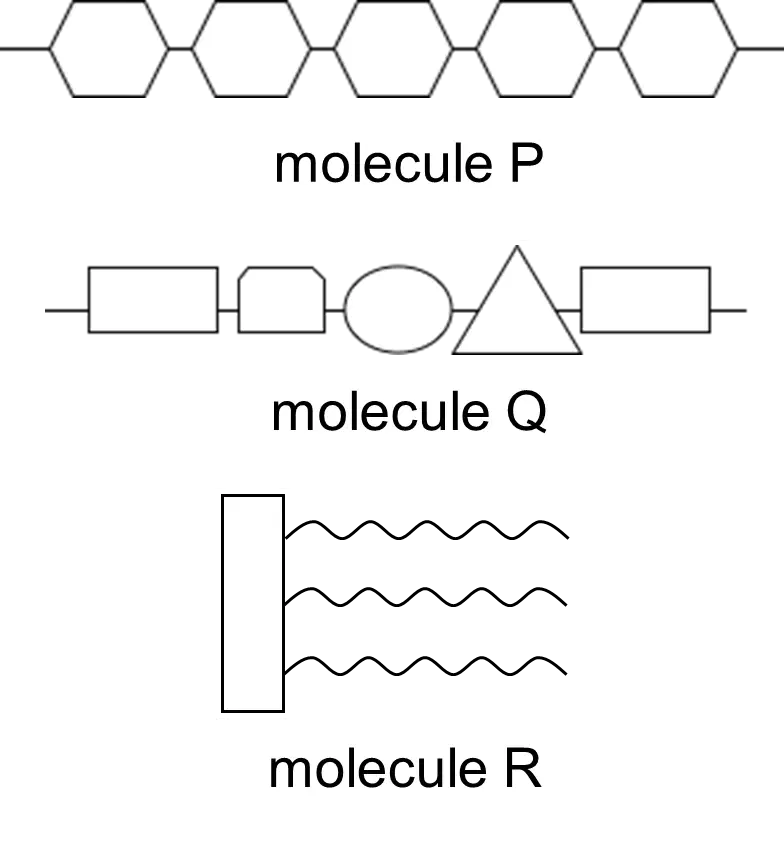
A student drew three pictorial representation of biological molecules P, Q and R.
Which row is correct?
P: fat
Q: polypeptide
R: starch
P: polypeptide
Q: starch
R: protein
P: glycogen
Q: starch
R: fat
P: starch
Q: polypeptide
R: fat

A food sample is tested with three reagents. The results of the test are:
· Iodine solution turns blue-black.
· Biuret test turns violet.
· Ethanol test gives a colourless solution.
Which nutrients are present in the food?
A
B
C
D
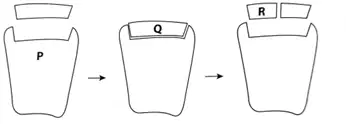
The diagram shows the enzyme reaction of protease.
Which row correctly identifies P, Q and R?
P: protease
Q: protein
R: amino acid
P: protease
Q: amino acid
R: protein
P: protein
Q: protease
R: amino acid
P: amino acid
Q: protease
R: protein

Catalase is an enzyme that breaks down hydrogen peroxide into oxygen and water.
In the ‘lock and key’ hypothesis, which row is correct?
lock: catalase
key: hydrogen peroxide
lock: hydrogen peroxide
key: catalase
lock: catalase
key: oxygen
lock: oxygen
key: catalase
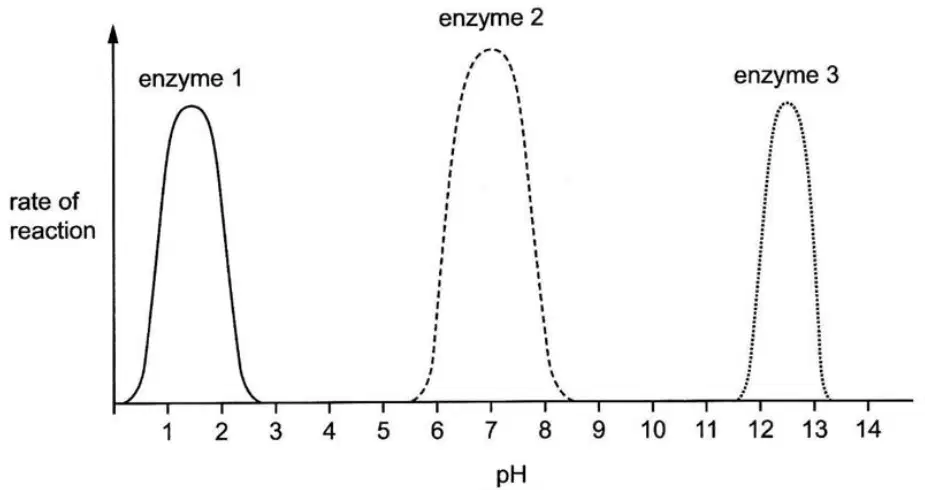
The graph shows the effect of pH on the rate of reaction of three different enzymes.
What conclusions can be drawn from the graph?
These enzymes are made of protein.
Each enzyme works best over a small temperature range.
These enzymes work best in acidic condition.
Each enzyme works best at a different pH.
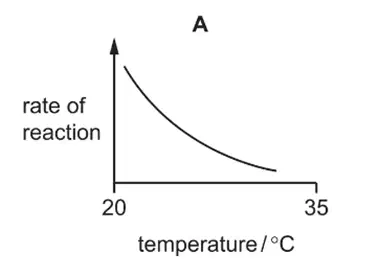
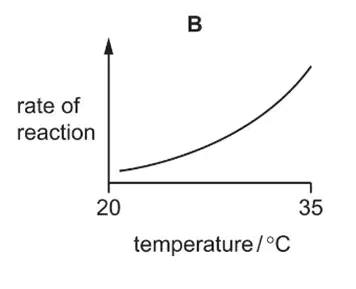
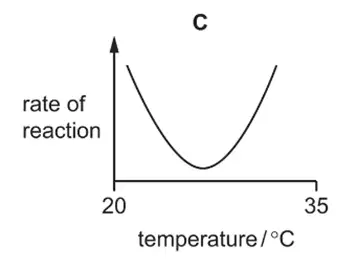
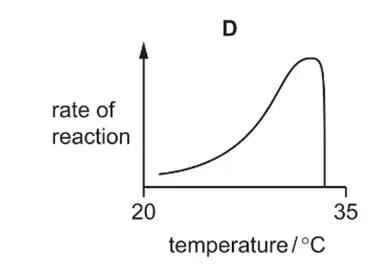
Which graph shows the effect of temperature between 20 oC to 35 oC on the activity of an enzyme in the human body?
Which of the following is an example(s) of physical digestion?
1 action of protease in the small intestine
2 chewing of food in the mouth
3 churning in the stomach
1 only
1 and 3 only
2 and 3 only
1, 2 and 3
In which order do these events occur in human nutrition?
digestion > ingestion > absorption > assimilation
digestion > ingestion > assimilation > absorption
ingestion > digestion > absorption > assimilation
ingestion > digestion > assimilation > absorption
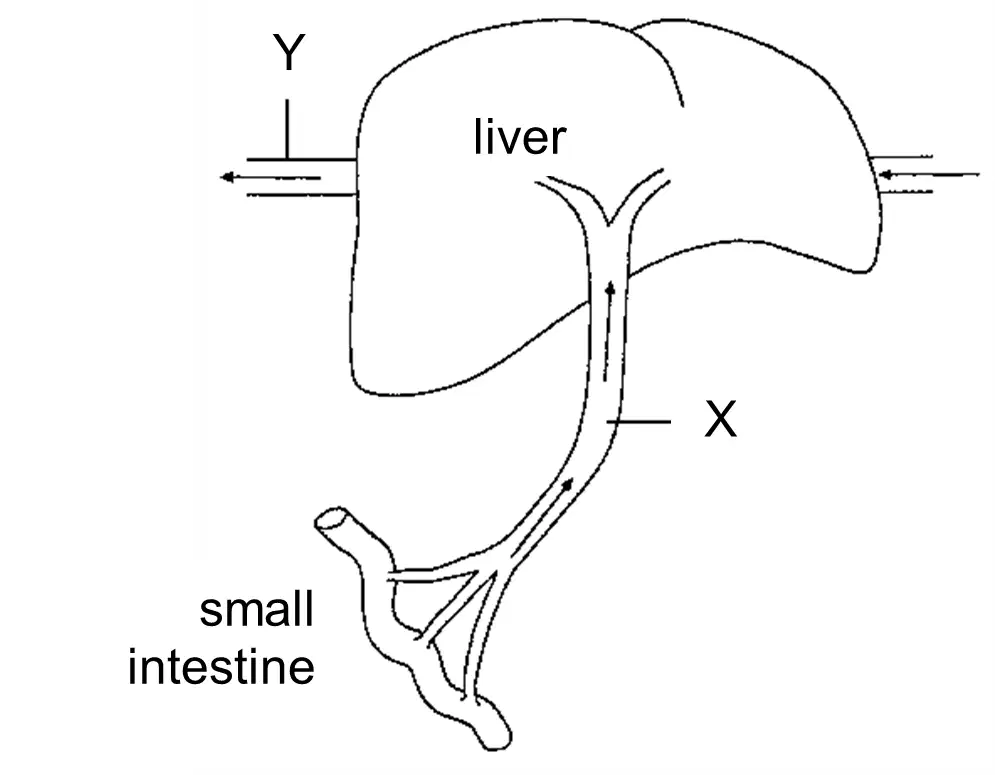
The diagram shows part of the human digestive system.
What will happen to the concentration of glucose in blood vessels X and Y following a meal rich in starch?
There will be no glucose in X and Y.
X will have a higher concentration of glucose than Y.
Y will have a higher concentration of glucose than X.
X and Y will have an equal concentration of glucose.
Deamination is a process which occurs in the liver.
Which statement is correct?
To break down proteins into amino acids for absorption into the bloodstream.
To remove excess amino acids which are toxic to the body.
To remove proteins that cannot be broken down by the digestive system.
To remove urea from the bloodstream.
The diagram shows a section of a leaf.
Where are chloroplasts found?
1 only
2 and 3 only
1, 2 and 3 only
2, 3 and 4 only
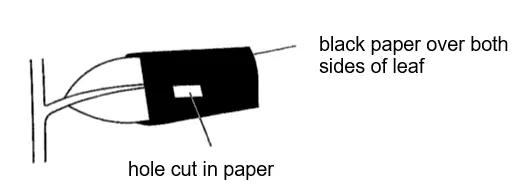
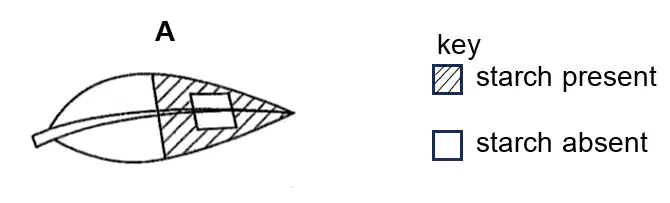
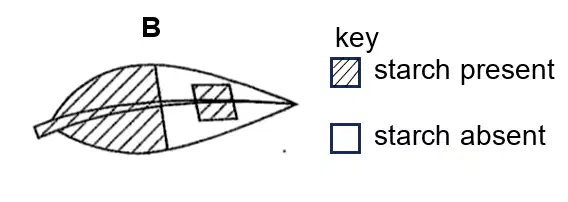
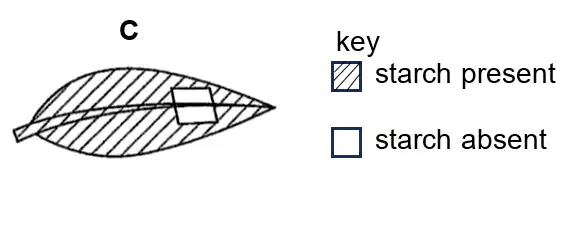
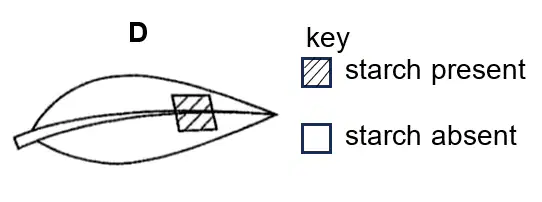
A destarched plant is placed in light with black paper over part of one green leaf as shown below.
After 8 hours, the leaf is tested for starch.
Which diagram shows the appearance of the leaf after the starch test?
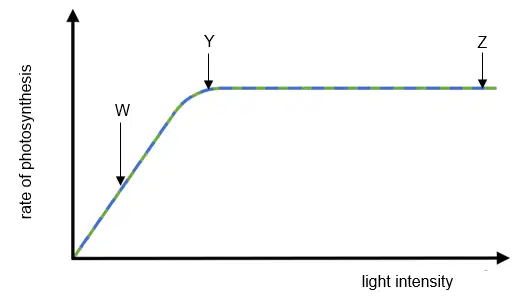
An investigation was carried out on the effect of light intensity on the rate of photosynthesis. Throughout the experiment, all other factors affecting photosynthesis were kept constant.
What can be concluded from this experiment?
Light affects the rate of photosynthesis at point W.
Light affects the rate of photosynthesis at point Y.
Light affects the rate of photosynthesis at point Z.
Light does not affect the rate of photosynthesis.

