
 Worksheets
Cardiac System
Total questions: 100
Worksheet time: 50mins
Name
Class
Date
1.
Cardi/o means
a)
A vascular
b)
B heart
c)
C spleen
d)
D cataract
2.
Arteri/o means
a)
A artery
b)
B vein
c)
C aorta
d)
D capillary
3.
Erythr/o means
a)
A white
b)
B blue
c)
C red
d)
D cell
4.
Leuk/o means
a)
A white
b)
B blue
c)
C red
d)
D cell
5.
________________ means slow
a)
A tachy-
b)
B phleb/o
c)
C coron/o
d)
D brady-
6.
__________________ means blood
a)
A cardi/o
b)
B angi/o
c)
C hem/o
d)
D capill/o
7.
Ather/o means
a)
A plaque
b)
B artery
c)
C aorta
d)
D heart
8.
A Cardiologist is
a)
A doctor who studies/practices blood
b)
B doctor who studies/practices the brain
c)
C doctor who studies/practices veins
d)
D doctor who studies/practices the heart
9.
Phlebography is the x-ray image of
a)
A heart
b)
B arteries
c)
C veins
d)
D lungs
10.
An arteriectomy is the surgical removal of
a)
A an artery
b)
B a vein
c)
C a capillary
d)
D the aorta
11.
True or False: The AV (atrioventricular) node serves as the primary pacemaker of the heart.
a)
True
b)
False
12.
True or False: The cardiac pacemaker generates impulses faster than other areas of the heart.
a)
True
b)
False
13.
True or False: The internodal conduction pathways connect the SA (sinoatrial) and AV (atrioventricular) nodes.
a)
True
b)
False
14.
True of False: The SA (sinoatrial) node is located in the left atrium.
a)
True
b)
False
15.
True or False: The bundle of HIS arises from the AV (atrioventricular) node.
a)
True
b)
False
16.
Which one of the following veins carries oxygenated blood?
a)
A Femoral vein
b)
B Inferior Vena Cava
c)
C Pulmonary Vein
d)
D Hepatic Vein
17.
The muscular wall of the heart is also called its:
a)
A Epicardium
b)
B Myocardium
c)
C Endocardium
d)
D Sarcolemma
18.
The endocardium is continuous with the:
a)
A Epicardium
b)
B Mediastinum
c)
C Endothelium
d)
D Cardiac Apex
19.
The pericardial cavity is a space between the visceral pericardium (the epicardium) and the:
a)
A Pleura
b)
B Mediastinum
c)
C Parietal pericardium
d)
D Endocardium
20.
Venous blood returning from the myocardium reaches the right atrium through the:
a)
A Superior vena cava
b)
B Inferior vena cava
c)
C Coronary sinus
d)
D Renal vein
21.
The left atrioventricular valve of the heart is also called the:
a)
A Bicuspid valve
b)
B Mitral valve
c)
C Tricuspid valve
d)
D Both A and B
22.
Which heart chamber has the thickest walls?
a)
A Right atrium
b)
B Right ventricle
c)
C Left atrium
d)
D Left ventricle
23.
The rapid spread of action potential between cardiac muscle cells is facilitated by the presence of:
a)
A Connective tissue
b)
B Basement membrane
c)
C Gap junctions
d)
D Z lines
24.
The normal rhythm of the heart is also referred to as:
a)
A Eupnea
b)
B Peristalsis
c)
C Sinus rhythm
d)
D Bradycardia
25.
Which one of the following valves is open during systole?
a)
A Tricuspid valve
b)
B Bicuspid valve
c)
C Mitral valve
d)
D Pulmonary valve
26.
Cardiac output is a product of heart rate and:
a)
A Ejection fracture
b)
B Stroke volume
c)
C Venous return
d)
D Atrial systole
27.
Atrial systole occurs near the end of:
a)
A Ventricular systole
b)
B Ventricular diastole
c)
C Inspiration
d)
D Expiration
28.
Which one of the following valves is a type of semilunar valve?
a)
A Tricuspid valve
b)
B Bicuspid valve
c)
C Mitral valve
d)
D Pulmonary valve
29.
Closure of which one of the following valves contributes to the 'dub' part of the heart's lub-dub sound?
a)
A Tricuspid valve
b)
B Bicuspid valve
c)
C Mitral valve
d)
D Pulmonary valve
30.
What is the largest artery in the body?
a)
A Brachial artery
b)
B Femoral artery
c)
C Aorta
d)
D Arteriole
31.
What are the two largest veins in the body?
a)
A Superior vena cava and inferior vena cava
b)
B Superior vena cava and pulmonary vein
c)
C Inferior vena cava and pulmonary vein
d)
D Superior vena cava and left ventricle
32.
What is the smallest branch of arteries?
a)
A Arterioles
b)
B Venules
c)
C Capillaries
d)
D Platelets
33.
What is the smallest branch of veins?
a)
A Arterioles
b)
B Venules
c)
C Capillaries
d)
D Platelets
34.
Which blood vessel is the largest, most muscular, and elastic blood vessel?
a)
A Artery
b)
B Capillary
c)
C Vein
d)
D Arteriole
35.
An inadequate number of red blood cells, hemoglobin, or both is known as
a)
A Anemia
b)
B Arteriosclerosis
c)
C Atherosclerosis
d)
D Aneurysm
36.
Dilated swollen veins are called
a)
A Arteries
b)
B Venules
c)
C Varicose Veins
d)
D Embolus
37.
A fatty deposit on the walls of arteries is called
a)
A Arteriosclerosis
b)
B Atherosclerosis
c)
C Embolus
d)
D Phlebitis
38.
What is a ballooning out of, or saclike formation in the wall of an artery called?
a)
A Anemia
b)
B Osteogenesis
c)
C Sprain
d)
D Aneurysm
39.
Which vessels contain valves that prevent backflow of the blood?
a)
A Artery
b)
B Capillary
c)
C Veins
d)
D Arteriole
40.
Which blood vessel allows oxygen and nutrients to pass through the cells?
a)
A Artery
b)
B Capillary
c)
C Vein
d)
D Arteriole
41.
Disease characterized by failure of the blood to clot is known as
a)
A Embolus
b)
B Hemophilia
c)
C Leukemia
d)
D Anemia
42.
High Blood pressure is also called
a)
A Hemophilia
b)
B Hypotension
c)
C Hypertension
d)
D Myocardial Infarction
43.
Inflammation of the veins with formation of clot is called
a)
A Thrombophlebitis
b)
B Hemophilia
c)
C Embolus
d)
D Anemia
44.
Blockage of the coronary artery that cuts off the supply of blood to the heart is known as
a)
A Hypertension
b)
B Myocardial Infaction
c)
C Congestive Heart Failure
d)
D Arteriosclerosis
45.
Foreign substance circulating in the blood stream is known as an
a)
A Embolus
b)
B Thrombus
c)
C Anemia
d)
D Aneurysm
46.
Malignant disease with large numbers of immature white blood cells is called
a)
A Anemia
b)
B Hemophilia
c)
C Leukemia
d)
D Phlebitis
47.
Blood pressure is greatest in which vessel?
a)
A Artery
b)
B Vein
c)
C Capillaries
d)
D Aorta
48.
What is known as the "pacemaker" because it initiates the heartbeat?
a)
A SA node
b)
B AV node
c)
C Purkinje fibers
d)
D Bundle of His
49.
A condition that occurs when the heart muscles do not beat adequately to supply the blood needs of the body is known as
a)
A Hypertension
b)
B Myocardial infarction
c)
C Congestive Heart Failure
d)
D Anemia
50.
__________________________ send blood through the lungs.
a)
A Pulmonary arteries
b)
B Pulmonary veins
c)
C Thrombocyte
d)
D Aortic Valve
51.
The __________________ sends blood to the rest of the body.
a)
A endocardium
b)
B septum
c)
C aorta
d)
D plasma
52.
The ____________________ is the liquid part of the blood and contains mostly water.
a)
A erythrocte
b)
B leukocyte
c)
C plasma
d)
D cytoplasm
53.
True or False: The heart sounds, lub-dup, are due to the closing of the valve.
a)
True
b)
False
54.
True or False: The only arteries that carry poorly oxygenated blood in the body are known as the Pulmonary arteries.
a)
True
b)
False
55.
The ____________________ serve the heart muscle itself with blood supply.
a)
A Pulmonary Veins
b)
B Pulmonary Arteries
c)
C Coronary Arteries
d)
D Coronary Veins
56.
Blood vessel that carries blood back to the heart
a)
A Pericardium
b)
B Pulmonary valve
c)
C Vein
d)
D Capillary
57.
Valve between the left ventricle and aorta
a)
A Aortic Valve
b)
B Septum
c)
C Pulmonary Valve
d)
D Ventricle Valve
58.
Muscular Middle layer of the heart
a)
A endocardium
b)
B pericardium
c)
C extocardium
d)
D myocardium
59.
Double-layered membrane on the outside of the heart
a)
A endocardium
b)
B pericardium
c)
C extocardium
d)
D myocardium
60.
Blood vessel that carries blood away from the heart
a)
A vein
b)
B capillary
c)
C artery
d)
D thrombocyte
61.
Muscular wall that separated the heart into a right and left side
a)
A pulmonary valve
b)
B endocardium
c)
C septum
d)
D atrium
62.
Complex protein on red blood cells
a)
A leukocyte
b)
B plasma
c)
C thrombocyte
d)
D hemoglobin
63.
Receives oxygen-poor blood from the body
a)
A Right atrium
b)
B Left atrium
c)
C Right ventricle
d)
D Right atrium
64.
Pumps oxygen-poor blood to the lungs
a)
A Right atrium
b)
B Left atrium
c)
C Right ventricle
d)
D Left ventricle
65.
Receives oxygen-rich blood from the lungs
a)
A Right atrium
b)
B Left atrium
c)
C Right ventricle
d)
D Left ventricle
66.
Pumps oxygen rich blood to the body
a)
A Right atrium
b)
B Left atrium
c)
C Right ventricle
d)
D Left ventricle
67.
The cardiovascular system is composed of which three parts?
a)
A Blood, neurons, blood vessels
b)
B Blood vessels, heart, digestive hormones
c)
C Heart, blood vessels, blood
d)
D Heart, blood vessels, lungs
68.
_________________ clump together to close wounds and form scabs.
a)
A platelets
b)
B plasma
c)
C thrombocytes
d)
D erythroctes
69.
A wave of blood being pumped from the right ventricle to the lungs and then following the lowest pressure back to the left atrium is known as the _____________________.
a)
A S/I Loop
b)
B Blood oxygenated loop (BOL)
c)
C systemic loop
d)
D pulmonary circulation loop
70.
High pressure caused by ventricular contraction is called ___________________.
a)
A Diastole
b)
B Systole
c)
C Endocardium
d)
D Septum
71.
Cardiac cells are loaded with energy-generating ___________________.
a)
A golgi cells
b)
B leukocytes
c)
C mitochondria
d)
D lipoproteins
72.
Cardiac impulses leap across synapse-like connections between the cells called __________________.
a)
A gap junctions
b)
B mitochondria
c)
C golgi apparatus
d)
D cytoplasm
73.
In the heart, out-of-sync behavior is called _____________.
a)
A Congestive Heart Failure
b)
B Angina
c)
C Artherosclerosis
d)
D Fibrillation
74.
CPR stands for
a)
A Congestive Pulmonary Re-start
b)
B Cardiopulmonary Resuscitation
c)
C Cardiac Pulmonary Re-start
d)
D Cardiopulmonary Reticullation
75.
Blood vessels carry _______________ and ________________ to cells throughout the body.
a)
A electrolytes and water
b)
B oxygen and wastes
c)
C oxygen and nutrients
d)
D electrolytes and nutrients
76.
Bruising is ___________________, usually into loose connective tissue.
a)
A a build up of excess endothelium
b)
B external bleeding
c)
C a collection of waste products
d)
D internal bleeding
77.
Your tiny, thin-walled _____________________ serve as a sort of exchange/bridge between arterial and venous systems.
a)
A capillaries
b)
B venules
c)
C arterioles
d)
D plasmites
78.
Your circulatory system moves about ______________ liters of blood through your heart every day.
a)
A 1,500
b)
B 3,500
c)
C 7,500
d)
D 9,500
79.
True or False: Your nervous and endocrine systems have some tricks to try and balance blood pressure when it gets too high or too low in an effort to create homeostatic balance.
a)
True
b)
False
80.
___________________ is the volume of blood flowing through any given vessel, or through the circulatory system as a whole, per minute.
a)
A systemic pulmonary loop
b)
B Blood volume loop
c)
C Cardiac output
d)
D Distribution volume
81.
The biggest factor that affects resistance in blood vessels has to do with
a)
A vessel diameter
b)
B blood backflow
c)
C platelet size and shape
d)
D volume or iron
82.
Your ________________ produce(s) hormones like renin and angiotensin which help regulate levels of sodium and fluids in your body, and also affect blood vessels.
a)
A spleen
b)
B lungs
c)
C kidneys
d)
D liver
83.
Erythrocytes survive an average of _____________ days.
a)
A 90
b)
B 120
c)
C 160
d)
D 220
84.
Red blood cells are _____________ hemoglobin.
a)
A 80%
b)
B 87%
c)
C 95%
d)
D 97%
85.
More _________________ equals more oxygen being carried to your muscles, and therefore better physical performance.
a)
A leukocytes
b)
B erythrocytes
c)
C DNA
d)
D macrophages
86.
Old red blood cells are broken down and recycled in the ____________, _____________ and __________
a)
A spleen, bone marrow, gallbladder
b)
B spleen, gallbladder, kidneys
c)
C bone marrow, kidneys, liver
d)
D Liver, spleen, bone marrow
87.
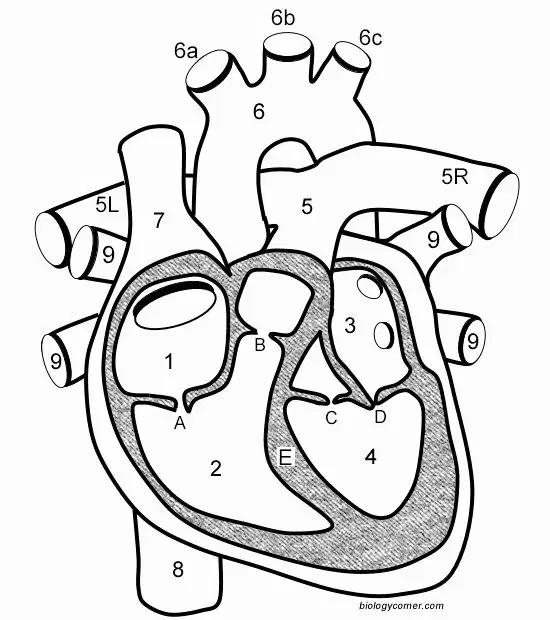
What is #6?
a)
A Superior Vena Cava
b)
B Pulmonary Artery
c)
C Right atrium
d)
D Aorta
88.
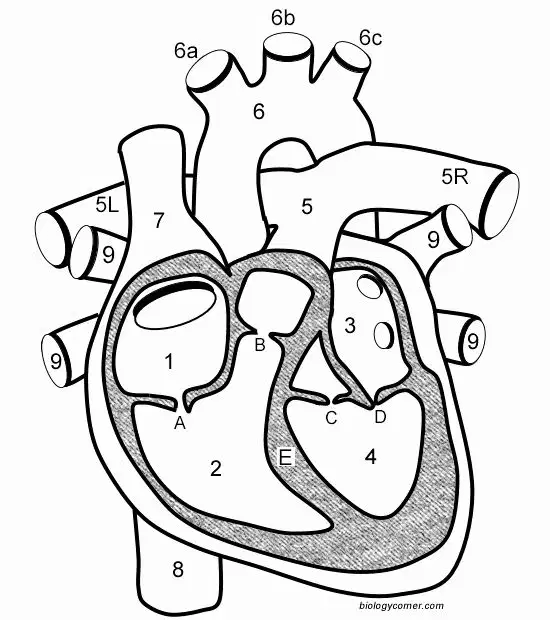
What is #8?
a)
A Superior Vena Cava
b)
B Inferior Vena Cava
c)
C Aorta
d)
D Aortic valve
89.
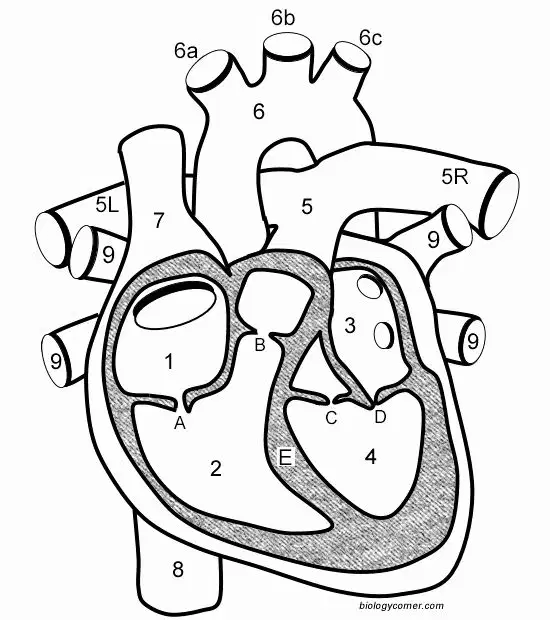
What is #2?
a)
A Right atrium
b)
B Right ventricle
c)
C Left atrium
d)
D Left ventricle
90.
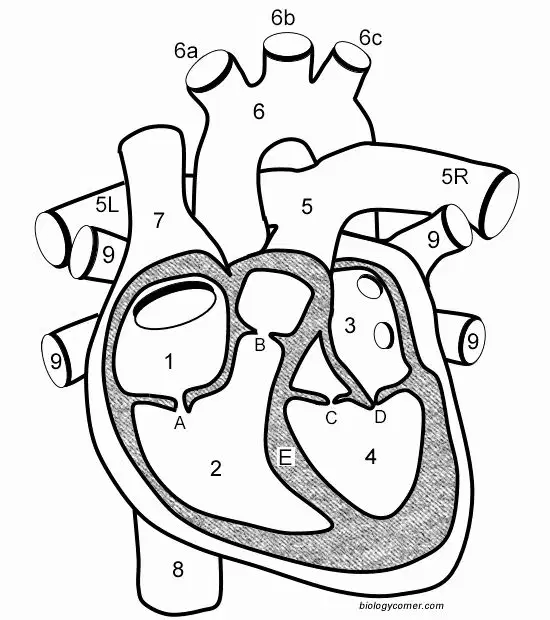
What is B?
a)
A Tricuspid Valve
b)
B Mitral Valve
c)
C Pulmonary Valve
d)
D Aortic Valve
91.
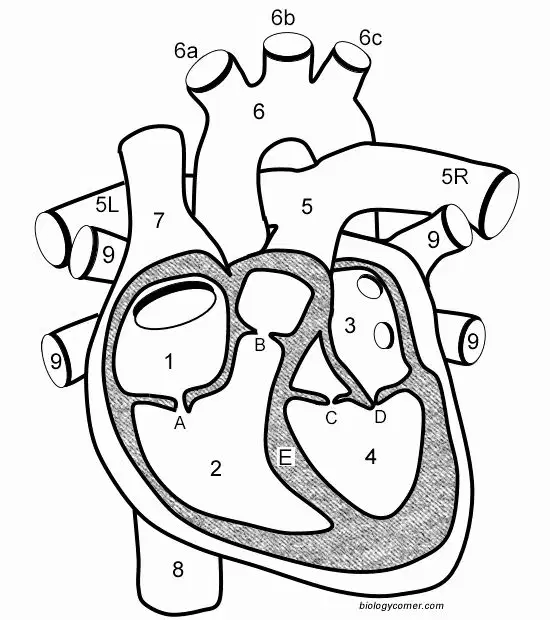
What is #3?
a)
A Right atrium
b)
B Left atrium
c)
C Right ventricle
d)
D Left ventricle
92.
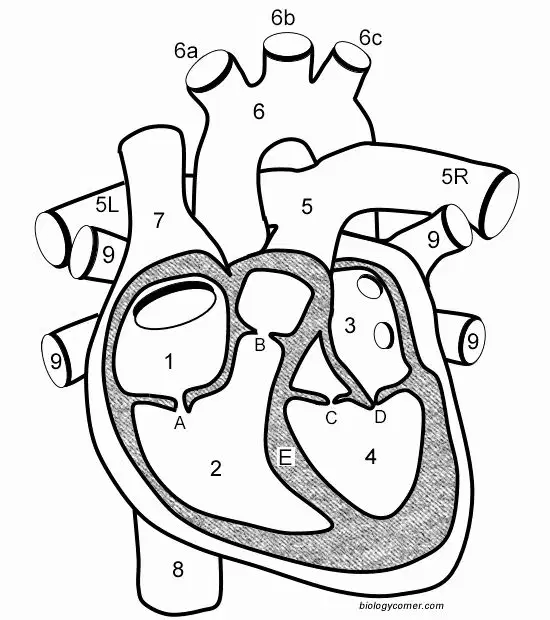
What is C?
a)
A Pulmonary Valve
b)
B Aortic Valve
c)
C Tricuspid Valve
d)
D Mitral Valve
93.
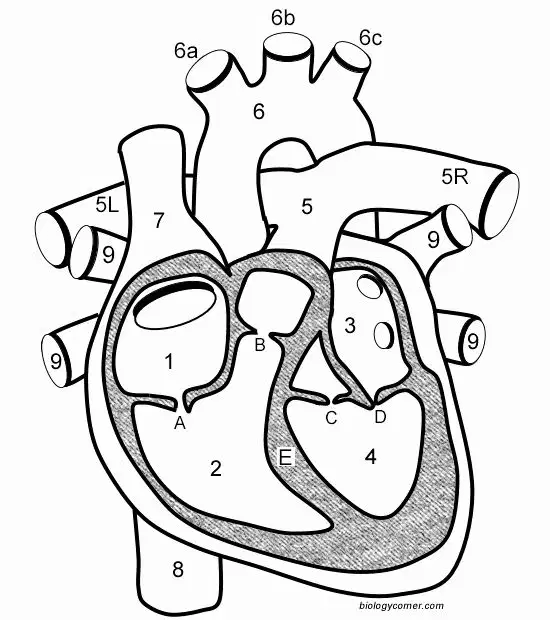
What is #9?
a)
A Pulmonary Vein
b)
B Aorta
c)
C Pulmonary Artery
d)
D Inferior Vena Cava
94.

Which pulse location is being checked?
a)
A Femoral
b)
B Radial
c)
C Carotid
d)
D Brachial
95.

Which pulse point is labeled #9?
a)
A Femoral
b)
B Radial
c)
C Apical
d)
D Brachial
96.

Which pulse point is labeled #1?
a)
A Femoral
b)
B Carotid
c)
C Radial
d)
D Posterior Tibial
97.
Blood flows in the heart from the Superior vena cava to the Right atrium through the _______________________ to the Right ventricle.
a)
A tricuspid valve
b)
B pulmonary valve
c)
C aorta
d)
D pulmonary vein
98.
Blood flows in the heart from the Right ventricle through the pulmonary valve to the _________________ and then to the lungs.
a)
A Superior vena cava
b)
B Right Atrium
c)
C Tricuspid Valve
d)
D Pulmonary Artery
99.
Blood flows from the lungs through the pulmonary veins and then through the ____________________.
a)
A Right Atrium
b)
B Left Atrium
c)
C Left Ventricle
d)
D Right Ventricle
100.
Blood flows through the body from the arteries to the arterioles then the capillaries to the _____________.
a)
A Superior Vena Cava
b)
B Lungs
c)
C Pulmonary Valve
d)
D venules
100 %

