wayground logo

Free Printable Worksheets

NEW

Font size

S
M
L
XL
Worksheets

Biosphere Quiz

Total questions: 38

Worksheet time: 44mins

Name
Class
Date
1.

What is the geosphere?

a)

The portion of the Earth where life is found

b)

The frozen portion of the hydrosphere

c)

The air surrounding the Earth

d)

The rocks, minerals, and soil of the Earth

2.

What is the hydrosphere?

a)

The portion of the Earth where life is found

b)

The air surrounding the Earth

c)

The rocks, minerals, and soil of the Earth

d)

All the water on the Earth's surface, underground, and in the air

3.

What is the atmosphere?

a)

The portion of the Earth where life is found

b)

The frozen portion of the hydrosphere

c)

The rocks, minerals, and soil of the Earth

d)

The air surrounding the Earth

4.

What is the biosphere?

a)

The portion of the Earth where life is found

b)

The frozen portion of the hydrosphere

c)

The air surrounding the Earth

d)

The rocks, minerals, and soil of the Earth

5.

What is ecology?

a)

The study of interactions between organisms and their environment

b)

The study of rocks, minerals, and soil

c)

The study of water and its properties

d)

The study of the atmosphere and weather

6.

What are biotic factors?

a)

Living organisms in an environment

b)

Non-living parts of an environment

c)

The study of interactions between organisms and their environment

d)

The study of rocks, minerals, and soil

7.

What is a habitat?

a)

The unique role a species plays in the environment

b)

The portion of the Earth where life is found

c)

The rocks, minerals, and soil of the Earth

d)

Where an organism lives and includes food, shelter, and resources

8.

What do food chains show?

a)

The feeding relationships among organisms

b)

The transfer of energy from one organism to another

c)

The interactions between biotic and abiotic factors

d)

The different trophic levels in an ecosystem

9.
Organisms in this category get their energy from both plant and animal matter. 
a)
Producer
b)
Carnivore
c)
Detrivore
d)
Omnivore
10.
Organisms that make their own food are known as ______________. 
a)
Omnivores
b)
Detrivores
c)
Heterotrophs
d)
Autotrophs
11.
After the first trophic level - what percentage of energy is available  to each of the following levels?
a)
100%
b)
90%
c)
10%
d)
8.5%
12.
These organisms break down organic matter and release it back into the environment. 
Ex: Bacteria, Fungi
a)
Carnivores
b)
Omnivores
c)
Detritivores
d)
Decomposers
13.
A collection of different populations that live in a specific area/habitat. 
a)
Community
b)
Niche
c)
Ecosystem
d)
Biome
14.
What is the term for each step in the transfer of energy and matter within a biological community?
a)
energy path
b)
food web
c)
trophic level
d)
food pyramid
15.
In an energy pyramid, energy_______ as you move up the pyramid.
a)
Increases
b)
Decreases
c)
Stays the same
d)
Changes up and down
16.
A secondary consumer 
a)
eats primary consumers
b)
eats producers
c)
eats plants
17.
A third-level consumer has to be which type?
a)
Carnivore.
b)
Decomposer.
c)
Producer.
d)
Herbivore.
18.
All the organisms on earth get their energy directly or indirectly from?
a)
Oxygen
b)
Water 
c)
Nitrogen
d)
The Sun
19.
The direction of the flow of energy in a food web is represented by ___.
a)
Light bulbs
b)
Dotted Lines
c)
Arrows
d)
Bubbles
20.
What does every food chain start with?
a)
producers
b)
sun
c)
consumer
d)
decomposers
21.
A connection of food chains with many food energy paths in an ecosystem is a ____________
a)
ecosystem
b)
food web
c)
environment
22.
Which of the following is a herbivore?
a)
cricket
b)
frog
c)
hawk
d)
shrew
23.
The shrew provides energy for the _______?
a)
cricket
b)
grasshopper
c)
frog
d)
snake
24.
Barnacles create home sites by attaching themselves to whales. This relationship neither harms nor benefits the whales. 
a)
parasitism
b)
commensalism
c)
mutualism
25.
Mistletoe extracts water and nutrients from a spruce tree. The spruce tree is harmed. 
a)
parasitism
b)
commensalism
c)
mutualism
26.
In a parasitic relationship, one organism is ___________ and one organism is benefiting. 
a)
helped
b)
harmed
c)
not effected
d)
happy
27.
In a mutual relationship, both organisms are ________________. 
a)
hurt
b)
not effected
c)
harmed
d)
benefiting 
28.
Commensalism is where one organism is benefiting and the other organism is _____________________. 
a)
not effected
b)
helped
c)
harmed
d)
hurt
29.
1.  A bee and a flower work together to benefit each other. This is an example of _________________. The bee helps the flower by pollinating it and the flower helps the bee by providing it with nectar. 
a)
commensal relationship 
b)
parasitic relationship 
c)
mutual relationship 
30.

All ecosystems combined...

a)

biosphere

b)

community

c)

habitat

d)

population

31.

Organisms who are members of the same species in an ecosystem.

a)

Organism

b)

Population

c)

Organ

d)

Community

32.

Where life is found on earth.

a)

Community

b)

Habitat

c)

Ecosystem

d)

Biosphere

33.

A student observed shrimp, birds, frogs, and fish in a nearby lake. Which level of organization has the student observed?

a)

Organism

b)

Population

c)

Community

d)

Ecosystem

34.
If you see cardinals, blue jays and owls in your back yard, this is an example of a 
a)
community
b)
population
c)
ecosystem
d)
species
35.
Nonliving factor that affects an ecosystem...
a)
biotic factor
b)
abiotic factor
c)
food chain 
d)
biome
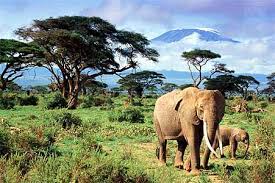
36.
What are the biotic factors in this image?
a)
sunlight, elephants, and grasses
b)
sunlight, water,  and air
c)
elephants, plants, trees 
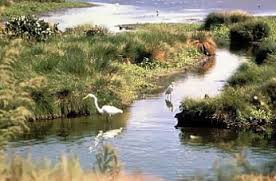
37.
What are the abiotic factors in this image? 
a)
water, sunlight, air
b)
birds and plants
c)
water, plants, and birds 
38.

A science class is planning a field trip to a local farm that has a large pond. Which of the following lists the order of biological organization from smallest to largest that the students can expect to find at the pond?

a)

Organism, community, population, ecosystem

b)

Organism, population, community, ecosystem

c)

Population, organism, community, ecosystem

d)

Population, organism, ecosystem, community