
 Worksheets
Earth Sci Unit 2 Ch. 4-5 Test Review
Total questions: 65
Worksheet time: 57mins
What is the difference between climate and weather?
climate happens in that moment, weather happens over time
weather happens in that moment, climate happens over time
No difference, they mean the same thing.
Latitude strongly influences climate because ________ solar energy falls on areas that are closer to the equator than to the poles.
the same amount of
sometimes less
more
less
Climate in a region is
Determined only by seasonal daylight hours
Never affected by ocean currents
the atmospheric conditions on a given day
the long-term, prevailing atmospheric conditions
Which sentence best describes the relationship between elevation and air temperatures?
LOWER elevation = COLDER temperatures
HIGHER elevation = COLDER temperatures
HIGHER elevation = WARMER temperatures
Which scientist?
Observed that certain organisms lived in specific environments. Observed climates in different parts of the world and connected climate to the biosphere, geosphere, atmosphere and hydrosphere.
Darwin
Von Humboldt
Holz
Einstein
Galileo

Air leaving the equator cools, becomes more dense, and sinks forming a pattern of smaller ____________________ cells.
conduction
convection
radiation
Deserts would most likely be found at what latitude?
0°
30°
60°
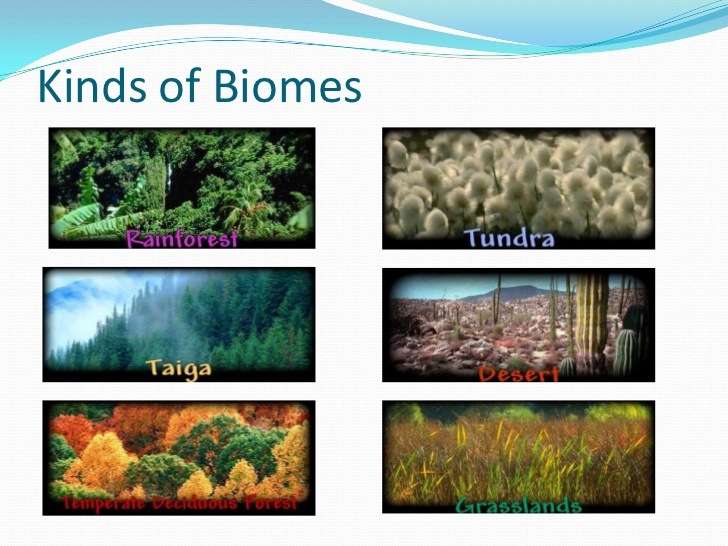
Which of the following best explains why the sand at the beach is hotter than the water?
Sand has a higher specific heat than water.
Sand has a lower specific heat than water.
There is more water than sand at the beach.
There is more sand than water at the beach.
What factors influence climates around the world? (Select all that apply)
Latitude (how far north or south a location is)
Motions of large air masses
Position relative to oceans
What is SPECIFIC HEAT?
It is the amount of heat energy needed to increase the temperature of one unit of mass of a given substance by one unit of temperature.
The exact temperature of a substance.
Heat that comes off an substance.
The opposite of specific coolness
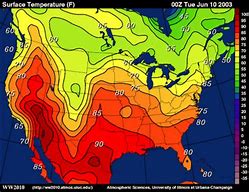
These maps connect points of equal temperature (THERMometer).
Isobar map
Isodown map
Isotherm map
Temperature map
The two jet streams that exist in the Americas are the Polar Jet Stream and the Sub-Tropical Jet Stream.
True
False
Which material has the lowest albedo?
Water
Sand
old snow
fresh snow
When Earth receives energy from the Sun, some is absorbed by land and water.
True
False
Which albedo would reflect 100% of light?
1
0
0.1
0.5
Latitude
The distance in degrees north or south of the equator
The amount of thermal energy required to increase the temp of 1 kg of material 1 degree Celsius.
The transfer of thermal energy between materials by the collisions of particles. (Transfer of energy through direct contact)
The transfer of thermal energy by electromagnetic waves.
Choose the three fossil fuels
natural gas
water
coal
hydrogen
oil
The word equation for combustion is: hydrocarbon compound + oxygen --> _________ + ________ __________
Water + Carbon dioxide
Limewater + carbon dioxide
Carbon + Carbon dioxide
water + Carbon monoxide
How are fossil fuels formed?
They are made in factories
Dead plants and animals died millions of years ago and were buried under heat and pressure
Dead plants were buried under heat and pressure
Dead animals were buried under heat and pressure
How old are fossil fuels?
Millions of years old
A few decades old
Hundreds of years old
They are new
Nitrous oxide
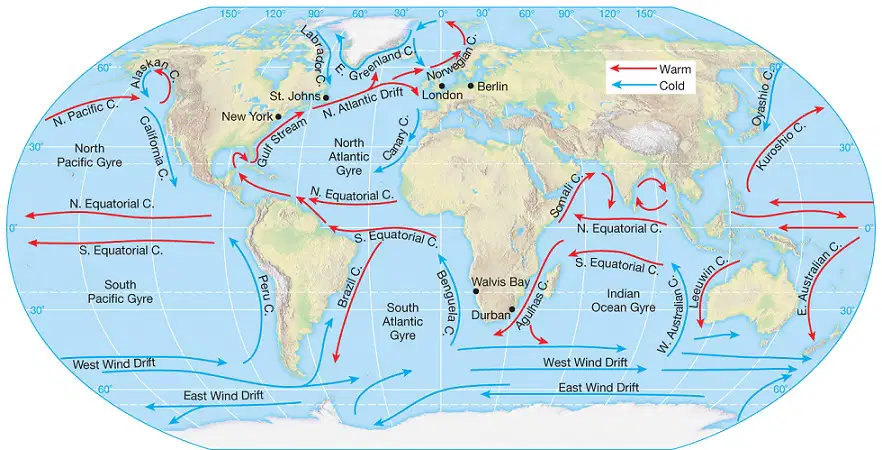
Charleston, South Carolina and San Diego, California are at about the same latitudes. Charleston is on the east coast of the US and San Diego is on the west coast. Based on ocean currents, which one would you expect to have a cooler climate?
Charleston
San Diego
Both are the same

Photosynthesis takes sunlight in and _______ reacts with __________ to make sugar (stored energy) and oxygen.
sugar and water
Carbon Dioxide and water
nitrogen and phosphorus
oxygen and carbon dioxide
Photosynthesis is carbon ________ and climate ________.
postive, negative
negative, positive
positive, positive
negative, negative
Climate can be summarized as the weather over a time period of the last ___ years.
1
5
30
50
Which of these is more likley to cause cloud formation and wetter weather and climate?
Rising air
Sinking air
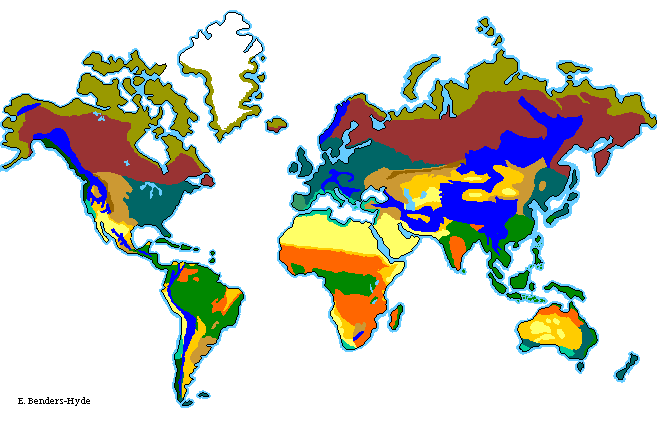
Which of these are high precipitation biomes? (Select all that apply)
Rain forest
Taiga (boreal forest)
deciduous forest
Tundra
Desert
Which would have the lowest albedo?
snow
desert
boreal forest
Select all that apply.
Which of the following can be carbon sinks.
soil and rocks
forming fossil fuels
forests
oceans
Select all that apply.
Which of the following are carbon sources.
fossil fuel combustion
volcanic eruptions
forests
oceans
Removing carbon (carbon negative) would be a climate ________.
positive
negative
neutral
Is this chemical reaction carbon positive or carbon negative?
2C8H18(l) + 25O2(g) → 16CO2(g) + 18H2O(g)
positive
negative
neither
Is this chemical reaction carbon positive or carbon negative?
5 CO2(g) + 6 H2O(g) --> C5H12(l) + 8 O2(g)
positive
negative
neither

Which 3 biomes exist in Minnesota? Select all that apply.
Temperate Grasslands
Taiga (Boreal Forest)
Tundra
Savanna Grasslands
Temperate Deciduous Forest
Select all that apply.
Which of the following are carbon sinks.
soil and rocks
fossil fuels
forests
oceans

Forests are carbon sinks because they remove carbon dioxide from the atmosphere through ____________.
combustion
respiration
photosynthesis
decomposition


According to the pHet lab, assuming equal heat and equal mass, which material would heat up the fastest?
iron
brick
According to the pHet lab, assuming equal heat and equal mass, which material has the higher heat capacity?
iron
brick
Which material has the highest heat capacity?
iron
brick
oil
water
Which of the following best explains why ultraviolet rays can cause sunburn but visible light from a light bulb does not damage skin?
Ultraviolet rays come before the light rays in the electromagnetic spectrum, which means anything before visible light automatically causes cancer.
Ultraviolet rays have lower frequencies than visible light rays and thus have higher energy than light rays from a light bulb.
Ultraviolet rays have higher frequency than visible light rays and thus have more energy than light rays from a light bulb.
Ultraviolet rays have higher frequencies than visible light rays and thus have less energy than light rays from a light bulb.

Describe the waves the arrow is pointing at.
long wavelength / low energy
long wavelength / high energy
short wavelength / low energy
short wavelength / high energy
Which greenhouse gas has the greatest warming potential?
H2O
CH4
CO2
Which of the following are greenhouse gases?
Carbon dioxide
Methane
Nitrogen Oxide
All answers are correct

The yellow lines represent energy with a __________ wavelength and _________ energy than the red lines.
longer, greater
shorter, greater
greater, greater
shorter, shorter
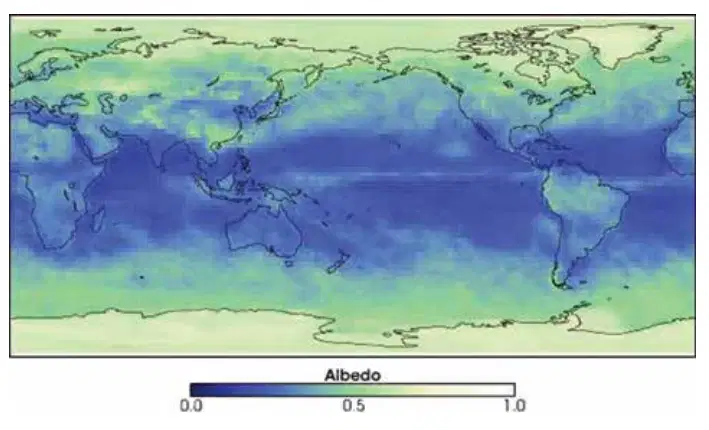
This map of albedo shows that polar ice has a ____ albedo.
high
low
can't be determined
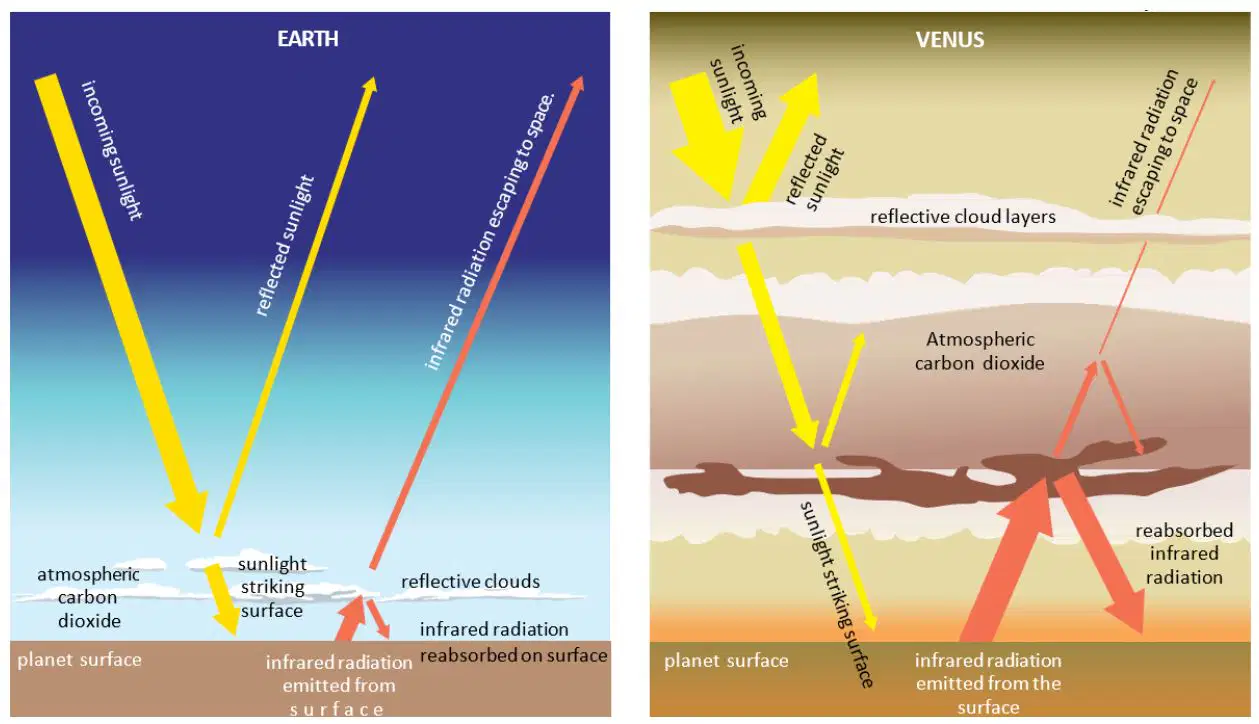
According to this diagram, which planet reabsorbs more infrared radiation?
Earth
Venus
Mars
Jupiter
Select all that are true regarding limestone in Minnesota:
Minnesota has limestone because it was once covered by a tropical ocean
Limestone is a place where carbon from the atmosphere can get stored in the geosphere, which is a climate positive, carbon negative
Limestone can be used as a building material
the limestone was created by volcanoes
the limestone was deposited by glaciers

