wayground logo

Free Printable Worksheets

Font size

S
M
L
XL
Worksheets

Superposition,Ecological Succession and Tectonics

Total questions: 30

Worksheet time: 45mins
Name
Class
Date
1.
Which organisms are typically found in the early stages of primary succession?
a)
Grasses and Wildflowers
b)
Lichens and Mosses
c)
Coniferous Trees
d)
Deciduous Trees
2.
In their geography class, Priya and Daniel learned about a process that causes the continents to move slowly over time. What is this process known as?
a)
sea-floor spreading
b)
trench making
c)
continental drift
d)
subduction
3.
During their field trip, Kai, Jackson, and Aiden are studying plate tectonics. They encounter a situation where an oceanic plate and a continental plate collide. What geological feature do they expect to form?
a)
mountain range
b)
a subduction zone
c)
the mid ocean ridge
d)
the rift valley
4.
Which of these landforms is caused by convergent boundaries?
a)
trenches
b)
fault
c)
the mid ocean ridge
d)
the rift valley
5.
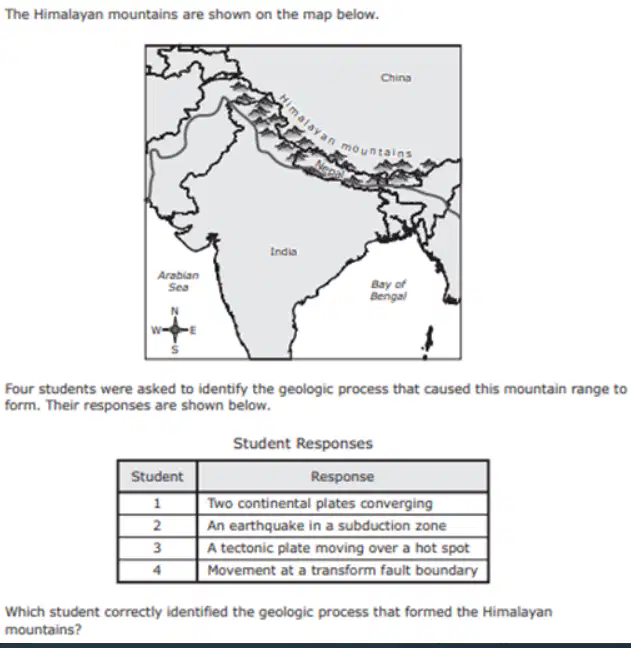
Which of these landforms is caused by convergent boundaries?
a)
Student 1
b)
Student 2
c)
Student 3
d)
Student 4
6.
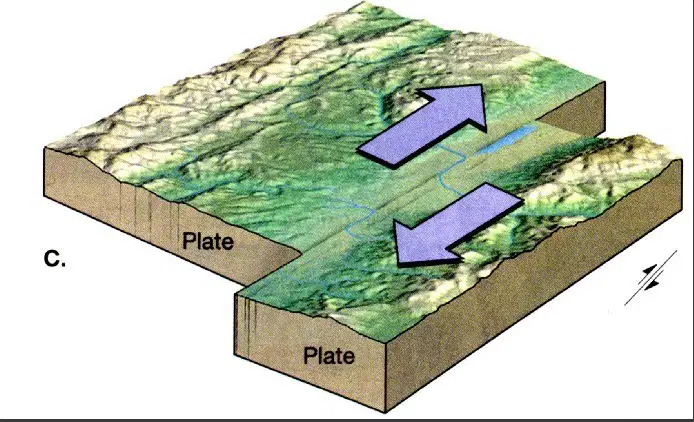
Which of these landforms is caused by convergent boundaries?
a)
The plate on the left (the plate with the volcano on it)
b)
Folded Mountains
c)
Faults
d)
Mid-Ocean Ridge
7.
Which TWO landforms occur when a continental plate and an oceanic plate hit each other?
a)
Volcanoes on land and Volcanic Islands
b)
Volcanoes on land and Deep Sea Trench
c)
Volcanoes on land and Folded Mountains
d)
Rift Valley and Mid Ocean Ridge
8.
What are the two types of crust
a)
continental and oceanic
b)
lower and upper
c)
ocean and upper
d)
pizza and subway
9.
Emma, Liam, and Olivia are discussing the key difference between primary and secondary ecological succession in a grassland ecosystem. What is the key difference they point out?
a)
Emma, Liam, and Olivia are discussing the key difference between primary and secondary ecological succession in a grassland ecosystem. What is the key difference they point out?
b)
Primary is the initial stage and secondary is the subsequent stage
c)
Primary focuses on animal community; secondary focuses on plant community
d)
Primary starts WITHOUT soil; Secondary starts WITH soil
10.
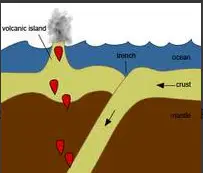
What type of event will occur at this boundary?
a)
Earthquake
b)
Tornado
c)
Volcanic Eruption
d)
Mountain Building
11.
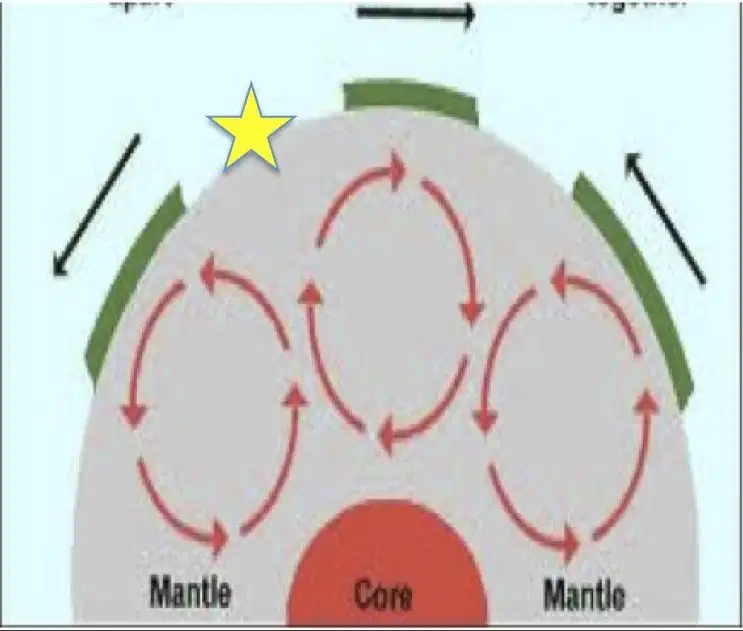
Study this diagram carefully, noticing the direction of the arrows. The green bars are tectonic plates. What will happen at the place where the star is drawn on this diagram?
a)
The plates will slide past each other (causing a major earthquake)
b)
The plates will hit each other (one will subduct)
c)
The plates will diverge (spread apart)
d)
None of these
12.
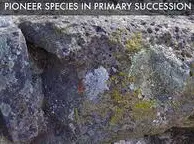
What is the primary role of pioneer species in an ecosystem?
a)
To break down rocks and contribute to soil formation
b)
To provide shade
c)
To attract tourists
d)
To serve as a food source for larger animals
13.
What is the main difference between primary and secondary succession in terms of their starting point?
a)
Primary succession starts with a pioneer species, while secondary succession starts with a climax community
b)
Primary succession starts with soil, while secondary succession starts with bare rock
c)
Primary succession starts with a climax community, while secondary succession starts with a pioneer species
d)
Primary succession starts with bare rock, while secondary succession starts with soil
14.
Which major tectonic plate is primarily composed of oceanic lithosphere and is the largest of the seven major plates?
a)
North American Plate
b)
African Plate
c)
Eurasian Plate
d)
Pacific Plate
15.
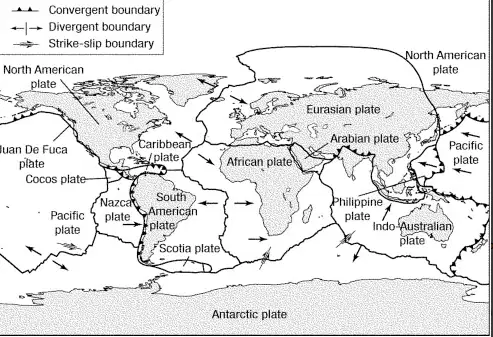
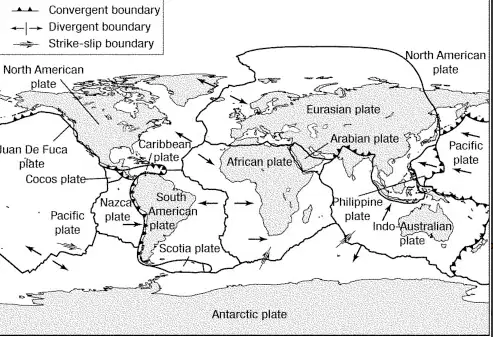
What type of plate boundary is present between the Nazca Plate and the South American Plate, as shown on the Plate Boundary Map?
a)
transform boundary
b)
convergent oceanic-continental plate boundary
c)
divergent boundary
d)
convergent oceanic-oceanic plate boundary
16.
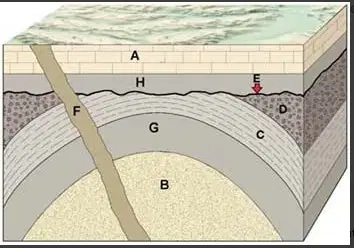
Organize the following sedimentary layers in chronological order from the oldest to the most recent:
a)
A, B, C, D, E, F, G, H
b)
B, H, C, D, E, F, A, G
c)
B, G, F, C, D, E, H, A
d)
G, A, F, E, D, C, H, B
17.
A candle is lit by a lighter, what is the name of the heat transfer that caused the candle to ignite?
a)
Conduction
b)
Radiation
c)
Convection
d)
Energy
18.
Which of the following is a type of energy that travels as electromagnetic waves and releases heat to it's surroundings?
a)
Conduction
b)
Radiation
c)
Convection
d)
Energy
19.
You and your dad are moving the couch from one side to another. Your dad pushes with a force of 35 N to the right and you push with a force of 25 N right. What is the net force on the couch?
a)
60 N right
b)
10 N left
c)
60 N Left
d)
10 N Right
20.
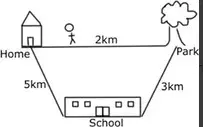
Jerry walked from home to school, then from the school to the park. What is his total distance?
a)
2 km
b)
8 km
c)
5 km
d)
10 km
21.

Which of the following orders the rock layers accurately from oldest to youngest?

a)

1, 2, 3, 4, 5

b)

5, 4, 3, 2, 1

c)

2, 3, 4, 5, 1

d)

1, 2, 3, 5, 4

22.
Which fossil is relatively the oldest?
a)
Trilobite
b)
Ammonite
c)
Crinoid
d)
Gastropod
23.

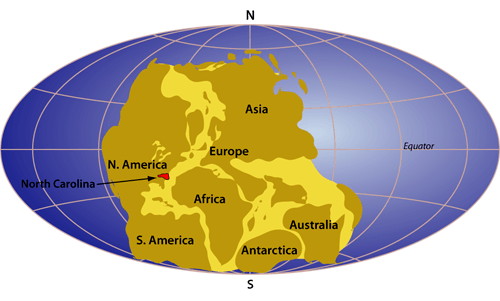
What is this a picture of?

a)

plate tectonics

b)

continental drift

c)

pangaea

d)

glacier scaring

24.
What two specific continents fit together most noticeably?
a)

South America and North America

b)

South America and Europe

c)

South America and Africa

d)

Antartica and Africa

25.
When one plate slides underneath another, it ____ and the magma _____. 
a)
hardens; sinks
b)
melts; sinks
c)
hardens; rises
d)
melts; rises
26.
What type of evidence was NOT used by Alfred Wegener to support his continental drift hypothesis?
a)
evidence from landforms
b)
evidence from fossils
c)
evidence from human remains
d)
evidence from climate
27.

Which of the following best describes primary succession?

a)

Volcano wipes out ecosystem that gradually grows back from ash covered soil

b)

Volcano creates a new island of rock that must break down to form an ecosystem

c)

Forest fire burns down forest that must bounce back over time

d)

Tornado destroys a crop that must slowly grow back over time.

28.

Which would result in primary succession?

a)

volcano destroying habitat leaving only soil and ash

b)

Tornado destroying a crop leaving very little soil

c)

Glacier retreating exposing bare rock

d)

limiting factors

29.
Natural disasters such as flooding and tornadoes are linked to ________________.
a)
primary
b)
secondary
c)
old field
d)
ecosystem
30.
What type of succession is shown going from figure A to figure B?
a)
primary succession
b)
eutrophication
c)
secondary succession
d)
intermediate