
 Worksheets
untitled
Total questions: 102
Worksheet time: 21hrs 35mins
direction


If two vectors to be added are at right angles, you will need to
just add them together.
use the Pythagorean theorem.
use the Law of Cosines.
subtract the smaller for the larger.


What is the direction of the acceleration for any projectile?
The direction the projectile is traveling.
Down
Up
Sideways
When is an object under uniform acceleration?
none of the following
when the direction is straight
when the velocity change is constant per unit time
when the time is constant
an object can be moving for 10 seconds and still have zero displacement.
true
false
Match each term with its formal physics definition
Displacement
The position of an object relative to its starting location
Velocity
The rate of change of displacement
Acceleration
The rate of change of velocity
Vector
A quantity with a magnitude and a direction
Scalar
A quantity with magnitude, but no direction
On the d vs t graph below, circle areas of positive acceleration in green, zero acceleration in yellow, and negative acceleration in red


Which graph best represents the motion of an object traveling at a constant positive velocity?
1
2
3
4
A car is traveling along an infinitely long, straight highway at a constant speed of 20 sm . Which of the following statements is true? [SELECT ALL THAT APPLY]
The car has constant speed
The car has no acceleration
The car is accelerating at a constant rate
The car's velocity is changing over time
World class athlete Lily Talented is running on a 400m track. Lily completes two laps and stops where she begins. What is her displacement Δx ?
0m
400m
800m
200m
World class athlete Lily Talented is running on a 400m track. Lily completes two laps and stops where she begins. What is her distance traveled?
0m
400m
800m
200m
Eccentric billionaire EY Wickham is riding in his sports car in a circular path at a speed of 25 mph . Which of the following correctly describes EY's motion?
Constant speed, changing velocity
Constant speed, constant velocity
Changing speed, constant velocity
changing speed, changing velocity

An object is moving along a straight line. The object’s velocity as a function of time is shown in the graph above. During which of the labeled segments on the graph is the object moving but not accelerating?
A
B
C
D

A roller coaster accelerates from an initial velocity of 6.0 sm to 70 sm over 4s . What is the roller coaster's acceleration?
24 m/s2
18 m/s2
16 m/s2
64 m/s2
A ball is thrown upward at an initial velocity of 20 m/s. How long will it take the ball to reach it's maximum height?
19.6 s
9.8 s
6.3 s
2.04 s
What is the correct unit for acceleration?
s2m
sm
Watts (W)
Newton⋅meter
What is the correct unit for velocity?
s2m
kg⋅s2m
sm
kg
If an object is NOT accelerating, then you know for sure that it is ….
Speeding up
Slowing down
moving with constant velocity
Turning with constant speed
Acceleration is…
The rate at which the position of an object changes
How quickly an object is traveling
How far away an object is from its starting position
The rate at which the velocity of an object changes
If the acceleration of an object is zero, then that object cannot be moving.
True
False
When a ball is thrown straight up with no air resistance, the acceleration at its highest point…
is upward
is downward
is zero
reserves from upward to downward
reverses from downward to upward
A ball is thrown straight up, reaches a maximum height, then falls to its initial height. Which of the following statements about the direction of the velocity and acceleration of the ball as it is going up is correct?
Both its velocity and its acceleration point upward.
Its velocity points downward and its acceleration points upward.
Its velocity points upward and its acceleration points downward.
Both its velocity and its acceleration points downward.
Which of the following is represented by the slope of the position-time graph?
Displacement
Acceleration
Velocity
Distance
Which of the following is represented by the slope of the velocity-time graph?
Displacement
Acceleration
Velocity
Distance
How can you calculate the displacement of an object from the velocity-time graph?
Find the slope of the line
Subtract the starting velocity from the ending velocity
Find the area between the line and the time axis
It’s not possible

Choose the best description of motion for the graph
The object is speeding up in the positive direction
The object is moving up and increasing its speed
The object is moving at a constant speed in the positive direction
The object is moving at a constant speed in the negative direction
None of the above

Which velocity-time graph best matches this position time graph?


Choose the best description of motion for this graph:
The object is slowing down and moving in the negative direction
The object is speeding up and moving in the negative direction
The object is slowing down and moving in the positive direction
The object is speeding up and moving in the positive direction
The object is moving at constant speed

Choose a velocity-time graph that best matches this position-time graph:


Calculate the displacement of the object for the first 8 seconds:
48 m
24 m
6 m
8 m
1.2 m
Mr. Berkley’s (imaginary) Corvette slows from a velocity of +32 m/s to one of +8m/s in 4 seconds. The acceleration is
-10 s2m
-6 s2m
6 s2m
10 s2m
If an object slows at a rate of 3.7 s2m how much time will it take for an object to slow from 22 m/s to 14 m/s?
2.16 s
9.73 s
0.46 s
4.30 s
A rock is dropped from a height of 12 meters. How fast will it be traveling the moment before it hits the ground?
10.8 m/s
15.3 m/s
117.7 m/s
235.4 m/s

What is this distance vs time graph representing?
Constant Speed
Acceleration
Deceleration (negative acceleration)
No motion

In the velocity time graph shown, what does the section of the graph below the time axis refer to?
Object travelling downward
Object traveling in the opposite direction to initial motion
Object traveling upward

What motion is represented by the speed-time graph?
Travelling at constant speed, then decelerating.
Accelerating, then decelerating.
Accelerating, then travelling at constant speed.
Traveling at constant speed, then stopping
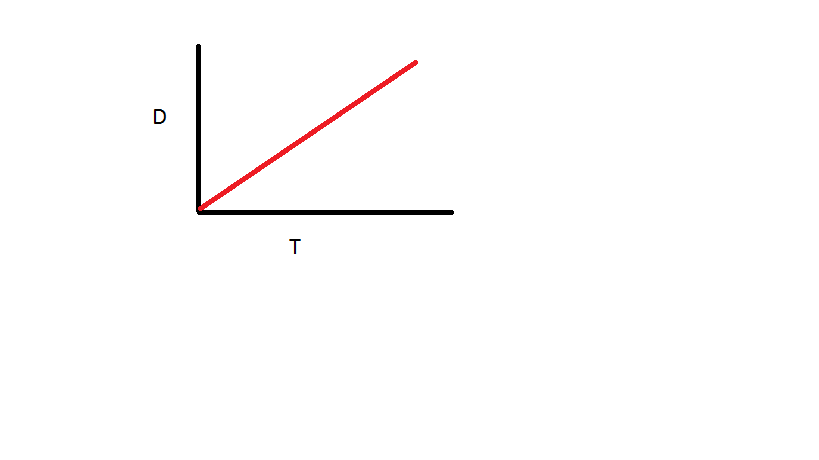
This distance vs time graph represents
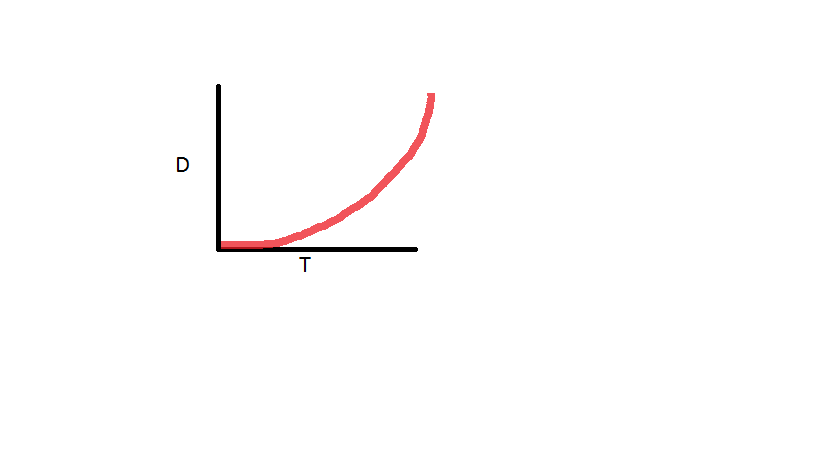
This distance vs time graph represents
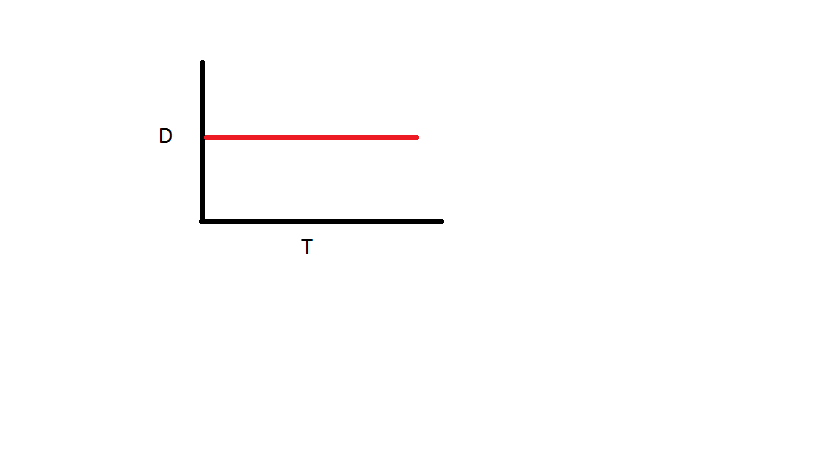
This distance vs time graph represents
Choose the correct equation to use for the following problem:
"Larry is jogging at a brisk 5 m/s. Suddenly, a bear! He speeds up to 9 m/s in 0.85 seconds. What was his acceleration?"
a=tΔv
v=td
d=v×t


The Velocity vs. Time graph for an object experiencing constant (nonzero) acceleration looks like:
A Horizontal Line
Any Diagonal Line
A Vertical Line
A Parabolic Curve
The Velocity vs. Time graph for an object experiencing constant velocity looks like:
A Horizontal Line
A Straight Line with a Positive Slope
A Vertical Line
A Parabolic Curve
A ball is thrown upwards, rises to its peak and eventually falls back to the original height. As the ball rises, its acceleration is upwards; as it falls, its acceleration is downwards.
True
False

Which object is traveling the slowest?
A
B
C

What is the velocity of the object from point A to B?
2 m/s
1 m/s
4 m/s
-4 m/s

Which graph shows an object that is moving with a constant velocity?
a
b
c
d
Which graph shows an object changing direction?
a
b
c
d
Which of the following quantities is not a vector?
velocity
speed
acceleration
displacement
In which one of the following situations does the car have a westward acceleration?
The car starts from rest and moves toward the east.
The car travels eastward and speeds up.
The car travels westward and slows down.
The car travels eastward and slows down.
.
In the process of delivering mail, a postal worker walks 161 m, due east from his truck. He then turns around and walks 194 m, due west from his truck. What is the worker's displacement relative to his truck?
33 m, due west
33 m, due east
194 m, due west
252 m, due east

A car is traveling south for 250 meters over the course of 100 seconds. What was the car's average velocity?
0.4 m/s south
0.4 m/s
2.5 m/s
2.5 m/s south

What is the average velocity of the object between 15 and 40 seconds?
6.0 m/s
1.5 m/s
-4 m/s
0 m/s

What is the the acceleration of the object between 0 and 4 seconds?
1 m/s
0 m/s2
-1 m/s2
1 m/s2

What is the velocity of the object between 4 and 5 seconds?
0 m/s
5 m/s
1 m/s
2 m/s

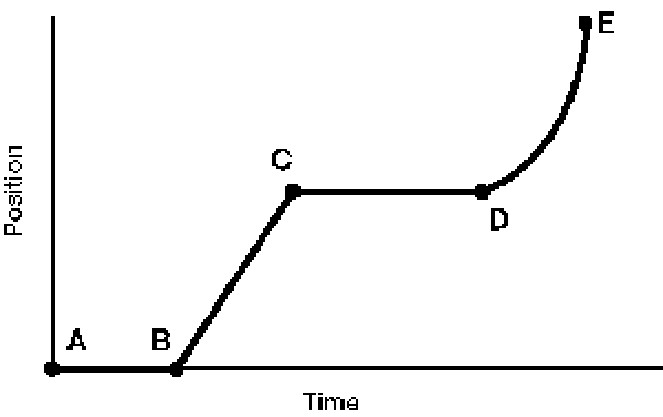
The velocity of the object is changing during interval:
A-B
B-C
C-D
D-E
An object travels 100 m North then 50 m South. What is its total displacement?
150 m
50 m North
50 m South
150 m North
A child left her home and started walking at a constant velocity. After a time she stopped for a while and then continued on with a velocity greater than she originally had. All of a sudden she turned around and walked very quickly back home. Which of the following graphs best represents the distance versus time graph for her walk?


A rock is dropped off a cliff and strikes the ground with an impact velocity of 30 m/s. How high was the cliff?
20 m
30 m
45 m
60 m

In section 5 of the velocity-versus graph, the object is:
Speeding up moving in the positive direction
Slowing down moving in the positive direction
Speeding up moving in the negative direction
Slowing down moving in the negative direction
As a rock in FREE FALL falls through the air, acceleration
stays constant
decreases until it hits terminal velocity
increases until it hits terminal velocity
increases ~10 m/s each second
Ball A is dropped from rest from a window. At the same instant, ball B is thrown downward; and ball C is thrown upward from the same window. Which statement concerning the balls after their release is necessarily true if air resistance is neglected?
At some instant after it is thrown, the acceleration of ball C is zero.
All three balls have the same initial velocity.
All three balls have the same velocity at any instant.
All three balls have the same acceleration at any instant.
On Earth, what is an object's velocity at it's highest point?
0 m/s
9.8 m/s2
-9.8 m/s2
Depends on the object
Acceleration due to gravity on Earth is ...
6.67 sm
6.67 s2m
9.81 sm
9.81 s2m

The P-T pictured below represents the motion of the two objects, A and B. Which of the following statements is true?
B travels the greater distance
A has the greater speed
A leaves the reference point at an earlier time
Both of the objects have the same speed at the point the lines cross
A is traveling for a longer period of time
A rock is dropped off a cliff and strikes the ground with an impact velocity of 30 m/s. How high was the cliff?
20 m
30 m
45 m
60 m
A stone is thrown vertically upward with an initial speed of 5 m/s. What is the velocity of the stone 3 seconds later?
25 m/s, upward
25 m/s, downward
35 m/s, upward
35 m/s, downward
A car is travelling along the road. It starts at 10 m/s and accelerates to a velocity of 25 m/s. It speeds up over a period of 5 seconds. What distance does it travel during this time?
62.5 m
77.5 m
82.5 m
87.5 m
A bicyclist is travelling along a bike path in the park at a constant velocity of 4 m/s. A deer darts in front of the bicyclist and they hit the brakes. The brakes decelerate the bike at -2 m/s^2.
How long does it take the bicyclist to stop?
0.5s
1.0s
1.5s
2.0s
A bicyclist is travelling along a bike path in the park at a constant velocity of 4 m/s. A deer darts in front of the bicyclist and they hit the brakes. The brakes decelerate the bike at -2 m/s^2.
What is the distance it takes the until the bicyclist stops?
1.5m
2.25m
4.0m
8.0m
A car is travelling along the road. It starts at 10 m/s and accelerates to a velocity of 25 m/s. It speeds up over a period of 5 seconds. What is the acceleration?
-5 s2m
2 s2m
3 s2m
5 s2m
A skydiver jumps from a plane. They leave the plane at rest, and fall vertically downwards. How fast are they falling after 100m of freefall?
42 m/s
44 m/s
98 m/s
1960 m/s
A lunar landing module is descending to the Moon’s surface at a steady velocity of 10.0 m s-1. At a height of 120 m a small object falls from its landing gear. Assuming that the Moon’s gravitational acceleration is 1.60 m s-2, at what speed, in m s-1 does the object strike the Moon?
22.0
19.6
16.8
10.0

