
 Worksheets
PHY 306 Review Quiz
Total questions: 100
Worksheet time: 2hrs 39mins
Which of the followiing is an intensive variable of a thermodynamic system?
mass
entropy
temperature
volume
_____ refers to the heat required to change the phase of a substance in a first-order phase transition.
Latent Heat
Fusion
Specific Heat
Sensible Heat
The _____ law of thermodynamics is used to understand the concept of energy conservation.
0th
1st
2nd
3rd
In an _____ thermodynamic process, there is no flow of heat between the system and the surroundings.
isobaric
isothermic
adiabatic
isochoric
If the temperature of the heat source is increased, the efficiency of carnot heat engine _____.
increases
decreases
remains constant
increases first then becomes constant
An ideal heat engine operates in Carnot's cycle between 227 °C & 127 °C . it absorbs 6.0×10⁴ J of heat at high temperature. The amount of work is (a) .
110 J of heat is added to a system. The change in the internal energy is 40 J.
Then the amount of work done is _____.
150 J on the system
70 J by the system
150 J by the system
70 J on the system
In thermodynamics, which of the following is not a state function?
Density
Internal Energy
Enthalpy
Heat
Heat does not spontaneously flow from a colder body to a hotter one. Which of the following thermodynamics law states this?
Zeroth law of thermodynamics
First law of thermodynamics
Second law of thermodynamics
Third law of thermodynamics
The entropy of an isolated system can never _____.
decrease
be zero
increase
A definite area or space where the thermodynamic process takes place is known as the _____.
thermodynamic system
thermodynamic cycle
thermodynamic equilibrium
thermodynamic variable
When two bodies are in thermal equilibrium with a third body, they are also in thermal equilibrium with
each other. This statement is called the _____.
zeroth law of thermodyamics
first law of thermodynamics
second law of thermodynamics
third law of thermodynamics
A chemical reaction that releases heat is an _____.
endothermic reaction
exothermic reaction
The value of cV,m for a diatomic gas is _____, if the vibrational motion is not considered.
23R
25R
27R
29R
The value of the adiabatic index for a monaotomic gas is around (a) . (give your answer in 3 significant figures)

What is the state of matter in the region of X?
A system in which neither mass nor energy is exchanged with the surrounding is called a(an) _____.
open system
closed system
isolated system
A thermodynamic process in which the volume remain constant is called an _____.
isochoric process
isobaric process
isentropic process
isothermal process
Under the constant temperature & pressure conditions, the chemical reaction proceeds spontaneously when _____.
∆G > 0
∆G < 0
∆H > 0
∆H< 0
Which law of thermodynamics states that the absolute zero cannot be reached?
0th
A 7.50 L sealed jar at 17 °C contains 0.100 moles of oxygen & 0.200 moles of nitrogen gas. What is the pressure (in Pa) in the container? (3 significant figures for answer)
(a)
Which of the following equation represents the Ideal Gas Law?


Gas
Same for all states
The internal energy of a fixed mass of an ideal gas depends on the _____ only.
pressure
volume
temperature
mass
According to the kinetic theory of matter, as the temperature of an object increases, its molecules _____.
move faster
get bigger
move farther apart
move faster & farther apart
get bigger & farther apart
Which of the following is NOT a path function?
Internal energy
Heat energy
Work energy
Entropy
(∂V∂T)s =
−(∂S∂P)V
(∂S∂P)V
(∂S∂V)P
−(∂S∂V)P
Given the following information, calculate the change of the standard Gibbs energy (in kJ) for the following chemical reaction at 25 oC. (2 significant figure for answer)
SnCl4 (l) + 2 H20 (l) ⟺ SnO2 (S) + 4 HCl (g)
ΔH0=+133.0 kJ and ΔS0 =+401.5 J/K
(a)
Which of the following statements are CORRECT?
1. The first law of thermodynamics represents the principle of conservation of energy.
2. Room temperature is about 20 degrees on the Kelvin scale.
3. A calorie is approximately 4.2 J.
4. Heat has the same unit as work.
5. Heat is a temperature difference.
1, 3, and 4.
3 and 5.
1 and 5.
1, 2 and 3.
2 and 4.
Which one of the following statements is true?
In an adiabatic process, the heat flow is positive
In an isovolumetric process, the work done is positive
The internal energy of a system is not a state function
In a cyclic process, the change in internal energy is zero
In an isobaric process, the change in internal energy is always zero

The graph which is drawn to scale, shows two isotherms at temperatures of T and T1 for a fixed mass of ideal gas. What is the relation between T1 and T?
T1 = 2T
T1 = 4T
T1 = 2T
T1 = 4T

The figure shows a complete cycle of change for an ideal gas. Heat enters the gas during the _____ stages.
PQ and QR
QR and RS
RS and SP
SP and QR
1 mole of an ideal gas undergoes an adiabatic process, its temperature increases by ∆T and its volume changes by ∆V. Which of the following is correct?
Pressure of the gas decreases
Work done by gas is p∆V
Internal energy increases by Cv,m∆T
Heat flows out of the gas

A monatomic gas expands adiabatically from the state X to the state Y as shown in the figure. What is the magnitude of the change in the internal energy (in kJ) of the gas?
(a)

The variation of internal energy per mole U with temperature of a gas is shown in the graph. What is the adiabatic index? (give your answer in 3 significant figures)
(a)
Temperature is a measure of the _____.

Copper, Stainless Steel, Carbon Steel, and Zinc were all heated with the same thermal energy from the same temperature. What material would be the coolest after being heated?
Fermi-Dirac statistics is for the _____.
distinguishable particles
symmetrical Particles
particles with half integral spin
particles with integral spin
Bose-Einstein statistics is for the _____.
distinguishable particles
symmetrical Particles
particles with half integral spin
particles with integral spin
Maxwell-Boltzmann statistics is for the _____.
distinguishable particles
indistinguishable Particles
particles with half integral spin
particles with integral spin
The average kinetic energy associated with each degree of freedom is _____.
kBT
2kBT
2kBT
23kBT

Which one of the following is the most probable speed?
A
B
C
D
The difference between fermions and bosons is that bosons do not obey _____.
Aufbau principle
Pauli’s Exclusion Principle
Hund’s Rule of Maximum Multiplicity
Heisenberg’s Uncertainty Principle
Striling’s approximation ln N! = _____.
NlnN−N
2NlnN+2
NlnN−1
NlnN+N

From the figure, what is the highest temperature?
T1
T2
T3
Insufficient information
In Fermi-Dirac Statistics, one energy state can be occupied by more than one particle. This statement is _____.
TRUE
FALSE
The ratio of rms velocity to most probable velocity is _____.
23
32
83π
4π
Which of the following is TRUE for a system that is in dynamic equilibrium?
The forward reaction goes to 100% completion.
The reaction stops.
The concentration of products is equal to the concentration of the reactants.
none of the above
Le Chatelier's principle states that _____.
a disturbing force must be applied to a system in order for it to reach equilibrium.
when a system at equilibrium is disturbed, a new equilibrium constant is established.
when a chemical system at equilibrium is disturbed, the system shifts in order to minimize the effect.
when a chemical system is at equilibrium it is no longer possible to alter the system.
What happens to the equilibrium position of an exothermic reaction when you remove heat?
shifts to the left
shifts to the right
no change
insufficient information
For the reaction
SO2 (g) + O2 (g) ⇌ SO3 (g)
If the concentration of SO2 is increased, the equilibrium of the reaction will shift to the _____.
left
right
right then left
left then right
For the reaction
N2 (g) + 3 H2 (g) ⇌ 2 NH3 (g)
If the pressure in the system is increased, which substance(s) will increase in concentration?
N2
H2
N2 and H2
NH3
2SO2 (g) + O2 (g) ⇌ 2SO3 (g)
Decreasing volume of container will _____.
shift equilibrium to the right
shift equilibrium to the left
change Keq
For a reaction Keq = 1.2 × 10⁻⁶ at T = 200 K. What is ΔG° for the reaction in KJ / mol? (give your answer in 3 significant figures)
(a)
A catalyst is added to a system at equilibrium. The concentration of the reactants will then _____.
decrease
increase
remain the same
approach zero
none of the above

Put a stopper on the flask.
Decrease the surrounding pressure.
For the following chemical equilibrium, Kp = 4.6 × 10⁻¹⁴ Pa at 25 °C, find the value of Kc (in m3mol ) for this reaction at 25 °C.
2 Cl2 (g) + 2 H2O (g) ⇔ 4 HCl (g) + O2 (g)
Kc = 2.2 × 10⁻¹⁴
Kc = 4.6 × 10⁻¹⁴
Kc = 9.4 × 10⁻¹⁴
Kc = 1.9 × 10⁻¹⁷
Kc = 1.1 × 10⁻¹²
What is ΔH° (in kJ/mol) for a reaction that has Keq = 1.456 at 273 K and Keq = 14.2 at 298 K? (give your answer in 3 significant figures)
(a)
What is the Kc expression for the reaction below:
SOCl2 (g) + H2O (g) ⇌ SO2 (g) + 2 HCl (g)
[SOCl2][H2O][SO2][2HCl]
[SOCl2][H2O][SO2][HCl]2
[SO2][2HCl][SOCl2][H2O]
[[SO2][2HCl][SOCl2][H2O]

Using the phase transition diagram, which of the following states coexist at the same time on the red curve?
solid and liquid
solid and gas
liquid and gas
solid, liquid, and gas

What letter on the diagram represents a substance only in the solid phase?
A
B
C
d
e
What letter on the diagram represents the triple point?
A
B
C
d
e
What is the boiling point of this substance at 1 atm of pressure?
45 °C
60 °C
100 °C
110 °C
What would the state of this substance be at 0.5 ATM of pressure at a 100 °C ?
Solid
Liquid
Gas
Liquid & gas coexist
Solid & liquid coexist
A phase change is a chemical or physical change?
Physical
Chemical
Transition from solid to gas without the intermediate liquid phase is called _____.
Condensation
Vaporization
Freezing
Deposition
Sublimation

deposition then melting
sublimation then melting
condensation then freezing
vaporization then freezing

What happens along the BC line?
Melting or freezing
Vaporization or condensation
Vaporization or melting
Freezing or condensation
Sublimation or deposition
The molecules of an ideal gas have _____.
kinetic energy only
potential energy only
both kinetic energy and
potential energy
no energy
The van der Waals equation for 1 mole real gas is _____.
(P+V2a)(V−b)=RT
(P+nV2a)=RT
(P−V2a)(V+b)=RT
PV=RT
The critical temperature of a van der Waals gas is _____.
TC=27bR8
TC=827 bRa
TC=27b2a
TC=27bR8a
At high pressure, the real gas deviates from the ideal gas behavior, because _____.
The gas molecules occupy sizable portion of the container.
The intermolecular forces is significant as the molecules are now closer to each other.
The molecule have energy to overcome intermolecular forces.
The gas molecules move faster at high pressure.
Based on the knowledge of Joule-Thomson effect, which of the following gases increase their temperature during the Joule-Thomson expansion?
O2 & N2
H2 & He
CO & O2
CH4 & N2
Oxygen molecules at temperature T have the same r.m.s. speed as helium molecules at 300 K. What is the temperature T in K?
(a)
The change in length (in mm) of a 100 mm aluminium bar that has increased in temperature by 55 ⁰C.
Take the coefficient of linear expansion to be 2.5 x 10⁻⁵ K−1 . (give your answer in 2 significant figures)
(a)
The mean free path is inversely proportional to the _____.
density
Pressure
square of the diameter of the molecule
All of the above
(∂S∂P)V equals to _____.
−(∂T∂V)P
−(∂V∂T)S
−(∂T∂P)V
−(∂V∂T)S
Enthalpy H = _____.
U + pV
U + pdV
dU+ pV
pV
A container having a volume of 1.0 m³ holds 5.0 moles of helium (He) gas at 50 °C. If the helium behaves like an ideal gas, what is the total energy of the system?
2.0 × 10⁴ J
2.5 × 10⁴ J
1.7 × 10³ J
1.5 × 10³ J
A container having a volume of 1.0 m³ holds 5.0 moles of helium (He) gas at 50 °C. If the helium behaves like an ideal gas, the average kinetic energy per molecule is _____.
3.3 × 10⁻²⁰ J
1.0 × 10⁻²¹ J
1.0 × 10⁻²⁰ J
6.7 × 10⁻²¹ J
The air in an automobile engine at 20.0 °C is compressed from an initial pressure of 1.00 atm and a volume of 200 cm³ to a volume of 20.0 cm³. Find the temperature (in K) if the air behaves like an ideal gas (γ = 1.40) and the compression is adiabatic. (give your answer in 3 significant figures)
(a)
If cp,m for an ideal gas is 35.4 J/mol⋅K, which of the following is cV,m for this gas?
12.5 J/mol⋅K
20.8 J/mol⋅K
29.1 J/mol⋅K
27.1 J/mol⋅K
For one phase and one component system, the degrees of freedom is _____.
1
2
3
4
A system containing liquid water and water vapour has the number of phases equal to _____.
2
0
1
3
What is meant by triple point?
Degree of freedom is three
Three phases are in equilibrium
Three components are in equilibrium
The ratio of the effusion speed of helium (He) to gas X is 16:1. What is the molar mass of gas X? (use 4 g/mol for He)
1024 g/mol
256 g/mol
128 g/mol
64 g/mol
Effusion is _____.
used to describe the combustibility of a gas
the ability of a gas to escape through a tiny opening
A tank of gas contains 50 kPa of helium, 50 kPa of argon, and 100 kPa of neon. What is the total pressure (in kPa) of the gas mixture?
(a)
What happens to the temperature of a substance during a phase change?
Increases
Remains constant
Decreases
Increases or Decreases
A reversible and irreversible heat engines are working between same two temperatures .The efficiency of _____.
both are the same
the reversible is greater
the irreversible is greater
1200 J of heat are added to a sample of gas while the gas does 400 J of work on the environment. What is the change in internal energy (in J) of the gas?
(a)
What is the correct form of equation for the first law of thermodynamics?
U=Q+W
dU=Q+W
ΔU=δQ+dW
dU=δQ−pdV
dU=dQ+dW
COP of heat pump = COP of refrigerator + ____
The cyclic integral of TδQ in a thermodynamic cycle can be _____ zero.
greater than or equal to
less than or equal to
greater than
A refrigerator needs to remove heat from 5 degree celsius cold body to a surrounding at 35 degree celsius. What is its COP? (give 2 significant figures for answer)
(a)
A 1.0 x 10⁴ m steel railroad track with a coefficient of linear expansion of K12×10−6 changes temperature from 18°C to 40°C . By how many meters will the railroad tracks expand? (give 2 significant figures for answer)
(a)
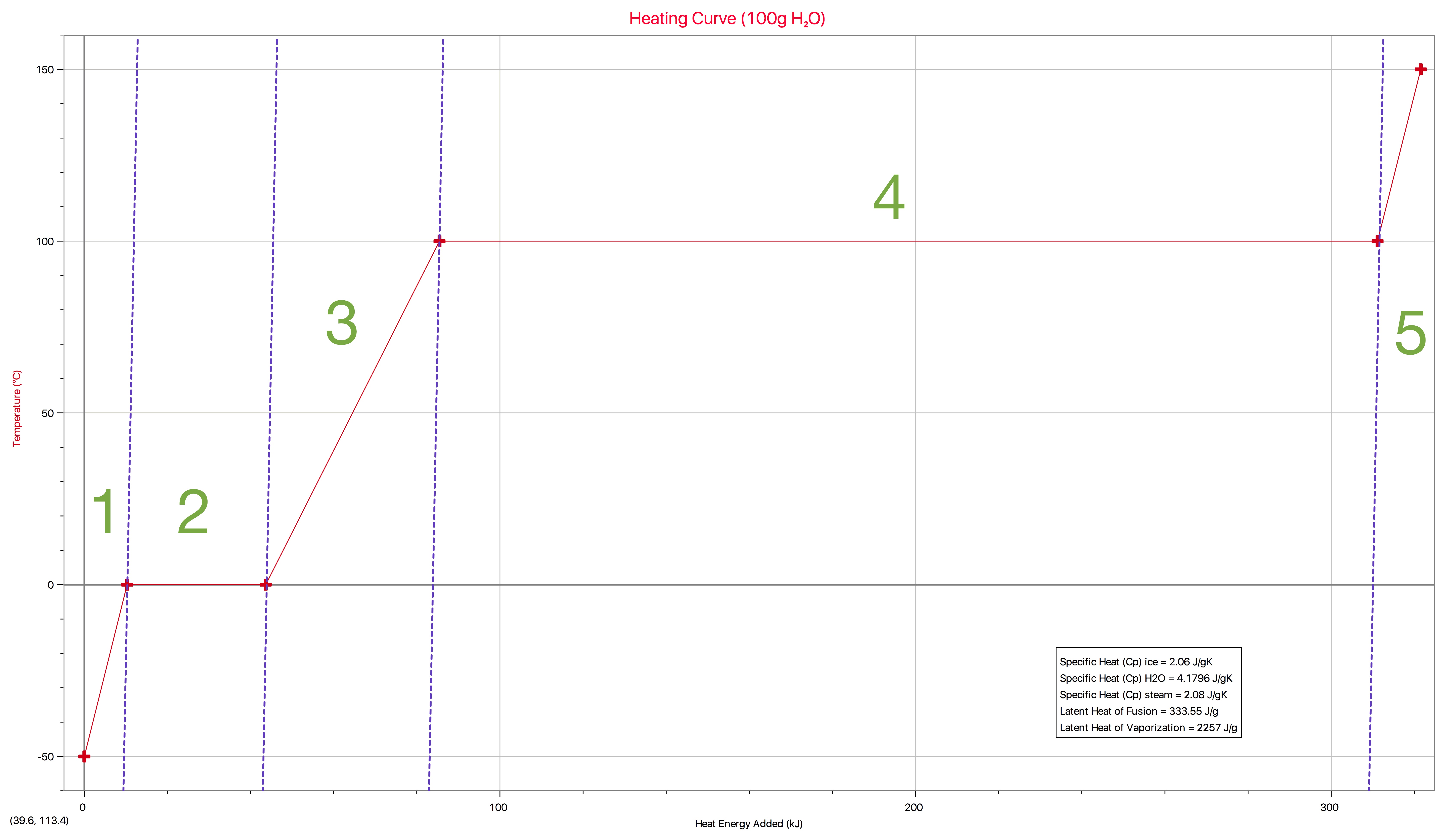
In which region(s) of the graph would we use a specific heat capacity to calculate heat energy?
Calculate the amount of heat (in MJ) required to convert 450 g of water at 100 oC to steam at the same temperature (Latent heat of vaporization of water = 22.7 x 10⁵ J/kg). (give 3 significant figures for answer)
(a)
Consider the following reaction at a certain temperature.
2 SO3 (g) ⇌ 2 SO2 (g) + O2 (g)
When the initial concentration of SO3 (g) is 0.128 mol/m3, at equilibrium the concentration of oxygen gas is found to be 0.0130 mol/m3. Calculate Kc (in mol/m3). (give 3 significant figures for answer)
(a)

