
Font size
 Worksheets
Unit 5 Practice-SPS 10
Total questions: 85
Worksheet time: 3hrs 7mins
A student is planning an experiment using a nail, wire, and a battery to investigate the factors that affect and do not affect the strength of an electromagnet. Which factor would NOT affect the strength of the electromagnet?
the kind of metal used for the nail in the electromagnet
the amount of current flowing through the electromagnet
the number of coils of wire used in the electromagnet
the direction of the current flowing through the electromagnet
A student creates an electromagnetic wave and then reverses the direction of the current. Which of the following will happen to the magnetic field?
The direction of the magnetic field will reverse.
The magnetic field will expand.
The magnetic field will be cancelled out and disappear.
The magnetic field will cause the voltage of the battery to be reduced.
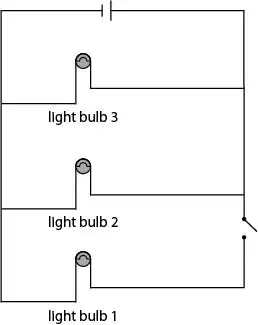
The diagram to the left shows three light bulbs connected in a parallel circuit with an open switch. Which light bulb will be turned off by the opened switch?
Light bulb 1
Light bulb 2
Both light bulbs 2 and 3
Both light bulbs 1 and 2

Three light bulbs are connected in a series, as shown in the diagram. After the circuit is completed, the middle light bulb breaks. What will happen to the remaining light bulbs?
Both of the remaining light bulbs will go out.
Both of the remaining light bulbs will stay lit.
Only the light bulb closest to the positive end of the battery will stay lit.
Only the light bulb closest to the positive end of the battery will go out.
The relationship between voltage (V), current (I), and resistance (R) is shown in the equation. V= IR Which of the following graphs BEST represents the relationship between current and voltage when the resistance remains constant?


What happens to the current flowing through a circuit as resistance increases?
It increases.
It decreases.
It stays the same.
It reverses direction.
What is a measure of how much work is needed to move a charge from one point to another?
amperage
resistance
electric current
voltage
What is the current flowing through a 120 volt toaster that has a resistance of 24 ohms?
0.20 amperes
5.0 amperes
24 amperes
96 amperes
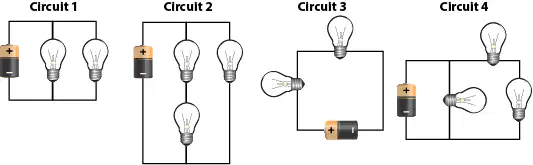
The diagram shows four different circuits. Which circuit will stop producing light if one bulb burns out?
Circuit 1
Circuit 2
Circuit 3
Circuit 4
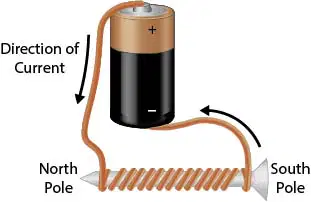
Maria makes an electromagnet shown in the figure below. The battery has a voltage of 6.0V, and she uses an iron nail. Which of the following would increase the strength of the magnetic field produced?
Doubling the number of times the wire wraps around the nail.
Changing the battery to a 3.0V battery.
Reversing the direction of the current flow.
Replacing the iron nail with one made of plastic.
There are 3.0 amps of current flowing through a 12 volt battery in a circuit. How many amps will flow through the circuit if the resistance in the circuit is reduced by half?
1.5 amps
3.0 amps
6.0 amps
12 amps
Which term BEST describes the ratio of the potential difference to the current in a conductor?
resistance
charge
conductivity
power
A 110V wall outlet has a resistance of 3.7 ohms. What is the amount of current flowing to the outlet?
0.04 A
29.7 A
113.7 A
407.0 A
How many amperes of current will flow through a circuit that has 4.0 ohms of resistance and is powered by a 16 volt battery?
0.25 amps
4.0 amps
12 amps
64 amps
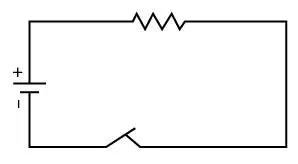
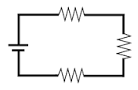
A 4.0 ohm resistor is connected to a 12 volt battery in the circuit shown below. What will happen to the current if the 12 volt battery is replaced with a 6.0 volt battery?
It will remain the same.
It will double.
It will be halved.
It will quadruple.
A car radio with a resistance of 15 ohms draws a current of 0.87 amperes. What is the voltage of the car battery?
1.3 volts
5.8 volts
13 volts
17 volts
If the length of a copper wire is reduced by half, what happens to the resistance of the wire?
It is quartered.
It is halved.
It stays the same.
It is doubled.
What is a disadvantage of using a series circuit?
If one section of the circuit fails, the whole circuit fails.
It requires a complicated pattern of wires to create.
Additional power sources are not able to be added.
Extra output devices increase the speed of the current.
Eve makes a simple series circuit using a battery and two light bulbs. Through how many paths will the current be able to travel in her circuit?
1
2
3
4
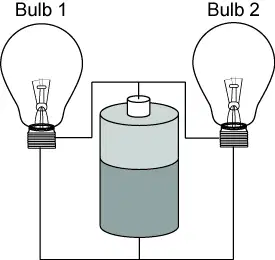
The diagram shows a simple circuit. What will happen if Bulb 1 burns out?
Bulb 2 will go out because it is connected in series to Bulb 1.
Bulb 2 will go out because it is connected in parallel to Bulb 1.
Bulb 2 will remain lit because it is connected in series to Bulb 1.
Bulb 2 will remain lit because it is connected in parallel to Bulb 1.
In which kind of materials is charge most easily transferred?
conductors
insulators
nonconductors
semiconductors
What is described as the flow of charged particles?
electric field
frictional force
electric current
gravitational force
In a simple electric circuit, a 24-ohm resistor is connected across a 6.0-volt battery. What is the current in the circuit?
0.25 A
1.0 A
4.0 A
144 A
If the potential difference across a 30.0-ohm resistor is 10.0 volts, what is the current through the resistor?
0.25 A
0.33 A
0.50 A
3.0 A
A lamp has a current of 2.0 amperes at 6.0 volts. What is the resistance of the lamp?
4 ohms
3 ohms
6 ohms
12 ohms
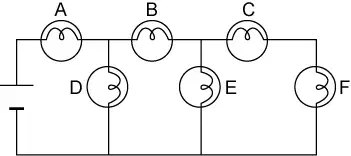
The diagram below is of a circuit. In this circuit, which bulb, when burned out, will cause all other bulbs to stop glowing?
A
B
C
F
Susie is in the kitchen making brownies. She melts butter in the microwave, turns on the oven to preheat, and uses the electric mixer all at the same time. Which best explains how Susie can turn the mixer off without the other appliances turning off as well?
The circuits are wired in series, and when one appliance turns off, the others can still run.
The circuits are wired in parallel, and when one appliance turns off, the others can still run.
The circuits are wired in series, and when one appliance turns off, the others will switch to parallel circuits for power.
The circuits are wired in parallel, and when one appliance turns off, the others will switch to series circuits for power.
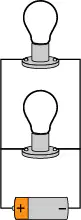
Tomas drew a model of a parallel circuit. Using conventional flow notation, which diagram correctly shows how the current flows through the circuit?


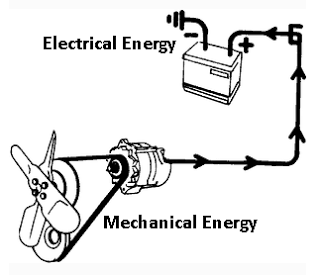
What is the transfer of energy in when you plug in a motor and it spins?
chemical to mechanical
electrical to mechanical
mechanical to electrical
physical to potential

What voltage is needed to cause a 50A current flow through a 10Ω resistor?
15V
500V
500 kV
0.2V


What is the definition of electrical current?
The opposition to the flow of electrons
The rate of flow of charge
The work done on each coulomb of charge
Electrons moving around
Opposition to the flow of an electric current, producing heat
Type of circuit where there are several branching paths to the components
The unit of measurement for voltage
Material through which electric current cannot move easily
Type of circuit where the components are lined up along one path
What resistance would produce a current of 200 amps with a voltage of 2,000 V?
What is the current produced with a 9-V battery through a resistance of 100 Ω?
What voltage is necessary to produce a current of 200 amps through a resistance of 100 Ω?
Using your knowledge of Ohm's Law, what happens to current as you increase voltage?
Using your knowledge of Ohm's Law, what happens to current as you increase resistance?

