wayground logo

Free Printable Worksheets

Font size

S
M
L
XL
Worksheets

Energy Quiz 2

Total questions: 89

Worksheet time: 2hrs 42mins

Name
Class
Date
1.

What is potential energy?

a)

The energy an object has due to its position or condition.

b)

The energy an object has due to its motion.

c)

The energy an object has due to its chemical composition.

d)

The energy as object has due to its atomic structure.

2.
Which type of potential energy causes the arrow to shoot from the bow?
a)
kinetic
b)
elastic
c)
chemical
d)
gravitational
3.

The diagram shows the same spring being stretched at different lengths using different masses. At which length does the spring have the MOST potential energy?

a)

length A

b)

length B

c)

length C

d)

length D

4.

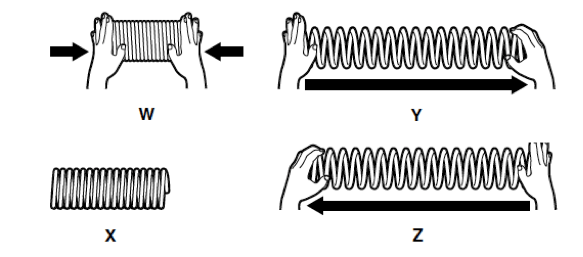
Elastic potential energy is energy stored in an object, such as a spring, due to the object being stretched or compressed. In which position is it most likely that the spring has lost its elastic potential energy?

a)

W

b)

Y

c)

X

d)

Z

5.

SELECT ALL POSTITIONS where the spring has STORED ELASTIC ENERGY

a)

W

b)

Y

c)

X

d)

Z

6.

Elastic Potential Energy is _____________________________________.

a)

the ability of a material to return to its original shape after it has been stretched or deformed.

b)

potential energy that is stored due to the deformation of an elastic object, such as a stretched spring.

c)

energy stored in the bonds of chemical compounds. Chemical energy is released during chemical reactions.

d)

the energy contained within a system that is responsible for its temperature.

e)

the flow of thermal energy.

7.
If F is force, k is spring constant and x is extension, Hooke's Law tells us that:
a)
F=k/x
b)
x=Fk
c)
k=Fx
d)
F=kx
8.
Hooke's Law fails when a material reaches its:
a)
breakdown
b)
elastic limit
c)
end of tether
d)
fracture stress
9.
A stiff material has a:
a)
high spring constant
b)
low spring constant
c)
spring constant of any value
d)
spring constant which is difficult to predict
10.
A spring extends 1.5m under load 10N. What is its spring constant?
a)
0.15N/m
b)
10N/m
c)
6.7N/m
d)
15N/m
11.
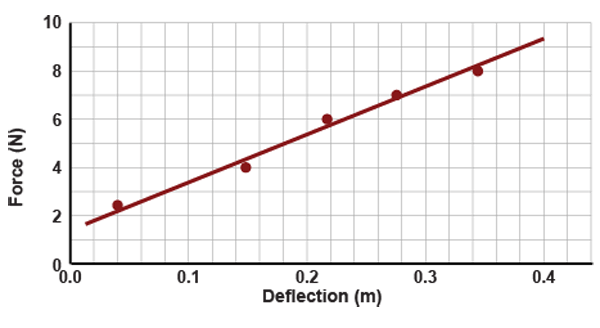
What Quantity can you calculate from the graph and give the magnitude of that quantity.  
a)
distance 4.5 m
b)
Force 15 N
c)
spring constant 20 N/m
d)
spring constant 200 N/m
12.

At point P, _______.

a)

the force applied to the spring is equal to its elongation

b)

Hooke's Law ceases to be valid

c)

the spring is can be stretched but still springs back into shape reversibly

d)

the spring constant increases

13.

Which quantity can be determined from this graph?

a)

the net force is 4N

b)

the spring is 0.4m long

c)

the stored potential energy in this spring is 1.6 J

d)

the spring constant is 10 N/m

14.
Which of the following is a true statement regarding springs?
a)
The higher the value of the spring constant, the stiffer the spring.  
b)
In Hooke's law, the force exerted by the spring acts in the same direction as displacement.  
c)
Springs are designed to provide unpredictable variations in force.  
d)
The force exerted by a spring has a quadratic relationship with the displacement form equilibrium.  
15.
Which of the following springs is the stiffest?
a)
A spring that requires a froce of 2000 N to compress it by 6.8 m.
b)
A spring that requires a force of 4000 N to stretch it by 9.0 m. 
c)
A spring that requires a force of 8000 N to compress it by 45 m.  
d)
A spring that requires a force of 4800 N to stretch it by 14 m.
16.

A force of 20 N is applied by a mass hanging at the bottom of a spring. How heavy is the mass?

a)

2.0 g

b)

2.0 kg

c)

20 g

d)

20 kg

17.
Hooke's Law describes the behaviour of which kind of material under tension?
a)
plastic
b)
metals only
c)
elastic
d)
non-metals only
18.

The formula for calculating elastic potential energy (Ee) is...

a)

2 x spring constant x extension2

b)

1/2 x spring constant2 x extension

c)

1/2 x spring constant x extension2

d)

1/2 x mass x extension2

19.

_________ is the unit of Spring Constant

a)

N

b)

N/m

c)

m

20.

Who discovered Hooke's law?

a)

Robert Hooke

b)

Charlie

c)

Newton

21.

According to Hooke's law; Force is equal to -

a)

Spring Constant × Extension

b)

Spring Constant ÷ Extension

c)

Spring Constant + Extension

22.

If the original length of a spring is 20m and its extended length is 30m. What is the extension?

a)

20m

b)

12m

c)

75m

d)

45m

e)

10m

23.

A bungee rope has a spring constant of 5N/m. How much a person must weighs in Newton if we want it to extend (stretch) 10m?

a)

20N

b)

22cm

c)

50N

d)

50cm

e)

21N

24.

What is the spring constant of a bungee rope in N/m if a person weighs 100 N if we want it to extend (stretch) 20m?

a)

5N/m

b)

5N/cm

c)

5N

d)

10N

e)

10N/m

25.

If a bungee rope has a spring constant of 10 N/m. How far will it extend (stretch) if a person who weighs 300 N is placed on it?

a)

21m

b)

30m

c)

31cm

d)

21miles

e)

None of the above

26.

___________ is the unit of force

a)

Km

b)

cm

c)

m

d)

N/cm

e)

N

27.
Energy due to motion is ____________ energy. 
a)
Potential 
b)
Energy
c)
Kinetic
d)
Friction
28.
The faster an object moves, the ________ kinetic energy it has. 
a)
more
b)
less
c)
none of the above
d)
all of the above 
29.
__________ is stored energy. 
a)
Potential
b)
Kinetic
c)
None of the above 
d)
All of the above 
30.
Gravitational potential energy depends on the ________ and ________ of the object. 
a)
Height and mass
b)
Friction and movement
c)
Mass and Movement
d)
Height and Friction 
31.
What kind of energy is in a rock at the edge of a cliff?
a)
Potential
b)
Kinetic
32.
What kind of energy is in a moving skateboard?
a)
Potential
b)
Kinetic
33.
What kind of energy is in a stretched rubber band?
a)
Potential
b)
Kinetic
34.
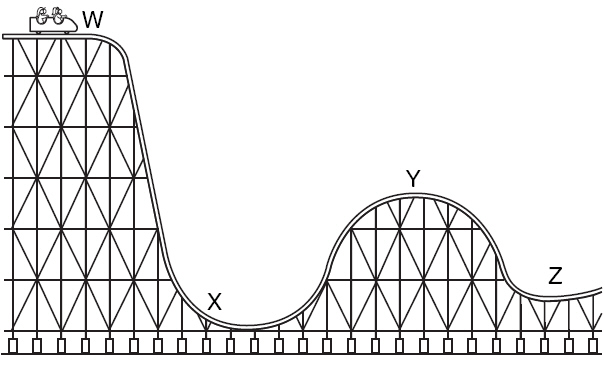
At which point is potential energy greatest?
a)
W
b)
X
c)
Y
d)
Z
35.
Which point has the most potential energy?
a)
G
b)
f
c)
b
d)
a
36.
A 0.40 kilogram bird is flying at a constant speed of 8.0 m/s. What is the bird's kinetic energy ?
a)
3.2 J
b)
4.2 J
c)
2.0 J
d)
12.8 J
37.
A 2600 kilogram car is moving at a speed of 25 m/s. How much kinetic energy does the car have?
a)
427,500 J
b)
237,500 J
c)
437,500 J
d)
537,500 J
38.
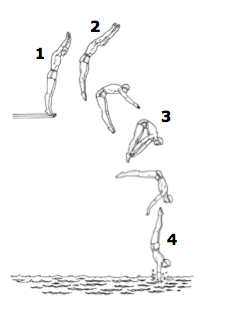
2. The diagram to the right represents a diver’s motion from the top of a high diving board into a pool of water. At what point does the diver have the greatest kinetic energy and the least potential energy?
a)
1
b)
2
c)
3
d)
4
39.
A 60.0 kg person walks from the ground to the roof of a 74.8 m tall building. How much gravitational potential energy does she have at the top of the building?
a)
43982.4 J
b)
63982.3 J
c)
43962.4 J
d)
83942.4 J
40.
A pitcher throws a 0.145 kg baseball at a velocity of 30.0m/s. How much kinetic energy does the ball have?
a)
65.35 J
b)
87.25 J
c)
23.45 J
d)
65.25 J
41.
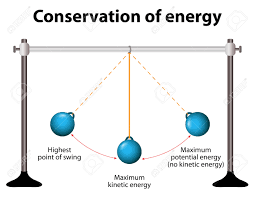
Conservation of energy states that energy cannot be ________ or ________, but can be altered from one form to another.
a)
created, destroyed
b)
gravity, force
c)
heat, created
42.
What is the unit of measurement for kinetic energy
a)
Newton
b)
Joule
c)
Watt
d)
Kilogram
43.
Which of the following is an exmaple of a change of kinetic energy into gravitational potential energy?
a)
a person parachuting out of a plane
b)
a car racing around an oval track
c)
a person skiing down a hill
d)
a person walking up a hill
44.
What would have the greatest kinetic energy?
a)
A car driving down a hill.
b)
A person running down a hill. 
c)
A ball rolling down a hill. 
d)
leaves rolling down a hill 
45.
Which is an example of potential energy?
a)
a roller coaster speeding down a hill
b)
the pulled back string on an archers's bow
c)
releasing the strings on a guitar
d)
an electric current lighting a light bulb
46.
Choose the BEST answer that is an example of an energy transformation from potential energy to kinetic energy.
a)
a ball rolling down a ramp
b)
a picture hanging on the wall
c)
a swing swaying back and forth
d)
a coat hanging on a hook
47.

Energy and work are measured in

a)

kilograms

b)

meters

c)

Joules

d)

m/s

48.
How can I gain potential energy? (choose the best answer)
a)
Run a mile
b)
Walk up the stairs
c)
Climb a mountain
d)
Go down the stairs
49.

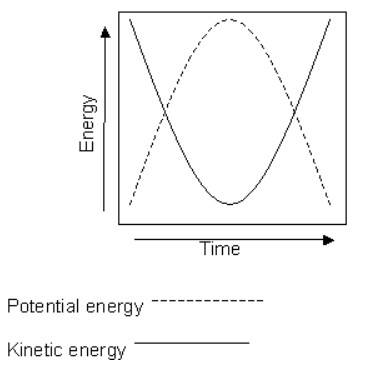
This graph depicts what type of relationship between kinetic and potential energy?

a)

Non-Linear

b)

Linear

c)

Inverse

d)

Poly-atomic

50.

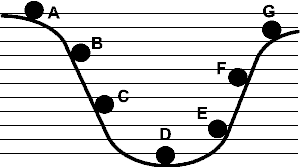
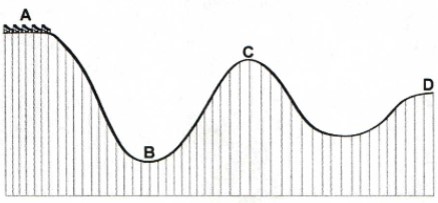
Based on the diagram of a roller coaster car on a roller coaster track, what statement is true?

a)

The car at point A has more kinetic energy than the car at point C

b)

The car at point C has less kinetic energy than the car at point B.

c)

The car at point C has more kinetic energy than the car at point B.

d)

The car at point D has less potential energy than the car at point B.

51.
What type of energy is in this picture?
a)
Kinetic
b)
Potential
c)
Chemical
d)
Sound
52.
At what position does the rock have the greatest kinetic energy?
a)
A
b)
B
c)
D
d)
E
53.

When you compress a spring, you are storing __________ energy.

a)

sound

b)

elastic

c)

light

d)

chemical

54.

How could you increase the gravitational potential energy of an object without changing its mass and gravity?

a)

Make the object larger

b)

Lower the object towards the ground

c)

Raise the object farther off the ground

d)

Allow the object to roll on the ground

55.

How could you increase the object's gravitational potential energy (GPE) without changing its distance from the ground (height) and gravity?

a)

Decrease the object's mass

b)

Increase the object's height

c)

Increase the object's mass

d)

Decrease the object's height

56.

You throw a ball into the air as shown in the diagram. At what point does the ball have the most gravitational potential energy?

a)

W

b)

X

c)

Y

d)

Z

57.

What is the potential energy of a 3kg ball that is on the ground?

a)

0 J

b)

3 J

c)

9.8 J

d)

29.4 J

58.

A 100 N force is applied to move an object a horizontal distance of 5 meters at constant speed in 10 seconds. How much power is done?

a)

50J

b)

50W

c)

500J

d)

500W

59.

What is the energy possessed by the cart?

a)

potential energy

b)

kinetic energy

c)

mostly potential

d)

mostly kinetic

60.

If the mass of the cart is 15kg, how much is the potential energy of the cart?

a)

0J

b)

1.2J

c)

6J

d)

58.8J

61.

If the mass of the cart is 8.12kg, what is the kinetic energy of the cart?

a)

0J

b)

1.2J

c)

6J

d)

58.8J

62.

How will you describe the energy at Point A?

a)

mostly potential energy

b)

mostly kinetic energy

c)

losing PE, gaining KE

d)

losing KE, gaining PE

63.
Energy of a rock perched on a cliff is an example of...
a)
gravitational
b)
elastic
c)
chemical
d)
kinetic
64.
How do you calculate power?
a)
P = W/t
b)
P = E/t
c)
P = w * t
d)
P = bbq/chicken
65.
How do we calculate work?
a)
W = F * d
b)
w = f * D
c)
W = F * D
d)
w = f * d
66.
How much work is being done with 200 N of force over 426 meters?
a)
85,200 J
b)
45,620 J
c)
90,480 J
d)
62,329 J
67.
The SI unit of work is?
a)
Joules
b)
Watts
c)
Newtons
d)
meters
68.
The energy of movement is...? 
a)
Kinetic
b)
Potential
69.
Energy that is stored is called...
a)
Kinetic
b)
Potential 
70.
The SI unit for power is...?
a)
Watts
b)
Joules
c)
Newtons
d)
Meters
71.
What is the formula for Kinetic Energy?
a)
PE = m*g*h
b)
KE = 1/2m*v2
c)
W = F*d
d)
P = W/t
72.
A force exerted over a distance to move an object is ______________________.
a)
power
b)
work
c)
momentum
d)
Watt
73.
If 150 Joules of work is needed to move a box 10 meters, what force was used? 
a)
1500 N
b)
15 N
c)
1.5 N
d)
150 N
74.
If 68 Joules were necessary to move a 4 Newton crate, how far was the crate moved?
a)
272 m
b)
17 m
c)
4.05 m
d)
272 cm 
75.
The faster an object moves, the ________ kinetic energy it has. 
a)
more
b)
less
c)
none of the above
d)
all of the above 
76.
Gravitational potential energy depends on the ________ and ________ of the object. 
a)
Height and mass
b)
Friction and movement
c)
Mass and Movement
d)
Height and Friction 
77.
Why does the total amount of mechanical energy stay constant in a system?
a)
energy is not created or destroyed
b)
energy leaves
c)
energy enters
d)
energy is not converted from one form into another
78.
What is the energy of position or shape that depends on weight and height, also called stored energy?
a)
Energy
b)
Kinetic energy
c)
Potential energy
d)
Sound energy
79.

The ability to do work or cause change:

a)

work

b)

energy

c)

momentum

d)

power

80.

A civilization that can use all the energy on it's planet is classified by physicists as a _____________ civilization

a)

Type 1

b)

Type 2

c)

Type 3

d)

Type 4

e)

Type Omega

81.

A civilization that can use all the energy in it's solar system is classified by physicists as a _____________ civilization

a)

Type 1

b)

Type 2

c)

Type 3

d)

Type 4

e)

Type Omega

82.

A civilization that can use all the energy in it's galaxy is classified by physicists as a _____________ civilization

a)

Type 1

b)

Type 2

c)

Type 3

d)

Type 4

e)

Type Omega

83.

A civilization that can use all the energy in it's local group over multiple galaxies is classified by physicists as a _____________ civilization

a)

Type 1

b)

Type 2

c)

Type 3

d)

Type 4

e)

Type Omega

84.

A civilization that can use all the energy in the universe (and more than likely created everything in the universe) is classified by physicists as a _____________ civilization

a)

Type 1

b)

Type 2

c)

Type 3

d)

Type 4

e)

Type Omega

85.

As societies get more and more advanced they demand more.......

a)

Energy

b)

Time

c)

Food

d)

material

86.

If you have mass, you have ____________.

a)

Weight

b)

Energy

c)

velocity

d)

Acceleration

87.

Work and Energy are the same.

a)

True

b)

False

88.

Which of the following equations would you use to calculate the amount of energy that would be released if the atoms of a substance were split?

a)

E = mc^2

b)

GPE = mgh

c)

F = ma

d)

W = Fd

89.

Moving objects have ____________ (hint: more than one answer is correct)

a)

kinetic energy

b)

acceleration

c)

momentum

d)

inertia