
 Worksheets
Unit 4B Test Review
Total questions: 176
Worksheet time: 3hrs 18mins

In the punnett square below, what belongs in the missing square
The genotype for a yellow plant is...

In the punnett square, what is the probability for white fur?
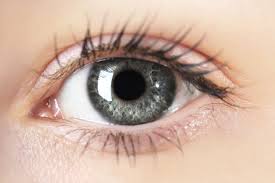


Mama Isabella has a blood type of O. Her son, Norman, has also a blood type of O. What is the blood type of Norman's father?
A
B
AB
O

If the image were real, it would represent what type of inheritance pattern?
Incomplete Dominance
Codominance
Multiple Alleles
Polygenic Inheritance

The two cows on the top are the parents and the cow on the bottom is the offspring. What is the type of inheritance pattern is being exhibited?
Incomplete Dominance
Codominance
Multiple Alleles
Polygenic Inheritance

What type of inheritance pattern does the diagram represent?
Incomplete Dominance
Codominance
Multiple Alleles
Polygenic Inheritance
In humans, the gene for curly hair (H) is incompletely dominant to the gene for straight hair (h). Individuals that are heterozygous (Hh) have wavy hair.
Two wavy-haired heterozygous parents have a child.
What is the likeliness that the child will have wavy hair?
1/4
1/2
3/4
4/4
The different forms of a gene are called ---
traits
hybrids
alleles
The blending of two traits in which one is not completely dominant over the other is known as ---
incomplete dominance
codominance

____ is an inheritance pattern that results in offspring that are a MIXTURE of the two traits of its parents, like yellow and blue flowers making green offspring.
incomplete dominance.
codominance
An inheritance pattern in which both alleles for a gene are expressed in the offspring so that both traits show up on its body is known as ---
Codominance
Incomplete dominance
What type of inheritance pattern do two alleles for a gene follow if their traits blend together on the offspring?
Incomplete dominance
Codominance

What type of inheritance pattern is shown here?
Codominance
Incomplete dominance

A calico cat shows both the traits for orange fur and black fur. What kind of allele expression is this?
Incomplete dominance
Codominance

If you cross a black chicken with a white chicken and only black AND white feathered chickens are produced, then feather color follows the inheritance pattern of ---
Incomplete dominance
Codominance

The green fish offspring in this image is an example of ---
Incomplete dominance
Codominance

This cow with brown and white spots is an example of ---
Incomplete dominance
Codominance
Snap dragon color is a incomplete dominant trait. A red flower (RR) is crossed with white flower (WW)? What color are flowers that are RW?
Red and white spotted
Red
Pink
White

A red flowered plant (RR) is crossed with a white flowered plant (WW). The gene for petal color in these plants expresses incomplete dominance. What percentage of the offspring will have pink (RW) flowers?
0%
25%
50%
100%
A tall plant (TT) is crossed with a short plant (SS). The result is a medium plant (TS). This is what type of inheritance pattern?
Incomplete dominance
Codominance

A red flowered plant (RR) is crossed with a white flowered plant (WW). The gene for petal color in these plants expresses incomplete dominance. What percentage of the offspring will have red (RR) flowers?
0%
25%
50%
100%
The hair form gene shows incomplete dominance. If your genotype is SS, you will have straight hair. If your genotype is CC, you will have curly hair. If your genotype is SC, you will have wavy hair. Mr. and Mrs. Anderson both have wavy hair (SC). What percentage of their children will also have wavy hair (SC)?
25%
50%
75%
100%

What do the phenotypes of the offspring in this Punnett square represent?
incomplete dominance
codominance

Codominance occurs in calico cats, which allows for the Black and Tan colors to show. What percentage of the offspring represented in this P square will be calico (black and tan spotted)?
25%
50%
75%
100%

Incomplete dominance occurs in cats, which allows them to be Black, White, or gray as shown on this Punnett square. What percentage of the offspring will be black?
25
50
75
100
Incomplete dominance occurs in cats, which allows them to be Black, White, or gray as shown on this Punnett square. What percentage of the offspring will be white?
25
50
0
100
Incomplete dominance occurs in cats, which allows them to be Black, White, or gray as shown on this Punnett square. What percentage of the offspring will be gray?
25
50
75
100
To determine the phenotype of the offspring
To determination the genotype of the offspring
To trace traits in families
To determine which gene is dominante
Which of the following genotypes shows a CARRIER for a trait?
XBXb
XbXb
XBXB
XbY
Colorblindness is a recessive X-linked disorder.
Which genotype represents a male with normal vision?
XN YN
Xn Yn
XN Y
Xn Y
What is 1 examples of an X-linked genetic disorder?
Huntington's Disease
Down's Syndrome
Colorblindness
Diabetes
Huntington's Disease is an autosomal dominant disorder. What would the genotype of an affected person be?
Hh
hh
HH
none of these
A gene that is located on 1 of the first 44 chromosomes is called _____.
autosomal
x-linked
dominant
recessive


Colorblindness is more common in males than in females because......
fathers pass the allele for colorblindness to their sons only
the allele for colorblindness is located on the Y chromosome
the allele for colorblindness is recessive and located on the X chromosome
males who are colorblind have two copies of the allele for colorblindness
Colorblindness is a recessive X-linked disorder.
Which genotype represents a male with normal vision?
XN YN
Xn Yn
XN Y
Xn Y
whether the father's sperm contains an x or y chromosome
whether the mother's egg contains an x or y chromosome
the age of the parents
whether the mother's egg contains an xx or xy
What would the genotype be of a colorblind male?
XNY
XNYn
XnY
XnYn
How many recessive genes does a carrier female have for colorblindness?
1
2
0
3
Colorblindness is a sex-linked recessive trait. A colorblind woman marries a male with normal color vision. What is the percent chance of them having a color blind son?
0%
25%
50%
75%
The woman who is colorblind marries a man with normal vision. What is the probability that their sons will be colorblind?
0%
25%
50%
100%

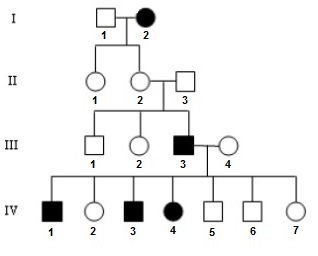
8
5
2
3

Which best explains why males cannot be carriers of X-linked traits?
Males only have one X chromosome
Males have two copies of the X chromosome
Males can be heterozygous for a particular trait
Males do not have an X chromosome
A woman who is a carrier for the sex-linked trait hemophilia has children with a man with hemophilia. What percentage of offspring would be expected to have hemophilia?
0%
25%
50%
75%


If one of your parents is blood type A and the other is type B, which of the following blood types could you be?
O
AB
A or B
Any of these

On a pedigree, this symbol represents a ---
not affected female.
not affected male.
affected male.
affected female.

How many individuals are there in the 3rd generation?
1
2
4
6

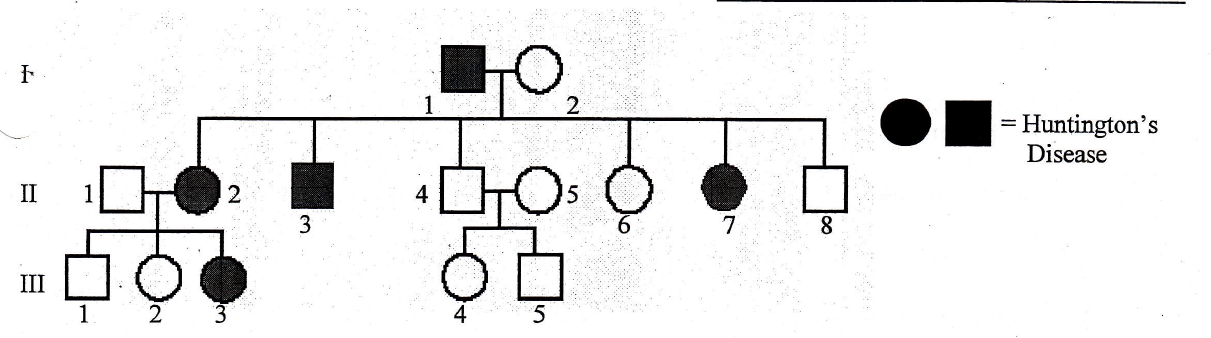


Generation 2 individuals 5 and 6 are
brother and sister.
cousins.
married.
not related.

What is the gender of this person?
Male
Female

What syndrome does this person have and what is their gender?
Male
Female
Edwards
Patau
Downs
How many alleles does a person carry for a trait?
1
2
3
4
How many alleles does a child get from each parent for a trait?
1
2
3
4
Dominant alleles are represented by a ---
capital letter.
lowercase letter.
Aa, DD, Bb, yy are all examples of ---
genotypes.
phenotypes.
In a heterozygous genotype, the _____ allele takes over in the phenotype.
recessive
dominant
both
What you see, or the physical appearance of an organism, is called the ---
genotype.
phenotype.
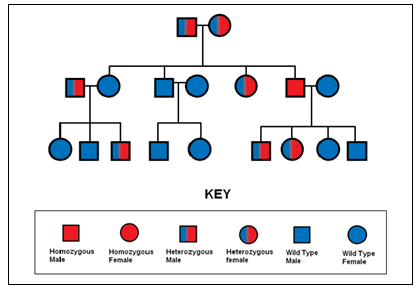
In a pedigree, which shape represents a male?
circle
square
Which gender has an X and a Y chromosome?
male
female
On a pedigree, this symbol represents a ---
not affected female.
not affected male.
affected male.
affected female.

On a pedigree, this symbol represents a ----
not affected male.
not affected female.
affected male.
affected female.
How many individuals are there in the 3rd generation?
1
2
4
6

How are individuals III-2 and II-4 related?
Brother and sister
Dad and daughter
Uncle and niece
Grandfather and granddaughter

What is the mode of inheritance shown here?
Recessive because it "skips" a generation
Dominant because it shows up in every generation

In the second generation of this pedigree, how many people are carriers of the trait? *Remember: a carrier does not have the disorder/disease, but can pass it on to his/her children.
1
2
3
5

On this pedigree, the allele for curly hair is dominant. The couple labeled 2 both have curly hair, but have a daughter who does not have curly hair. Therefore, we can tell from the chart that for the couple labeled 2 -
the male is heterozygous and the female is heterozygous.
the male is homozygous recessive and the female is homozygous dominant.

Why do all the daughters in Generation II carry the colorblind gene?
Because mom passed on the gene.
Because dad passed on the X chromosome.

The trait this pedigree traces is recessive because it skips a generation and individuals can be carriers. What is the most likely genotype for person III-3?
GG
Gg
gg

Which individual in the first generation is a carrier?
I-1
I-2
If this pedigree shows a recessive disorder, what MUST the genotype of individual II-3 be?
HH
Hh
hh


Where does transcription take place?
mitochondria
ribosome
nucleus
cytoplasm


Protein synthesis (Translation) is important because it __________.
Converts mRNA into a protein
Copies the genetic information in DNA
Produces RNA from DNA molecules
Recycles tRNA molecules for reuse
Where does protein synthesis (translation) take place?
in the nucleus
in the cytoplasm on ribosomes
in the chloroplasts
in the mitochondria

What is the term for a three nucleotide sequence that codes for an amino acid? For example: AUG
Nitrogen base
Codon
Anticodon
Phosphate group


Name this structure
double helix
nucleotide
twisted ladder
hydrogen bond
Which of the following is correct?
Proteins are made of nucleotides
Nucleic acids are of amino acids
Proteins are made of amino acids
Mutations are
changes in DNA
changes in RNA
changes in amino acids
changes in tRNA
DNA molecule segment is : TTACGCAAG
The mutated DNA segment is TTACGCAAC. This is an example of ___ mutation.
Base Substitution
Base Insertion
Base Deletion
ATTTGAGCC- Original
ATTGAGCC - Mutated
The example above is an example of a
Insertion- Frameshift
Substitution
Deletion -Frameshift
Which of the following is true about mutations?
Mutations are always harmful.
Mutations are always helpful.
Mutations can be helpful, harmful, or neutral.
Mutations always have no effect on the protein.
In RNA, adenine binds with ?
thymine
uracil
cytosine
guanine
The process of making mRNA from DNA is called?
replication
translation
transcription
duplication
mRNA is made in the ?
nucleus
ribosome
mitochondria
cytoplasm
The actual decoding of mRNA to a protein is called ?
translation
replication
transcription
nuclear fission
What organelle does the mRNA attach to in order to make the protein?
ribosome
mitochondria
chloroplast
lysosome
mRNA is made from what?
proteins
DNA
mitochondria
Sugar
The mutated DNA segment is TTCGCAAG. This is an example of ___ mutation.
T-G-A-C-C-A
T-G-A-G-C-A
GAG-CTC-GAC-AGA
Mutant
GAG CTC-CAC-AGA
AGA-TTC-ATA-GCG
Mutant-
AGA-TTC-AAT-AGC-G
The mutated DNA segment is TTACGCAAC. This is an example of ___ mutation.
The mutated DNA segment is TTCGCAAG. This is an example of ___ mutation.
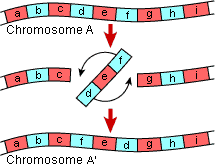
ATTGAGCC - Mutated
The example above is an example of a
A mutation in which only one nucleotide is altered is called a:
Frameshift Mutation
Deletion Mutation
Point Mutation
Insertion Mutation
A mutation is defined as:
A change in the cell's structure
Anything that changes in an embryo
Any change in the physical features of a human
A change in the DNA sequence
Genetic mutations can be...
beneficial, harmful, or neutral
beneficial only
harmful only
neutral only


Why are insertion and deletion mutations so harmful?
They change all of the codons from the mutation on down the line, which changes the amino acid sequence
They insert things that an organism doesn't need.
They often delete things that organisms need.
Insertion and deletions are not any more harmful than substitution mutations.
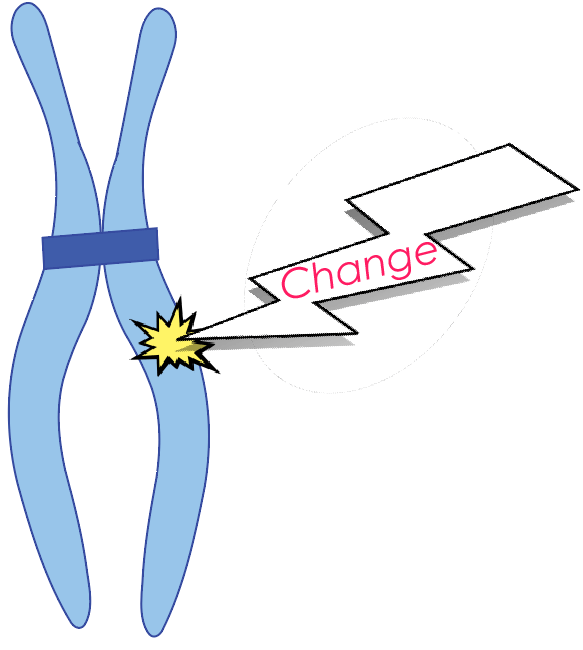
A change in a gene, group of genes or chromosome that results in a change in the proteins
Replication
Mutations
Translation
Transcription
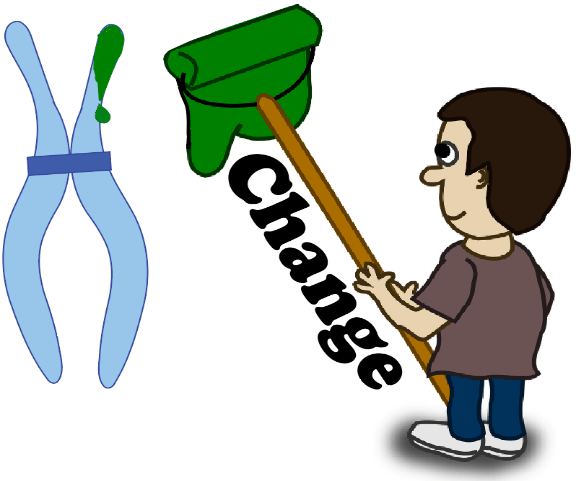
Mutations that involve parts of or all of
a chromosome
Replication
Deletion Mutation
Chromosomal Mutation
Transcription

Part of a chromosome
is deleted
Deletion Mutation-Gene
Translocation
Deletion Mutation -Chromosomal
Crossing Over

Part of a chromosome is repeated
Gene Mutation
Point Mutation
Deletion Mutation
Duplication Mutation
WHAT DOES MEIOSIS CREATE?
CHROMOSOMES
GAMETES
DNA
TRAITS
MEIOSIS IS NEEDED BECAUSE...
IT ACTUALLY ISN'T, BUT CAN BE HELPFUL IN SOME ORGANISMS
TO REDUCE THE CHROMOSOME NUMBER BY HALF
SO THAT EVERY CELL IS EXACTLY IDENTICAL
TO MAKE SURE EVERY HUMAN CELL HAS 92 CHROMOSOMES
THE END RESULT OF MEIOSIS IS...
FOUR UNIDENTICAL GAMETES
FOUR IDENTICAL GAMETES
TWO IDENTICAL GAMETES
TWO UNIDENTICAL GAMETES
THE GAMETES ARE CONSIDERED TO HAVE ONE HALF OF THE GENETIC INFO SO IT IS CALL
DIPLOID (2N)
DIPLOID (N)
HAPLOID (2N)
HAPLOID (N)
THE STRUCTURE THAT CONTAINS THE DNA IS CALLED (CHOOSE THE MOST SPECIFIC ANSWER)
CHROMOSOME
CELL BODY
CELL
NUCLEUS
MALE GAMETE IS KNOWN AS
EGG
SPERM
A FEMALE GAMETE IS KNOWN AS
EGG
SPERM
HOW MANY CHROMOSOMES DO HUMAN GAMETES HAVE?
46
23
47
22
CROSSING OVER ALLOWS FOR WHAT TO HAPPEN?
ALL CELLS TO STAY THE SAME
GENETIC VARIATION
REDUCTION OF CHROMOSOMES
CHROMOSOME NUMBER TO INCREASE
WHEN THE SPERM FERTILIZES THE EGG WHAT IS FORMED
ZYGOTE
EMBRYO
FETUS
FERTILIZATION
FERTILZATION IS ...
THE FUSION OF A HAPLOID EGG AND SPERM
THE FUSION OF A DIPLOID EGG AND SPERM
THE FUSION OF A HAPLOID EGG AND DIPLOID SPERM
THE FUSION OF TWO EGGS
WHY ARE THE CHROMOSOMES EVEN NUMBERED FOR ORGANISIMS?
JUST A COINCIDENCE
BECAUSE 75% OF THE INFO COMES FROM MOM AND 25% COMES FROM DAD
BECAUSE 51% OF THE INFO COMES FROM MOM AND 49% COMES FROM DAD
BECAUSE HALF OF THE GENTIC INFORMATION COMES FROM MOM AND HALF COMES FROM DAD

THIS IMAGE SHOWS WHAT IS HAPPENING WITH THE CHROMOSOMES?
NON- DISJUNCTION
METAPHASE
TELOPHASE
CROSSING OVER
The idea of non-disjunction of the 21st chromosome means the following:
complete seperation of chromosomes
complete seperation of genes
failure for chromosomes to seperate
failure for genes to seperate
To find out how much variation an organism with a diploid number of 20 chromosomes would have you would need to do the following
20^2
2^10
2^20
10^2
Chromosomes assort independantly, not genes because of the following
The chromosomes contain the genes, genes can't leave the chromosome
The genes contain the chromosomes
It depends on the sex of the offspring
In sexual selection of most organisms the genes will be directed by the DNA to assort independantly

Explain the karyotype of this individual
Male - no genetic defect
Male - Down's Syndrome
Female - no genetic defect
Female - Down's Syndrome

