wayground logo

Free Printable Worksheets

Font size

S
M
L
XL
Worksheets

Biology AIR Test Review

Total questions: 175

Worksheet time: 2hrs 21mins

Name
Class
Date
1.

Which of the following are conditions for Hardy-Weinberg equilibrium? (select all that apply)

a)

No mutations

b)

Random mating

c)

No natural selection

d)

Gene flow

e)

Small population size

2.

What does the Hardy-Weinberg principle allow scientists to determine?

a)

changes in allele frequencies in a population

b)

numbers of mutations in a population

c)

evolution of individuals

d)

genetic diversity within a community

3.

If a population is in Hardy-Weinberg equilibrium, it is NOT evolving.

a)

True

b)

False

4.

Which of the following are mechanisms for evolution because they violate Hardy-Weinberg equilibrium?

a)

gene flow

b)

genetic drift

c)

natural selection

d)

large population size

e)

random mating

5.
What is another name for natural selection?
a)
survival of the smartest
b)
survival of the fastest
c)
survival of the biggest
d)
survival of the fittest
6.

What is a feature of an organism that allows it to survive and reproduce in its environment?

a)

homologous

b)

vestigial

c)

variation

d)

adaptation

7.
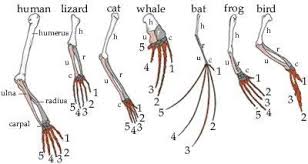
What is this an example of?
a)
vestigial structures
b)
embryology
c)
homologous structures
d)
fossil record
8.

When the DNA of an organism is altered, it is referred to as…

a)

mutation

b)

gene flow

c)

genetic drift

d)

sexual selection

9.

The cause of artificial selection is…

a)

the environment

b)

humans

c)

mutation

d)

gene flow

10.
Which of the following is NOT an example of natural selection? 
a)
People selectively breeding hamsters.
b)
Insect populations developing resistance to certain pesticides.
c)
Bacteria becoming resistant to antibiotics.
d)
Male birds of certain species developing colorful feathers to attract female mates.
11.

Two organisms that are closely related would have

a)

very similar DNA sequences

b)

exactly the same DNA sequences

c)

no proteins in common

d)

completely different DNA sequences

12.
Structures with the same parts have different functions; suggests that organisms share a common ancestry
a)
vestigial structures
b)
homologous structures
c)
adaptive radiation
d)
fossil
13.
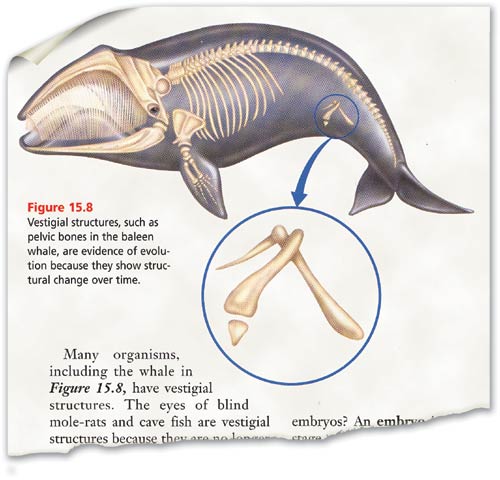
Which of the following is an example of a vestigial structure?
a)
the wings of a red-tailed hawk
b)
the hind limbs of a house cat
c)
the fins of sharks
d)
the tailbone of a human
14.

Which of the following is a term for a group of similar organisms that can interbreed and produce fertile offspring?

a)

individual

b)

population

c)

species

d)

fossil

15.

Why are advantageous traits more likely to be passed onto offspring?

a)

Because the parents are more likely to survive and reproduce.

b)

Because they come from dominant alleles.

c)

Because they come from recessive alleles.

d)

Because the traits are acquired phenotypes.

16.

This term describes the ability of an organism to survive and reproduce in its specific environment.

a)

diversity

b)

evolution

c)

adaptation

d)

fitness

17.

All of the meerkats that live in the same place at the same time make up a ____________.

a)

Community

b)

Ecosystem

c)

Population

d)

Biosphere

18.

______________ is all of the living and nonliving things in a given area.

a)

A population

b)

A community

c)

An ecosystem

d)

The biosphere

19.

All of the populations in a given area make up a ____________.

a)

community

b)

habitat

c)

ecosystem

d)

species

20.

Anything that restricts the size of a population is a ________________________.

a)

biotic potential

b)

carrying capacity

c)

species

d)

limiting factor

21.

What is a group of organisms that have similar traits and are able to produce fertile offspring?

a)

community

b)

population

c)

species

d)

competition

22.
Where the better adapted organisms survive to pass traits along to offspring.
a)
Evolution
b)
Natural Selection
c)
Extinction
d)
Artifical Selection
23.
Individuals that are well adapted to their environment will survive and produce:
a)
Fewer mutations
b)
Stronger genes
c)
More offspring
d)
Better traits
24.
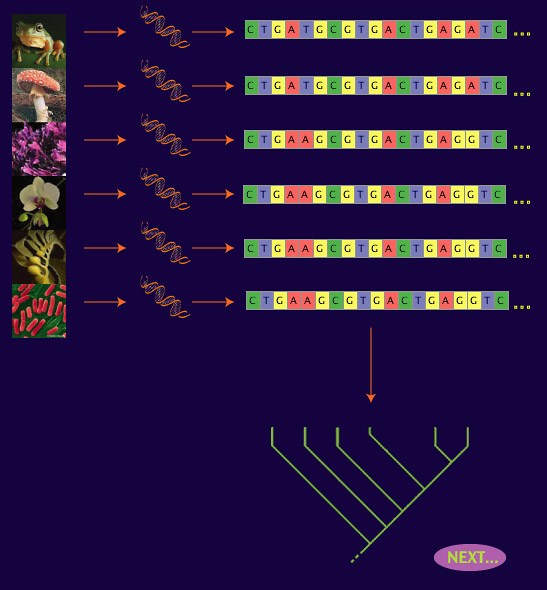
You look at two species and see very similar DNA. What does this likely tell you?
a)
These are the same animal.
b)
These animals have a common ancestor.
c)
These animals are not likely related.
d)
These animals are likely becoming one species.
25.
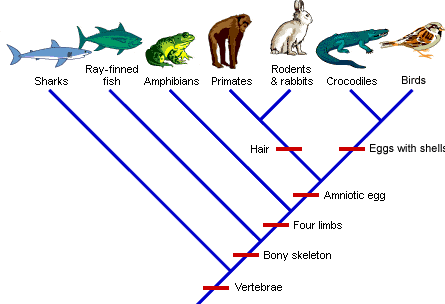
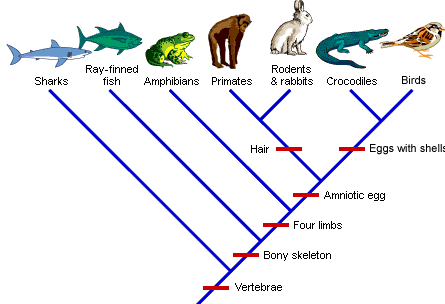
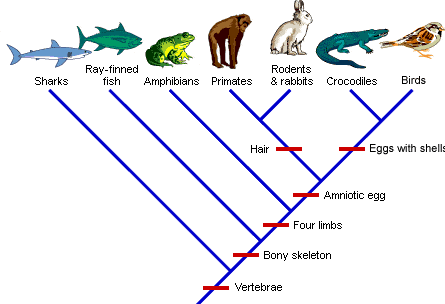
According to this cladogram, sharks are MOST closely related to which organism? 
a)
Amphibians
b)
Ray finned fish
c)
Crocodiles
d)
Birds
26.
Which two orgainsms have hair? 
a)
Sharks & Ray Finned Fish
b)
Primates & Rodents
c)
Birds & Crocodiles
d)
Rabbits & Birds
27.
According to this cladogram, birds are LEAST related to: 
a)
Amphibians
b)
Sharks
c)
Ray Finned Fish
d)
Crocodiles
28.
What does a food web represent?
a)
All connections of energy flow throughout all organisms in a habitat.
b)
The specific ways that mutualism is carried out.
c)
A single pathway or energy flow between organisms. 
d)
How carnivores get their food. 
29.
The energy at each trophic level in the pryamid of energy decreases by a factor of ____.
a)
10
b)
1
c)
100
d)
2
30.
What is the term for each step in the transfer of energy and matter within a biological community?
a)
energy path
b)
food web
c)
trophic level
d)
food pyramid
31.
What is the original source of almost all energy in most ecosystems?
a)
carbohydrates
b)
sunlight
c)
water
d)
carbon
32.
Non-living factor that affects an ecosystem
a)
biotic factor
b)
abiotic factor
c)
food chain 
d)
biome
33.
Green plants are
a)
producers
b)
consumers
c)
herbivores
d)
omnivores
34.
As resources in a population become less available, population growth
a)
declines rapidly
b)
increases slowly
c)
reaches carrying capacity
d)
enters a phase of exponential growth
35.
If the death rate of a population is greater than the birthrate, the population shrinks.
a)
True
b)
False
36.
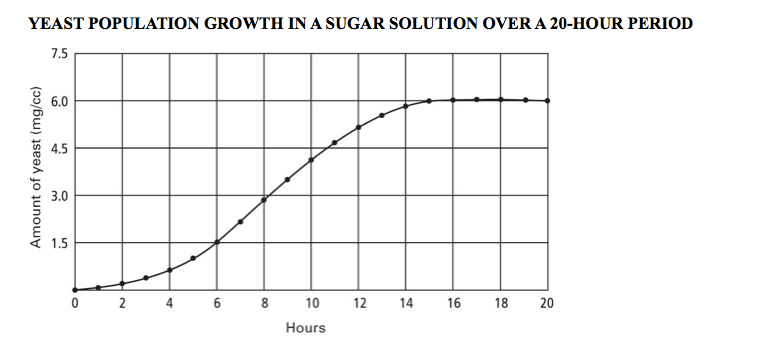
What type of growth model is this?
a)
exponential growth model
b)
logistic growth model
c)
Type I curve
d)
Type III curve
37.
Carrying Capacity is
a)
the capacity of what one person can carry per day 
b)
how many animals you have in your daily bag limit at the end of the year
c)
wildebeest at a watering hole with zebras
d)
the maximum number of individuals that the environment can support
38.
How can a populaiton grow?
a)
Emigration and death
b)
Immigration and death
c)
Immigration and birth
d)
Emigration and birth
39.
Is a fungal infection in frogs considered biotic or abiotic?
a)
biotic
b)
abiotic
40.
What type of growth is shown on this graph?
a)
logistic
b)
exponential
c)
average
d)
density-independent
41.

Which of the following is a density-independent limiting factor?

a)

natural disaster

b)

predation

c)

disease

d)

parasitism

42.
What pattern of growth will a population with limited resources show?
a)
density-dependent
b)
exponential 
c)
logistic
d)
logical 
43.
Diseases may spread more rapidly when an area is crowded, so disease is considered to be a
a)
type I survivorship curve
b)
population crasher
c)
density-dependent limiting factor
d)
population enhancer
44.

What usually makes a species invasive?

a)

Moving to a new ecosystem and taking resources from natives

b)

Overusing space

c)

Species that can't adapt

d)

Plants that take up too much space

45.
The process when concentrations of a harmful substance increases in organisms at higher trophic levels in a food chain or food web.
a)
Biomagnification
b)
Predation
c)
Extinction
d)
Accumulation
46.
The  number of individuals a habitat can sustain with the resources it has available
a)
Carrying capacity
b)
Limiting factors
c)
Resources
d)
Population
47.
What human activity affects the environment in such a way that algae blooms increase?
a)
agriculture
b)
fertilizer run off increases nutrients in ground water
c)
people contaminating fresh water sources
d)
all of the above
48.

The processes where excess nitrogen enter a body of water causing overgrowth of algae is called _______.

a)

Run-off and algal bloom

b)

Acid Precipitation and aquatic fertilization

c)

Nitrogen Fixation and dead zone

d)

Decomposition and recycling

49.
Has membrane bound organelles
a)
Prokaryote
b)
Eukaryote
c)
both
50.
Oldest type of cell
a)
Prokaryote
b)
Eukaryote
c)
both
51.
Smaller
a)
Prokaryote
b)
Eukaryote
c)
both
52.
Has Mitochondria
a)
Prokaryote
b)
Eukaryote
c)
both
53.

Which has ribosomes?

a)

Prokaryote

b)

Eukaryote

c)

both

54.
Has cytoplasm
a)
Prokaryote
b)
Eukaryote
c)
both
55.
Has nucleus
a)
Prokaryote
b)
Eukaryote
c)
both
56.
Bacteria
a)
Prokaryote
b)
Eukaryote
c)
both
57.
Has chloroplast
a)
Prokaryote
b)
Eukaryote
c)
both
58.
Which type of cell?
a)
Prokaryote
b)
Eukaryote
59.
Plants and animal cells are examples of ___ cells 
a)
prokaryotic cells 
b)
eukaryotic cells 
60.
Chromosome movement in mitosis and meiosis is regulated by
a)
microtubules
b)
microfilaments
c)
intermediate filaments
d)
All of thiese
61.
phospholipid bilayer controlling what enters and exits all cells
a)
Cell Wall
b)
Cell Membrane
c)
Cytoplasm
d)
Cytoskeleton
62.
rigid structure that provides support and protection to plant, bacterial, and fungal cells
a)
Cell Wall
b)
Cell Membrane
c)
Cytoplasm
d)
Cytoskeleton
63.
jelly-like substance housing the organelles and providing a medium for chemical reactions
a)
Chloroplast
b)
Cytoskeleton
c)
Cytoplasm
d)
Centriole
64.
contains the DNA of eukaryotic cells and controls cellular activities
a)
Mitochondria
b)
Cytoplasm
c)
Centriole
d)
Nucleus
65.
Made of microtubules and microfilaments that provide shape to the cell 
a)
Cytoplasm
b)
Cytoskeleton
c)
Cell Membrane
d)
Cell Wall
66.
Generates cellular energy (ATP) through the process of cellular respiration
a)
Chloroplast
b)
Centriole
c)
Mitochondrion
d)
Golgi Apparatus
67.

Carries out protein synthesis

a)

Golgi body

b)

Centriole

c)

Mitochondria

d)

Ribosome

68.
Sorts, packages, and ships proteins to their final destination
a)
Ribosome
b)
Lysosome
c)
Endoplasmic Reticulum
d)
Golgi Apparatus
69.
Site of photosynthesis
a)
Centriole
b)
Chloroplast
c)
Cytoplasm
d)
Cytoskeleton
70.

Site of protein AND lipid synthesis

a)

Ribosome

b)

Lysosome

c)

Endoplasmic Reticulum

d)

Golgi Apparatus

71.

How do enzymes speed up chemical reaction?

a)

Increasing activation energy

b)

Decreasing activation energy

c)

Increasing deactivation energy

d)

Decreasing deactivation energy

72.
What is a substance called if it speeds up a chemical reaction?
a)
reusable
b)
catalyst
c)
specific
d)
fragile
73.
Any substance that is acted upon by an enzyme is called a(n)?
a)
Coenzyme
b)
Substrate
c)
Vitamin
d)
Polypeptide
74.
Enzymes are...
a)
nucleic acids
b)
proteins
c)
lipids
d)
carbohydrates
75.
What happens when enzymes are heated to a high temperature?
a)
The enzymes die.
b)
The shapes of the enzyme are altered denature
c)
The enzymes' amino acid sequence changes.
d)
The enzymes remain the same
76.
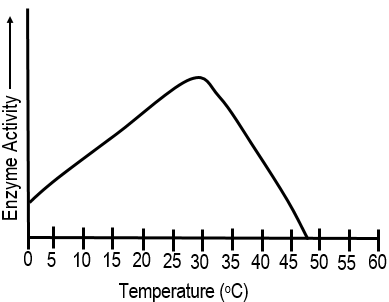
Based on the graph, what is the optimal temperature for this enzyme? 
a)
15oC
b)
40oC
c)
30oC
d)
35oC
77.
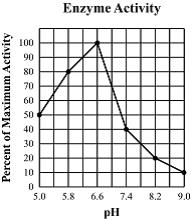
Which of the following conclusions can be drawn from this graph?
a)
The optimum pH of the enzyme is 6.6.
b)
The optimum pH of the enzyme is 5.8
c)
The enzyme’s activity increases as pH increases 5.0 to 9.0
d)
The enzyme’s activity is greater around pH of 8.0 .
78.
DNA and RNA are examples of 
a)
Carbohydrates
b)
Lipids
c)
Proteins
d)
Nucleic Acids
79.
Waxes, oils and fats are examples of
a)
Carbohydrates
b)
Lipids
c)
Proteins
d)
Nucleic Acids
80.
What is the function of nucleic acids?
a)
store genetic information
b)
store energy (long-term)
c)
store energy (short-term)
d)
build skin, hair, nails, muscles
81.
Which of the following organic compounds is the main source of energy for living things?
a)
carbohydrates
b)
lipids
c)
nucleic acids
d)
proteins
82.
Which macromolecule stores energy, insulates us, and makes up the cell membrane?
a)
lipids
b)
proteins
c)
carbohydrates
d)
nucleic acids
83.
This is one job proteins do NOT have in the body
a)
insulation
b)
structure for tissues and organs
c)
speed up chemical reactions
d)
transport things through cell membrane
84.
Which macromolecule is made of simple and complex sugars?
a)
lipids
b)
proteins
c)
carbohydrates
d)
nucleic acids
85.
How does a cell maintain homeostasis?
a)
Regulates what enters and leaves the cell
b)
Flexibility
c)
Protective barrier
d)
Structure and support
86.
Controlling what goes into or out of the cell without energy is called
a)
active transport
b)
endocytosis
c)
passive transport
d)
exocytosis
87.
What is it called when molecules move across the cell membrane from an area of high concentration to an area of low concentration through a carrier protein?
a)
Diffusion
b)
Osmosis
c)
Active Transport
d)
Facilitated Diffusion
88.
Two examples of passive transport are
a)
Earth and Sun
b)
Diffusion and Osmosis
c)
Energy and Wind
d)
None of the above
89.
Most active transport proteins use energy from the breakdown of:
a)
nucleus
b)
cell membrane
c)
ATP
d)
mitochondria
90.
The movement of molecules against a concentration gradient
a)
simple diffusion
b)
facilitated diffusion
c)
active transport
d)
osmosis
91.
This picture represents what type of cell transport?
a)
endocytosis
b)
exocytosis
c)
osmosis
d)
passive transport
92.
ALL living cells have this in common
a)
Nucleus
b)
Cell Membrane
c)
Cell Wall
d)
Mitochondria
93.

A cell will _____________________ in a solution that contains a higher concentration of solute than what is in the cell (hypertonic solution).

a)

swell

b)

shrink

c)

not change in size

94.

A cell will __________________ when placed in a solution with a smaller solute concentration than what is in the cell (hypotonic solution).

a)

swell and perhaps burst

b)

shrink

c)

not change in size

95.

Moving "big stuff" out of the cell in vesicles

a)

Endocytosis

b)

Exocytosis

c)

Diffusion

d)

Osmosis

96.

A cell will _____________________ in a solution that contains an equal concentration of solute compared to what is in the cell.

a)

swell

b)

shrink

c)

not change

d)

explode

97.

Select all of the following molecules that could move into or out of the cell through the phospholipid bilayer.

a)

Na+

b)

CO2

c)

H2O

d)

O2

e)

Glucose

98.

Select any of the following molecules that could move into or out of the cell by facilitated diffusion.

a)

Na+

b)

CO2

c)

H2O

d)

O2

e)

Glucose

99.

Select any of the following molecules that could move into or out of the cell by active transport.

a)

Na+

b)

CO2

c)

H2O

d)

O2

e)

Glucose

100.

Which characteristic is most likely to influence if/how a molecule moves through the cell membrane?

a)

Size

b)

Shape

c)

Color

101.
The reactants of photosynthesis are
a)
sugar and water.
b)
sugar and oxygen.
c)
carbon dioxide and water.
d)
carbon dioxide and oxygen.
102.
What are the products of photosynthesis?
a)
Carbon dioxide and water
b)
Carbon dioxide and oxygen
c)
Glucose and oxygen
d)
Glucose and water
103.
What pigment absorbs sunlight for photosynthesis?
a)
chloroplast
b)
thylakoid
c)
grana
d)
chlorophyll
104.
Which of the following is the correct equation for PHOTOSYNTHESIS?
a)
6CO2 + 6H2O --> 6O+ C6H12O6
b)
6CO+ C6H12O6 + 6H2O --> O
c)
6O2 + 6H2O --> 6CO+ C6H12O6
d)
C6H12O6 + 6O2 ---> 6H2O + 6CO2 
105.
Which gas is removed from the atmosphere during photosynthesis?
a)
hydrogen
b)
oxygen
c)
nitrogen
d)
carbon dioxide
106.
What is the function of NADPH and ATP?
a)
They absorb light
b)
They power the light-dependent reactions
c)
They are light-reflecting pigments
d)
They are short term energy carriers
107.
Which of the following best describes photosynthesis?
a)
Photosynthesis converts radiant energy into chemical energy.
b)
Photosynthesis produces carbohydrates.
c)
Plants need sunlight, carbon dioxide, water, nutrients, and chlorophyll to complete photosynthesis.
d)
Plants use chlorophyll, water, and carbon dioxide to make sugar.
108.

All living things do which of the following?

a)

Chemosynthesis

b)

Respiration

c)

Photosynthesis

d)

All of the above

109.

______________ produces the most ATP.

a)

Photosynthesis

b)

Aerobic respiration

c)

Anaerobic respiration

d)

Glycolysis

110.
What are the products of aerobic respiration?
a)
Glucose and oxygen
b)
Carbon dioxide and water
c)
Lactic acid
d)
Carbon monoxide
111.
What type of respiration requires oxygen?
a)
Aerobic
b)
Anaerobic
112.
What is the correct equation for cellular respiration?
a)
6O2 + C6H12O6 -> 6CO2 + 6H2O + Energy
b)
6O2 + C6H12O6 + Energy -> 6CO2 + 6H2O
c)
6CO2 + 6H2O -> 6O2 + C6H12O6 + Energy
d)
6CO2 + 6H2O + Energy -> 6O2 + C6H12O6
113.
What is cellular respiration?
a)
the breakdown of glucose  to release ATP
b)
the breakdown of glucose to release NADH
c)
the breakdown of glucose to release FADH
d)
the breakdown of glucose to release carbon
114.
Which process produces CO2 as a waste product?
a)
Lactic Acid Fermentation
b)
Ethanol (Alcoholic) Fermentation
115.
Fermentation is:
a)
Cellular Respiration 
b)
Photosynthesis
c)
Aerobic
d)
Anaerobic
116.
I have 2 X chromosomes. What am I?
a)
Male
b)
Female
117.
I have 1 X chromosome and 1 Y chromosome. What am I?
a)
Male
b)
Female
118.
A male beetle has the genotype Ttbb. If this beetle mates with a female with genotype TTBb, what is the chance their offspring will have the genotype TtBb?
a)
12.5%
b)
25%
c)
50%
d)
75%
119.
Cross Two Homozygous plants
(
RRYY x rryy)
R = round seeds, r  = wrinkled seeds Y = yellow seeds, y = green seeds
What percent will have Round and Yellow seeds? 
a)
0%
b)
25%
c)
50%
d)
100%
120.
The red and blue pair of chromosomes in the bottom row are
a)
genetically identical
b)
carrying the same  genes, but different alleles
c)
carrying completely different genes
d)
carrying the same genes and the same alleles
121.
Homologous chromosomes will have similar genes on them. However, they could have different versions of these genes. These different versions are called...
a)
Mutants
b)
Recombinants
c)
Alleles
d)
Mendel's code
122.
This produces 2 identical cells.
a)
mitosis
b)
meiosis
123.
The cells produced via meiosis are called:
a)
sex cells
b)
somatic cells
c)
body cells
d)
skin cells
124.
What causes genetic variation in meiosis?
a)
chromosomes lining up
b)
crossing over of chromosomes
c)
separation of chromosomes
d)
chromosomes pulling apart
125.
When an area of a chromatid is exchanged with the matching area on a chromatid of its homologous chromosome, _________________ occurs
a)
crossing over
b)
mutagenesis
c)
hybridization
d)
fertilization
126.
Which process and type of resulting cells are represented?
a)
mitosis, gametes
b)
mitosis, body cells
c)
meiosis, gametes
d)
meiosis, body cells
127.
The chromosomes that pair up during meiosis, are called __________ chromosomes.  
a)
homozygous 
b)
asexual
c)
homologous
d)
genes
128.
Crossing over helps promote 
a)
male genotype
b)
genetic variation
c)
DNA replication
d)
mitosis
129.
What type of inheritance is determined by multiple genes located at different loci on different chromosomes and there can be a range of traits?
a)
Codominance
b)
Incomplete dominance
c)
Polygenic traits
130.

B = Black, b = Chocolate. Some labs inherit black or brown fur alleles but have light fur. This graphic shows an example of...

a)

Codominance

b)

Epistasis

c)

Mendelian Dominance

d)

Polygenic inheritance

131.

Crossing two parent organisms that are BOTH heterozygous for two different traits will result in an offspring ratio of

a)

9:3:3:1

b)

3:1

c)

6:2:6:2

d)

1:1

132.

A gene is a section of DNA that codes for a(n)

a)

protein

b)

allele

c)

channel

d)

receptor

133.

Autosomal traits are those that

a)

are coded on X and Y chromosomes

b)

are coded on numbered (non-sex) chromosomes

c)

are encoded by dominant alleles

d)

are encoded by recessive alleles

134.

Which of the following describes an inheritance pattern that occurs when one gene influences multiple phenotypic traits?

a)

Polygenic traits

b)

Multiple alleles

c)

Epistasis

d)

Pleiotropy

135.

Which of the following is an inheritance pattern in which one gene modifies or masks the expression of another gene?

a)

Polygenic traits

b)

Multiple alleles

c)

Epistasis

d)

Pleiotropy

136.

Sex-linked traits are those that

a)

are coded on X and Y chromosomes

b)

are coded on numbered (non-sex) chromosomes

c)

are encoded by dominant alleles

d)

are encoded by recessive alleles

137.

Which inheritance pattern is characterized by heterozygotes displaying a blended or intermediate phenotype?

a)

Multiple alleles

b)

Codominance

c)

Incomplete dominance

d)

Polygenic traits

138.

Which inheritance pattern is characterized by heterozygotes displaying both allelic phenotypes at the same time?

a)

Multiple alleles

b)

Codominance

c)

Incomplete dominance

d)

Polygenic traits

139.

Fathers pass X chromosomes to their

a)

sons

b)

daughters

c)

sons and daughters

140.

Mothers pass X chromosomes to their

a)

sons

b)

daughters

c)

sons and daughters

141.
Which sequence of DNA bases would be complementary to this partial strand?
ATG TGA CAG
a)
ATG TGA CAG
b)
TAC ACT GTC
c)
GTA AGT GAC
d)
CAT TCA CTG
142.
Which of the following best describes a DNA molecule?
a)
double helix
b)
contains ribose
c)
made of amino acids
d)
contains uracil
143.
In a molecule of double-stranded DNA, the amount of adenine present is always equal to the amount of
a)
cytosine
b)
guanine
c)
thymine
d)
uracil
144.
Guanine bonds with ______________.
a)
Adenine
b)
Guanine
c)
Cytosine
d)
Thymine
145.
DNA replication results in two DNA molecules,
a)
each one with two original strands
b)
each one with two new strands
c)
each one with one new strand and one original strand
d)
one with two new strands and the other with two original strands
146.
This image shows that DNA Replication is _______.
a)
Conservative
b)
Semiconservative
c)
Dispersive
d)
Spontaneous
147.
What is a change in DNA sequence?
a)
nucleotide
b)
mutation
c)
mutagen
d)
unfortunate
148.
Which RNA bases would pair with TACGAA in transcription
a)
AUGCUU
b)
ATGCTT
c)
GCATCC
d)
GCAUCC
149.
We know that the results of mutations can be partially functioning proteins, nonfunctional proteins, or no protein at all.  Which of the following types of mutations produces a fully functioning protein?
a)
missense
b)
frameshift
c)
point
d)
silent
150.
Mutations are
a)
always bad 
b)
never bad
c)
only bad if the mutation makes it more difficult for the organism to survive
d)
always good
151.
Mutations are only passed on to offspring when they happen in 
a)
somatic (body) cells
b)
gamete cells
c)
prokaryotic cells
d)
the mitochondria
152.
What cell part is NOT found in all cells?
a)
Cell Wall
b)
Cell Membrane
c)
Cytoplasm
d)
Genetic Material
153.
The picture is an example of...
a)
active tranport
b)
passive transport
c)
diffusion
d)
osmosis
154.
Unlike Facilitated Diffusion, Simple Diffusion is able to use the concentration gradient to move SMALL NON-POLAR molecules across the plasma membrane.
a)
True
b)
False
155.
Facilitated Diffusion is the movement of LARGE or POLAR molecules across the cell membrane with the help of membrane proteins
a)
True
b)
False
156.
Active transport and facilitated diffusion both require
a)
membrane proteins
b)
movement against a gradient
c)
energy
d)
vesicles
157.
Which is the correct sequence of transfer of organisms in most organisms?
a)
RNA to Protein to DNA
b)
RNA to DNA to Protein
c)
Protein to DNA to RNA
d)
DNA to RNA to Protein
158.
Which of the following bases is found only in RNA?
a)
Adenine
b)
Guanine
c)
Thymine
d)
Uracil
159.
All our cells, except sex cells like eggs or sperm, have ___________ DNA
a)
different
b)
similar
c)
exactly the same
d)
half the amount of 
160.
The diagram shows the process of cell specialization from a single stem cell. Which of the following statements is true about the process of specialization.
a)
Specilized cells (blood, skin, nervous etc) cannot be produced from a single stem cell
b)
Specilized cells are produced immediately following fertilization
c)
Even though all the cells in an organism come from one single cell, they can specialize into different cell types
d)
Sincce all the cells in an organism come from one single cell, they must all have the same structure and function
161.
In what way is the DNA of a nerve cell different from the DNA of a muscle cell?
a)
The DNA is the same but each cell contains different genes
b)
The DNA is the same but different genes are turned on in each cell
c)
Each cell has its own unique DNA
d)
The DNA is different, but each cell contains the same genes
162.
What is cell specialization or differentiation?
a)
The process where unspecialized cells become different in structure and function.
b)
When DNA controls the cell cycle.
c)
The ability of cells to make more cells.
d)
The ability of cells to maintain homeostasis.
163.

A stem cell is defined as

a)

a cell that has the ability to divide only once and stay the same as other kinds of cells

b)

a cell that has the ability to continuously divide and differentiate into various other kinds of cells/tissues

c)

any cell of a living organism other than the reproductive cells

d)

a cell that contains a nucleus surrounded by a membrane and whose DNA is bound together by proteins

164.

A somatic cell is...

a)

any cell of a living organism other than the reproductive cells.

b)

a reproductive cell of an organism.

c)

an undifferentiated cell of a multicellular organism

d)

one or more layers of densely packed cells

165.

A germ cell or gamete is...

a)

any cell of a living organism other than the reproductive cells.

b)

a reproductive cell of an organism.

c)

an undifferentiated cell of a multicellular organism

d)

one or more layers of densely packed cells

166.
____ is an application of the human genome project that involves the insertion of normal genes into cells with defective genes in order to correct genetic disorders.
a)
gene gun
b)
gene mapping
c)
gene linkage
d)
gene therapy
167.
What is recombinant DNA?
a)
DNA containing genes foreign to that organism
b)
DNA which has been impacted by epigenetics
c)
DNA that has restriction enzymes
d)
DNA that has been sequenced
168.
One function of gel electrophoresis is to
a)
separate DNA fragments
b)
cut DNA
c)
recombine DNA
d)
extract DNA
169.
Which two bear species are most closely related?
a)
Bear 1 and Bear 2
b)
Bear 1 and Bear 3
c)
Bear 2 and Bear 3
d)
There’s no way to tell
170.
Organisms that contain genes from different species are called___________ organisms.
a)
Blended
b)
Hybrid
c)
Transgenic
d)
Freaky
171.
Which process is used to make a DNA fingerprint?
a)
gel electrophoresis
b)
DNA sequencing
c)
PCR
d)
biological resistance
172.
What is genetic engineering?
a)
Manipulation/addition of genes
b)
Naturally breeding two animals with desired traits
c)
Cross-pollinating two crops
d)
Harvesting stem cells
173.
True or false:  The larger the DNA fragment, the further it will travel.
a)
True
b)
False
174.
Which of the following would be an example of gene therapy technology?
a)
development of a nasal spray that contains copies of the normal gene that is defective in person with cystic fibrosis
b)
cutting DNA into fragments with restriction enzymes
c)
modifying E. coli to produce indigo dye for coloring denim blue jeans
d)
separation DNA fragments using gel electrophoresis
175.

When making a DNA fingerprint, which of the following is used to cut DNA into DNA fragments?

a)

DNA helicase

b)

DNA polymerase

c)

restriction enzyme

d)

transgenic enzyme