wayground logo

Free Printable Worksheets

Font size

S
M
L
XL
Worksheets

Homeostasis Unit Test Review

Total questions: 172

Worksheet time: 2hrs 18mins

Name
Class
Date
1.

Which of the following is the basic unit of structure and function in living things?

a)

Cells

b)

Tissues

c)

Organs

d)

Organ Systems

2.
Is a weather an abiotic or biotic factor? 
a)
abiotic
b)
biotic
3.
Is sunlight an abiotic or biotic factor? 
a)
abiotic
b)
biotic
4.
A living or once-living organisms in an ecosystem is a
a)
population
b)
biotic factor
c)
abiotic factor
d)
community
5.
Which of the following is not an abiotic factor?
a)
sun
b)
temperature
c)
soil
d)
grass
6.
A nonliving element in an ecosystem is an 
a)
animal
b)
abiotic factor
c)
biotic factor
d)
organism
7.
Which of the following is not a biotic factor?
a)
mushroom
b)
air
c)
elephant
d)
coyote
8.
The efficiency of energy transfer from a lower trophic level to the next highest level is roughly
a)
1%
b)
10%
c)
100%
d)
1000%
9.
Why is a shark a carnivore.
a)
because it eats seaweed
b)
because it eats dead animals
c)
because it eats sand 
d)
because it eats other animals
10.
The arrows in a food chain or web represents what?
a)
They point to the organism that is being eaten.
b)
It shows how sunlight flows within an ecosystem.
c)
They show what direction the energy is flowing between organisms. 
d)
They represent how water is transferred within a habitat.
11.
An organism that gets energy from breaking down dead organisms, non-living material or waste is a(an) ___________.
a)
producer
b)
consumer
c)
decomposer
d)
autotroph
12.
Organisms that create their own energy from sunlight or chemicals
a)
Herbivore
b)
Omnivore
c)
Autotroph
d)
Heterotroph 
13.
Eat primary consumers (can be carnivores and omnivores)
a)
Tertiary Consumers
b)
Secondary Consumers
c)
Quaternary Consumers 
d)
Top Predators 
14.
An organism that obtains energy from eating meats
a)
Omnivores
b)
Carnivores
c)
Herbivores
d)
Animals 
15.
An organism that obtains energy by consuming plants and animals.
a)
Omnivores
b)
Carnivores
c)
Herbivores
d)
Humans 
16.
An organism that uses an outside source of energy like the sun to create energy-rich food molecules.
a)
Consumer
b)
Producer
c)
Decomposer
d)
Parasite 
17.
The process of plants using energy from the sun to create the first trophic level is called?
a)
Photosynthesis
b)
Chemosynthesis
c)
Cellular Respiratation
d)
Primary Producers
18.
Which of the following is a herbivore?
a)
cricket
b)
frog
c)
hawk
d)
shrew
19.
How many herbivores are in this web?
a)
1
b)
2
c)
3
d)
4
20.
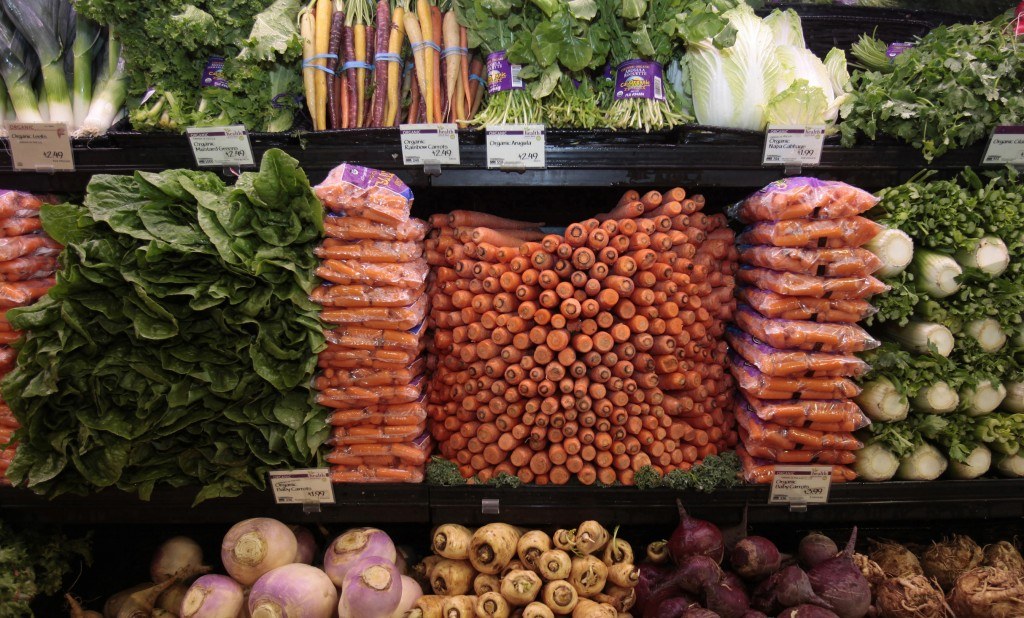
The image provided is an example of a:
a)
Producer
b)
Heterotroph
c)
Consumer
d)
Decomposer
21.
The image provided is an example of a(n):
a)
Producer
b)
Autotroph
c)
Consumer
d)
Insect
22.

If there is 1000 Kcal for the producers, how much energy would be transferred to the Primary Consumers?

a)

10 Kcal

b)

1 Kcal

c)

100 Kcal

d)

1000 Kcal

23.
Which organism recieves the least amount of energy from the producer?
a)
Owl
b)
Grasshopper
c)
Lilypad
d)
Mouse
24.
Which level will contain plants?
a)
A
b)
B
c)
C
d)
D
25.

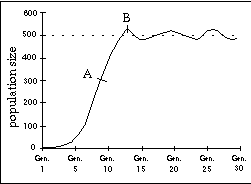
What is the carrying capacity of the graph?

a)

1000

b)

8000

c)

800

d)

600

26.

What happens if a population grows past its carrying capacity?

a)

The population keeps growing

b)

The population starts to die off

c)

The entire species will go extinct

d)

The carrying capacity just increases

27.

This may cause a population to increase

a)

increase of food supply

b)

removal of predators

c)

removal of disease

d)

all of these

28.

The largest number of individuals that an environment can support long term is...

a)

carrying capacity

b)

emigration

c)

immigration

d)

population density

29.

Something that regulates the size of a population is called...

a)

a limiting measure

b)

a limiting factor

c)

carrying capacity

d)

biodiversity

30.

What is the carrying capacity of the graph?

a)

around 500

b)

more than 800

c)

less than 300

d)

around 700

31.
Which of the following would INCREASE the carrying capacity of an ecosystem?
a)
increase in predators
b)
disease
c)
increase in available food
d)
drought
32.

The prefix "bio" comes from a Greek word that means what?

a)

Life

b)

Water

c)

Earth

d)

Ground

33.

What do we call regions of the world with similar climate, plants, and animals?

a)

Atmospheres

b)

Habitats

c)

Biomes

d)

None of the above

34.

Which of the following is found in the earths Geosphere

a)

Soil

b)

Rocks

c)

Minerals

d)

All of the Above

35.
The hydrosphere is predominately made of
a)
liquid water
b)
frozen water
c)
solid rock
d)
gaseous air
36.
Which of the following describes all of the types of water found in the hydrosphere?
a)
all frozen water on the Earth
b)
all of the water on the Earth
c)
all of the fresh water on the Earth
d)
all of the water found on the surface of the continents
37.
The rock, dust, soil, and minerals of the Earth's solid crust and outer mantle make up the ____
a)
Biosphere
b)
Geosphere
c)
Cryosphere
d)
Atmosphere
38.

Where is most water on Earth located?

a)

In the atmosphere

b)

In the ground.

c)

In the ocean.

39.
Geo = 
a)
Earth
b)
Sphere
c)
Life
d)
Water
40.
Hydro = 
a)
Sphere
b)
Earth
c)
Life
d)
Water
41.
Body of air surrounding our planet. 
a)
Hydrosphere 
b)
Biosphere 
c)
Atmosphere 
d)
Geosphere 
42.

Which organelle is responsible making food (Glucose) using sunlight?

a)

Ribosomes

b)

Nucleus

c)

Chloroplast

d)

Mitochondria

43.

Select all that are raw materials for Photosynthesis.

a)

Water

b)

Carbon Dioxide

c)

Oxygen

d)

Sunlight (Light Energy)

e)

Glucose (Sugar/food)

44.

Select all that are products of Photosynthesis.

a)

Water

b)

Carbon Dioxide

c)

Oxygen

d)

Sunlight (Light Energy)

e)

Glucose (Sugar/food)

45.

What is the green pigment that "traps" sunlight?

a)

Chlorophyll

b)

Chloroplasts

c)

Photosynthesis

d)

ATP

46.

How many products are produced during photosynthesis?

a)

1

b)

2

c)

3

d)

4

47.

Is Oxygen a Raw Material (Ingredient) or Product of Photosynthesis?

a)

Product

b)

Raw Material

c)

Niether

d)

What's Photosynthesis?

48.

Is Glucose (C6H12O6) a Raw Material (Ingredient) or Product of Photosynthesis?

a)

Product

b)

Raw Material

c)

Niether

d)

What's Photosynthesis?

49.
____________________ provides the energy necessary for photosynthesis.
a)
water
b)
sunlight
c)
glucose
d)
soil
50.
the products of photosynthesis are...
a)
glucose and sunlight
b)
carbon dioxide and water
c)
glucose and chlorophyll
d)
oxygen and glucose
51.
The reactant of photosynthesis are...
a)
sunlight and chlorophyll
b)
glucose and oxygen
c)
carbon dioxide and water
d)
sunlight and water
52.
Plants take in ________from the air as one key ingredient for photosynthesis
a)
oxygen
b)
soil
c)
carbon dioxide
d)
sugar
53.
Why are producers (plants) important for all life on Earth? 
a)
They make our world more beautiful
b)
They make the planet look green
c)
They use carbon dioxide and give us oxygen
d)
They provide shade for insects
54.
Which of the following statement is true regarding photosynthesis
a)
creates oxygen for animals to breath
b)
creates energy for consumers to use
c)
creates food for plants to use
d)
all of these are correct
55.
Which of the following examples go through the process of photosynthesis?
a)
bees
b)
algae
c)
humans
d)
mushrooms
56.
Where does glycolysis take place?
a)
Cytoplasm
b)
Stroma
c)
Thylakoid
d)
Mitochondria
57.
What is the name of the 1st step of cellular respiration?
a)
Glycolysis
b)
Kreb's Cycle
c)
ETC
d)
Anaerobic respiration
58.
Where does aerobic respiration take place?
a)
Cytoplasm
b)
Mitochondria
c)
Stroma
d)
Thylakoid
59.
What is the net gain of ATP during glycolysis?
a)
1
b)
2
c)
4
d)
34
60.
Which type of respiration occurs in the presence of oxygen?
a)
Aerobic
b)
Anaerobic
61.
Which type of respiration occurs without the presence of oxygen?
a)
Aerobic 
b)
Anaerobic 
62.
What are the two reactants of cellular respiration?
a)
C6H12O6 & 6CO2
b)
6 CO2 & 6H2O
c)
C6H12O& 6O2
d)
6CO2 & 6O2
63.
Glucose is broken down during which process?
a)
Calvin cycle
b)
Glycolysis
c)
Krebs Cycle
d)
Photosynthesis 
64.
The overall goal of cellular respiration is to make:
a)
Glucose
b)
ATP
c)
Oxygen
d)
Water
65.
Which is a product of Kreb's Cycle?
a)
Carbon dioxide
b)
Glucose
c)
Pyruvate
d)
Water
66.
Which is a product of the ETC?
a)
Carbon dioxide
b)
Glucose
c)
Oxygen
d)
Water
67.
In which way are photosynthesis and cellular respiration different?
a)
Cellular respiration stores ATP, while photosynthesis releases ATP.
b)
Cellular respiration produces oxygen, while photosynthesis uses oxygen.
c)
Photosynthesis releases energy, while cellular respiration stores energy.
d)
Photosynthesis used carbon dioxide, while cellular respiration produces carbon dioxide.
68.
What is the correct equation for cellular respiration?
a)
6O2 + C6H12O6 -> 6CO2 + 6H2O + Energy
b)
6O2 + C6H12O6 + Energy -> 6CO2 + 6H2O
c)
6CO2 + 6H2O -> 6O2 + C6H12O6 + Energy
d)
6CO2 + 6H2O + Energy -> 6O2 + C6H12O6
69.
What are the reactants in cellular respiration?
a)
glucose and oxygen
b)
glucose and carbon dioxide
c)
water and carbon dioxide
d)
oxygen and glucose
70.
What are the products in cellular respiration?
a)
water and carbon dioxide
b)
water and glucose
c)
carbon dioxide and oxygen
d)
glucose and oxygen
71.

The release in energy from the sugar that are in plant and animal cells is called...

a)

photosynthesis

b)

transpiration

c)

cellular respiration

d)

transition

72.

Which of the following equation explains cellular respiration?

a)

sugar+water -> salt+sunlight

b)

sugar+oxygen -> water+carbon dioxide+energy

c)

water+carbon dioxide+sunlight -> sugar+oxygen

d)

Sugar+energy -> water+carbon dioxide+oxygen

73.

Which of the following organelles is responsible for cellular respiration?

a)

Mitochondria

b)

Nucleus

c)

Endoplasmic Reticulum

d)

Ribosome

74.
What is the function of ATP in living things?
a)
provides energy for cells
b)
stores genetic information
c)
provides structure in the nucleus
75.
Energy is released from ATP when
a)
a phosphate group is added
b)
adenine bonds to ribose
c)
ATP is exposed to sunlight
d)
a phosphate group is removed
76.
Which of the following can be compared to a battery in need of recharging?  (empty wallet)
a)
ADP
b)
ATP
c)
Ribose
d)
Adenosine
77.
Which structures shown in the Figure make up the ADP molecule?
a)
A and B
b)
A, B and C
c)
A, B, C, and D
d)
C and D
78.
What does the "TP" in ATP stand for?
a)
2 phosphates
b)
tri (3) phosphates
c)
Two proteins
d)
tri (3) proteins
79.
Which of the following results in the storage of energy in terms of the ATP/ADP cycle?
a)
The breaking of the bond between the 5-carbon sugar and the 1st phosphate group
b)
The addition of a phosphate group
c)
The removal of a phosphate group
d)
The addition of glucose 
80.
Which bond of the ATP molecule is broken in order to release energy?
a)
A
b)
B
c)
C
d)
D
81.
ADP is an abbreviation for:
a)
aniline diphosphate.
b)
adenine diphosphate.
c)
adenosine diphosphate.
d)
adenosine triphosphate.
82.
What particle is released to provide the energy spark from the ATP molecule
a)
Potassium
b)
Phosphate
c)
Adenosine
d)
Thymine
83.
What does the "TP" in ATP stand for?
a)
2 phosphates
b)
tri (3) phosphates
c)
Two proteins
d)
tri (3) proteins
84.
Carbon can be found in...
a)
The atmosphere
b)
Soil
c)
Fossil fuels
d)
All of the above
85.
Which of the following removes carbon from the atmosphere?
a)
Combustion
b)
Respiration
c)
Photosynthesis
d)
Death
86.
Respiration is the process by which animals take in _____ and release _____. 
a)
photosynthesis, air
b)
carbon, oxygen
c)
oxygen
d)
oxygen, carbon dioxide
87.
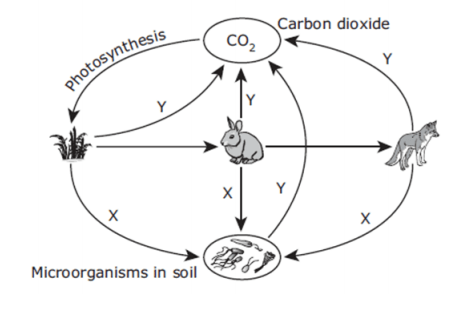
The diagram shows the flow of organic molecules through an ecosystem. What two processes are identified by the labels X and Y?
a)
X : Respiration
Y : Predation
b)
X : Adaptation
Y : Decomposition
c)
X : Fermentation
Y : Nitrogen Fixation
d)
X : Decomposition
Y : Respiration
88.
oxygen is a gas produced by _ and used by  _ 
a)
plants and animals 
b)
photosynthesis and carbon dioxide 
c)
animals and plants 
d)
carbon dioxide and photosynthesis
89.
All of the carbon in existence is continually recycled in the carbon cycle
a)
True
b)
False
90.
Which of the following is an example of a decomposer?
a)
Owl
b)
Fish
c)
Tree
d)
Mushroom
91.
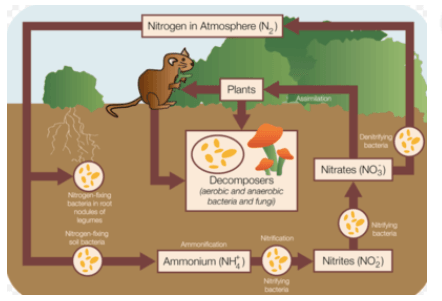
What is the process of combining nitrogen gas with other elements to make nitrogen into usable compounds?
a)
nitrogen composition
b)
ammonia 
c)
nitrogen fixation
d)
denitrification
92.
Organisms that need nitrogen to survive
a)
only plants
b)
only animals
c)
only bacteria
d)
all living organisms
93.
Plants and animals cannot use nitrogen directly from the air.
a)
True
b)
False
94.
After plants and animals contain nitrogen, what puts it back into atmosphere and soil?
a)
decomposition
b)
precipitation
c)
condensation
d)
bacteria
95.
What happens when organisms die and decay? 
a)
Their bodies are lifted up
b)
Their nitrogen returns to the soil
c)
they keep their nitrogen
d)
They stay on earth forever
96.
The process in which Nitrogen circulates and is recycled is called ____________
a)
The nitrogen cycle
b)
The water cycle
c)
The carbon cycle
d)
Nitrogen Fixation 
97.
_____ is the conversion of organic nitrogen into ammonia
a)
Nitrogen Fixation
b)
Ammonification
c)
Denitrification
d)
Assimilation 
98.

How is nitrogen "fixed" into a usable form for plants?

a)

Through action of bacteria only

b)

Through lightning only

c)

Through action of bacteria and lightning

d)

Through photosynthesis

99.

How do animals get the nitrogen they need?

a)

From the air they breathe

b)

From the water they drink

c)

From the food they eat

d)

From the sun

100.

What is the process of combining nitrogen gas with other elements to make nitrogen into usable compounds?

a)

nitrogen composition

b)

nitrogen fixation

c)

ammonia

d)

denitrification

101.

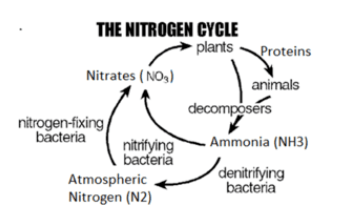
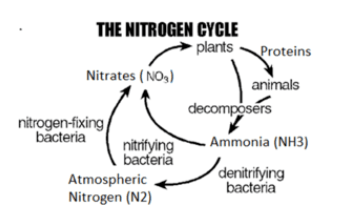
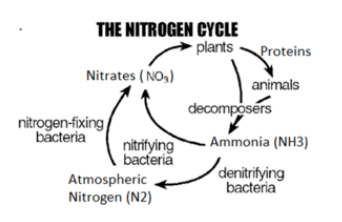
According to this diagram, plants use nitrogen to make _________________________

a)

bacteria

b)

animals

c)

proteins

d)

decomposers

102.

According to this diagram, plants absorb

a)

nitrates

b)

nitrogen fixing bacteria

c)

animals

d)

decomposers

103.

According to this diagram, animals get proteins from eating ________________________

a)

decomposers

b)

bacteria

c)

plants

d)

sunlight

104.

A correct path that nitrogen could take would be

a)

air -> animals -> plants -> bacteria

b)

animals -> air -> bacteria -> plants

c)

bacteria -> air -> plants -> animals

d)

air -> bacteria -> plants -> animals

105.

The process that allows organisms to use nitrogen

a)

assimilation

b)

denitrification

c)

fixation

d)

ammonification

106.

Bacteria fix nitrogen from the atmosphere into a form plants can use.

a)

True

b)

False

107.

Bacteria create a form of nitrogen that animals can use directly.

a)

True

b)

False

108.

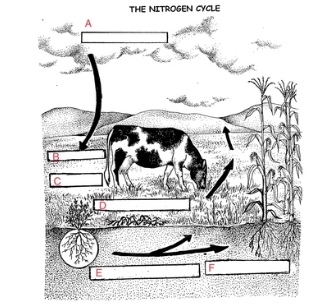
In the nitrogen cycle, what does label A in the diagram represent?

a)

Gas

b)

Clouds

c)

Carbon dioxide in the atmosphere

d)

Nitrogen in the atmosphere

109.
What is the water cycle?
a)
the 3 forms of water
b)
the movement of water on, above, or below the surface of the Earth
c)
when water melts
d)
when clouds form
110.
Snow, sleet, hail, and rain are all examples of  ________________. 
a)
evaporation
b)
condensation
c)
accumulation
d)
precipitation
111.
What follows evaporation during the water cycle? How does this occur?
a)
Water evaporates into water vapor
b)
Water vapor condenses and forms a  cloud
c)
Water precipitates to the ground
d)
Water runs down into the hydrosphere
112.
What is it called when plants give off water vapor as a waste product?
a)
condensation
b)
evaporation
c)
sublimation
d)
transpiration
113.
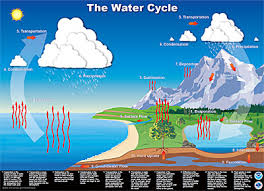
During which stage do clouds form?
a)
condensation
b)
evaporation
c)
precipitation
114.

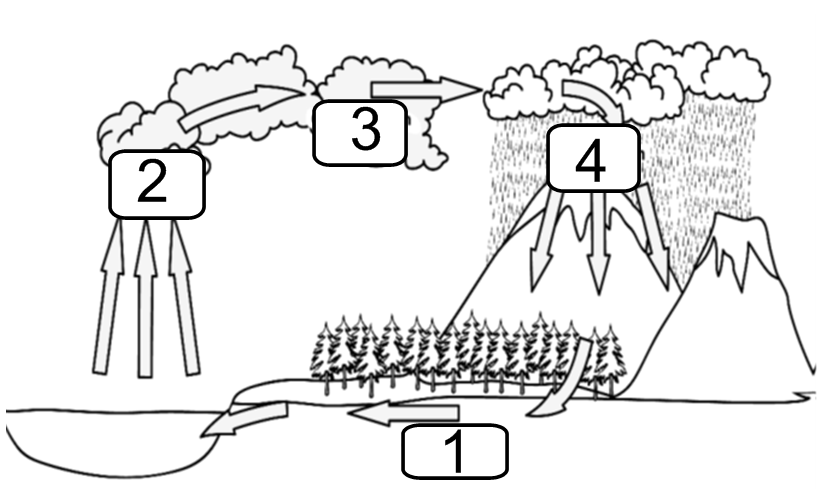
Which stage does the arrow below #2 show in the diagram?

a)

condensation

b)

evaporation

c)

precipitation

d)

run off

115.
Which stage does the #3 show in the diagram?
a)
condensation
b)
evaporation
c)
precipitation
d)
run off
116.
What is the difference between active and passive transport?
a)
Active does not need energy and passive uses ATP (energy)
b)
Active uses ATP (energy) and passive does not need energy
c)
Active stores transport proteins and passive releases 
d)
Active uses hormones and passive does not 
117.
What is homeostasis?
a)
How the body releases oxygen
b)
Passive transportation 
c)
How the body regulates itself for survival (keeping a stable internal environment)
d)
Active transport
118.
What does semi-permeable mean?
a)
Only some things can move through membrane
b)
Nothing can move through membrane
c)
Reagan can move through membrane
d)
Membrane connot be moved through
119.
What are three types of passive transport
a)
Transport proteins, Endocytosis, Exocytosis
b)
None of the ones listed
c)
Osmosis, Diffusion, Facilitated diffusion 
d)
Touchdown, interception, football
120.
Diffusion is the movement of molecules from an area of higher concentration to an area of lower concentration.
a)
True
b)
False
121.
Osmosis is the diffusion of
a)
Iodine
b)
Oxygen
c)
Water
d)
Fruit punch
122.
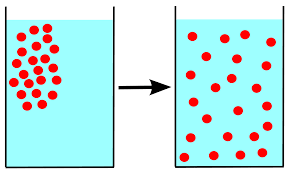
The picture below is an example of _________________.
a)
osmosis
b)
isotonic
c)
diffusion
d)
active transport
123.
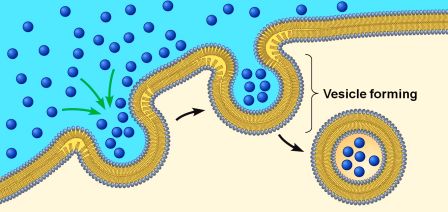
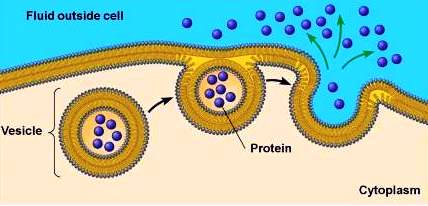
Which form of active transport is being shown?
a)
Facilitated Diffusion
b)
Exocytosis
c)
Endocytosis
d)
Protein Pumps
124.
Which is NOT a form of active transport?
a)
Endocytosis
b)
Osmosis
c)
Exocytosis
d)
Pinocytosis
125.
Which form of active transport is being shown?
a)
Pinocytosis
b)
Endocytosis
c)
Exocytosis
d)
Osmosis
126.
When cells form a vesicle to take in materials, which form of transport is occurring? 
a)
Endocytosis
b)
Exocytosis
c)
Facilitated Diffusion
d)
Osmosis
127.
 If a cell containing 5% salt is placed into a glass of water with 20% salt, the water is _______ compared to the cell.
a)
hypertonic-
b)
hypotonic
c)
isotonic
128.
Both side of a selectively- permeable membrane are equal. The sides are ______.
a)
isotonic
b)
hypertonic
c)
hypotonic
129.
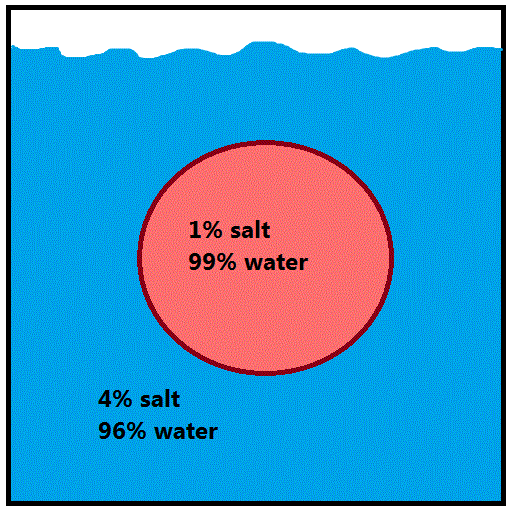
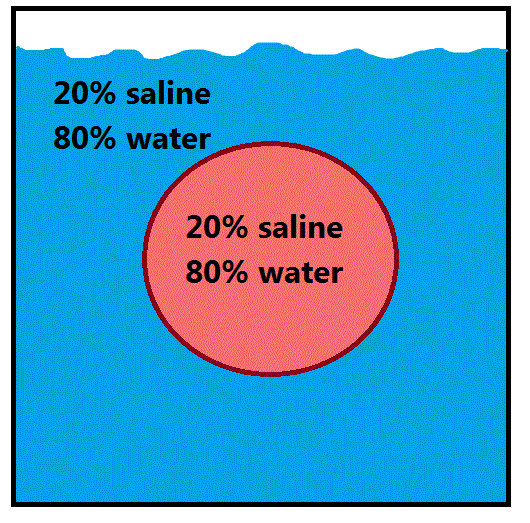
Where will the water go?
a)
Into the cell
b)
Out of the cell
c)
Equally in & out - it's isotonic
d)
There is no water
130.
A blood cell is placed into the jar, as seen. Where will the water go?
a)
Into the cell
b)
Out of the cell
c)
Equally in & out - it's isotonic
d)
The water is a lie
131.
 If a cell containing 5% salt is placed into a glass of water with 20% salt, the water is _______ compared to the cell.
a)
hypertonic
b)
hypotonic
c)
isotonic
132.
During osmosis
a)
water moves from high to low concentration
b)
large or oddly shaped molecules move across a cell membrane
c)
water moves when energy is used
d)
proteins are built
133.
HYPO means...
a)
Low
b)
High
c)
Equal
d)
Fat
134.
ISO means...
a)
Low
b)
A lot
c)
Equal
d)
Mammal
135.
Which major macromolecule is being represented in this image? 
a)
carbohydrate
b)
lipid
c)
protein
d)
nucleic acid
136.
Which of the following contains the genetic code for protein synthesis?
a)
carbohydrate
b)
lipid
c)
protein
d)
nucleic acid
137.
What type of macromolecule is being represented in this image? 
a)
carbohydrate
b)
lipid
c)
protein
d)
nucleic acid
138.
Which of the following decreases the activation energy necessary to initiate the chemical change within the body?
a)
nucleotides
b)
enzymes
c)
amino acids
d)
fatty acids
139.
What are the building blocks of proteins?
a)
amino acid
b)
fatty acid
c)
nucleotide
d)
lipid
140.
What are the single sugars that are the building blocks of carbohydrates?
a)
monosaccharides
b)
disaccharides
c)
polysaccharides
d)
amino acid
141.
Why are lipids insoluble in water?  
a)
lipids are polar
b)
lipids are non-polar
c)
lipids have a negative charge
d)
lipids are building blocks of protiens
142.
Which of the four major biological macromolecules can be easily identified by the nitrogen base and phosphate found in its structure?
a)
carbohydrate
b)
lipid
c)
protein
d)
nucleic acid
143.
Proteins are made of monomers called ___________
a)
Nucleotides
b)
Monosaccharides
c)
Amino Acids
d)
Glycerol and fatty acids
144.
DNA and RNA are examples of 
a)
Carbohydrates
b)
Lipids
c)
Proteins
d)
Nucleic Acids
145.
Nucleotides are monomers of
a)
Carbohydrates
b)
Lipids
c)
Proteins
d)
Nucleic Acids
146.
Waxes, oils and fats are examples of
a)
Carbohydrates
b)
Lipids
c)
Proteins
d)
Nucleic Acids
147.
What is the function of nucleic acids?
a)
store genetic information
b)
store energy (long-term)
c)
store energy (short-term)
d)
build skin, hair, nails, muscles
148.
Which of the following organic compounds is the main source of energy for living things?
a)
carbohydrates
b)
lipids
c)
nucleic acids
d)
proteins
149.
Which macromolecule stores energy, insulates us, and makes up the cell membrane?
a)
lipids
b)
proteins
c)
carbohydrates
d)
nucleic acids
150.
Lipids can be digested into what smaller subunits?
a)
nucleic acids
b)
amino acids
c)
fatty acids
d)
glucose
151.
All polymers are made up of...
a)
monosaccharides
b)
monomers
c)
proteins
d)
None of these
152.

Enzymes belong to which class of macromolecules?

a)

lipids

b)

carbohydrates

c)

proteins

d)

nucleic acids

153.

DNA belongs to which class of macromolecules?

a)

proteins

b)

nucleic acids

c)

carbohydrates

d)

lipids

154.

Sugar belongs to which class of macromolecules?

a)

proteins

b)

lipids

c)

nucleic acids

d)

carbohydrates

155.

Enzymes are an example of

a)

Lipids

b)

Carbohydrate

c)

Protein

d)

Nucleic Acid

156.
What is the purpose  of an enzyme?
a)
give permission for the reaction
b)
raise activation energy
c)
speed up reactions
d)
control how many reactions occur
157.
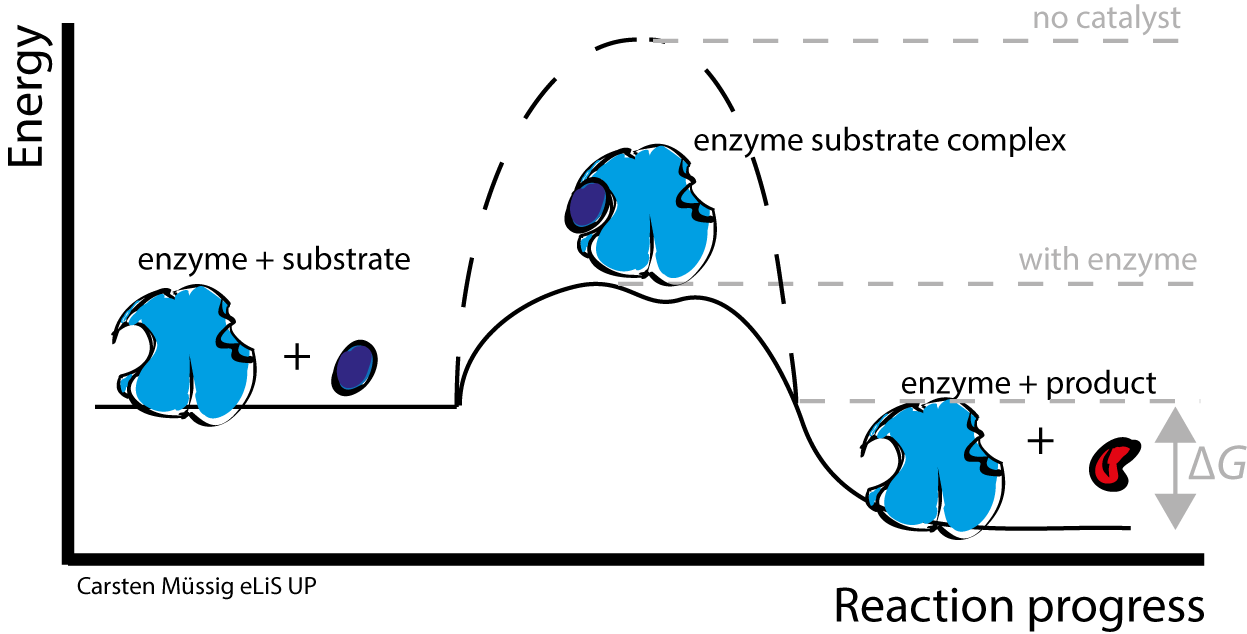
Enzymes are capable of increasing the rate of a chemical reaction within a living cell.  Enzymes accomplish this through which of the following means?
a)
reducing the number of products   
b)
reducing the activation energy
c)
increasing the temperature of the cell
d)
increasing the concentration of reactants 
158.
What 3 letters do enzymes typically end in?
a)
-ose
b)
-ase
c)
-ese
d)
-tic
159.
In a chemical reaction, bonds are broken and new bonds are formed that create new substances. The bonds that are broken are called what?
a)
Reactants
b)
Products
c)
Atoms
d)
Catalysts
160.

In a chemical reaction, ________ are what you have at the end

a)

Products

b)

Molecules

c)

Reactants

d)

Substances

161.
Chemical reactions always involve
a)
the breaking of bonds in reactants.
b)
the formation of new bonds in products.
c)
the breaking of bonds in reactants and the formation of new bonds in products.
d)
enzymes. 
162.
An enzyme speeds up a reaction by
a)
lowering the activation energy.
b)
raising the activation energy.
c)
releasing energy.
d)
absorbing energy.
163.
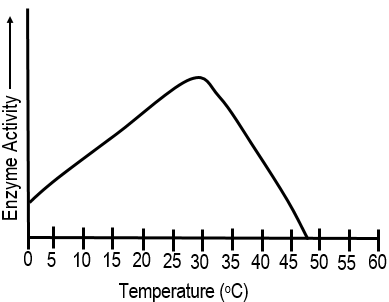
Based on the graph, what is the optimal temperature for this enzyme? 
a)
15oC
b)
40oC
c)
30oC
d)
35oC
164.
What is a substance called if it speeds up a chemical reaction?
a)
reusable
b)
catalyst
c)
specific
d)
fragile
165.
What happens when enzymes are heated to a high temperature?
a)
The enzymes die.
b)
The shapes of the enzyme are altered or denatured
c)
The enzymes' amino acid sequence changes.
d)
The enzymes remain the same
166.
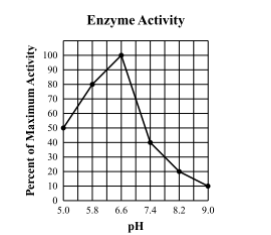
The graph below shows how the activity of an enzyme changes over a range of pH values. Which of the following conclusions can be drawn from this graph?
a)
The optimum pH of the enzyme is 6.6.
b)
The optimum pH of the enzyme is 5.8
c)
The enzyme’s activity continually increases as pH increases from 5.0 to 9.0
d)
The enzyme’s activity is greater around pH of 8.0 than around pH of 5.0.
167.
What will most likely happen if an appropriate enzyme is added to a chemical reaction? 
a)
The reaction rate will increase.
b)
The equilibrium of the reaction will be maintained. 
c)
The reaction rate will decrease.
d)
The reaction will stop. 
168.
The human body maintains a temperature of around 98.6 degrees at all times. Enzymes are involved in almost every chemical reaction in the body. Which of the following describes the connection between these two statements? 
a)
 Enzymes function best at a specific temperature.
b)
The body needs to be warm to prevent hypothermia.
c)
The body is kept relatively warm to prevent too much enzyme action.
d)
 There is no connection between the two statements. 
169.
Enzymes are
a)
nucleic acids
b)
proteins
c)
lipids
d)
carbohydrates
170.
Enzymes are composed of which of the following monomers? 
a)
amino acids
b)
carbohydrates
c)
nucleotides
d)
monosaccharides
171.

Which of the following are true about enzymes? (Choose all that apply)

a)

Enzymes speed up chemical reactions.

b)

Enzymes react best at a specific temperature.

c)

Enzymes only control ONE type of reaction.

d)

Enzymes are made of fatty acids.

172.
What is another name for enzymes?
a)
chemical catalysts
b)
microorganisms
c)
biological catalysts
d)
inorganic catalysts