wayground logo

Free Printable Worksheets

NEW

Font size

S
M
L
XL
Worksheets

Evolution

Total questions: 39

Worksheet time: 29mins
Name
Class
Date
1.
This scientist came up with the idea of natural selection.
a)
Jean Baptiste Lamarck
b)
Gregor Mendel
c)
Charles Darwin
d)
Thomas Malthus
2.
Inherited trait that helps an organism survive is a(n) __________.
a)
Fossil
b)
Adaptation
c)
Ancestor
d)
Natural selection
3.
Survival of the fittest or when favorable adaptations reproduce faster is called what?
a)
Evolution
b)
Adaptation
c)
Natural selection
d)
Fossilization
4.
Structures with the same parts have different functions; suggests that organisms share a common ancestry
a)
vestigial structures
b)
homologous structures
c)
adaptive radiation
d)
fossil
5.
Which of the following is an example of a vestigial structure?
a)
the wings of a red-tailed hawk
b)
the hind limbs of a house cat
c)
the fins of sharks
d)
the tailbone of a human
6.
The diagram shows fossils in different rock layers. Which of these statements about the age of these fossils is most likely correct?
a)
Fossil A and C are the same age
b)
Fossil B is older than fossil C
c)
Fossils A is older than fossil B
d)
Fossil D is older than fossil C
7.

What do we call a change in a species over time?

a)

Adaptation

b)

Evolution

c)

Extinction

d)

Environmental influences

8.
Why do embryologist study embryos?
a)
to see if they are related
b)
to understand adaptations
c)
to determine the age
d)
to learn what parents are vestigial
9.
What is embryology?
a)
the age of organisms
b)
the oldest stage of development
c)
the life span of an organism
d)
the earliest growth stage of development
10.
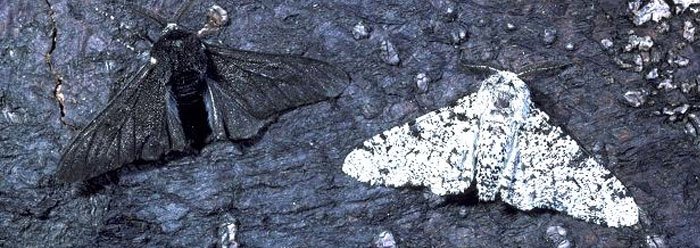
The environment around Manchester, England, changed during the Industrial Revolution.  How did this change affect peppered moths living in the area?
a)
Natural selection favored moths with dark wings because predators could not see them on the soot-colored trees.
b)
Natural selection favored moths with white wings that were easy for predators to see.
c)
Natural selection favored moths with white wings because predators could not see them on the soot-colored trees.
d)
Natural selection caused moths with white wings to become extinct.
11.
When an organism completely dies out, it is called.....
a)
Adaption
b)
Extinction
c)
Fossilization
d)
Mutation
12.
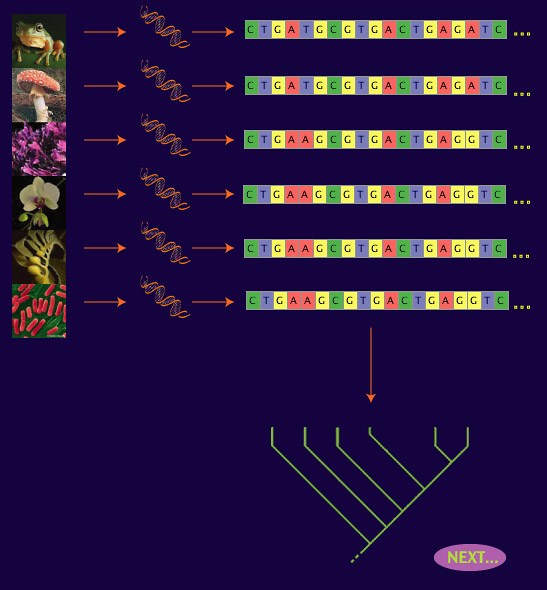
Two organisms that are closely related would have
a)
very similar DNA sequence
b)
exactly the same DNA sequences
c)
no proteins in common
d)
completely different DNA sequence
13.
Comparing human hemoglobin of chimpanzees, horses, kangaroos, and chickens, reveal that humans have the fewest amino acid differences with 
a)
Kangaroos
b)
Horses
c)
chickens
d)
chimpanzees
14.
All the individuals of a species that live in a particular area are called a
a)
variation
b)
population
c)
fossil
d)
group
15.
Which layer is oldest?
a)
A
b)
W
c)
G
d)
Z
16.
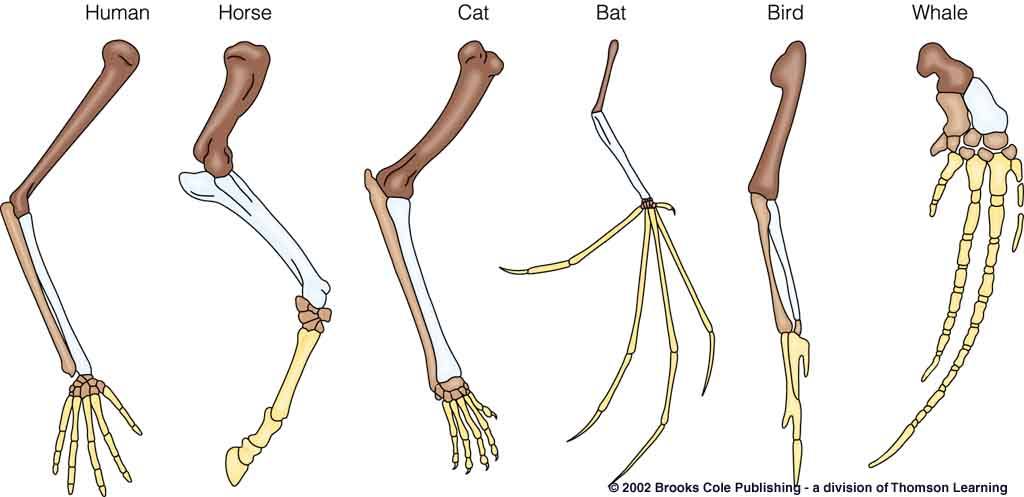
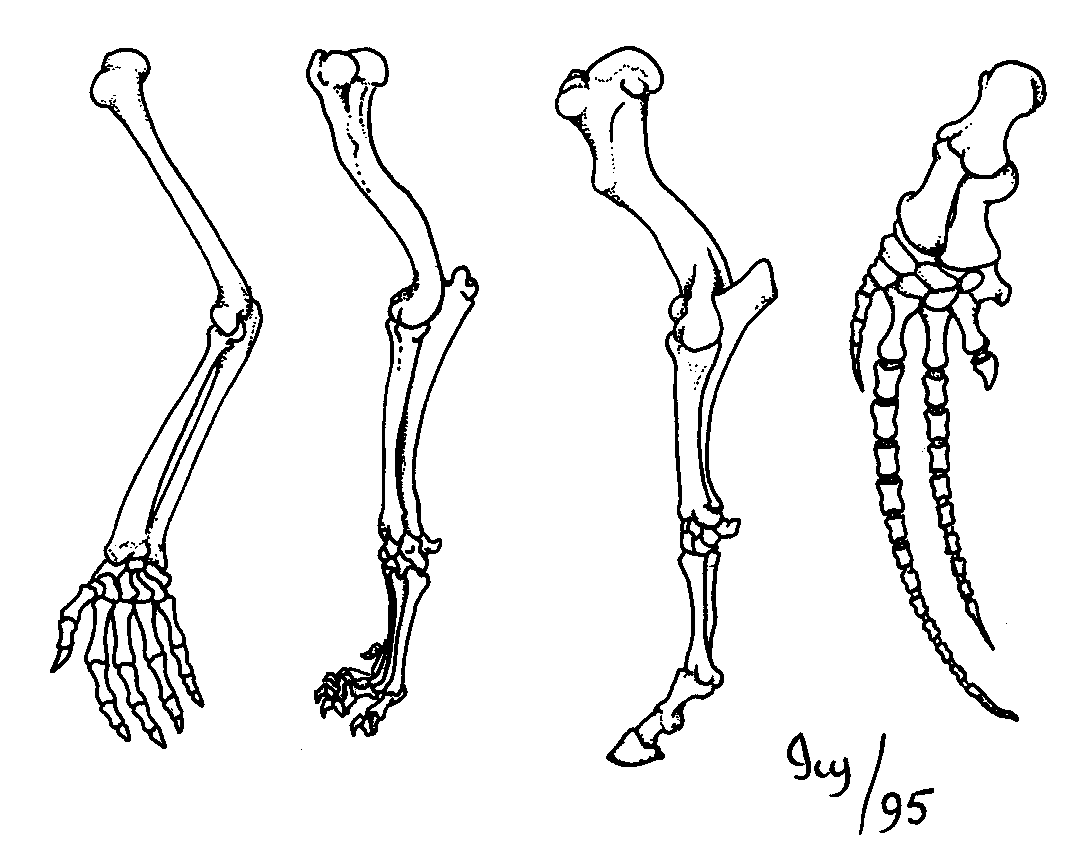
The structures shown are_________
a)
homologous
b)
heterologous
c)
analogous
d)
vestigial
17.
Why are advantageous traits more likely to be passed onto offspring?
a)
Because they are more likely to survive and reproduce.
b)
Because they come from dominant alleles.
c)
Because they come from recessive alleles.
d)
Because the trait is an acquired phenotype.
18.
Natural selection is when ____________ decides who survives and who doesn't
a)
nature
b)
humans
c)
animals
d)
years
19.
The trees these moths used to live on were white, but have been covered in soot from coal factories. Which moth will be more successful in this environment?
a)
Dark moth
b)
Light moth
c)
Both will be equally successful
d)
Neither will be successful
20.

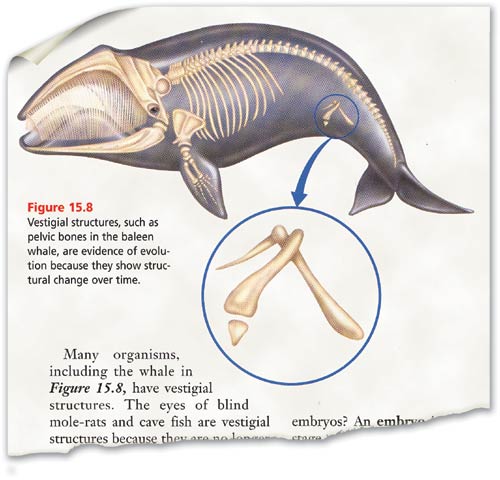
Whales are aquatic mammals that contain a pelvis (hip) bone. Even though it does not aid in its movement, the function must have been used by a common ancestor of the whale. Thus, the pelvis is referred to as a(n)

a)

vestigial structure

b)

analogous structure

c)

homologous structure

21.
A theory has significant evidence to support it.  True or False
a)
True
b)
False
22.
The ability of an organism to survive and reproduce in its specific environment 
a)
diversity.
b)
evolution
c)
adaptation
d)
 fitness
23.
Where humans have bred organisms together based on traits we like.
a)
Evolution
b)
Natural Selection
c)
Extinction 
d)
Artificial Selection
24.
Genetic differences between organisms of the same species
a)
Variation
b)
Adaptation
c)
Behavior
d)
Environment
25.

Do organisms "decide" to evolve and change? (they have the ability to change whenever they want)

a)
Yes, they know they need to change to survive 
b)
No, they change because of natural selection
26.

Darwin wrote that organisms with traits that are best suited to the environment will survive and __________.

a)

reproduce more often

b)

become extinct

c)

never reproduce

d)

lose all their traits

27.
The opossum and kangaroo both incubate their young in a pouch. This provides evidence that they---
a)
are descended from a common ancestor
b)
Have very similar skeletal structures
c)
belong to the same species
d)
must range great distances to eat
28.

Genetic drift is a process that causes a change in a population's gene pool. What can cause genetic drift?

a)

disease plague

b)

hurricane

c)

volcanic eruption

d)

all of the above

29.

The table shows the survival rate of two types of beetles in the same environment over a period of three years.


Based on the table, which statement is correct?

a)

Brown beetles have a shorter life cycle than green beetles have

b)

Green beetles are more fit for their environment than brown beetles

c)

Brown beetles undergo more unfavorable mutations than green beetles

d)

Green beetles do not have the adaptations suited for survival in this environment

30.

This mechanism of evolution occurs when individuals, and their genetic material, move from one population to another.

a)

Extinction

b)

Gene flow

c)

Genetic drift

d)

Natural Selection

31.

What is the process of which humans breed organisms for certain traits?

a)

artificial selection

b)

survival of the fittest

c)

inheritance of acquired characteristics

d)

natural selection

32.

A remains or traces left over of an organism from the past is called a _______.

a)

Ancestor

b)

Skeleton

c)

Fossil

d)

Imprints

33.

What do we call a change in the genome over time?

a)

Evolution

b)

Adaptation

c)

Extinction

d)

Environmental influences

34.
This mechanism of evolution occurs when populations migrate.
a)
Extinction
b)
Gene flow
c)
Genetic drift
d)
Natural Selection
35.

What type of evidence is shown in the picture above?

a)

Ancestral traits

b)

Embryonic Development

c)

Homologous Structures

d)

Vestigial Structures

36.
A few deer wander out of their native woods into a completely new park where no deer had ever been before. They go on to create an entirely new population.
a)

Genetic Flow

b)
Natural Selection
c)
Non-random mating
d)
Mutation
37.

The female birds of paradise tend to look for the most colorful, best dancing males to make babies together.

a)

Genetic Drift

b)

Non-random mating

c)

Gene flow

d)

Mutation

38.
What does the picture represent?
a)
Founder Effect
b)
Mutations
c)
Bottleneck effect
d)
Gene Flow
39.

Charles Darwin observed that finches of different species on the Galápagos Islands have many similar physical characteristics, this supports the hypothesis that these finches

a)

are twins

b)

acquired traits through use and disuse.

c)

all eat the same type of food.

d)

descended from a common ancestor.