wayground logo

Free Printable Worksheets

NEW

Font size

S
M
L
XL
Worksheets

2nd 6 weeks review

Total questions: 35

Worksheet time: 1hrs 6mins

Name
Class
Date
1.

Do all objects have the same density?

a)

yes

b)

no

2.

What happens to an object that is less dense than the liquid it is in?

a)

floats

b)

sinks

3.
Frank has a paper clip. It has a mass of 9g and a volume of 3cm3. What is its density?
a)
3 g/cm3
b)
1/3 g/cm3
c)
27 g/cm3
d)
39 g/cm3
4.
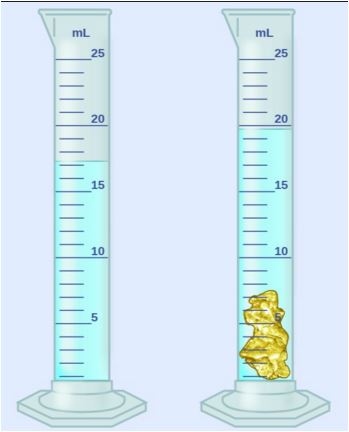
An irregularly shaped piece of gold was lowered into a graduated cylinder holding a volume of water equal to 17 ml. The height of the water rose to 20 ml. If the mass of the gold was 27 g, what was its density?
a)
9 g/mL
b)
10.5 g/mL
c)
6.5 g/mL
d)
8 g/mL
5.
How much water has been displaced in the image shown?
a)
40 mL
b)
65 mL
c)
20 mL
d)
25 mL
6.
Find the density of a 2 cm x 2 cm x 2 cm cube with a mass of 64 g.
a)
6 cm3
b)
12 g/cm3
c)
128 g/cm3
d)
8  g/cm3
7.

An object is is placed into 45 mL of water. The water rises to 48 mL. What is the volume of the object?

a)

3 mL

b)

93mL

c)

8 mL

d)

83 mL

8.
The tool used to measure the mass of a substance or object is a ______________.
a)
balance
b)
graduated cylinder
c)
ruler
d)
thermometer
9.
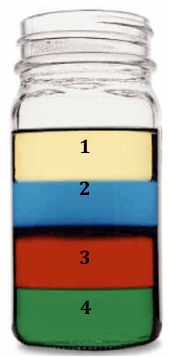
Put the liquids in order from most dense to least dense?
a)
4, 3, 2, 1
b)
1, 2, 3, 4
c)
3, 4, 2, 1, 
d)
4, 3, 1, 2
10.

What 2 measurements are used for DENSITY

a)

Mass and Weight

b)

Mass and Acceleration

c)

Mass and Volume

d)

Length and Width

11.
Jack has a rock. The rock has a mass of 14 g and a volume of 2 cm3. What is the density of the rock?
a)
7 mL
b)
7 g/cm3
c)
28 g/cm3
d)
1/7 g/cm3
12.
Which property of matter is determined by dividing its mass by its volume?
a)
elasticity
b)
buoyancy
c)
density
d)
viscosity
13.
Mercury is a metal that is liquid at room temperature and has a density of 13.5 g/cm3.  Which of these metals would sink below the mercury if dropped into a container of mercury?
a)
gold (density=19.3 g/cm3)
b)
lead (density=11.4 g/cm3)
c)
iron (density=7.9g/cm3)
d)
aluminum (density=2.7g/cm3)
14.

You are given a mystery object in science class. Your teacher asks you to determine if your object is more or less dense than water. You place the object in the water and it sinks. What statement would best describe this situation?

a)

The mystery substance is denser than water.

b)

Water is denser than the mystery substance.

c)

They both have the same mass.

d)

The mystery substance must be hollow.

15.

Which box has a higher density?

a)

A

b)

B

c)

They are the same

16.

A change that results in the formation of new chemical substances

a)

chemical change

b)

physical change

17.
Which of the following is a sign that a chemical reaction has occurred?
a)
change in shape
b)
melting
c)
formation of a gas
d)
dissolving
18.
Physical or Chemical Change?  Iron rusts
a)
Physical Change
b)
Chemical Change
19.

The following are examples of evidence of a chemical reaction....

a)

ice melting into a liquid

b)

condensation

c)

endothermic reaction

d)

change in color, production of gas bubbles

20.

Which is NOT evidence of a chemical change?

a)

Unexpected color change

b)

gas produced

c)

breaking

d)

light produced

21.

Which of the following options provides evidence of a CHEMICAL change?

a)

Wood is burned releasing ash and smoke

b)

Rocks separate when soil is sifted

c)

Boiling water bubbles when heated

d)

Salt dissolves in water

22.

What is potential energy?

a)

The energy an object has due to its position or condition.

b)

The energy an object has due to its motion.

c)

The energy an object has due to its chemical composition.

d)

The energy as object has due to its atomic structure.

23.

You throw a ball into the air as shown in the diagram. At what point does the ball have the most potential energy?

a)

W

b)

X

c)

Y

d)

Z

24.
On a roller coaster, where is maximum kinetic energy?
a)
At the bottom of a big hill
b)
When going around a corner
c)
When going upside down
d)
At the top of a big hill
25.
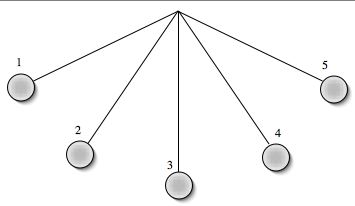
When a pendulum swings, at which point is kinetic energy highest?
a)
1
b)
2
c)
3
d)
4
26.
The faster an object moves, the ________ kinetic energy it has. 
a)
more
b)
less
c)
none of the above
d)
all of the above 
27.
Energy due to motion is ____________ energy. 
a)
Potential 
b)
Energy
c)
Kinetic
d)
Friction
28.
The faster an object moves, the ________ kinetic energy it has. 
a)
more
b)
less
c)
none of the above
d)
all of the above 
29.
When you stretch a rubber band, you are storing __________ energy. 
a)
kinetic 
b)
potential
c)
none of the above
d)
all of the above 
30.
What kind of energy is in flowerpot sitting on a windowsill?
a)
Potential
b)
Kinetic
31.
At which point is potential energy greatest?
a)
W
b)
X
c)
Y
d)
Z
32.

What type of elements border the “stair step” or “zigzag line”?

a)

metals

b)

nonmetals

c)

metalloids

d)

solids

33.

Krypton (Kr) is a colorless gas that does not conduct electricity. Where would you find this element on the Periodic Table?

a)

on the left

b)

on the right

c)

in the middle

d)

at the bottom

34.

What kind of elements are dull and have low melting points?

a)

metals

b)

nonmetals

c)

metalloids

d)

megametals

35.

What kind of elements are malleable and mostly solid?

a)

metals

b)

nonmetals

c)

metalloids

d)

megametals